

ENOLOGY / Original research article
Abstract
Wine harbours a wide range of beneficial and spoilage yeasts, including Brettanomyces bruxellensis. Its genotypic diversity, persistence during vinification, and tolerance to various chemical preservatives (including sulfur dioxide) make it difficult to control. Killer toxins secreted by other yeast species may represent a promising biological alternative to chemical preservatives. Killer phenotype against B. bruxellensis has been described in various yeasts, but their application in industry remains limited. Such killer activity was recently reported in Lachancea thermotolerans but not fully investigated. This study aimed to determine and further explore killer phenotypes in the Lachancea genus against B. bruxellensis (29 strains representative of the six main genetic groups) and other wine spoilage and beneficial yeast species from the Torulaspora, Schizosaccharomyces, Candida, Hanseniaspora, Metschnikowia and Zygosaccharomyces genera. The killer phenotype of 17 Lachancea isolates was assessed against the target isolates, using a solid medium-based killer assay at pH 3.5 and a temperature of 24 °C. Ten of the 17 Lachancea isolates screened displayed variable growth inhibition phenotypes against spoilage yeasts. Of these, L. thermotolerans CTL 302, L. thermotolerans CTL 277 and L. waltii NRRL Y-8285 consistently displayed high permanent growth inhibitory effect against B. bruxellensis strains across the six genetic groups. Remarkably, these strains had no killer effect against all the commercial wine yeasts tested, highlighting them as promising biocontrol yeasts. The impact of lactic acid (3 g/L to 18 g/L) on the growth of spoilage yeasts was also assessed, and lactic acid was deemed ineffective at inhibiting the growth of target isolates. It also showed that lactic acid was not involved in the killer phenotype. Additionally, the killer compound was identified as a killer toxin through both heat and protease treatments. Altogether, these results highlighted the three killer strains as potential biocontrol yeasts, even though further investigations are yet to be carried out under real winemaking conditions.
Introduction
Wine is home to a diversity of microorganisms including yeasts, lactic acid bacteria (LAB) and acetic acid bacteria (AAB) (Aires et al., 2025). Amongst these, the yeast Saccharomyces cerevisiae is the main microorganism conducting alcoholic fermentation. While spontaneous fermentation by indigenous strains remains an option for winemakers, hundreds of strains have been carefully selected and are available as active dry yeasts for inoculated fermentations. Additionally, some non-conventional yeast species like Lachancea thermotolerans, Metschnikowia pulcherrima and Torulaspora delbrueckii are also commercialised for various benefits, e.g., managing acidity in warm winemaking regions, improving aroma complexity and mouthfeel of wines, and bioprotection. These non-Saccharomyces species are used in mixed or sequential cultures with S. cerevisiae to ensure the completion of alcoholic fermentation. Nevertheless, while some yeast species are recognised as beneficial, others mainly contribute negatively to wine quality through the overproduction of undesirable sensory compounds. These include Hanseniaspora uvarum, Zygosaccharomyces spp., Schizosaccharomyces pombe and Brettanomyces bruxellensis. Amongst all wine spoilage microorganisms, the latter is the main culprit of microbial spoilage in dry red wine, due to its ability to utilise a wide range of nitrogen and carbon sources, offering it a better survival advantage (Crauwels et al., 2015; Crauwels et al., 2017; Rodrigues et al., 2001; Smith & Divol, 2018). B. bruxellensis strains can enter a viable but non-culturable (VBNC) state during fermentation, which may be followed by resuscitation when the environmental conditions become more favourable, typically during ageing (Millet & Lonvaud-Funel, 2000; Serpaggi et al., 2012). They contribute negatively to the sensory profile of wine through the production of undesirable compounds such as acetic acid (vinegar aroma), isovaleric acid (cheesy and pungent aromas) and volatile phenols (VPs; horse sweat, leathery, smoky, band-aid and medicinal aromas) (Kheir et al., 2013). Although these metabolic traits are conserved within the B. bruxellensis species, strains are highly diverse from a genetic viewpoint. Recent studies have identified and sorted B. bruxellensis strains into genetic groups based on both substrate origin (groups mostly associated with wine, beer, tequila and kombucha) and ploidy levels (Avramova et al., 2018; Loegler et al., 2025). Indeed, most B. bruxellensis strains display a primary diploid genome, while 40 % possess an additional haploid genome, making them triploid. At least six genetic groupings are currently recognised: two diploid populations (D1 and D2), three allotriploid populations (A1, A2, A3), and one autotriploid admixed population (D1/D2). These populations display different characteristics, particularly regarding sensitivity to chemical or physical treatments (Avramova et al., 2018; Paulin et al., 2020; Pilard et al., 2021).
Several mitigation strategies have been employed to combat B. bruxellensis spoilage in wine, which include physical, chemical, biochemical and biological approaches (Escott et al., 2017; Pinto et al., 2020). Physical methods such as filtration and cleaning of fermentation equipment are still employed in the wine industry but only transiently control B. bruxellensis. Some innovative physical treatments (UV-C, pulsed light) are efficient but not yet authorised for winemaking (Pilard et al., 2021). Most chemical methods inhibit B. bruxellensis growth more effectively at concentrations higher than those prescribed by the Organisation Internationale de la Vigne et du Vin (2022) (Benito et al., 2009; Tedesco et al., 2022). Indeed, the OIV recommends the application of 0.4-0.6 mg/L molecular SO2 to prevent spoilage by B. bruxellensis (resolution OIV-OENO 686-2022). However, this concentration range is difficult to reach in wines with pH > 3.5. Furthermore, sulfur dioxide (SO2) addition has for many years been broadly employed to control the prevalence of wine spoilage microorganisms chemically (Henick-Kling & Park, 1994; Vaquero et al., 2021). Moreover, the over-reliance on SO2 in wine over the years is believed to have driven the selection of SO2-tolerant B. bruxellensis strains associated with two groups (allotriploid A2 and autotriploid D1/D2) (Avramova et al., 2018). Chitosan is an effective biochemical additive used in the wine industry, but again here, its efficacy depends not only on the strain of B. bruxellensis but also on the wine pH (Miot-Sertier et al., 2022; Paulin et al., 2020; Picariello et al., 2023; Tedesco et al., 2025). These emphasise the need for more efficient non-chemical alternatives to combat wine spoilage. Some yeast species, including Kluyveromyces wickerhamii, Pichia anomala, Pichia membranifaciens, and Ustilago maydis, have previously been identified as producing killer toxins active against B. bruxellensis strains (Table S1). Nevertheless, although effective in laboratory settings, several factors make the use of these yeasts in the wine industry difficult. Indeed, they were either not isolated from the broader wine environment (e.g., K. wickerhamii) or classified as potential spoilage yeasts themselves (e.g., Pichia anomala). The filamentous fungus U. maydis is a plant pathogen, further ruling out its potential future application in wine. Interestingly, a recently discovered killer toxin (Sc54Kt) produced by S. cerevisiae is active against B. bruxellensis (El Dana et al., 2025a). This contrasts with previously identified killer toxins of S. cerevisiae, which typically only harbour a narrow spectrum of activity against other strains of S. cerevisiae. However, its efficacy against a wide range of B. bruxellensis strains has not been investigated. To date, only one yeast, a strain of Suhomyces pyralidae, is commercialised under the name Level2 SALVATM (Lallemand Inc., Montreal, QC, Canada), for its inhibitory phenotype against B. bruxellensis (Lallemand Oenology, 2025; Mehlomakulu et al., 2014). This non-fermentative yeast offers an efficient biocontrol solution in grape juice at the early phase of alcoholic fermentation, but does not prevent later contamination during wine ageing, since its CpKT1 killer toxin is sensitive to high ethanol and sulfur dioxide concentrations. Finally, novel anti-B. bruxellensis killer toxins were recently identified in L. thermotolerans (strains Lt29Kt & Lt54Kt) and M. pulcherrima (El Dana et al., 2025b). However, although these strains were successfully tested in wine, only four B. bruxellensis strains were investigated, thus trivialising the genetic variability of B. bruxellensis. Interestingly, the two Lachancea strains did not inhibit the growth of the S. cerevisiae strains investigated in their study, but only those of B. bruxellensis and H. uvarum in synthetic grape must.
In this context, this study aimed to explore the inhibitory phenotype of Lachancea species against genetically diverse B. bruxellensis strains, including additional wine spoilage yeasts.
Materials and methods
1. Yeast strains investigated
All yeast strains used in the study are summarised in Table 1. Precultures were conducted in Yeast Peptone Dextrose (YPD) broth and preserved at –80 °C in 20 % (v/v) glycerol solutions.
Lachancea spp. | B. bruxellensis strains | Other wine-associated yeast spp. | Commercial starter cultures+ |
| Diploid 2 (D2):
Diploid 1(D1):
Allotriploid 3 (A3):
Allotriploid 2 (A2):
Allotriploid 1 (A1):
Autotriploid (Admixed D1/D2):
|
|
|
CLIB (Collection de Levures d’Intérêt Biotechnologique, now CIRM-Levures = Centre International de Ressources Microbiennes –Levures, Montpellier, France); ISA (Instituto Superior de Agronomia , University of Lisbon, Portugal); NCYC (National Collection of Yeast Cultures, Norwich, United Kingdom); CBS (Centraalbureau voor Schimmel cultures, Utrecht, Netherlands); UWOPS (Culture collection of the University of Western Ontario, Ontario, Canada); NRRL (Northern Regional Research Laboratory, ARS Culture collection, Peoria, IL, USA); YJS (Laboratory for Molecular Genetics, Genomics and Microbiology, Strasbourg University, France); CRBO (Centre de Ressources Biologiques Oenologie, Bordeaux, France); CTL (Collection de Travail Levure, Institut Français de la Vigne et du Vin, Nantes, France). *Strains without collection ID belong to UMR Oenology (Bordeaux, France). +Commercial starter cultures are from Oenobrands SAS (Montpellier, France).
2. Screening for the killer phenotype of several Lachancea species
Precultures were conducted in Yeast Peptone Dextrose medium (YPD) for all strains investigated in this study. 250 mL Erlenmeyer flasks covered with cotton wool (250 rpm agitation on a magnetic stirrer) and 13 mL plastic test tubes (175 rpm agitation on an orbital shaker) were used for both target and killer (Lachancea) isolates, respectively. All investigated isolates were incubated at 24 °C for 48 h. Optical density was measured using a spectrophotometer (Lovibond, Nordrhein-Westfalen, Germany) at a wavelength of 600 nm. A 4 × concentrated solution of 5 g/L agar was sterilised in an autoclave for 15 min at 121 °C. The pH of a commercial preservative-free red grape juice was adjusted to 3.5 using 5 M KOH and subsequently filter-sterilised using 0.45 µm pore-sized (ACN) cellulose acetate filter membranes (Sartorius Stedim Biotech, Goettingen, Germany) and maintained in a water bath (JB Aqua 12 plus, Shepreth, UK) at 55 °C for 15 min. This was then mixed with the agar solution to obtain a grape juice agar medium with a final agar concentration of 5 g/L and maintained at 55 °C until needed. An adequate cell suspension of target strains corresponding to an OD600nm of 0.1 was then inoculated into 50 mL Falcon® tubes (Corning, New York, NY), centrifuged at 8228 g for 5 min at 25 °C, where the cell pellets were eventually mixed with 30 mL of grape juice agar medium. Subsequently, 30 mL of the grape juice agar medium mixed with target strains was poured into square Petri dishes and allowed to solidify. The optical density of Lachancea isolates was adjusted to OD600nm of 2.0, and 5 µL of cell suspensions from each isolate were spotted onto the plates. Similarly, 5 µL of lactic acid solutions (3 g/L; 6 g/L; 9 g/L; 12 g/L; 15 g/L and 18 g/L) were also spotted onto the plates. The plates were incubated at 24 °C for 3 to 7 days, followed by measurements of zones of inhibition (global diameter) in mm. The plates were then reincubated at 24 °C for over 14 days to monitor possible re-growth of sensitive target strains, particularly B. bruxellensis strains.
3. Determining the nature of the killer compound
Three Lachancea isolates (L. thermotolerans CTL 302, L. thermotolerans CTL 277 and L. waltii NRRL Y-8285) exhibiting the strongest inhibitory phenotype were tested against B. bruxellensis CBS 2499, which was selected due to its sensitivity and its consistent rapid growth. The precultures were conducted in 5 mL YPD overnight (16 h) inside test tubes. 50 µL of the overnight cultures was then transferred into 5 mL sterile commercial red grape juice medium (pH 3.5) inside test tubes. These were then incubated at 25 °C overnight, after which the cultures were subsequently transferred into 500 mL of the same medium inside 1L Erlenmeyer flasks and incubated for 48 h at 25 °C with 120 rpm agitation on an orbital shaker. The cultures were centrifuged (Multifuge × Pro Series, Thermo Fisher Scientific, Waltham, Massachusetts, United States of America) inside 1 L flasks at 3738 g for 5 min. The supernatants were then filter sterilised using 0.22 µm pore-sized filter membranes and ultimately ultrafiltered using PES (Polyethersulfone) Amicon® 30 kDa MWCO (Merck KGaA, Darmstadt, Germany). The 17-fold concentrated recovered retentates were treated as described in paragraphs 3.1 and 3.2 below. B. bruxellensis CBS 2499 was precultured only in YPD for 48 h at 25 °C, agitated at 40 rpm on a rotating wheel inside test tubes. Similarly, the grape juice agar medium seeded with B. bruxellensis strain was prepared as described in section 2, but only 10 mL of the medium was poured into the 90 mm round Petri dishes. Wells were drilled into the grape juice agar medium using sterile P200 micropipette tips, as this method was more robust than spotting on top of the medium when using supernatants. All the plates were incubated at 25 °C for 3 days before analysis of the results.
3.1. Protease treatment
A concentrated stock solution of pepsin (Sigma-Aldrich/Merck, Darmstadt, Germany; CAS 9001-76-6) was prepared using an ice-chilled 10 mM HCl solution at pH 2.0. The ultrafiltered supernatants of the individual killer strains were mixed with a pepsin stock solution to final concentrations of 25 mg/mL in 1.5 mL microcentrifuge tubes. The final volume was 100 µL, and the solutions were then incubated for 4 h at 43 °C in a heating block. The treated supernatants were ultimately spotted (20 µL) into the wells on the grape juice agar medium seeded with B. bruxellensis CBS 2499. The non-treated supernatants were used as positive controls.
3.2. Heat treatment
The same ultrafiltered supernatants in section 3.1 (80 µL) from respective killer strains were transferred into 1.5 mL microcentrifuge tubes and 1.8 mL screw-capped microcentrifuge tubes, respectively, and incubated for 2 h at both 100 °C and 120 °C in a heating block. Subsequently, 20 µL of the supernatants were spotted into the drilled wells on the grape juice agar medium and allowed to completely diffuse into the medium before the plates were incubated. The non-treated supernatants were used as positive controls.
4. Statistical analysis
Zones of inhibition (n = 3) from the L. thermotolerans CTL 302, L. thermotolerans CTL 277 and L. waltii NRRL Y-8285 tested against all B. bruxellensis strains were analysed using two-way analysis of variance (2-way ANOVA) using XLstat (Paris, France). The two factors investigated were killer strains and target strains (B. bruxellensis). Means between groups were compared using Tukey’s HSD test; p < 0.05. Levene’s test assessed homoscedasticity, and visual inspection of Q-Q plots showed that the normality assumption was met.
Results
1. Assessing the killer phenotype of Lachancea species against wine-associated yeasts
To explore the potential killer phenotype in the Lachancea genus, 17 isolates of Lachancea spp. were tested on grape juice agar medium against 29 B. bruxellensis strains representing the six genetic groups of this species, nine S. cerevisiae commercial yeast starter cultures and an additional 14 wine-associated yeasts (Table 1). The latter set of yeasts included potentially beneficial and detrimental yeasts such as Torulaspora delbrueckii, Hanseniaspora uvarum and Schizosaccharomyces pombe. The pH of the commercial red grape juice agar medium used during screening was adjusted to 3.5, i.e., an average wine pH. The inhibitory effects of Lachancea spp. against target strains were revealed through the presence of zones of growth inhibition (measured in mm, n = 3) on the agar plates after 3 to 7 days of incubation, depending on the growth rate of the target strain seeded in the medium (Figure S1). Subsequently, means for each Lachancea strain against target strains were compiled in a heat map (Figure 1).
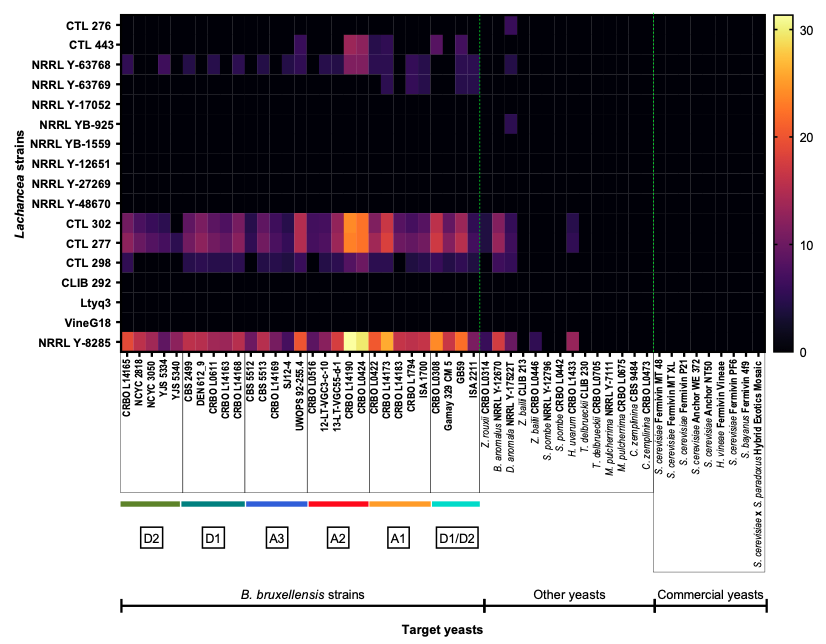
Figure 1. The killer effect of several Lachancea species on the growth of targeted wine-associated yeast. The grading scale represents mean values (n = 3) of zones of inhibition measured in mm. Light green: group D2, diploid; dark cyan: group D1; dark blue: group A3, allotriploid; red: group A2, allotriploid; orange: group A1, allotriploid; turquoise: group D1/D2, autotriploid admixed. Distinction of the genetic groups with colours was implemented as described previously (Avramova et al., 2018; Loegler et al., 2025).
The plates were also re-incubated for 14 days to determine whether the growth inhibition remained beyond the initial incubation period.
Amongst all the Lachancea isolates tested, only ten (i.e., Lachancea dobzhansky CTL 276, Lachancea waltii × S. cerevisiae hybrid CTL 443, Lachancea lanzarotensis NRRL Y-63768, Lachancea mirantina NRRL Y-63769, Lachancea cidri NRRL Y-17052, Lachancea fermentati NRRL YB-925, Lachancea thermotolerans CTL 302, Lachancea thermotolerans CTL 277, Lachancea thermotolerans CTL 298, and Lachancea waltii NRRL Y-8285) displayed growth inhibitory effects specifically against the wine spoilage yeasts. These included B. bruxellensis strains from all genetic groups, Z. rouxii, Z. bailii and B. anomalus. However, B. bruxellensis strains from different genetic groups showed variable sensitivities. For example, L. waltii NRRL Y-8285 exhibited the highest average inhibition halo diameter of 31 mm against the most sensitive B. bruxellensis strain CRBO L14190, whereas other identified killer strains such as L. lanzarotensis NRRL Y-63768 had no inhibitory effect against some B. bruxellensis strains such as CRBO L0516, NCYC 2818 and SJ12-4, amongst others. Interestingly, none of the investigated commercial wine starter culture yeasts and none of the other non-Saccharomyces yeasts was inhibited by any of the investigated Lachancea strains.
Overall, L. thermotolerans CTL 302, L. thermotolerans CTL 277 and L. waltii NRRL Y-8285 displayed the highest zones of inhibition (24, 23, and 31 mm, respectively), of all Lachancea strains. They also inhibited the growth of all B. bruxellensis strains from the different genetic groups. To better compare the ability of these three Lachancea strains to inhibit B. bruxellensis strains, zones of inhibition from only these three strains against all B. bruxellensis strains were visualised in box plots (Figure 2).
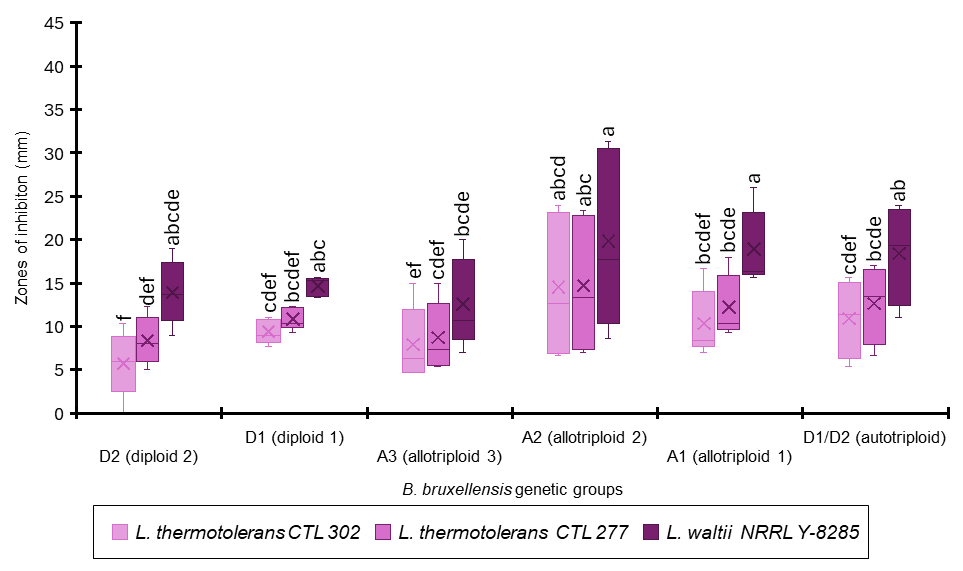
Figure 2. The impact of potent killer strains on the growth of several genetically distinct B. bruxellensis strains. The figure compares the growth-inhibition potency of killer strains and depicts the overall sensitivity of B. bruxellensis strains by genetic group. The letters on top of the bars represent results of a post-hoc statistical test (Tukey's HSD). The same letters mean no statistically significant differences, and different letters mean statistically significant differences (p < 0.05).
Evidently, L. waltii NRRL Y-8285 was more efficient at inhibiting B. bruxellensis strains than both L. thermotolerans strains, as its minimum and maximum inhibition zone values were consistently higher on the box plots. The data allowed identification of B. bruxellensis strains from the allotriploid 2 genetic group as the most sensitive amongst all the genetic groups investigated, whereas the strains belonging to the diploid 2 genetic group were the least sensitive. Indeed, the A2 genetic group was highly heterogeneous in their tolerance and/or sensitivity to Lachancea growth-inhibitory compounds compared to the D1 genetic group strains, which were more homogeneous.
In a separate experiment, the ten identified growth-inhibitory Lachancea strains were tested against each other to determine the possible cross-killer effect (data not shown). This was conducted in a similar manner to the screening described above except that the ten Lachancea strains were individually seeded into the grape juice agar medium as target strains. None of the identified killer strains displayed the killer phenotype when tested against each other, i.e., no inhibition zones were observed.
Since strains of Lachancea spp. produce varying levels of lactic acid as reviewed by (Porter et al., 2019), different concentrations of lactic acid ranging from 3 g/L, 6 g/L, 9 g/L, 12 g/L, 15 g/L and 18 g/L were also tested on the same grape juice agar medium used during screening to verify whether the killer phenotype observed could be due to this metabolite (Table S2). No growth inhibition was observed for all the tested concentrations against all the target yeasts, indicative of a distinct killer compound apart from lactic acid.
2. Identifying the nature of the killer compound
The nature of the inhibitory compound of the three Lachancea isolates, i.e., L. thermotolerans CTL 302, L. thermotolerans CTL 277 and L. waltii NRRL Y-8285, was investigated using both protease and heat treatments (Figure 3).
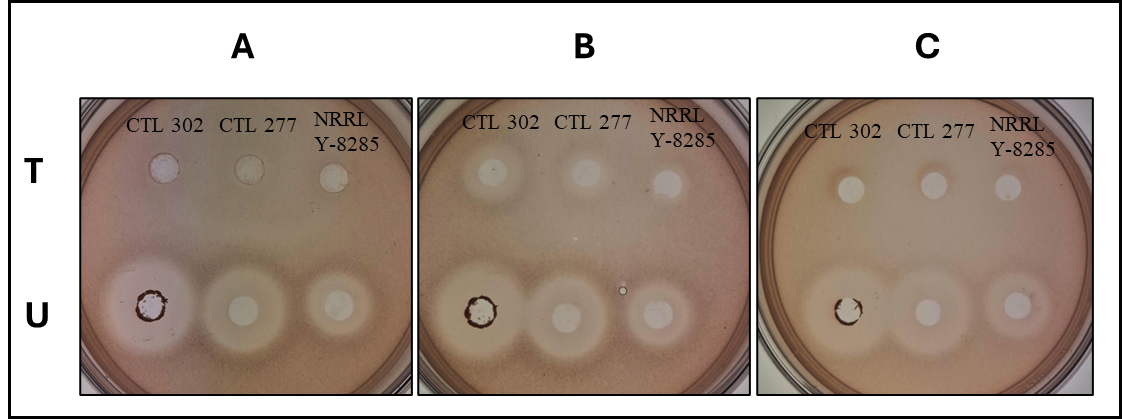
Figure 3. Denaturation of the killer compound by both heat and protease (pepsin) treatments. (A): enzyme treatment; (B): heat treatment (100 °C); (C): heat treatment (120 °C); (T): Treated; (U): Untreated control; CTL 302: L. thermotolerans CTL 302; CTL 277: L. thermotolerans CTL 277; NRRL Y-8285: L. waltii NRRL Y-8285.
Pepsin (i.e., an acid protease) was chosen as the ideal protease, as the killer effect of these strains was observed at pH 3.5 above. Following pepsin treatment, the killer effect was lost for all killer strains, as indicated by the disappearance of zones of inhibition around the wells. Interestingly, inhibition zones were still visible after the heat treatment at 100 °C for 2 h, albeit much smaller than those of the untreated controls. Nevertheless, the zones of inhibition were no longer observed following treatments at 120 °C.
Discussion
In this study, several Lachancea strains displaying a growth-inhibitory phenotype against several spoilage yeasts, including B. bruxellensis, were identified. The strains belong to various species, namely L. dobzhansky, L. lanzarotensis, L. mirantina, L. cidri, L. fermentati, L. thermotolerans, L. waltii and a L. waltii × S. cerevisiae hybrid. Growth inhibitory phenotypes within the Lachancea genus have been previously identified in both L. thermotolerans and L. waltii species (El Dana et al., 2025b; Kono & Himeno, 1997). However, this phenotype in L. waltii was only investigated against a single S. pombe strain and not B. bruxellensis. Contrastingly, the two S. pombe strains investigated in this study were resistant to the L. waltii strain. This highlighted intraspecific resistant phenotypes in S pombe. Nevertheless, this study was the first to report the growth-inhibitory phenotype of L. waltii against B. bruxellensis, H. uvarum, Z. rouxii and Z. bailii. Although more L. thermotolerans strains were investigated in this study compared to strains from other Lachancea species, not all of them displayed the growth-inhibitory phenotype.
To unravel the nature of the growth inhibitory compound(s) by the Lachancea strains, different concentrations of lactic acid (3 g/L to 18 g/L) were subsequently spotted on the same grape juice agar medium used during screening. All the investigated target strains were resistant to lactic acid. Lactic acid typically acts synergistically with SO2, pH and ethanol to suppress growth of unwanted microorganisms in wine (Edwards & Oswald, 2018). This could explain why no inhibition at all lactic acid concentrations (3 g/L to 18 g/L) against target strains was observed on solid medium in this study, but this is unlikely considering the very high concentrations tested. The pepsin (a protein-digesting enzyme) and heat treatments, however, allowed us to identify the inhibitory compound as a protein (Figure 3). This confirmed the previous result obtained for L. waltii NRRL Y-8285 (Kono & Himeno, 1997), and extended it to the other Lachancea species. Amongst many killer toxins previously identified in non-Saccharomyces yeasts, some are glucanases that digest the glycan cell-wall structure of target yeasts, as seen in Tetrapisispora phaffii (Kpkt), whereas others are small molecular weight proteins of viral origin that can induce different antagonistic mechanisms (K1, K2, K28 and Klus) best described in S. cerevisiae strains (Mehlomakulu et al., 2015). The intraspecific variations observed in this study, as well as in that of El Dana and co-workers (2025b), could suggest that dsRNA viruses could also be responsible for the killer phenotype of the Lachancea genus, as described in the species Torulaspora delbrueckii (Ramírez et al., 2015). This hypothesis is reinforced by the fact that the ratio of killer to non-killer strains was low, like Saccharomyces (Pieczynska et al., 2013). Nevertheless, the exact identity of the killer toxins of L. thermotolerans CTL 302, L. thermotolerans CTL 27 and L. waltii NRRL Y-8285 remains to be identified.
Different strains, particularly within the B. bruxellensis species, displayed variable sensitivities to killer toxins by the aforementioned Lachancea strains. These variations may be primarily linked to the type and mechanism of action of the growth-inhibitory compounds secreted by Lachancea strains, which have not yet been identified. However, the growth rates of different B. bruxellensis strains could have also played a role in either accentuating their resistance or susceptibility. Indeed, B. bruxellensis strains CRBO L14190 and CRBO L0424 were more sensitive than all the strains (Figure 1), but they are slow-growing strains. Subsequently, the zones of inhibition could only be measured after an extended incubation. Therefore, growth rates of different target strains were acknowledged as a limitation of the assay. Interestingly, the growth of B. bruxellensis strains across all genetic groups was inhibited (Figure 1). This was not observed with all other spoilage yeasts (Figure 1). In fact, L. thermotolerans CTL 277 and L. waltii NRRL Y-8285 inhibited the growth of all the investigated B. bruxellensis strains across all the genetic groups. Previously identified killer toxins such as Kwkt, Pikt, PMKT2, KP6, CpKT1, CpKT2, Sc54Kt, Mp2, Lt29Kt and Lt54Kt that could also inhibit the growth of B. bruxellensis strains were only tested on a limited number of strains and the impact of B. bruxellensis genetic groups was not considered (Comitini et al., 2021 ; Comitini et al., 2004; Comitini & Ciani, 2011; El Dana et al., 2025a; El Dana et al., 2025b; Mehlomakulu et al., 2014; Santos et al., 2009; Santos et al., 2011; Marquina et al., 1992; Ullivarri et al., 2018; Villalba et al., 2016). Even then, the identified killer toxins did not inhibit the growth of all the investigated B. bruxellensis strains.
In this study, target strains were pre-cultured for 48 h, indicating that all target yeasts except B. bruxellensis and B. anomalus were already in stationary phase prior to being seeded into the grape juice agar medium. Wood & Bevan (1968) observed enhanced sensitivity and tolerance of target S. cerevisiae strains to killer toxins when tested at both exponential and stationary growth phases, respectively. This further suggests that the physiological state of B. bruxellensis strains, compared with other target yeasts in this study, could have influenced their sensitivity to Lachancea killer toxins. Additionally, Piecyznska et al. (2016) observed an acquired resistant phenotype of an initially sensitive S. cerevisiae strain that was co-evolved with a killer S. cerevisiae strain, suggesting that resistant phenotypes are more likely to be found in strains that share the same habitat with the killer strains. Although this phenomenon was not explored at a species level, it could still explain why B. bruxellensis strains were identified as more sensitive to Lachancea killer toxins since they are phylogenetically very distant from Lachancea species, indicative of evolution in different niches, as shown by Opulente et al. (2024).
Both Avramova et al. and Paulin et al. respectively investigated the impact of SO2 and chitosan on the growth of a wide range of B. bruxellensis strains across distinct genetic groups (Avramova et al., 2018; Paulin et al., 2020). Indeed, Avramova et al. observed that A2 and D2 B. bruxellensis populations were more tolerant and sensitive to sulfites, respectively. Moreover, Paulin observed that the sulfite-tolerant A2 B. bruxellensis populations were more sensitive to chitosan. Overall, A2 strains were more sensitive, whereas D2 strains were less sensitive to killer toxins (Figure 2). Sulfite-tolerant B. bruxellensis strains pose a major spoilage threat to winemakers; thus, the ability of L. thermotolerans CTL 302, L. thermotolerans CTL 277 and L. waltii NRRL Y-8285 to target sulfite-tolerant strains further anchors their strong potential as biocontrol agents in wine.
Conclusion
This study identified three Lachancea strains from two Lachancea species that display a consistent killer effect against spoilage yeasts, with high specificity against B. bruxellensis strains. Although the results were obtained from experiments on solid agar medium, the significant potential application of these strains in real winemaking is undeniable, considering the killer toxins function well at wine pH (3.5) used throughout screening. Applications could also extend to cider production, as these strains inhibited the growth of cider spoilage yeast B. anomalus at pH 3.5, consistent with pH ranges for both wine and cider production (i.e., 3.0–4.0). With growing interest in trying to mimic spontaneous wine fermentations by utilising different consortia, the addition of these strains in such consortia could be useful as they do not primarily target beneficial yeasts such as M. pulcherrima, T. delbrueckii and S. cerevisiae, which are typically included in such studies.
Acknowledgements
This research is part of a Cifre PhD program funded by Oenobrands SAS and subsidised by the Association Nationale de la Recherche et de la Technologie (ANRT, Paris, France). The authors thank Marie-Charlotte Colosio (Institut Français de la Vigne et du Vin, 44120 Nantes, France) for providing the CTL Lachancea strains investigated in this project.
References
- Aires, C., Maioto, R., Inês, A., Dias, A. A., Rodrigues, P., Egas, C., & Sampaio, A. (2025). Microbiome and microbiota within wineries: A review. Microorganisms, 13(3), 538. https://doi.org/10.3390/microorganisms13030538
- Avramova, M., Vallet-Courbin, A., Maupeu, J., Masneuf-Pomarède, I., & Albertin, W. (2018). Molecular diagnosis of Brettanomyces bruxellensis’ sulfur dioxide sensitivity through genotype specific method. Frontiers in Microbiology, 9, 1260. https://doi.org/10.3389/fmicb.2018.01260
- Benito, S., Palomero, F., Morata, A., Calderón, F., & Suárez‐Lepe, J. A. (2009). Factors affecting the hydroxycinnamate decarboxylase/vinylphenol reductase activity of Dekkera/Brettanomyces : Application for Dekkera/Brettanomyces control in red wine making. Journal of Food Science, 74(1). https://doi.org/10.1111/j.1750-3841.2008.00977.x
- Comitini, F., Agarbati, A., Canonico, L., Galli, E., & Ciani, M. (2021). Purification and characterization of WA18, a new mycocin produced by Wickerhamomyces anomalus active in wine against Brettanomyces bruxellensis spoilage yeasts. Microorganisms, 9(1), 56. https://doi.org/10.3390/microorganisms9010056
- Comitini, F., & Ciani, M. (2011). Kluyveromyces wickerhamii killer toxin: Purification and activity towards Brettanomyces/Dekkera yeasts in grape must. FEMS Microbiology Letters, 316(1), 77–82. https://doi.org/10.1111/j.1574-6968.2010.02194.x
- Comitini, F., Ingeniis, J., Pepe, L., Mannazzu, I., & Ciani, M. (2004). Pichia anomala and Kluyveromyces wickerhamii killer toxins as new tools against Dekkera/Brettanomyces spoilage yeasts. FEMS Microbiology Letters, 241(1), 127–127. https://doi.org/10.1016/j.femsle.2004.07.040
- Crauwels, S., Van Assche, A., de Jonge, R., Borneman, A. R., Verreth, C., Troels, P., De Samblanx, G., Marchal, K., Van de Peer, Y., Willems, K. A., Verstrepen, K. J., Curtin, C. D., & Lievens, B. (2015). Comparative phenomics and targeted use of genomics reveals variation in carbon and nitrogen assimilation among different Brettanomyces bruxellensis strains. Applied Microbiology and Biotechnology, 99(21), 9123–9134. https://doi.org/10.1007/s00253-015-6769-9
- Crauwels, S., Van Opstaele, F., Jaskula-Goiris, B., Steensels, J., Verreth, C., Bosmans, L., Paulussen, C., Herrera-Malaver, B., de Jonge, R., De Clippeleer, J., Marchal, K., De Samblanx, G., Willems, K. A., Verstrepen, K. J., Aerts, G., & Lievens, B. (2017). Fermentation assays reveal differences in sugar and (off-) flavor metabolism across different Brettanomyces bruxellensis strains. FEMS Yeast Research, 17(1). https://doi.org/10.1093/femsyr/fow105
- Edwards, C. G., & Oswald, T. A. (2018). Interactive effects between total SO2 , ethanol and storage temperature against Brettanomyces bruxellensis. Letters in Applied Microbiology, 66(1), 71–76. https://doi.org/10.1111/lam.12816
- El Dana, F., David, V., Hallal, M. A., Tourdot-Maréchal, R., Hayar, S., Colosio, M.-C., & Alexandre, H. (2025b). Metschnikowia pulcherrima and Lachancea thermotolerans killer toxins: Contribution to must bioprotection. Foods, 14(9), 1462. https://doi.org/10.3390/foods14091462
- El Dana, F., David, V., Tourdot-Maréchal, R., Hayar, S., Colosio, M.-C., & Alexandre, H. (2025a). Bioprotection with Saccharomyces cerevisiae: A promising strategy. Microorganisms, 13(5), 1163. https://doi.org/10.3390/microorganisms13051163
- Escott, C., Loira, I., Morata, A., Bañuelos, M. A., & Suárez-Lepe, J. A. (2017). Wine spoilage yeasts: Control strategy. In A. Morata & I. Loira (Eds.), Yeast - Industrial Applications. IntechOpen. https://doi.org/10.5772/intechopen.69942
- Henick-Kling, T., & Park, Y. H. (1994). Considerations for the use of yeast and bacterial starter cultures: SO2 and timing of inoculation. American Journal of Enology and Viticulture, 45(4), 464–469. https://doi.org/10.5344/ajev.1994.45.4.464
- Kheir, J., Salameh, D., Strehaiano, P., Brandam, C., & Lteif, R. (2013). Impact of volatile phenols and their precursors on wine quality and control measures of Brettanomyces/Dekkera yeasts. European Food Research and Technology, 237(5), 655–671. https://doi.org/10.1007/s00217-013-2036-4
- Kono, I., & Himeno, K. (1997). A novel killer yeast effective on Schizosaccharomyces pombe. Bioscience, Biotechnology, and Biochemistry, 61(3), 563–564. https://doi.org/10.1271/bbb.61.563
- Lallemand Oenology. (2025). LEVEL2 SALVATM: Suhomyces pyralidae—Bioprotection against Brettanomyces bruxellensis. https://products.lallemandwine.com/storage/files/wine-yeasts/336-technical-datasheet-cp-1745399397.pdf
- Loegler, V., Runge, J.-N., Eberlein, C., Peltier, É., Harrouard, J., Miot-Sertier, C., Albertin, W., Friedrich, A., & Schacherer, J. (2025). Whole-genome sequencing of 1,060 Brettanomyces bruxellensis isolates reveals significant phenotypic impact of acquired subgenomes in allopolyploids. Nature Communications, 16(1), 5500. https://doi.org/10.1038/s41467-025-60706-4
- Marquina, D., Peres, C., Caldas, F. V., Marques, J. F., Peinado, J. M., & Spencer-Martins, I. (1992). Characterization of the yeast population in olive brines. Letters in Applied Microbiology, 14(6), 279–283. https://doi.org/10.1111/j.1472-765X.1992.tb00705.x
- Mehlomakulu, N. N., Setati, M. E., & Divol, B. (2014). Characterization of novel killer toxins secreted by wine-related non-Saccharomyces yeasts and their action on Brettanomyces spp. International Journal of Food Microbiology, 188, 83–91. https://doi.org/10.1016/j.ijfoodmicro.2014.07.015
- Mehlomakulu, N. N., Setati, M. E., & Divol, B. (2015). Non-Saccharomyces killer toxins: possible biocontrol agents against Brettanomyces in wine? South African Journal of Enology and Viticulture, 36(1). https://doi.org/10.21548/36-1-939
- Millet, V., & Lonvaud-Funel, A. (2000). The viable but non-culturable state of wine micro-organisms during storage. Letters in Applied Microbiology, 30(2), 136–141. https://doi.org/10.1046/j.1472-765x.2000.00684.x
- Miot-Sertier, C., Paulin, M., Dutilh, L., Ballestra, P., Albertin, W., Masneuf-Pomarède, I., Coulon, J., Moine, V., Vallet-Courbin, A., Maupeu, J., & Dols-Lafargue, M. (2022). Assessment of chitosan antimicrobial effect on wine microbes. International Journal of Food Microbiology, 381, 109907. https://doi.org/10.1016/j.ijfoodmicro.2022.109907
- Opulente, D. A., LaBella, A. L., Harrison, M.-C., Wolters, J. F., Liu, C., Li, Y., Kominek, J., Steenwyk, J. L., Stoneman, H. R., VanDenAvond, J., Miller, C. R., Langdon, Q. K., Silva, M., Gonçalves, C., Ubbelohde, E. J., Li, Y., Buh, K. V., Jarzyna, M., Haase, M. A. B., … Hittinger, C. T. (2024). Genomic factors shape carbon and nitrogen metabolic niche breadth across Saccharomycotina yeasts. Science, 384(6694), eadj4503. https://doi.org/10.1126/science.adj4503
- Organisation Internationale de la Vigne et du Vin. (2022). Review of the code of good vitivinicultural practices in order to avoid or limit contamination by Brettanomyces. https://www.oiv.int/node/2875/download/pdf
- Paulin, M., Miot-Sertier, C., Dutilh, L., Brasselet, C., Delattre, C., Pierre, G., Dubessay, P., Michaud, P., Doco, T., Ballestra, P., Albertin, W., Masneuf-Pomarède, I., Moine, V., Coulon, J., Vallet-Courbin, A., Maupeu, J., & Dols-Lafargue, M. (2020). Brettanomyces bruxellensis displays variable susceptibility to chitosan treatment in wine. Frontiers in Microbiology, 11, 571067. https://doi.org/10.3389/fmicb.2020.571067
- Picariello, L., Errichiello, F., Coppola, F., Rinaldi, A., Moio, L., & Gambuti, A. (2023). Effect of chitosan addition on acetaldehyde and polymeric pigments production after oxidation of red wines with different tannin/anthocyanins ratio. European Food Research and Technology, 249(9), 2447–2455. https://doi.org/10.1007/s00217-023-04292-z
- Pieczynska, M. D., de Visser, J. A. G. M., & Korona, R. (2013). Incidence of symbiotic dsRNA ‘killer’ viruses in wild and domesticated yeast. FEMS Yeast Research, 13(8), 856–859. https://doi.org/10.1111/1567-1364.12086
- Pieczynska, M. D., Wloch-Salamon, D., Korona, R., & de Visser, J. A. G. M. (2016). Rapid multiple-level coevolution in experimental populations of yeast killer and nonkiller strains. Evolution, 70(6), 1342–1353. https://doi.org/10.1111/evo.12945
- Pilard, E., Harrouard, J., Miot-Sertier, C., Marullo, P., Albertin, W., & Ghidossi, R. (2021). Wine yeast species show strong inter- and intra-specific variability in their sensitivity to ultraviolet radiation. Food Microbiology, 100, 103864. https://doi.org/10.1016/j.fm.2021.103864
- Pinto, L., Baruzzi, F., Cocolin, L., & Malfeito-Ferreira, M. (2020). Emerging technologies to control Brettanomyces spp. in wine: Recent advances and future trends. Trends in Food Science & Technology, 99, 88–100. https://doi.org/10.1016/j.tifs.2020.02.013
- Porter, T. J., Divol, B., & Setati, M. E. (2019). Lachancea yeast species: Origin, biochemical characteristics and oenological significance. Food Research International, 119, 378–389. https://doi.org/10.1016/j.foodres.2019.02.003
- Ramírez, M., Velázquez, R., Maqueda, M., López-Piñeiro, A., & Ribas, J. C. (2015). A new wine Torulaspora delbrueckii killer strain with broad antifungal activity and its toxin-encoding double-stranded RNA virus. Frontiers in Microbiology, 6, 983. https://doi.org/10.3389/fmicb.2015.00983
- Rodrigues, N., Goncalves, G., Pereira-da-Silva, S., Malfeito-Ferreira, M., & Loureiro, V. (2001). Development and use of a new medium to detect yeasts of the genera Dekkera/Brettanomyces. Journal of Applied Microbiology, 90(4), 588–599. https://doi.org/10.1046/j.1365-2672.2001.01275.x
- Santos, A., Navascués, E., Bravo, E., & Marquina, D. (2011). Ustilago maydis killer toxin as a new tool for the biocontrol of the wine spoilage yeast Brettanomyces bruxellensis. International Journal of Food Microbiology, 145(1), 147–154. https://doi.org/10.1016/j.ijfoodmicro.2010.12.005
- Santos, A., San Mauro, M., Bravo, E., & Marquina, D. (2009). PMKT2, a new killer toxin from Pichia membranifaciens, and its promising biotechnological properties for control of the spoilage yeast Brettanomyces bruxellensis. Microbiology, 155(2), 624–634. https://doi.org/10.1099/mic.0.023663-0
- Serpaggi, V., Remize, F., Recorbet, G., Gaudot-Dumas, E., Sequeira-Le Grand, A., & Alexandre, H. (2012). Characterization of the “viable but nonculturable” (VBNC) state in the wine spoilage yeast Brettanomyces. Food Microbiology, 30(2), 438–447. https://doi.org/10.1016/j.fm.2011.12.020
- Smith, B. D., & Divol, B. (2018). The carbon consumption pattern of the spoilage yeast Brettanomyces bruxellensis in synthetic wine-like medium. Food Microbiology, 73, 39–48. https://doi.org/10.1016/j.fm.2017.12.011
- Tedesco, F., Biundo, A., Caporusso, A., Pisano, I., Siesto, G., Pietrafesa, R., Abry, C., Hervé, A., Falabella, P., & Capece, A. (2025). Chitosan-based strategies as eco-friendly solutions for controlling Brettanomyces bruxellensis contamination in wine production. Frontiers in Microbiology, 16, 1631987. https://doi.org/10.3389/fmicb.2025.1631987
- Tedesco, F., Siesto, G., Pietrafesa, R., Romano, P., Salvia, R., Scieuzo, C., Falabella, P., & Capece, A. (2022). Chemical methods for microbiological control of winemaking: An overview of current and future applications. Beverages, 8(3), 58. https://doi.org/10.3390/beverages8030058
- Ullivarri, M., Mendoza, L. M., & Raya, R. R. (2018). Characterization of the killer toxin KTCf20 from Wickerhamomyces anomalus, a potential biocontrol agent against wine spoilage yeasts. Biological Control, 121, 223–228. https://doi.org/10.1016/j.biocontrol.2018.03.008
- Vaquero, C., Loira, I., Heras, J. M., Carrau, F., González, C., & Morata, A. (2021). Biocompatibility in ternary fermentations with Lachancea thermotolerans, other non-Saccharomyces and Saccharomyces cerevisiae to control pH and improve the sensory profile of wines from warm areas. Frontiers in Microbiology, 12. https://doi.org/10.3389/fmicb.2021.656262
- Villalba, M. L., Susana Sáez, J., del Monaco, S., Lopes, C. A., & Sangorrín, M. P. (2016). TdKT, a new killer toxin produced by Torulaspora delbrueckii effective against wine spoilage yeasts. International Journal of Food Microbiology, 217, 94–100. https://doi.org/10.1016/j.ijfoodmicro.2015.10.006
- Woods, D. R., & Bevan, E. A. (1968). Studies on the nature of the killer factor produced by Saccharomyces cerevisiae. Journal of General Microbiology, 51(1), 115–126. https://doi.org/10.1099/00221287-51-1-115
 Views: 411
 XML: 35