

ENOLOGY / Original research article
Abstract
This study investigates the impact of grapevine age on the secondary metabolites of Vitis vinifera L. cv. Riesling berries, focusing on free and bound monoterpenes, C13-norisoprenoids, and skin flavonols. While old vineyards are often culturally revered for producing superior wines, direct scientific evidence comparing vineyards of different ages while controlling for extrinsic factors has been limited.
The study was conducted in an experimental vineyard in the Rheingau region, Germany, over three consecutive vintages (2015–2017). The vineyard was initially planted in 1971 with Riesling grapevines (clone Gm 239-17 grafted on 5C Teleki rootstock) trained in double Guyot. In 1995 and 2012, adjacent rows were uprooted and replanted with the same planting material, resulting in a vineyard of four blocks with grapevines planted in 1971 (old vines), 1995 (mature vines), and 2012 (young vines). The study found that young grapevines consistently accumulated higher levels of key aroma compounds, specifically bound nerol oxide, vitispirane, and 1,1,6-trimethyl-1,2-dihydronaphthalene (TDN), compared to the older groups. These differences were most pronounced during the first harvest year of the young vines (2015), likely driven by their lower productivity, smaller root systems, and initial differences in soil management.
Conversely, mature and old grapevines showed remarkably similar berry composition across most studied compounds throughout the trial. Skin flavonols were largely unaffected by grapevine age, showing more significant fluctuations based on the growing season. The findings indicate that grapevine age effects are most evident in the transition from young to mature vines and tend to stabilise afterwards. This challenges the traditional belief that increasing vine age beyond maturity inherently enhances the oenological potential of berries under these specific conditions.
Introduction
Old vineyards are usually held in high regard and are considered in many wine regions as part of the cultural heritage. Many authors report a general belief that older grapevines can produce superior wines (Goode, 2005; Heymann & Noble, 1987; Koblet & Perret, 1982; Robinson & Harding, 2015). The common explanation is that ageing vines reach a better balance between vegetative growth and yield (Zufferey & Maigre, 2008). However, few studies have directly tested how vine age affects wine character, and researching this question – especially in commercial vineyards – poses substantial challenges (OIV, 2024).
In most wine regions, vineyards are typically replaced after 25–30 years, often due to a decrease in yield and/or berry quality. Conversely, vineyards that produce sustainable crop yields and high-quality wines are retained for longer periods of time and managed carefully, allowing them to age (Dry, 2013). Studying older vineyards is further complicated by the gradual loss and replacement of individual vines due to damage or trunk disease, creating wide withinvineyard age heterogeneity. In addition, extrinsic factors such as vineyard microclimate, soil texture and composition, biotic stressors, and cultural practices can have cumulative effects over time, which makes direct comparisons between vineyards of different ages difficult (Duthie et al., 1991; Lider et al., 1978). For instance, severe drought can cause xylem cavitation and subsequent cavitation fatigue, increasing a grapevine’s sensitivity to future cavitation events (Gambetta et al., 2020).
Previous research on grapevine age has focused on primary metabolites and technological maturity (Grigg et al., 2018; Reynolds et al., 2008; Zufferey & Maigre, 2008). Some studies reported that berries from older grapevines had higher titratable acidity and free amino acid as well as ammonium cation content (formol index) compared to young grapevines, while sugar content remained similar across age groups. Nevertheless, the observed trends often depended on cultivar, type of wine produced, and differences between growing seasons (Reynolds et al., 2008; Zufferey & Maigre, 2008). The largest agespan study to date – own-rooted Shiraz in the Barossa Valley ranging from 6 to 168 years and distributed among various vineyards – found greater reproductive capacity in old grapevines, though significant seasonal and site interactions were present (Grigg et al., 2018); this increase in reproductive capacity may be due to larger reserves of wood carbohydrates (Howell, 2001).
The current study examines berries and must from grafted Vitis vinifera cv. Riesling grapevines, of identical plant material (same scion and rootstock clones) but planted in 1971, 1995, and 2012 in a single vineyard in Geisenheim, Germany. It compares the three grapevine age groups with regard to secondary metabolites, with a focus on free and bound monoterpenes, norisoprenoids, and flavonols.
Riesling is often characterised as a non-Muscat aromatic cultivar, with a wine profile strongly shaped by monoterpenes and C13-norisoprenoids (Lott et al., 2010). Monoterpenes fulfil various functions in plants, including deterring animals and protecting against fungal and bacterial infections (Gershenzon & Dudareva, 2007). They are primarily found in berries as glycoside conjugates and are gradually released during wine fermentation and ageing (Black et al., 2015). Norisoprenoids are derived from the oxidative degradation of carotenoids, which play a role in the light harvesting activity of chloroplasts and protect plant cells from photo-oxidative damage (Lashbrooke et al., 2013). These two classes of compounds contribute to Riesling’s typical floral and fruity aromas, as well as its distinctive ‘kerosene’ note, which is attributed to the presence of free 1,1,6-trimethyl-1,2-dihydronaphthalene (TDN) (Mateo & Jiménez, 2000).
Flavonols, a subclass of flavonoids, are primarily located in berry skin and act as protectants against oxidation by UV radiation (Haselgrove et al., 2000). They also contribute to the golden-yellow hue of white grapes (Ferrer-Gallego et al., 2016). Although flavonols are less relevant than monoterpenes and norisoprenoids from an aromatic point of view, flavonols contribute to the typicity of white wines by modulating astringency and bitterness (Rienth et al., 2021).
Materials and methods
1. Experimental design and plant material
The study was conducted in a single experimental plot located in Geisenheim, Germany, with alternating rows of Vitis vinifera L. cv. Riesling grapevines (clone Gm 239-17) grafted on 5C Teleki rootstocks and trained in double Guyot. While the original vineyard was planted in 1971, some rows were uprooted in 1995 and 2012 and replanted with the same plant material to obtain four blocks with each grapevine age group. This resulted in alternating row pairs of grapevines planted in 2012 (young), 1995 (mature), and 1971 (old). The vineyard is described in more detail in Bou Nader et al. (2019). The study began in 2014, which was the young grapevines' first harvest year, and continued until 2017.
Due to the general vigour of the site, a cover crop of grass and clover had already been sown in alternating rows (Bou Nader et al., 2019). When the young grapevines were planted, their rows were ploughed in the first three years to prevent excessive competition with the cover crop during the early developmental stages of the grapevines. Afterwards, these rows were sown with the same cover crop combination that already existed in mature and old grapevine rows.
2. Berry sampling and processing
Phenology was followed with the modified E-L system developed by (Coombe, 1995). No significant phenological shifts were found between grapevine age groups during the study. The veraison date was determined by the onset of berry softening. Harvest dates (September 30 in 2015, October 05 in 2016, and September 28 in 2017) were decided according to technological maturity with targets of 23 °Brix, 9 g tartaric acid eq. L-1 and pH 2.9, but also depended on berry health status. One day before harvest, randomised samples of 200 berries were collected for each treatment × replicate combination for a total of 12 samples (n = 4). The berries were collected by cutting their pedicel with scissors and were placed in liquid nitrogen under a CO2 atmosphere. The samples were then stored under a CO2 atmosphere at –20 °C in sealed bags until analysis.
3. Free and potential monoterpene and C13-norisoprenoid content in berries
Free and potential monoterpenes and C13-norisoprenoids were analysed by a modified solid-phase extraction (SPE) for sample preparation (Günata et al., 1985) as described in (Schüttler et al., 2015), followed by gas chromatography coupled with mass spectrometry (GC-MS). The method was adapted by replacing the enzymatic release of aglycones with acid hydrolysis using the procedure described by Kotseridis et al. (1999). Frozen berry samples were allowed to thaw overnight at 4 °C and were blended for 30 s. The resulting must was centrifuged three times in 50 mL tubes (VWR, Lutterworth, UK) at 7200 g and 4 °C in a 5430 R centrifuge (Eppendorf, Hamburg, Germany), and the clear must was analysed.
Strata SDB-L cartridges containing 500 mg of styrene-divinylbenzene polymer (Phenomenex, Torrance, CA, USA) were preconditioned with 5 mL of pentane/dichloromethane (2/1 v/v), followed by 10 mL of methanol, 10 mL of methanol/H2O (1/1 v/v) and 10 mL of H2O. Must samples of 50 mL were diluted 1:1 with ultrapure water and were spiked with octan-3-ol and 2.6-dimethylhept-5-en-2-ol (DMH) as internal standards (octan-3-ol) = 50 µg L-1; c(DMH) = 25 µg L-1) and were loaded on the SPE cartridges. Cartridges were washed with 10 mL of water and dried for 1 h with nitrogen under vacuum. Dried samples were eluted with 10 mL of pentane/dichloromethane (2/1 v/v). The eluates were dried with anhydrous sodium sulphate and concentrated to a final volume of 50 µL under gentle nitrogen flow, and 2 µL were used to analyse free monoterpenes and norisoprenoids by gas chromatography.
For potential monoterpenes and norisoprenoids, the SPE cartridges were eluted with 10 mL of ethyl acetate. The fractions were evaporated to dryness under vacuum with a rotary evaporator (Büchi, Flawil, Switzerland) at water bath temperature 40 °C and p = 138 kPa. The residues were dissolved in 5 mL of 0.2 M citric acid (pH = 2.5), transferred to 10 mL headspace vials, sealed, and heated in a laboratory oven at 100 °C for 60 min. After cooling the samples on ice, the internal standard mix was added based on the initial sample volume. Three successive liquid-liquid extractions were conducted with 2 mL, 1 mL, and 1 mL pentane/dichloromethane (2/1 v/v), combined with anhydrous sodium sulphate, and concentrated under nitrogen flow to reach a final volume of 50 µL. Gas chromatography coupled to mass spectrometry (GC-MS) was performed with a Thermo Fisher Trace GC Ultra gas chromatograph equipped with a PTV injector and coupled to a Thermo Fisher ITQ 900 Ion Trap MS mass spectrometric detector (Thermo Fisher Scientific, Waltham, MA USA). Samples (2 µL) were injected in splitless mode (splitless time 90 s) at 200 °C. An Agilent DB-Wax capillary column of dimensions 30 m × 0.25 mm ID × 0.5 µm film thickness (Agilent Technologies, Santa Clara, CA, USA) was used for the separation. The following temperature gradient program was used: 40 °C for 1 min, then temperature increased until 60 °C at 10 °C min-1, then from 60 °C to 200 °C at 3 °C min-1, and from 200 °C to 230 °C at 10 °C min-1. The temperature was finally maintained at 230 °C for 10 min. Helium was used as a carrier gas with a flow rate of 1.4 mL min-1 and an average velocity of 27 cm s-1. The interface and MS source temperatures were set to 240 °C and 200 °C, respectively. Mass spectrometric data were acquired in electron impact (EI) mode with an ionisation energy of 70 eV. Quantification was made in Selected Ion Monitoring (SIM) mode.
4. Flavonol content in berry skin
The flavonol extraction from skins and their analysis were done according to Torres et al. (2017) with 20 mg of skin powder and 500 μL of acidified methanol at 0.1 % (v/v) HCl. The extracts were centrifuged for 1 min at 4500 g at room temperature and were filtered directly into UHPLC vials with 0.22 μm syringe filters (GHP Acrodisc, Pall Gelman Corporation, Ann Arbour, MI USA). The analysis was performed with an UltiMate 3000 UHPLC system (Thermo Electron SAS, Waltham, MA USA) equipped with a DAD-3000 diode array detector at a wavelength of 360 nm (Thermo Electron SAS, Waltham, MA USA). The separation was made with a Syncronis C18 column of dimensions 2.1 × 100 mm and particle size 1.7 μm (Thermo Fischer Scientific, Waltham, MA USA) at an elution debit of 0.368 mL min-1 and the following binary gradient (v/v): 0 min 92.2 % A 7.8 % B, 9.6 min 73 % A 27 % B, 14.1 min 70 % A 30 % B, 14.8 min 92.2 % A 7.8 % B (eluent A, ultrapure water and formic acid, 90/10 v/v; eluent B, acetonitrile 100 %). The retention times and UV-visible spectrometric data of the samples were compared with those of pure standards for the identification and assignment of peaks. Peak area was calculated with the Chromeleon 7.1 software (Thermo Electron SAS, Waltham, MA USA). Individual flavonol concentrations were translated into milligrams per gram of dry skin (mg g-1 dry weight) with quercetin-3-O-glucoside (Extrasynthèse, Genay, France) as reference.
5. Statistical analysis
Due to unequal variances among treatments, the Kruskal–Wallis test with Dunn’s post hoc comparisons with the Bonferroni correction was used as a univariate test to examine the effect of grapevine age and year on the variables of interest, with age group and year as categorical variables. The interactions between response variables were also assessed by multivariate analysis. Principal component analysis (PCA) was first used on normalised data to evaluate how much of the variance between samples could be explained by the various chemical compounds that were analysed. As a second step, a partial least squares discriminant analysis (PLS-DA) was performed per vintage on normalised data in order to examine the potential intra-vintage effect of grapevine age. The number of PLS-DA components was optimised using leave-one-out cross-validation (LOOCV) with one sample removed per iteration (n = 12) to maximise the use of the limited sample size.
The Kruskal–Wallis tests were performed with JASP (version 0.96.0). PCA and PLS-DA were done in R (version 4.5.3) with the packages FactoMineR (version 2.14; Lê et al., 2008), missMDA (version 1.21; Josse & Husson, 2016), factoextra (version 2.0.0; Kassambara & Mundt, 2019), and caret (version 7.0-1; Kuhn & Max, 2008). When the berry contents of a certain compound were under the detection limit (less than 5 % of the total data), a random number lower than the detection limit was imputed in the dataset.
Results
The berry contents for the detected free and bound monoterpenes and norisoprenoids, as well as skin flavonols from 2015 to 2017 are shown in Table 1. In general, the amounts of free and bound monoterpenes and norisoprenoids per berry followed a higher trend for young grapevines across the three vintages. However, based on the Kruskal–Wallis test, only nerol oxide, vitispirane, and TDN amounts per berry were significantly higher for young grapevines. The Dunn post-hoc comparisons showed no statistical difference between mature and old grapevines. Overall, the year 2015 was characterised by the lowest amounts of monoterpenes and norisoprenoids in berries. Skin flavonol content varied seasonally, with higher values for quercetin-3-galactoside and quercetin-3-glucuronide in 2017 for all age groups. However, there were no significant impacts from either grapevine age or year on the amount of quercetin-3-glucoside per berry.
Year | 2015 | 2016 | 2017 | Age group | Year | ||||||
Age group | Old | Mature | Young | Old | Mature | Young | Old | Mature | Young | ||
Free monoterpenes and norisoprenoids (ng berry-1) | |||||||||||
linalool | 8.0 ± 1.1 | 8.2 ± 0.5 | 11.3 ± 2.5 | 22.0 ± 2.6 | 14.1 ± 2.5 | 23.5 ± 4.0 | 23.7 ± 5.3 | 21.4 ± 2.1 | 19.8 ± 3.1 | 0.993 | < 0.001a,b,b |
Bound monoterpenes and norisoprenoids (ng berry-1) | |||||||||||
α-terpineol | 335.3 ± 10.7 | 327.6 ± 42.8 | 418.8 ± 50.8 | 693.5 ± 22.3 | 671.2 ± 21.2 | 893.4 ± 113.9 | 673.6 ± 57.8 | 681.6 ± 47.7 | 778.9 ± 120.3 | 0.109 | <0.001a,b,b |
nerol oxide | 60.5 ± 6.1 | 67 ± 8.3 | 87.4 ± 11.2 | 82 ± 6.6 | 99.5 ± 10 | 105.3 ± 7.1 | 85.8 ± 5.2 | 94.4 ± 8.1 | 92.6 ± 14.4 | 0.012a,ab,b | 0.001a,b,b |
cis-linalool oxide | 33.3 ± 2.7 | 35.7 ± 4.7 | 43.2 ± 3.7 | 41.8 ± 2.6 | 49.1 ± 2.9 | 46.5 ± 2.1 | 42.5 ± 1.9 | 43.4 ± 3.4 | 37.9 ± 6.7 | 0.150 | 0.002a,b,a |
trans-linalool oxide | 25.7 ± 1.6 | 28.4 ± 3.7 | 31.8 ± 2.7 | 33.1 ± 2.4 | 38.9 ± 3 | 36.5 ± 2.3 | 34.7 ± 1.9 | 35.4 ± 2.1 | 31.6 ± 5.3 | 0.179 | <0.001a,b,b |
vitispirane | 47.7 ± 11.3 | 53.2 ± 3.1 | 105.3 ± 20.1 | 84.3 ± 12.6 | 107.1 ± 20.3 | 162.5 ± 30.5 | 94.4 ± 10.1 | 130.7 ± 27.3 | 176.5 ± 39.1 | <0.001a,a,b | <0.001a,b,b |
TDN | 4.5 ± 0.9 | 6.2 ± 0.5 | 11.1 ± 2 | 11.5 ± 2.9 | 20.1 ± 5 | 27.4 ± 7.2 | 11.4 ± 1.4 | 16.4 ± 3.5 | 20.5 ± 1.8 | 0.004a,a,b | <0.001a,b,b |
Flavonol glycosides (µg berry-1) | |||||||||||
quercetin-3-galactoside | 8.5 ± 2.9 | 9.2 ± 2.8 | 5.6 ± 1.2 | 23.3 ± 5.0 | 17.4 ± 1.9 | 11.4 ± 3.5 | 43.0 ± 13.1 | 37.4 ± 2.1 | 41.2 ± 5.4 | 0.544 | <0.001a,b,c |
quercetin-3-glucuronide | 40.2 ± 13.0 | 44.0 ± 17.3 | 36.6 ± 10.9 | 52.2 ± 5.2 | 52.2 ± 2.2 | 37.1 ± 10.3 | 80.9 ± 24.2 | 63.1 ± 28.1 | 85.8 ± 6.3 | 0.889 | <0.001a,a,b |
quercetin-3-glucoside | 54.3 ± 18.7 | 67.9 ± 20.9 | 61.9 ± 11.1 | 46.6 ± 3.1 | 58.6 ± 15.1 | 57.4 ± 12.1 | 54.0 ± 15.5 | 55.4 ± 5.6 | 67.7 ± 6.2 | 0.077 | 0.350 |
Fractions of monoterpenes and norisoprenoids that were below the detection limit were excluded from the table. Initially planted grapevines: Old in 1971; Mature in 1995; Young in 2012.
Data about the concentration of monoterpenes, norisoprenoids, and flavonols are presented in Table S1. Here, the trend observed for young grapevines with nerol oxide, vitispirane and TDN was noticeable again, in conjunction with higher concentrations of cis- and trans-linalool oxide. The concentration results, while valuable from a winemaking perspective, are modulated by the fact that young grapevines had smaller berries than mature and old vines in 2015, which may have led to a concentration effect that can influence statistical analysis. For this reason, working with berry contents was preferred.
The Kruskal–Wallis non-parametric test was used in this trial due to the heteroscedastic nature of the data. As a result, it was not possible to univariately examine the interaction between age group and year for the studied compounds. To better understand this interaction, PCA was performed on berry content data for the three vintages. Figure 1 shows the resulting PCA biplot, with eigenvalues and eigenvectors presented in Tables S2 and S3. The first three principal components of the PCA accounted for 87.0 % of the variance in the data.
The colour polygons represent the four replicates for each grapevine age group and growing season. Young, mature and old grapevines are shown in pink, green, and grey, respectively.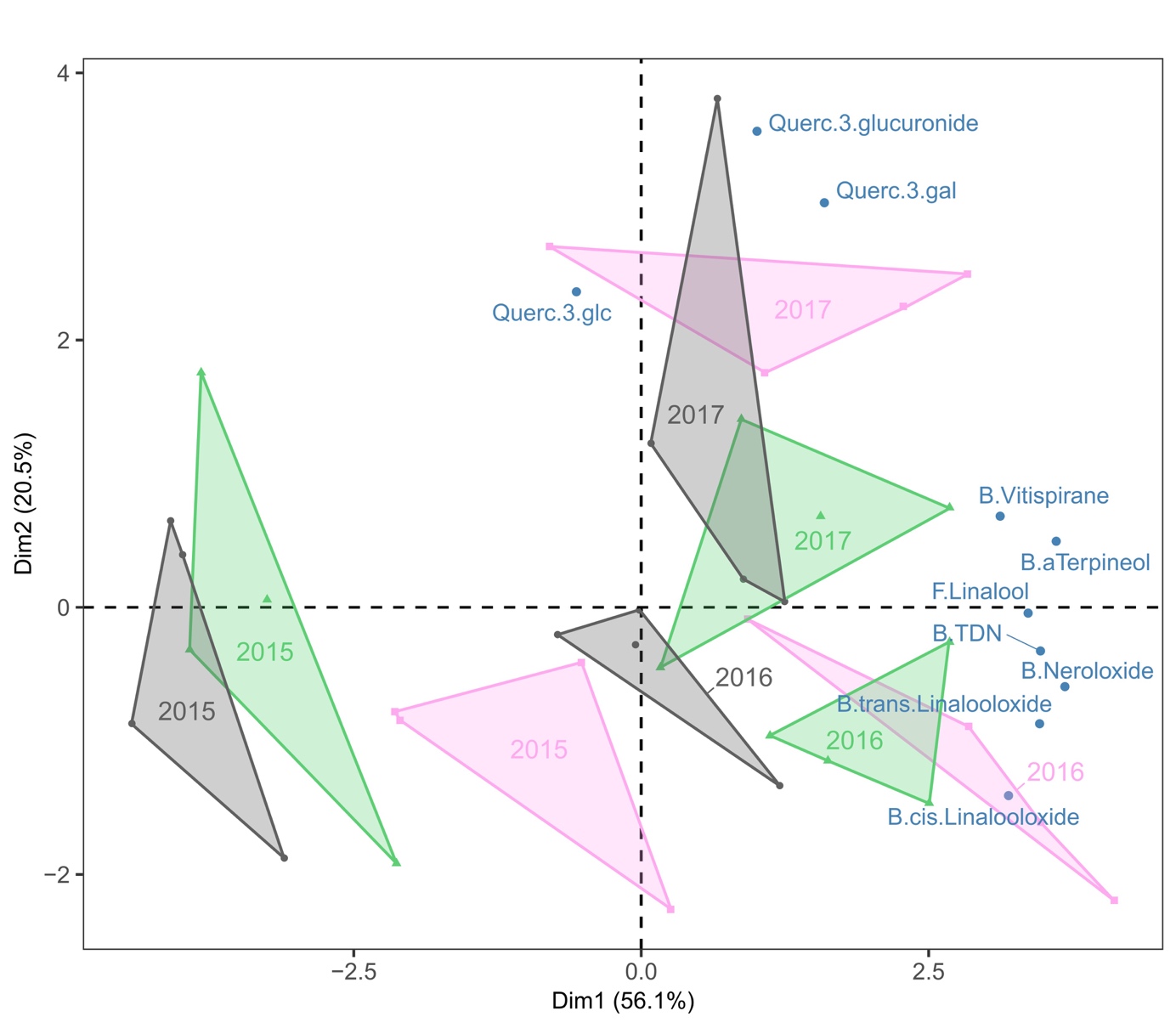
Figure 1. PCA biplot of the secondary metabolites (free and bound terpenes and norisoprenoids and flavonol glycosides) from 2015–2017.
The largest contributions to the first principal component were from monoterpenes and norisoprenoids, in particular nerol oxide, while quercetin-3-glucuronide was the largest contributor to the second principal component. Bound monoterpenes and norisoprenoids were the most discriminant variables among samples. Young grapevine samples were associated with higher contents of monoterpenes and norisoprenoids than mature and old grapevines in 2015, as expressed by the distance between young grapevine individuals and those of older grapevines than for later vintages. For the three vintages, the clusters for mature and old grapevines remained closer to each other, although old grapevines showed a relatively stronger negative correlation with the first principal component.
PLS-DA with LOOCV identified 2 latent components as optimal for the classification of samples per vintage based on minimising LOOCV error rates. The model achieved an overall LOOCV accuracy of 58.3 % in 2015, 75.0 % in 2016, and 58.3 % in 2017. The LOOCV confusion matrix revealed that young grapevines were classified with 100 % sensitivity (4/4 correct predictions) in 2015 and 2017 and 75 % in 2016 (3/4 correct predictions), while sensitivity was not higher than 75 % for mature and old vines throughout the study (Table S4). Overall specificity ranged from 63 % to 100 % across classes. Finally, prediction accuracy was highest for young grapevines in the three vintages (Table S4). The PLS-DA score plots for berry contents for free and bound monoterpenes, norisoprenoids, and flavonols are shown in Figure 2. The first and second latent components were responsible for 99.5 % of the variance between samples in 2015, 84.2 % in 2016, and 60.9 % in 2017. In 2015, the first latent component was driven primarily by TDN (VIP = 1.31), vitispirane (VIP = 1.30), and nerol oxide (VIP = 1.18), all negatively weighted, while the second latent component was mostly driven by TDN (VIP = 1.20), vitispirane (VIP = 1.14), and quercetin-3-glucoside (VIP = 1.07), all positively weighted. TDN, vitispirane, and α-terpineol were consistently among the five most important variables for the first latent component throughout the study. The PLS-DA results should be considered exploratory given the small sample size (n = 12) relative to the number of predictors (p = 10), which increases the risk of overfitting.
The confidence ellipses were calculated at a significance level of α = 0.05.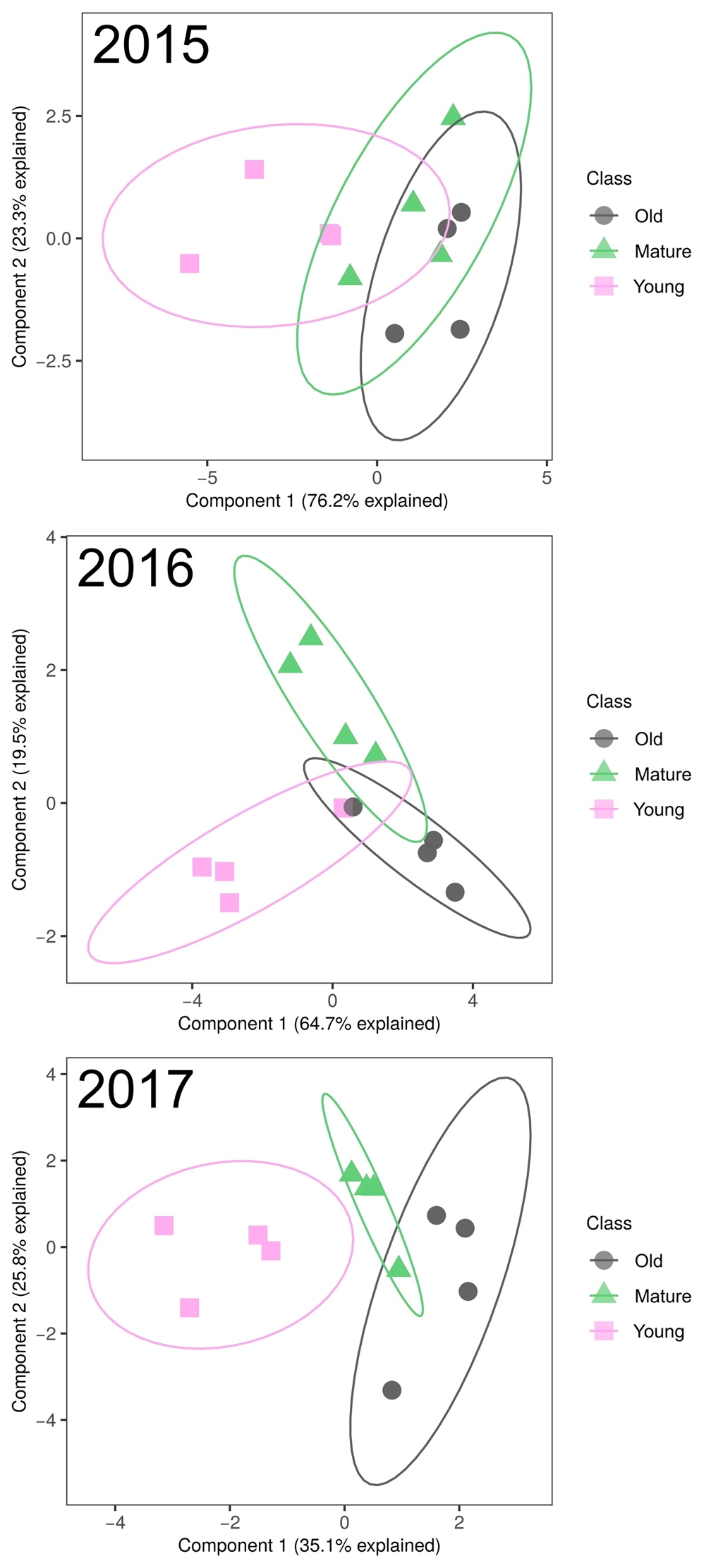
Figure 2. PLS-DA score plots of berry contents for free and bound monoterpenes, norisoprenoids, and flavonol glycosides in 2015, 2016, and 2017.
Discussion
The data indicate that berry monoterpene and norisoprenoid composition is influenced by grapevine age, with young vines consistently accumulating higher levels of key aroma compounds across multiple growing seasons. Three bound norisoprenoids – nerol oxide, vitispirane, and TDN – were significantly higher in berries from young grapevines, a pattern that remained in place despite vintage-to-vintage variations. The multivariate analyses reinforced this age-related differentiation: PCA revealed that bound monoterpenes and norisoprenoids were the most discriminant variables among samples, while PLS-DA showed near-perfect classification of young grapevines (100 % sensitivity in 2015 and 2017) based on their metabolite profiles. Also important to note is that both univariate and multivariate analyses showed that young grapevines had a distinct profile, while mature and old vines had similar profiles throughout the study (Dunn test, PCA biplot, PLS-DA score plots). Skin flavonols were largely unaffected by vine age but showed year-to-year fluctuations in quercetin glycosides.
The production of monoterpenes, norisoprenoids, and flavonols in grape berries is influenced by a complex interplay between factors like solar radiation, nitrogen supply, and water availability. Solar radiation upregulates monoterpene biosynthesis in berries by upregulating genes (e.g., VviDXS) (Lu et al., 2022; van Leeuwen et al., 2020) and promotes the production of carotenoids, the precursors of norisoprenoids (Rienth et al., 2021). However, separating the effect of radiation from that of temperature is difficult; strong exposure to solar radiation combined with high temperatures can degrade aroma compounds (Rienth et al., 2021). Conversely, studies on artificial berry shading have shown that shading berries in situations of heat stress can actually preserve aroma compounds (Alem et al., 2019). As for flavonols, their production is primarily driven by light exposure, especially in the case of quercetin glycosides (Friedel et al., 2016), which were the dominant flavonols observed in this study. As such, canopy density, which is modulated by nitrogen and water availability, will have an indirect impact on their formation (Rienth et al., 2021).
Water status affects the formation of monoterpenes and norisoprenoids through osmotic stress responses. A controlled water deficit favours the production of these compounds, while severe drought risks disrupting precursor pathways (Gambetta et al., 2020), whereas excessive irrigation dilutes them (Lu et al., 2022). Young grapevines are generally more sensitive to water stress (Riffle et al., 2021; Zufferey & Maigre, 2007) and, in this trial, experienced slight water stress at the end of the 2015 and 2016 growing seasons.
Nitrogen also affects aroma precursor biosynthesis (Cheng et al., 2021), but its effects vary based on its availability. An optimal nitrogen supply enhances the biosynthesis of precursors to these aroma compounds (Sáenz de Urturi et al., 2023), while a nitrogen deficiency can negatively impact grape composition by reducing vine growth and berry set (Verdenal et al., 2021). On the other hand, excessive nitrogen can lead to excessive vigour and alter the source-sink relationship of the plant. This often increases vine vigour and creates a more shaded bunch zone, which is detrimental to aroma synthesis.
The experimental design within a single vineyard managed with consistent practices over time provided a controlled framework to assess grapevine age effects. Following three age cohorts nearly 20 years apart allowed us to observe whether changes in berry composition manifest early or later in a grapevine's life. Treating grapevine age as a three-level factor, rather than a continuous variable, supported this approach.
Young, grafted grapevines are particularly sensitive to their environment in the first years after planting. Because of their small root system (Riffle et al., 2022), their ability to access water and nutrients is reduced, affecting their growth and even putting their survival at risk in hot, dry seasons. Newly planted vineyards therefore require specific management strategies to ensure that the grapevines are well established. In the current trial, the vineyard employed different soil cultivation practices for young grapevines compared to older groups in 2015, with tilling during summer to reduce the competition from cover crops (Davies et al., 2001). This practice, while necessary, introduced an extrinsic source of variability to the trial and was correlated in 2015 with an increase in the soil water and nitrate contents for the young grapevines. It also led to a higher nitrogen accumulation in the leaves and berries of the young grapevines (Helwi et al., 2016). There were no significant differences between the mature and old grapevines for the studied parameters, including soil water and nitrate content.
Another source of variability in the data, this one intrinsic to young grapevines, was their lower number of shoots compared to the older groups in 2015 (7.8 buds per vine on average for grapevines planted in 2012 compared to 12.8 and 13.3 for grapevines planted in 1995 and 1971, respectively), which resulted in a lower production of leaves and clusters. The low number of shoots produced a thinner canopy and greater cluster exposure that likely increased monoterpene and norisoprenoid synthesis (Rienth et al., 2021).
In 2016, the rows of young grapevines were managed in the same way as those of mature and old grapevines. Beginning with this vintage, several vegetative and reproductive parameters became similar across grapevine age groups. The shoot number and berry size of young grapevines also increased to the level of mature and old grapevines, and the canopy of young grapevines became fully developed.
The statistical tests underline the effect of the growing season on the results. The changes in soil management for young grapevines and their lower shoot number and berry size in 2015 probably increased the yearly effect on the data, as seen in the Kruskal–Wallis test. The PCA highlighted the differences between the growing seasons with a visible separation on the first component between the three age clusters of 2015 on one side, and those of 2016 and 2017 on the other. The PCA also showed that the compounds affected by grapevine age were not consistent across vintages, which points to interactions between the two variables. In PLS-DA, the variance explained by the first and second latent components was the highest in 2015 at 99.5 %, but by 2017 it had decreased to 60.9 %, indicating an increased similarity in metabolite profiles over time. By the end of the study, the amounts of monoterpenes and norisoprenoids for young grapevines were closer to those of older grapevines for most compounds, albeit still higher, with nerol oxide, vitispirane, and TDN being the clearest differentiators among grapevine ages.
The early differences in soil management, the smaller root systems, and the gradual increase in productivity of young grapevines likely contributed to interactions between grapevine age and growing season. From an experimental perspective, this variability might have been reduced if soil management had been consistent across all age groups from the start. However, following this approach would have increased the risk of severe competition between cover crops and young grapevines, which could have stunted the long-term development of the latter. It would be interesting for future publications on this trial to study later vintages to see whether these trends persisted.
Nevertheless, a key finding of this trial is the similarity in berry composition between mature and old grapevines. This result challenges the notion that old grapevines consistently produce higher-quality berries than younger ones. Instead, it suggests that differences are most pronounced when one group of grapevines is very young and that these differences diminish over time. These findings are valid for Riesling, an aromatic white cultivar planted in the relatively cool Rheingau region, and care should be taken in extrapolating them to other plant materials, wine types, and terroirs. Such studies would be welcome to better understand the dynamics of grapevine development over time.
The field experiment compared secondary metabolites in Riesling berries from grapevines with identical scion and rootstock clones and similar planting density, established in the same vineyard in 1971, 1995, and 2012. In 2015, the youngest vines (2012) received different soil cultivation than the older blocks, and they had a more open canopy and smaller berries. Early in the study, berries from young vines contained higher amounts of free and bound monoterpenes and norisoprenoids. Vines planted in 1995 and 1971 showed comparable berry composition across the three vintages.
These results indicate that grapevine age effects are most pronounced in young grapevines, driven mainly by differences in productivity, root development, and initial management; these intrinsic and extrinsic influences tend to diminish over time. Notably, vines aged 19 and 43 years did not differ in the studied berry compounds over three consecutive vintages, challenging the assumption that older vines inherently yield superior oenological potential under the conditions tested.
Acknowledgements
The authors would like to thank Dr Susanne Tittmann, Magali Blank, Bernhard Gaubatz and Mathias Scheidweiler (Department of General and Organic Viticulture, HGU) for laboratory organisation and vineyard management, Johann Seckler and Christoph Schüssler (Department of Oenology, HGU) for vinification and sensory analysis. We also gratefully acknowledge the support of Beata Beisert, Stephanie Fritsch and Heike Semmler (Department of Microbiology and Biochemistry, HGU), Birgit Krause (Department of Soil Science, HGU), Petra Kürbel, Sonja Kunz, Anja Rheinberger and Anja Giehl (Department of Wine and Beverage Technology, HGU), and Claude Bonnet (UMR EGFV) for the chemical analysis of must and wine. We would also like to thank the students Julian Dittmann, Hélène Georges, Elise Laizé, Maximilian Pfahl, and Liying Shao, who contributed to the collection of samples and data analysis. Finally, we extend our thanks to Prof. Serge Delrot and Prof. Hans Reiner Schultz for their continuous interest and for making the collaboration between the EGFV and HGU possible. This work was funded by a doctoral scholarship to Khalil Bou Nader from the "Forschungsring des Deutschen Weinbaus" (FDW) association.
References
- Alem, H., Rigou, P., Schneider, R., Ojeda, H., & Torregrosa, L. (2019). Impact of agronomic practices on grape aroma composition: A review. Journal of the Science of Food and Agriculture, 99(3), 975–985. https://doi.org/10.1002/jsfa.9327
- Black, C. A., Parker, M., Siebert, T. E., Capone, D. L., & Francis, I. L. (2015). Terpenoids and their role in wine flavour: Recent advances. Australian Journal of Grape and Wine Research, 21(S1), 582–600. https://doi.org/10.1111/ajgw.12186
- Bou Nader, K., Stoll, M., Rauhut, D., Patz, C.-D., Jung, R., Loehnertz, O., Schultz, H. R., Hilbert, G., Renaud, C., Roby, J.-P., Delrot, S., & Gomès, E. (2019). Impact of grapevine age on water status and productivity of Vitis vinifera L. cv. Riesling. European Journal of Agronomy, 104, 1–12. https://doi.org/10.1016/j.eja.2018.12.009
- Cheng, X., Liang, Y., Zhang, A., Wang, P., He, S., Zhang, K., Wang, J., Fang, Y., & Sun, X. (2021). Using foliar nitrogen application during veraison to improve the flavor components of grape and wine. Journal of the Science of Food and Agriculture, 101(4), 1288–1300. https://doi.org/10.1002/jsfa.10782
- Coombe, B. G. (1995). Growth Stages of the Grapevine: Adoption of a system for identifying grapevine growth stages. Australian Journal of Grape and Wine Research, 1(2), 104–110. https://doi.org/10.1111/j.1755-0238.1995.tb00086.x
- Davies, M., Smith, K., & Vinten, A. (2001). The mineralisation and fate of nitrogen following ploughing of grass and grass-clover swards. Biology and Fertility of Soils, 33(5), 423–434. https://doi.org/10.1007/s003740100348
- Dry, P. (2013, September). Ask the AWRI - Vines: Is an oldie necessarily a goodie? Australian & New Zealand Grapegrower & Winemaker, (596), 57.
- Duthie, J., Munkvold, G., Marois, J., Grant, S., & Chellemi, D. (1991). Relationship between age of vineyard and incidence of Eutypa dieback. Phytopathology, 81, 1183.
- Ferrer-Gallego, R., Brás, N. F., García-Estévez, I., Mateus, N., Rivas-Gonzalo, J. C., de Freitas, V., & Escribano-Bailón, M. T. (2016). Effect of flavonols on wine astringency and their interaction with human saliva. Food Chemistry, 209, 358–364. https://doi.org/10.1016/j.foodchem.2016.04.091
- Friedel, M., Frotscher, J., Nitsch, M., Hofmann, M., Bogs, J., Stoll, M., & Dietrich, H. (2016). Light promotes expression of monoterpene and flavonol metabolic genes and enhances flavour of winegrape berries (Vitis vinifera L. cv. Riesling). Australian Journal of Grape and Wine Research, 22(3), 409–421. https://doi.org/10.1111/ajgw.12229
- Gambetta, G. A., Herrera, J. C., Dayer, S., Feng, Q., Hochberg, U., & Castellarin, S. D. (2020). The physiology of drought stress in grapevine: Towards an integrative definition of drought tolerance. Journal of Experimental Botany, 71(16), 4658–4676. https://doi.org/10.1093/jxb/eraa245
- Gershenzon, J., & Dudareva, N. (2007). The function of terpene natural products in the natural world. Nature Chemical Biology, 3(7), 408–414. https://doi.org/10.1038/nchembio.2007.5
- Goode, J. (2005). Wine science. London: Mitchell Beazley.
- Grigg, D., Methven, D., Bei, R. de, López, C. M. R., Dry, P., & Collins, C. (2018). Effect of vine age on vine performance of Shiraz in the Barossa Valley, Australia. Australian Journal of Grape and Wine Research, 24(1), 75–87. https://doi.org/10.1111/ajgw.12312
- Günata, Y., Bayonove, C., Baumes, R., & Cordonnier, R. (1985). The aroma of grapes I. Extraction and determination of free and glycosidically bound fractions of some grape aroma components. Journal of Chromatography A, 331, 83–90.
- Haselgrove, K., Botting, D., van Heeswijck, R., Hoj, P. B., Dry, P. R., & Ford, C. (2000). Canopy microclimate and berry composition: The effect of bunch exposure on the phenolic composition of Vitis vinifera L. cv. Shiraz grape berries. Australian Journal of Grape and Wine Research, 6, 141–149.
- Helwi, P., Guillaumie, S., Thibon, C., Keime, C., Habran, A., Hilbert, G., Gomes, E., Darriet, P., Delrot, S., & van Leeuwen, C. (2016). Vine nitrogen status and volatile thiols and their precursors from plot to transcriptome level. BMC Plant Biology, 16, 173. https://doi.org/10.1186/s12870-016-0836-y
- Heymann, H., & Noble, A. C. (1987). Descriptive Analysis of Commercial Cabernet Sauvignon Wines from California. American Journal of Enology and Viticulture, 38(1), 41–44.
- Howell, G. S. (2001). Sustainable Grape Productivity and the Growth-Yield Relationship: A Review. American Journal of Enology and Viticulture, 52(3), 165–174.
- Josse, J., & Husson, F. (2016). missMDA: A Package for Handling Missing Values in Multivariate Data Analysis. Journal of Statistical Software, 70, 1–31. https://doi.org/10.18637/jss.v070.i01
- Kassambara, A., & Mundt, F. (2019). factoextra: Extract and Visualize the Results of Multivariate Data Analyses. https://CRAN.R-project.org/package=factoextra
- Koblet, W., & Perret, P. (1982). Wanderung, Einlagerung and Mobilisation von Kohlehydraten in Reben. Wein-Wissenschaft.
- Kotseridis, Y., Baumes, R. L., & Skouroumounis, G. K. (1999). Quantitative determination of free and hydrolytically liberated β-damascenone in red grapes and wines using a stable isotope dilution assay. Journal of Chromatography A, 849(1), 245–254. https://doi.org/10.1016/S0021-9673(99)00540-3
- Kuhn & Max. (2008). Building Predictive Models in R Using the caret Package. Journal of Statistical Software, 28(5), 1–26. https://doi.org/10.18637/jss.v028.i05
- Lashbrooke, J. G., Young, P. R., Dockrall, S. J., Vasanth, K., & Vivier, M. A. (2013). Functional characterisation of three members of the Vitis vinifera L. carotenoid cleavage dioxygenase gene family. BMC Plant Biology, 13(1), 156. https://doi.org/10.1186/1471-2229-13-156
- Lê, S., Josse, J., & Husson, F. (2008). FactoMineR: A Package for Multivariate Analysis. Journal of Statistical Software, 25(1), 1–18. https://doi.org/10.18637/jss.v025.i01
- Lider, L. A., Ferrari, N. L., & Bowers, K. W. (1978). A Study of Longevity of Graft Combinations in California Vineyards, with Special Interest in the Vinifera x Rupestris Hybrids. American Journal of Enology and Viticulture, 29(1), 18–24.
- Lott, H., Pfaff, F., & Prior, B. (2010). Taschenbuch der Rebsorten. Fachverl. Fraund.
- Lu, H.-C., Chen, W.-K., Wang, Y., Bai, X.-J., Cheng, G., Duan, C.-Q., Wang, J., & He, F. (2022). Effect of the Seasonal Climatic Variations on the Accumulation of Fruit Volatiles in Four Grape Varieties Under the Double Cropping System. Frontiers in Plant Science, 12, 809558. https://doi.org/10.3389/fpls.2021.809558
- Mateo, J. J., & Jiménez, M. (2000). Monoterpenes in grape juice and wines. Journal of Chromatography A, 881(1), 557–567. https://doi.org/10.1016/S0021-9673(99)01342-4
- OIV. (2024). OIV Definitions and recommendations on old grapevines and old vineyards in the vitivinicultural sector (Resolution OIV-VITI 703-2024). https://www.oiv.int/node/3806
- Reynolds, A. G., Pearson, E. G., Savigny, C. D., Coventry, J., & Strommer, J. (2008). Interactions of Vine Age and Reflective Mulch Upon Berry, Must, and Wine Composition of Five Vitis vinifera Cultivars. International Journal of Fruit Science, 7(4), 85–119. https://doi.org/10.1080/15538360802003381
- Rienth, M., Vigneron, N., Darriet, P., Sweetman, C., Burbidge, C., Bonghi, C., Walker, R. P., Famiani, F., & Castellarin, S. D. (2021). Grape Berry Secondary Metabolites and Their Modulation by Abiotic Factors in a Climate Change Scenario–A Review. Frontiers in Plant Science, 12, 643258. https://doi.org/10.3389/fpls.2021.643258
- Riffle, V. L., Arredondo, J. A., LoMonaco, I., Appel, C., Catania, A. A., Peterson, J. C. D., & Casassa, L. F. (2022). Vine Age Affects Vine Performance, Grape and Wine Chemical and Sensory Composition of cv. Zinfandel from California. American Journal of Enology and Viticulture, 73(4), 277–293. https://doi.org/10.5344/ajev.2022.22014
- Riffle, V. L., Palmer, N., Casassa, L. F., & Dodson Peterson, J. C. (2021). The Effect of Grapevine Age (Vitis vinifera L. cv. Zinfandel) on Phenology and Gas Exchange Parameters over Consecutive Growing Seasons. Plants, 10(2), Article 2. https://doi.org/10.3390/plants10020311
- Robinson, J., & Harding, J. (2015). The Oxford Companion to Wine. Oxford University Press.
- Sáenz de Urturi, I., Ribeiro-Gomes, F. M., Marín-San Román, S., Murillo-Peña, R., Torres-Díaz, L., González-Lázaro, M., Pérez-Álvarez, E. P., & Garde-Cerdán, T. (2023). Vine Foliar Treatments at Veraison and Post-Veraison with Methyl Jasmonate Enhanced Aromatic, Phenolic and Nitrogen Composition of Tempranillo Blanco Grapes. Foods, 12(6), Article 6. https://doi.org/10.3390/foods12061142
- Schüttler, A., Friedel, M., Jung, R., Rauhut, D., & Darriet, P. (2015). Characterizing aromatic typicality of Riesling wines: Merging volatile compositional and sensory aspects. Food Research International, 69, 26–37. https://doi.org/10.1016/j.foodres.2014.12.010
- Torres, N., Hilbert, G., Luquin, J., Goicoechea, N., & Antolín, M. C. (2017). Flavonoid and amino acid profiling on Vitis vinifera L. cv Tempranillo subjected to deficit irrigation under elevated temperatures. Journal of Food Composition and Analysis, 62, 51–62. https://doi.org/10.1016/j.jfca.2017.05.001
- Van Leeuwen, C., Barbe, J.-C., Darriet, P., Geffroy, O., Gomès, E., Guillaumie, S., Helwi, P., Laboyrie, J., Lytra, G., Menn, N. L., Marchand, S., Picard, M., Pons, A., Schüttler, A., & Thibon, C. (2020). Recent advancements in understanding the terroir effect on aromas in grapes and wines: This article is published in cooperation with the XIIIth International Terroir Congress November 17-18 2020, Adelaide, Australia. Guest editors: Cassandra Collins and Roberta De Bei. OENO One, 54(4), Article 4. https://doi.org/10.20870/oeno-one.2020.54.4.3983
- Verdenal, T., Dienes-Nagy, Á., Spangenberg, J. E., Zufferey, V., Spring, J.-L., Viret, O., Marin-Carbonne, J., & Leeuwen, C. van. (2021). Understanding and managing nitrogen nutrition in grapevine: A review. OENO One, 55(1), Article 1. https://doi.org/10.20870/oeno-one.2021.55.1.3866
- Zufferey, V., & Maigre, S. (2008). Age de la vigne II. Influence sur la qualité des raisins et des vins. Revue Suisse de Viticulture, Arboriculture, Horticulture, 40(4), 241–245.
- Zufferey, V., & Maigre, S. D. (2007). Age de la vigne. I. Influence sur le comportement physiologique des souches. Revue Suisse de Viticulture, Arboriculture, Horticulture, 39(4), 257–261.
 Views: 264
 XML: 14