

ENOLOGY / Original research article
Abstract
Moscatel de Setúbal is a Portuguese fortified wine with Protected Designation of Origin (PDO Setúbal), made from the Moscatel de Setúbal (Muscat of Alexandria) grape cultivar through fermentation interrupted by fortification, followed by an extended maceration with skins and seeds (approximately six months) and traditional ageing in used oak barrels. Despite its recognized quality, it remains under-researched. This study characterized 27 vintages, assessing physicochemical composition, chromatic characteristics, namely CIELab parameters, and phenolic profile. The results demonstrated the paramount role of ageing in shaping colour and phenolic composition, distinguishing younger from older wines. Older vintages exhibited greater colour intensity (absorbance at 420 nm) and colorimetric difference (ΔE*), as well as higher tanning capacity and flavanol content, whereas younger wines showed lower colour intensity, higher brightness, and predominance of the proanthocyanidins polymeric fraction. A strong correlation between colour and glucose plus fructose content was observed. By elucidating the effects of ageing, this work provides new insights into the quality determinants of this iconic fortified wine, with potential relevance for other wine styles.
Introduction
Moscatel de Setúbal is a Portuguese fortified wine produced in the Península de Setúbal wine region. It is classified as a “Generoso” wine, a traditional Portuguese appellation shared with other fortified wines holding Protected Designation of Origin (PDO) status, such as Porto, Madeira, and Carcavelos (Decreto-Lei No. 326/88; Council Regulation No. 491/2009; Commission Delegated Regulation (EU) No. 2019/934). The Moscatel de Setúbal region is the second-oldest demarcated wine region in Portugal, established in 1907 and formally regulated in 1908 (Salvador, 2010). Moscatel de Setúbal is produced from the ‘Moscatel de Setúbal’ grape cultivar (Vitis vinifera L.), also designated as “Moscatel Graúdo” (Almadanim et al., 2007) and “Muscat of Alexandria” (Lopes et al., 1999; JKI, 2025). The traditional appellation Moscatel de Setúbal may be applied only when a minimum of 85 % of the grape must used in its production is obtained from this grape cultivar (Portaria Nº 118/2014; IVV, 2026). Following the requirements established in the applicable legislation (IVV, 2026), fortification is made when the desirable level of sugars is achieved (Garcia, 2001) and a prolonged maceration between the grape seeds and skins and the fortified wine takes place (Tredoux & Silva Ferreira, 2012; Abreu et al., 2021), lasting up to six months (Garcia, 2001).
The maceration step, carried out under varying conditions and lengths, is considered essential in red winemaking (Boulton, 1995; Morata et al., 2019). Through this process, anthocyanins, proanthocyanidins, flavonols, and flavour compounds transfer from grape skins and seeds to the wine (Cheynier, 2005; Jordão & Ricardo-da-Silva, 2019; Morata et al., 2019). This is particularly important for Muscat grape cultivars, which are aromatic and derive most varietal aroma compounds from the berry skins (Aragón-Garcia et al., 2021).
Wine phenolic compounds are responsible for colour, astringency, bitterness, and aroma, being thus a key parameter of quality in wines (Monagas et al., 2005; Ferreira-Lima et al., 2016; Li & Sun, 2019; Pérez-Navarro et al., 2020; Gutiérrez-Escobar et al., 2021) which are incremented by extended maceration (Darias-Martín et al., 2000; Tian et al., 2020; Merkytė et al., 2020; Bestulić et al., 2022). This process allows the transfer of the flavonoid fraction, namely proanthocyanidins, which are present especially in seeds, stems, and skins (Cheynier, 2005; Jordão & Ricardo-da-Silva, 2019).
In white wines, studies investigating maceration have generally focused on pre-fermentative skin maceration, with a few exceptions (Bavčar et al., 2011; Di Lecce et al., 2013; Lukić et al., 2015; Bestulić et al., 2022). This focus reflects that, with the exception of “orange” wines, where an extended maceration is practiced, white wines are typically not fermented in contact with the solid grape components (Dos Santos & Kempka, 2025). Fundamentally, in the case of white non-special wines, it is usually expected to extract aroma-related compounds and as few phenolic compounds as possible (Aleixandre-Tudo et al., 2015; Vilar-Bustillo et al., 2023), since phenolic compounds are linked to the (undesirable) browning, both by enzymatic and non-enzymatic paths (Li et al., 2008). In contrast, the extraction of phenolic compounds is considered favourable in sweet fortified wines such as Madeira (Pereira et al., 2013), Sherry (Durán-Guerrero et al., 2021) and Port wines (Milheiro et al., 2023), being related to the characteristic colour of these wines.
According to the literature, due to the maceration process, red wines generally present higher phenolic content – typically exceeding 1000 mg of GAE/L (gallic acid equivalents)/L – whereas white wines usually present lower levels, commonly above 500 mg of GAE/L (Bene et al., 2019; Teissedre & Landrault, 2000; Waterhouse, 2002; Stratil et al., 2008). Regarding Moscatel de Setúbal, studies reported total phenolic content ranging from around 400 mg/L to 2000 mg/L expressed as gallic acid (Franco & Singleton, 1984; Bravo et al., 2006; Silva et al., 2014). This can be explained not only by the maceration process, but also by the addition of wine spirit, which, together with continued maceration, promotes extraction through the action of ethanol (Ribéreau-Gayon et al., 2006; Setford et al., 2017), as well as by the influence of wooden ageing (Feliciano et al., 2009). After the maceration period, the pomace is pressed, and the resulting wine must undergo an ageing period of at least 18 months (Portaria Nº 793/2009 updated by Portaria Nº 118/2014).
The ageing stage is well recognised for enhancing beverage quality, particularly through the evolution of its organoleptic properties: flavour, aromatic complexity, modulation of astringency, wine structure, colour stability and generally the physicochemical stability (González-Centeno et al., 2016; Kyraleou et al., 2016; McCallum et al., 2019; Pilet et al., 2019; Del Álamo-Sanza & Nevares, 2018; Pfahl et al., 2021). In the case of fortified wines, this step is considered essential for developing their distinctive characteristics, as reported for Madeira wines (Perestrelo et al., 2023), Port wines (Milheiro et al., 2023), and Carcavelos wines (McCallum et al., 2019).
Although not mandatory, the ageing stage of Moscatel de Setúbal wines is traditionally conducted in used wooden barrels, typically made from species of the Quercus genus (Garcia, 2001; Salvador, 2010). According to Garcia (2001), these barrels are intentionally kept partially empty to promote oxidative conditions that favour the wine’s chemical and sensory evolution. This practice is common in the traditional ageing of some sweet fortified wines (Cutzach et al., 2000).
Repeated use of wooden barrels progressively decreases their extraction potential, as extractable compounds are gradually depleted by previous wines, limiting the release of volatile and non-volatile compounds, including ellagic tannins (Cutzach et al., 2000; McCallum et al., 2019; Zamora, 2019). Thus, ageing in previously used wooden barrels promotes oxidative reactions to a greater extent than the transfer of wood-derived compounds into the wine. The slow and continuous permeation of oxygen through the wood pores, the stave joints and from the headspace results in natural micro-oxygenation of the wine, promoting oxidation, condensation and polymerisation reactions involving proanthocyanidins and phenolic acids (Cheynier & Ricardo-da-Silva, 1991; González-Centeno et al., 2016; Kyraleou et al., 2016; Del Álamo-Sanza & Nevares, 2018). These reactions induce organoleptic changes described as "oxidised" in dry wines, "rancio" in sweet fortified red wines, and "maderized” in sweet fortified white wines, which are considered essential for aroma development in sweet fortified wines (Câmara et al., 2006).
Wooden barrels may be stored under conditions of either low or high thermal amplitude, with higher temperature fluctuations being empirically associated with accelerated wine evolution, as observed in the “Torna-Viagem” Moscatel wines from the José Maria da Fonseca company (Garcia, 2001; Bouça, 2016). Cutzach et al. (1999) highlighted the influence of Maillard reactions on aroma development in sweet fortified wines following heat treatment. However, according to Oliveira (2014) and Starowicz and Zieliński (2019), beyond their impact on aroma formation in heat-treated products, Maillard reaction products and sugar caramelisation are largely responsible for the evolution of colour and flavour in these wines. All these phenomena impart modifications to wines. During the intermediate stage of the Maillard reaction, 5-HMF (5-hydroxymethylfurfural), a furanic compound with UV-absorbing properties, is formed (Chen et al., 2014; Francisquini et al., 2017). This compound is commonly associated with the caramel descriptor (Pereira et al., 2014) and contributes to browning (Pereira et al., 2011; Serra-Cayuela et al., 2013). According to several authors (Tredoux & Silva Ferreira, 2012; Oliveira, 2014; Starowicz & Zieliński, 2019), the formation of colour by Maillard reactions is mainly attributed to brown pigments called melanoidins, which are responsible for the characteristic colour of coffee, cocoa, bread and malt. Melanoidins are insoluble end products of Maillard reactions formed by non-enzymatic oxidation under heating, being compounds with high molecular weight and brown colour, containing varying amounts of nitrogen. However, their chemical structure is not yet well established.
Despite its distinctive quality, longstanding tradition, historical and social significance, and economic importance of this fortified wine for Portuguese economy, the available scientific literature is still scarce and limited to a few studies (Bravo et al., 2006; Bravo et al., 2008; Feliciano et al., 2009; Silva, 2011; Silva et al., 2014), with only one study involving physicochemical analysis in addition to the general phenolic characterisation (Franco & Singleton, 1984) and a recent literature review (Granja-Soares et al., 2025).
In this context, this study, part of a broader research project on the ageing of Moscatel de Setúbal that also includes volatile and sensory characterisation, aimed to examine wines from multiple vintages by characterising their chemical profile, chromatic characteristics (including CIELab measurements), and phenolic composition. The study aims to provide new insights into how ageing influences the quality and evolution of this distinguished traditional fortified wine, thereby enhancing existing knowledge.
Materials and methods
1. Wine samples
Twenty-seven Moscatel de Setúbal fortified wines, representing vintages 1985 and 1995–2020, from the Setúbal PDO (Figure 1), provided by the wine company Bacalhôa Vinhos de Portugal, S.A., were analysed.
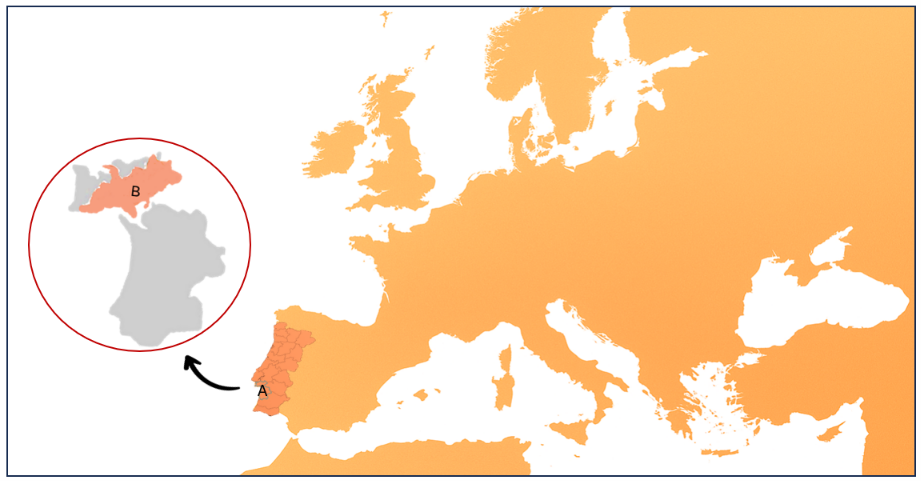
Figure 1. Península de Setúbal wine region (A) and Setúbal PDO (B) – adapted from (Granja-Soares et al., 2025).
Grapes from all vintages were harvested from late August to late September. of the corresponding year, from the Península de Setúbal PDO wine region/vineyards. Wines were produced following the legally authorised vinification technology as schematised in the literature (Granja-Soares et al., 2025). Briefly, for all vintages, grapes were crushed and fermented in stainless steel tanks, and fortification with 96 % (vol.) vinous alcohol was performed four days after their reception. The maceration period, with grape skins and seeds and fortified wine, lasted approximately six months, with pumping over once a day.
The free run and press wine were fined/clarified separately using 1 g/L bentonite, decanted, subsequently blended and transferred into partially filled used French oak barrels of 225 L from Quercus petreae L., previously used for the maturation of red wine during five/seven years. Those were stored for the first fifteen years in a metal-roofed room, exposing the wines to high air thermal amplitudes that can range between 5 and 40 ºC (Garcia, 2001), and after that moved to a place with low thermal amplitudes. The barrels were not topped during the ageing period. Table 1 provides information on the vineyards of grape origin and summarises the general physicochemical composition of the wines at the time of barrel filling.
Vintage | Alcoholic strength by volume at 20 °C (% vol.) | Volatile acidity (g of acetic acid/L) | Titratable acidity (g of tartaric acid/L) | pH | Reducing substances (g/L) | Density at 20 ºC (g/mL) |
1985 | 19.2 | 0.87 | 7.10 | 3.40 | 212.0 | 1.0681 |
1995 | 19.1 | 0.90 | 6.00 | 3.48 | 190.0 | 1.0595 |
1996 | 19.0 | 0.96 | 6.20 | 3.46 | 175.0 | 1.0541 |
1997 | 19.2 | 0.90 | 7.70 | 3.29 | 181.0 | 1.0560 |
1998 | 18.7 | 0.78 | 6.30 | 3.50 | 180.0 | 1.0560 |
1999 | 19.1 | 0.72 | 6.80 | 3.49 | 186.0 | 1.0580 |
2000 | 20.3 | 0.48 | 6.90 | 3.36 | 213.0 | 1.0672 |
2001 | 18.1 | 0.72 | 6.90 | 3.44 | 218.0 | 1.0715 |
2002 | 18.8 | 0.75 | 7.80 | 3.21 | 180.0 | 1.0560 |
2003 | 20.3 | 0.90 | 6.80 | 3.39 | 203.0 | 1.0631 |
2004 | 18.3 | 0.66 | 6.60 | 3.33 | 195.0 | 1.0625 |
2005 | 17.6 | 0.72 | 4.90 | 3.46 | 146.0 | 1.0440 |
2006 | 17.9 | 0.99 | 5.70 | 3.39 | 136.0 | 1.0400 |
2007 | 18.4 | 0.51 | 5.60 | 3.29 | 144.0 | 1.0425 |
2008 | 18.3 | 0.54 | 5.60 | 3.46 | 164.0 | 1.0505 |
2009 | 17.1 | 0.18 | 5.10 | 3.34 | 158.0 | 1.0495 |
2010 | 18.4 | 0.24 | 4.90 | 3.40 | 160.0 | 1.0485 |
2011 | 17.8 | 0.66 | 6.40 | 3.53 | 176.0 | 1.0485 |
2012 | 18.0 | 0.36 | 5.60 | 3.36 | 148.0 | 1.0445 |
2013 | 18.5 | 0.51 | 5.80 | 3.41 | 148.0 | 1.0431 |
2014 | 19.0 | 0.48 | 5.60 | 3.54 | 150.0 | 1.0440 |
2015 | 19.6 | 0.54 | 5.60 | 3.41 | 178.0 | 1.0544 |
2016 | 20.2 | 0.36 | 6.40 | 3.37 | 209.0 | 1.0656 |
2017 | 17.2 | 0.33 | 5.00 | 3.51 | 158.0 | 1.0494 |
2018 | 17.5 | 0.30 | 4.00 | 3.72 | 152.0 | 1.0467 |
2019 | 18.1 | 0.26 | 5.60 | 3.60 | 156.0 | 1.0475 |
2020 | 17.1 | 0.24 | 6.00 | 3.55 | 166.0 | 1.0525 |
In May 2023, samples representative of each vintage included in this study were collected. Each sample consisted of a blend of wines obtained from the surface of seven randomly selected barrels, without stirring. The wines were stored at 20 ºC and protected from light before analysis.
1.1. Analytical characterisation
A. General physicochemical analysis
Physicochemical analysis were performed according to OIV methods (OIV, 2025), specifically alcoholic strength by volume (determined by distillation followed by hydrometry: OIV-MA-AS312-01B, Type IV) - Distilator VAP 300 Gerhardt (Königswinter, Germany); density (by hydrometry: OIV-MA-AS2-01, Type IV), sugar free extract and total dry matter (by calculation: OIV-MA-AS2-03B Type IV), glucose plus fructose (enzymatic method: OIV-MA-AS311-02, Type II) - Analyzer Y15 BioSystems, S.A. (Barcelona, Spain), free and total sulphur dioxide (titration with iodine: OIV-MA-AS323-04A1, Type IV; OIV-MA-AS323-04A2, Type II) - Sulfilyser, Dujardin-Salleron (Arcueil, France);, pH (potentiometry: OIV-MA-AS313-15, Type I) - Potentiometer Orion Star A211 (Thermo Fisher Scientific, Waltham, MA, USA); titratable acidity (titration with sodium hydroxide to pH 7: OIV-MA-AS313-01, Type I), volatile acidity (steam distillation followed by acid-base titrimetry and correction for the acidity of sulphur dioxide: OIV-MA-AS313-02, Type I) and fixed acidity (by calculation OIV-MA-AS313-03, Type I). All the analyses were performed using two analytical replicates.
B. Turbidity
Turbidity, expressed in nephelometric turbidity units (NTU), was determined by nephelometry using a turbidimeter (Hach 2100N IS Turbidimeter, Loveland, CO, USA), according to method OIV-MA-AS2-08, type IV (OIV, 2025). The turbidimeter was calibrated prior to measurements using formazin solutions of known concentration. Each sample was measured in triplicate.
1.2. Chromatic characteristics
A. Absorbance at 420 nm
The colour of the wines was assessed by spectrophotometric determination at 420 nm (using a 1 mm path length quartz cuvette) according to Singleton and Kramling (1976), with a Cary 100 UV-Vis spectrometer (Agilent Technologies, Santa Clara, CA, USA). Results were expressed in reference to a 1 cm path length cuvette.
B. CIELab
The colour characteristics of a wine are defined by the CIELab parameters luminosity (L*), red/green component (a*), blue/yellow component (b*) and their derived magnitudes chroma (C*) and hue (H*). The evaluation of these parameters was carried out in triplicate with a Cary 100 UV-Vis spectrometer (Agilent Technologies, Santa Clara, CA, USA) according to the method OIV-MA-AS2-11, type I, following recommendations of the Commission Internationale de L'Eclairage, with spectrophotometric measurements every 5 nm of transmittance in the 380 to 780 nm spectrum, using a 1 mm path length cuvette. Total colorimetric differences were calculated as ΔE*= [(Δ L*)2 + (Δ a*)2 + (Δ b*)2] 1/2 (OIV, 2025).
1.3. Phenolic composition
A. Total phenols
Total phenols content was determined according to the “Prussian Blue Method”, established by Price and Butler (1977) and adapted by Milheiro et al. (2023). This method minimises the interference of 5-hydroxymethylfurfural and does not seem to be affected by high levels of reducing sugars present in fortified wines, avoiding the overestimation of total phenols (Milheiro et al., 2023). Briefly, 50 μL of wine was placed in a test tube with a lid, followed by the addition of 5 mL of FeCl3 • 6 H2O (0.1 M) in HCl (0.1 M) and immediately afterwards 5 mL of K3Fe (CN)6 (0.008 M). This mixture was vortexed for 10 seconds, and the absorbance at 720 nm was measured in a 1 cm cell exactly 10 minutes later, using distilled water as a blank (Cosme, 2025; personal communication). Calculations were performed using the calibration curve (y = 0.0025x + 0.146; R² = 0.9989) obtained with gallic acid under the same conditions. Analyses were performed in triplicate, and results were expressed in mg of GAE/L.
B. Tanning capacity
The tanning capacity describes the potential astringency of the wine. This parameter was evaluated in triplicate using an analytical procedure adapted from the method proposed by De Freitas and Mateus (2001). The principle of the method is that tannin, true to the origin of its name, can denature proteins. The protein-polyphenol interaction can be analysed by nephelometry due to the ability of polyphenols to bind proteins, in this case bovine serum albumin (BSA). Briefly, clarified wine samples obtained after centrifugation were diluted 1:50 with a model hydroalcoholic solution (consisting of 12 % (vol.) ethanol and 5 g of tartaric acid/L, with the pH adjusted to 3.20). Then, 940 µL of BSA solution (0.8 g/L) was added to 25 mL of the diluted sample. After homogenization, samples were incubated in the dark for 45 min. Tanning capacity was expressed as the difference in turbidity between the BSA-containing solution after incubation and the corresponding control without BSA. Results are given by the difference between the turbidity values before and after BSA addition.
C. Monomeric flavanols and proanthocyanidins according to the degree of polymerisation
The separation and analysis of the wine's monomeric flavanols, oligomeric and polymeric proanthocyanidins were carried out according to the method developed by Sun et al. (1998a) and Sun et al. (1998b). This method consists of separating the monomeric flavanols and proanthocyanidins into three fractions (monomeric, oligomeric and polymeric) through successive elution, using C18 Sep Pak cartridges (Waters, Milford, MA, USA), and their respective assay, based on the reaction with vanillin in an acidic medium, by spectrophotometry at 500 nm. Briefly, after vacuum evaporation of the sample to dryness, the fractions were obtained through successive elutions and separation using Sep-Pak cartridges. Each fraction was subsequently evaporated to dryness and redissolved in methanol. The resulting extract was then reacted with a sulphuric acid/methanol solution and vanillin, and the absorbance was measured at 500 nm.
1.4. Statistical analysis
For each analytical parameter, the data from the corresponding analytical replicates were subjected to one-way analysis of variance (ANOVA), with vintage year considered as a fixed factor. Cochran's test was used to verify the homogeneity of variances. When this assumption was verified and ANOVA revealed significant differences (p < 0.05), multiple comparisons were performed using Fisher's Least Significant Difference (LSD) test, and the same level of significance was adopted. The results were assigned different letters based on significant differences, i.e., groups sharing at least one letter were considered statistically similar, while groups with different letters were interpreted as significantly different. In cases where the homogeneity of variances was not verified, the non-parametric Kruskal-Wallis test was conducted.
A multidimensional analysis of results was also performed, considering only those parameters for which a significant effect of the year of production was observed. More specifically, the data were subjected to principal component analysis (PCA), given its specific suitability for providing information from large data sets by reducing the original matrix and maintaining the total variability of the source variables, which provides an overview of the position of the samples. All statistical treatment was carried out using the Statistica software (version 14.2.018, Cloud Software Group, Inc 2023) Data Science Workbench, version 14.
Results and discussion
1. General physicochemical characteristics
A significant effect of vintage year on general physicochemical parameters of the wines was verified (Table 2), with the exception of the 2007 vintage due to practical constraints. The vintage year denotes the growing season corresponding to the grape harvest (IVV, 2025), which is climate-dependent (Fraga et al., 2023). The wines of the oldest harvests presented, in general, higher values of density, alcoholic strength by volume and glucose plus fructose content, thus having higher values of total dry extract and sugar-free extract, as well as higher values of volatile and fixed acidity, and consequently, titratable acidity. Conversely and congruently, these denote lower values of pH. It should be emphasised that this trend was already observed in the wines prior to ageing. However, the 2011 vintage combined the highest volatile acidity (1.57 g acetic acid/L) with one of the highest pH values (3.57). According to the Caderno de Especificações (IVV, 2026) wines must have between 16 and 22 % (vol.) of alcoholic strength by volume; volatile acidity ranging up to 1.5 mg or up to 1.8 mg of acetic acid/L, if the wine has until or more 10 years, respectively – since by chemical oxidation ethanol is successively transformed into ethanal and acetic acid (Ribéreau-Gayon et al., 2006) and reducing sugars between 280 and 340 g/L if the wine has until or more than 20 years. Franco and Singleton (1984) found similar results in their study, following the tendency for higher volatile acidity and sugars in the older vintages. Nevertheless, this should be regarded as a tendency rather than a rule, likely resulting from one or more phenomena, such as concentration by evaporation, extraction from the wooden barrel, or initial differences among wines from different vintages, as authors pointed out.
In a study conducted with Madeira wines (other Portuguese Generoso wine), it was observed that the levels of acetic acid and ethyl acetate increased during wood ageing and were strongly influenced by the degree of sweetness, with sweeter wines exhibiting higher concentrations of both compounds (Miranda et al., 2017). With respect to sulphur dioxide, for which the legal limit is 200 mg/L (IVV, 2026), higher values of total sulphur dioxide were observed in some of the oldest vintages; however, all values remained well below the legal limit. According to Franco and Singleton (1984), sulphur dioxide addition to grapes occurs prior to crushing and is dependent on sanitary conditions, with amounts reaching up to 30 mg/L. Moreover, turbidity was evaluated, and wines from older vintages generally exhibited turbidity values equal to or less than 2 NTU, with the vintages of 1997 and 1998 showing values under 1 NTU and can therefore be considered clear (Ribéreau-Gayon et al., 2006). An exception is the wine of 2017, with 97.5 NTU. White wines naturally contain grape proteins, which can cause cloudiness and deposits if they flocculate. After alcoholic fermentation, the wine is not clear, showing some cloudiness due to yeast lees, proteins, pectins and other polysaccharides, phenolic compounds and salts (Ribéreau-Gayon et al., 2006; Marchal & Waters, 2010). In a study conducted by Mesquita et al. (2001), involving single-varietal wines from the Moscatel grape cultivar and other Portuguese single-varietal wines, higher protein concentrations and greater susceptibility to the development of protein cloudiness were observed in wines from the Moscatel grape cultivar. Silva (2011) investigated the turbidity that may occur after bottle opening and concluded that it results from tannin polymerisation upon exposure to oxygen. As barrels are small-volume containers, they facilitate the natural sedimentation of unstable colloidal matter in wine, as well as high molecular weight constituents (from condensation and polymerisation phenomena, involving phenolic compounds, proteins and polysaccharides), contributing to the stability and clarity of the wine, resulting in lower turbidity (Ribéreau-Gayon et al., 2006). Thus, the lower turbidity values observed in wines with longer ageing times can possibly be explained by the phenomena that occur in the barrel during wine ageing. Nevertheless, the possibility that accidental stirring during barrel sampling caused sediment resuspension cannot be excluded.
Year | Free SO2 (mg/L) | Total SO2 (mg/L) | ρ at 20 ºC (g/mL) | Volatile acidity (g of acetic acid/L) | Titratable acidity (g of tartaric acid/L) | Fixed acidity (g/L) | pH | Glucose plus frutose (g/L) | Alcoholic strength by volume at 20 ºC (% vol.) | Total dry extract (g/L) | Sugar free extract (g/L) | Turbidity (NTU) |
1985 | 10 ± 0 l | 34 ± 2 h,i | 1.1120 ± 0.000 s | 1.34 ± 0.02 | 12.85 ± 0.07 m | 7.95 ± 0.03 o | 3.33 ± 0.00 c,d | 311.7 ± 2.6 q | 20.7 ± 0.3 f,g | 365.4 ± 0.8 x | 53.7 ± 3.4 l | 2.2 ± 0.1 |
1995 | 7 ± 0 h,i | 38 ± 0 j | 1.0950 ± 0.000 p | 1.34 ± 0.02 | 11.30 ± 0.00 i | 6.79 ± 0.00 k | 3.36 ± 0.04 e | 275.6 ± 2.8 n | 20.6 ± 0.1 f,g | 319.8 ± 0.5 r | 44.2 ± 2.3 h,i,j | 2.0 ± 0.0 |
1996 | 8 ± 1 i,j | 45 ± 4 k | 1.0840 ± 0.000 n | 1.34 ± 0.00 | 11.80 ± 0.14 j,k | 7.18 ± 0.01 l | 3.36 ± 0.00 e | 248.9 ± 2.1 l | 21.4 ± 0.4 h,i | 293.0 ± 1.0 p | 44.1 ± 3.1 h,i,j | 1.8 ± 0.0 |
1997 | 7 ± 0 h,i | 48 ± 0 k | 1.0880 ± 0.000 o | 1.43 ± 0.00 | 13.20 ± 0.00 n | 8.11 ± 0.00 o | 3.23 ± 0.00 b | 263.0 ± 1.8 m | 21.8 ± 0.4 i | 304.6 ± 1.1 q | 41.6 ± 0.7 h,i | 0.87 ± 0.02 |
1998 | 7 ± 0 h,i | 62 ± 0 l | 1.0950 ± 0.000 p | 1.22 ± 0.00 | 11.55 ± 0.21 i,j | 7.14 ± 0.02 l | 3.43 ± 0.00 h | 272.8 ± 1.3 n | 22.3 ± 0.1 j | 325.0 ± 0.0 s | 52.3 ± 1.3 k,l | 0.95 ± 0.03 |
1999 | 6 ± 1 g,h,i | 86 ± 2 m | 1.0990 ± 0.000 q | 1.30 ± 0.00 | 12.45 ± 0.21 l | 7.71 ± 0.02 n | 3.40 ± 0.01 g | 290.2 ± 4.6 o | 22.6 ± 0.1 j | 336.2 ± 0.4 t | 45.9 ± 4.2 i,j | 1.3 ± 0.0 |
2000 | 9 ± 0 k,l | 88 ± 0 m | 1.1120 ± 0.000 s | 1.54 ± 0.00 | 14.65 ± 0.21 o | 9.06 ± 0.02 p | 3.38 ± 0.00 f | 315.9 ± 0.4 q | 20.2 ± 0.3 d,e | 363.9 ± 1.0 v | 48.0 ± 1.4 j,k | 1.3 ± 0.0 |
2001 | 8 ± 1 j,k | 85 ± 0 m | 1.1050 ± 0.000 r | 1.36 ± 0.00 | 12.20 ± 0.14 l | 7.45 ± 0.01 m | 3.47 ± 0.00 j,k | 294.9 ± 0.7 p | 21.6 ± 0.2 h,i | 349.1 ± 0.7 u | 54.2 ± 1.4 l | 2.5 ± 0.0 |
2002 | 5 ± 0 d,e,f | 21 ± 2 d,e | 1.0740 ± 0.000 k | 1.19 ± 0.06 | 11.90 ± 0.14 k | 7.50 ± 0.00 m | 3.32 ± 0.01 c | 229.7± 1.4 i | 21.2 ± 0.1 h | 266.1 ± 0.3 l | 36.4 ± 1.2 f,g | 1.4 ± 0.1 |
2003 | 6 ± 1 e,f,g | 29 ± 2 f,g | 1.0720 ± 0.000 i | 1.16 ± 0.00 | 10.45 ± 0.21 h | 6.39 ± 0.02 j | 3.45 ± 0.00 i | 217.6 ± 1.1 e,f | 20.4 ± 0.1 e,f,g | 258.6 ± 0.2 h,i | 40.9 ± 1.3 g,h | 7.1 ± 0.2 |
2004 | 6 ± 1 e,f,g | 24 ± 2 e | 1.0800 ± 0.000 m | 1.16 ± 0.02 | 9.95 ± 0.07 g | 6.00 ± 0.01 h,i | 3.34 ± 0.01 d | 236.9 ± 3.0 j | 19.9 ± 0.1 d | 278.2 ± 0.6 o | 41.3 ± 2.4 h,i | 2.6 ± 0.1 |
2005 | 4 ± 1 c,d,e | 15 ± 0 a | 1.0780 ± 0.000 l | 1.16 ± 0.02 | 9.20 ± 0.14 d,e,f | 5.47 ± 0.01 d,e | 3.48 ± 0.00 k,l | 211.4 ± 0.3 d | 19.4 ± 0.0 c | 271.2 ± 0.0 m | 59.8 ± 0.3 m | 5.5 ± 0.1 |
2006 | 2 ± 1 a | 24 ± 2 e | 1.0560 ± 0.000 c | 1.33 ± 0.00 | 11.65 ± 0.07 j,k | 7.07 ± 0.01 l | 3.18 ± 0.00 a | 181.5 ± 2.2 a,b | 20.6 ± 0.1 e,f,g | 216.6 ± 0.1 e | 35.1 ± 2.3 f | 2.3 ± 0.0 |
2008 | 6 ± 1 e,f,g | 24 ± 2 e | 1.0780 ± 0.000 l | 1.09 ± 0.04 | 10.00 ± 0.00 g | 6.17 ± 0.01 i | 3.46 ± 0.00 i,j | 244.2 ± 1.9 k | 20.4 ± 0.2 e,f | 274.0 ± 0.6 n | 29.8 ± 2.5 d,e | 5.8 ± 0.2 |
2009 | 6 ± 1 e,f,g | 21 ± 2 d,e | 1.0730 ± 0.000 j | 1.07 ± 0.02 | 9.35 ± 0.21 e,f | 5.66 ± 0.02 e,f | 3.39 ± 0.00 f,g | 224.0 ± 2.5 g,h | 19.2 ± 0.2 c | 257.6 ± 0.5 h | 33.6 ± 3.0 e,f | 3.8 ± 0.1 |
2010 | 4 ± 0 b,c,d | 15 ± 0 a | 1.0740 ± 0.000 k | 1.04 ± 0.02 | 9.40 ± 0.14 f | 5.78 ± 0.01 f,g | 3.40 ± 0.00 g | 237.8 ± 1.3 j | 20.8 ± 0.2 g | 264.5 ± 0.6 k | 26.7 ± 1.9 c,d | 2.4 ± 0.1 |
2011 | 4 ± 1 a,b,c | 35 ± 0 i,j | 1.0710 ± 0.000 h | 1.57 ± 0.00 | 11.65 ± 0.21 j,k | 6.78 ± 0.02 k | 3.57 ± 0.00 m | 213.8 ± 0.5 d,e | 21.5 ± 0.1 h,i | 259.0 ± 0.4 i | 45.1 ± 0.8 h,i,j | 1.5 ± 0.0 |
2012 | 3 ± 0 a,b | 20 ± 0 c,d | 1.0700 ± 0.000 g | 1.03 ± 0.00 | 9.25 ± 0.07 d,e,f | 5.65 ± 0.01 e,f | 3.34 ± 0.00 d | 228.3 ± 2.2 h,i | 22.2 ± 0.1 j | 258.4 ± 0.5 h,i | 30.0 ± 2.7 d,e | 1.2 ± 0.0 |
2013 | 4 ± 1 c,d,e | 31 ± 2 g,h | 1.0720 ± 0.000 i | 0.84 ± 0.00 | 9.95 ± 0.07 g | 6.40 ± 0.01 j | 3.32 ± 0.01 c,d | 224.8 ± 3.7 g,h | 21.2 ± 0.1 h | 260.8 ± 0.2 j | 36.0 ± 4.0 f | 6.7 ± 0.0 |
2014 | 4 ± 0 b,c,d | 20 ± 0 c,d | 1.0540 ± 0.000 b | 0.85 ± 0.00 | 9.05 ± 0.07 d | 5.72 ± 0.01 f,g | 3.49 ± 0.00 l | 182.4 ± 2.3 a,b | 21.5 ± 0.0 h,i | 214.1 ± 0.0 d | 31.7 ± 2.3 e,f | 1.8 ± 0.1 |
2015 | 6 ± 0 f,g,h | 19 ± 2 b,c,d | 1.0630 ± 0.000 f | 0.77 ± 0.02 | 9.10 ± 0.14 d,e | 5.89 ± 0.02 g,h | 3.43 ± 0.00 h | 221.9 ±1.9 f,g | 20.6 ± 0.1 f,g | 235.2 ± 0.4 g | 13.3 ± 2.3 a | 1.9 ± 0.1 |
2016 | 4 ± 1 c,d,e | 18 ± 0 a,b,c | 1.0600 ± 0.000 d | 0.52 ± 0.04 | 8.10 ± 0.00 c | 5.38 ± 0.01 d | 3.38 ± 0.00 f | 203.3 ± 4.7 c | 21.4 ± 0.1 h,i | 226.8 ± 0.5 f | 23.4 ± 5.2 b,c | 2.2 ± 0.0 |
2017 | 6 ± 1 e,f,g | 21 ± 2 d,e | 1.0610 ± 0.000 e | 0.64 ± 0.02 | 7.85 ± 0.07 c | 5.11 ± 0.01 c | 3.45 ± 0.00 i | 205.9 ± 0.6 c | 19.5 ± 0.0 c | 226.8 ± 0.0 f | 21.0 ± 0.6 b | 97.5 ± 0.4 |
2018 | 4 ± 1 c,d,e | 28 ± 0 f | 1.0540 ± 0.000 b | 0.52 ± 0.00 | 6.10 ± 0.14 a | 3.93 ± 0.03 a | 3.70 ± 0.01 n | 180.8 ± 0.7 a | 18.0 ± 0.1 a | 204.2 ± 0.2 b | 23.4 ± 0.5 b,c | 5.1 ± 0.1 |
2019 | 6 ± 1 e,f,g | 16 ± 2 a,b | 1.0520 ± 0.000 a | 0.55 ± 0.00 | 6.70 ± 0.14 b | 4.34 ± 0.02 b | 3.58 ± 0.00 m | 180.1 ± 0.3 a | 18.9 ± 0.2 b | 201.3 ± 0.7 a | 21.2 ± 0.4 b | 6.5 ± 0.1 |
2020 | 5 ± 0 d,e,f | 16 ± 1 a | 1.0560 ± 0.000 c | 0.52 ± 0.00 | 6.75 ± 0.07 b | 4.41 ± 0.01 b | 3.58 ± 0.01 m | 185.4 ± 0.3 b | 17.9 ± 0.0 a | 209.2 ± 0.0 c | 25.3 ± 0.3 b,c,d | 14.3 ± 0.1 |
Vintage year effect | *** | *** | *** | ** | *** | *** | *** | *** | *** | *** | *** | *** |
For each vintage year and parameter, the results are expressed as mean ± standard deviation of the corresponding analytical replicates. Means followed by the same letter in a column are not significantly different at the 0.01** or 0.001*** level of significance. For volatile acidity and turbidity parameters, statistical analysis was conducted using the Kruskal–Wallis test.
2. Colour – Absorbance at 420 nm and CIELab
The chromatic characterisation of the wines was first assessed by measuring absorbance at 420 nm (Figure 2). This wavelength corresponds to the maximum absorbance of yellow and brown pigments, which are widely used as an indicator of browning in wines (Singleton & Kramling, 1976; Chaves et al., 2007). As expected, the fortified wines in this study subjected to longer oxidative barrel ageing exhibited higher absorbance values (ranging from 1.318 to 7.264 a.u.), with the highest absorbance, and consequently the most intense colour, observed in the oldest sample, from the 1985 vintage (Figure 2). According to Comissão Vitivinícola Regional da Península de Setúbal (CVRPS, 2025), aged and superior Moscatel de Setúbal wines, matured for five years or more, display a golden hue that varies from topaz to amber. The emergence of this colour, evidenced by the increase in absorbance at 420 nm, may be primarily attributed to the duration of barrel ageing. As previously mentioned, during this period, a slow and continuous permeation of oxygen through the wood pores and diffusion in the wine promotes the gradual oxidation of phenolic compounds, leading to the progressive development of brownish tones (Chaves et al., 2007; Bravo, 2008; Del Álamo-Sanza & Nevares, 2018; Pfahl et al., 2021).
The progressive increase in absorbance at 420 nm from younger to older vintages, and the corresponding shift towards brownish hues, may also result from the formation of melanoidins (Tredoux & Silva Ferreira, 2012; Oliveira, 2014; Starowicz & Zieliński, 2019). This hypothesis is supported by the research of Milheiro et al. (2023) in white Port wines, where a positive correlation was observed between 5-hydroxymethylfurfural levels and the presence of small polymeric pigments absorbing at 420 nm, which increased with wine age (10, 20, and 40 years). These results suggest that browning in fortified wines may largely arise from sugar-derived reactions such as Maillard and caramelisation processes, rather than phenolic compound oxidation.
A high correlation between absorbance at 420 nm and glucose plus fructose concentrations (y = 22.348 x + 165.31, R2 = 0.7783) was observed, with wines from the 1985, 2000, and 2001 vintages showing the highest values. Nevertheless, these observations should be interpreted with caution, as the direct effect of glucose and fructose on colour was not specifically investigated within the scope of the present study. Therefore, further investigation would be valuable to clarify the potential contribution of these sugars to colour development.
Furthermore, the colour intensity may be enhanced during the extended maceration period that precedes barrel ageing, which promotes the diffusion of phenolic compounds and may contribute to the yellowish hues characteristic of these white wines (Feliciano et al., 2009). In the present study, two of the highest absorbance values correspond to the highest total phenols content, above 600 mg of GAE/L. Nevertheless, only a low correlation was observed between colour and total phenolic content (y = 46.125 x + 326.72, R² = 0.4072).
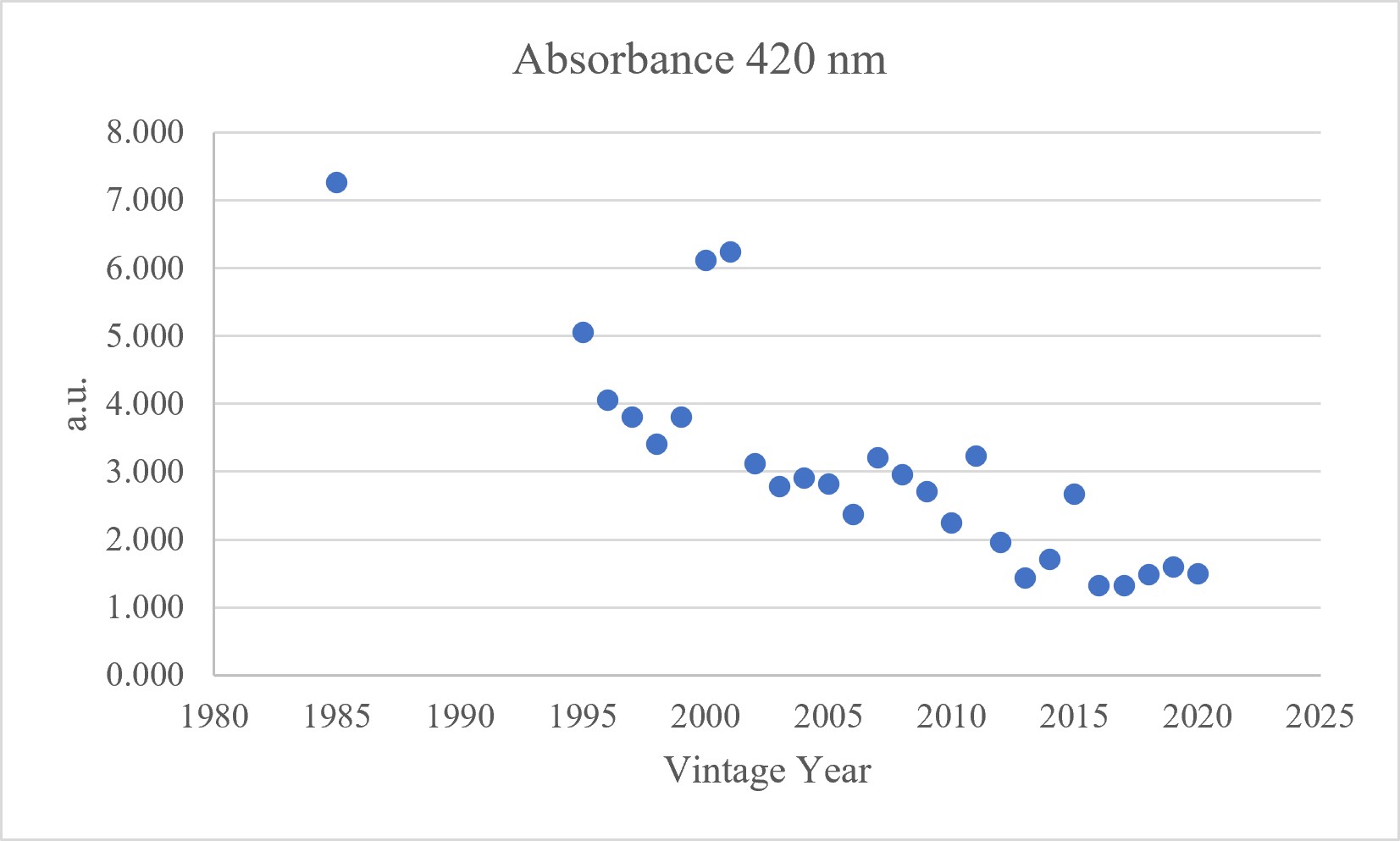
Figure 2. Colour (measured by absorbance at 420 nm) of the 27 vintages of Moscatel de Setúbal fortified wines after ageing.
Studies on Sherry wines reported values between 1.27 and 1.57 a.u. for Oloroso wines aged for 7 years (Fabios et al., 2000) and around 2.2 and 4.4 for sweet Pedro Ximénez wines aged for 1.3–11.5 years, and 1.2 a.u. for non-aged wines (Chaves et al., 2007). In this study, Moscatel de Setúbal aged in barrels for 7 years (2015 harvest) presented a higher absorbance value at 420 nm (2.664 a.u., while the 2016 harvest aged for 6 years presented a lower value (1.32 a.u.), similar to the values recorded for Jerez Oloroso wines subjected to a similar ageing period.
Regarding the Portuguese Generosos, in the study by McCallum et al. (2019) on Carcavelos fortified wines, aged in barrels for 8 years, absorbance values of between 0.939 a.u. and 1.211 a.u. were obtained at 420 nm. In contrast, Moscatel de Setúbal fortified wine aged in barrels for 8 years (2014 harvest) exhibited a higher absorbance at 420 nm (1.712 a.u.). In the study by Milheiro et al. (2023), in white Port wines with an age indication of 10 and 20 years, the absorbance at 420 nm was on average 0.361 a.u. and 0.311 a.u., respectively. In comparison, the absorbance values observed in Moscatel de Setúbal fortified wines aged in barrels for 10 years (2012 harvest) and 20 years (2002 harvest) were 1.963 a.u. and 3.116 a.u., respectively (Table 4). The absorbance values measured in Moscatel de Setúbal fortified wines are higher than those observed for Carcavelos and white Port fortified wines, which can be explained by the possible enrichment in colour due to the long maceration period involved in its winemaking technology, or by the formation of pigments through Maillard reactions and the caramelisation of sugars (Oliveira, 2014; Milheiro et al., 2023; IVV, 2026). The findings of the present study are, however, in line with those from a study on Madeira fortified wines, specifically Malvasia (white cultivar) reported by Pereira et al. (2013), who performed chromatic characterisation by measuring absorbance at 420 nm after subjecting the wines to a warming process (0, 1, 2, and 3 months at 45 °C, and 1 month at 70 °C). The heating process was shown to accelerate the kinetics of reactions typically occurring during long-term ageing; consequently, wines subjected to thermal treatment exhibited chromatic characteristics similar to those of wines aged naturally for several years. The absorbance values at 420 nm after heating at 45 ºC for 2 months are comparable to those obtained for Moscatel de Setúbal fortified wines aged for 2 years in barrels (2020 harvest), suggesting that thermal treatment contributes to the development of similar chromatic features as thermal amplitude suffered by Moscatel de Setúbal subject to ageing with high thermal amplitudes. Moreover, the absorbance recorded for Madeira wine after 1 month at 70 °C was substantially higher than in the other treatments and closely resembled that of Moscatel de Setúbal fortified wines aged for 10 years in barrels (2012 harvest), reinforcing the role of heating/high thermal amplitudes in accelerating browning reactions.
The CIElab method is among the most widely applied approaches for assessing the colour characteristics of wines and monitoring their evolution (Pérez-Magariño & González-Sanjosé, 2003), being an official method (Resolution Oeno 1/2006) of OIV (OIV, 2025). This approach has previously been used to assess colour in Madeira wines (Carvalho et al., 2015), Porto wines (Milheiro et al., 2023) or Sherry wines (Chaves et al., 2007), but to the best of our knowledge, there are no scientific studies regarding Moscatel de Setúbal. The results obtained from the CIELab system for the samples of Moscatel de Setúbal fortified wines are shown in Figure 3. Analysing parameter by parameter, we can observe a decrease in brightness (L*) with the years of ageing. The minimum value (87.7) was observed in the oldest wine (1985), and the maximum value (98.5) was observed in the wine from the 2013 harvest, with a noticeable trend towards darkening as the harvest year becomes older (Figure 3). As for the red/green component (a*), with increased barrel ageing, the red component decreases (in most cases) and gives way to the green component. In fact, most wines from more recent harvests have reddish tones, while wines from older harvests mostly have greenish tonality (Figure 3). The general trend towards a decrease in a* values during wine ageing may be related to the oxidation reactions of tannins, with the formation of new polymeric complexes, which are also present in white wines, but generally in smaller quantities than in red wines (Pereira et al., 2013; Teissedre & Jourdes, 2013; Pereira et al., 2022) or in white wines subject to maceration. This trend has been observed in white fortified Madeira wines (Pereira et al., 2013; Pereira et al., 2022).
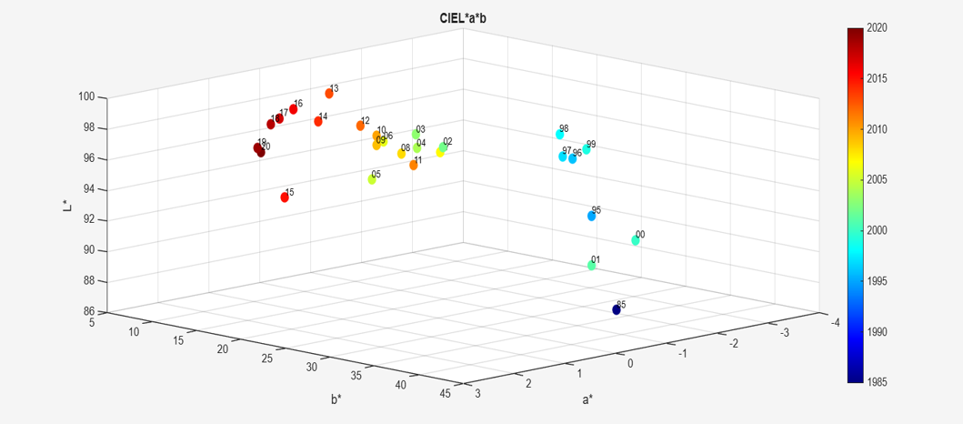
Figure 3. Chromatic characteristics (measured by L*a*b* coordinates) of the 27 vintages of Moscatel de Setúbal fortified wines after ageing. Numbers in the graph (85, 95, 00, 01…20) correspond to the wines from the 1985, 1995, 2000, 2001…2020 vintages—plot created with MATLAB Online.
In the yellow/blue component (b*), all values obtained are higher than zero, meaning that all wines have only a yellow component (Figure 3). The yellow component intensifies with older vintages having a yellow component 30 units higher, as in the case of the 1985 vintage (40.16), when compared to the yellow component of wines from more recent vintages, such as the 2017 vintage (9.44).
This trend was also observed in white fortified Madeira wines in the studies by Pereira et al. (2013) and Pereira et al. (2022) and has been associated with the oxidation of phenolic compounds and the formation of new polymeric complexes. Pereira et al. (2013) found that in fortified Madeira wine, yellow pigments were always predominant, as expected for a white grape cultivar.
The total colorimetric difference (ΔE*) was also calculated, based on the average of L*, a* and b* parameters as follows: ΔE* = [(ΔL*)2 + (Δa*)2 + (Δb*)2]1/2. Generally, the human eye can discriminate between two colours when ΔE ≥ 1. However, when wine is observed through a glass, colour discrimination is reduced, and the visual threshold may increase to differences of up to approximately ΔE* = 5 (Pérez-Magariño & González-SanJosé, 2003). Consistently, in a study with Madeira wine, Pereira et al. (2013) considered colour differences to be higher than 3 units perceptible by humans.
The results (Table 3) revealed that the 1985, 2000 and 2001 vintages exhibited the most distinct colour profiles, showing higher values of b*. It is also possible to observe a separation between older and younger wines, denoted by darker colour cells indicating greater differences. Thus, according to the results obtained in this study, and bearing in mind the colour difference of 3 units, it was easy to discriminate colour with the human eye, for example between 1985, 2000 and 2001 and all the other years, but it was not possible to discriminate between 2000 and 2001 with each other or between 2018, 2019 and 2020 vintages. Thus, the results indicate that the chromatic variations observed among the samples are sensorially relevant. ΔE values exceeding the threshold of 3 units reflect significant colour evolution. These results suggest that both vintage and ageing conditions influence the chromatic characteristics of the wines, leading to perceptible differences in colour that may affect visual quality assessment.
Year | 1985 | 1995 | 1996 | 1997 | 1998 | 1999 | 2000 | 2001 | 2002 | 2003 | 2004 | 2005 | 2006 | 2007 | 2008 | 2009 | 2010 | 2011 | 2012 | 2013 | 2014 | 2015 | 2016 | 2017 | 2018 | 2019 | 2020 |
1985 | 0.0 | 11.6 | 16.8 | 18.2 | 20.5 | 17.7 | 5.7 | 5.4 | 21.6 | 23.7 | 22.4 | 22.3 | 25.5 | 21.8 | 22.5 | 23.4 | 26.6 | 22.4 | 26.7 | 32.5 | 29.8 | 22.0 | 32.2 | 32.3 | 30.9 | 28.7 | 29.3 |
1995 | 11.6 | 0.0 | 5.3 | 6.6 | 8.9 | 6.1 | 6.4 | 6.2 | 10.2 | 12.3 | 11.0 | 11.1 | 14.1 | 10.4 | 11.1 | 12.1 | 15.2 | 11.0 | 15.3 | 21.0 | 18.4 | 11.1 | 20.8 | 20.9 | 19.6 | 17.5 | 18.1 |
1996 | 16.8 | 5.3 | 0.0 | 1.6 | 3.8 | 1.0 | 11.3 | 11.3 | 5.3 | 7.4 | 6.1 | 6.8 | 9.3 | 5.6 | 6.4 | 7.3 | 10.4 | 6.5 | 10.4 | 16.1 | 13.6 | 7.3 | 15.9 | 16.2 | 14.8 | 12.9 | 13.5 |
1997 | 18.2 | 6.6 | 1.6 | 0.0 | 2.3 | 0.9 | 12.8 | 12.8 | 3.9 | 6.0 | 4.8 | 5.4 | 7.8 | 4.1 | 5.0 | 6.0 | 8.9 | 5.0 | 9.0 | 14.6 | 12.1 | 6.2 | 14.4 | 14.6 | 13.3 | 11.5 | 12.0 |
1998 | 20.5 | 8.9 | 3.8 | 2.3 | 0.0 | 2.9 | 15.1 | 15.1 | 2.4 | 4.0 | 3.2 | 4.2 | 5.8 | 2.6 | 3.5 | 4.3 | 6.9 | 3.5 | 7.0 | 12.4 | 10.0 | 5.5 | 12.3 | 12.5 | 11.3 | 9.6 | 10.1 |
1999 | 17.7 | 6.1 | 1.0 | 0.9 | 2.9 | 0.0 | 12.2 | 12.3 | 4.6 | 6.7 | 5.5 | 6.2 | 8.6 | 4.9 | 5.7 | 6.7 | 9.6 | 5.8 | 9.7 | 15.3 | 12.8 | 6.9 | 15.1 | 15.4 | 14.0 | 12.2 | 12.8 |
2000 | 5.7 | 6.4 | 11.3 | 12.8 | 15.1 | 12.2 | 0.0 | 1.5 | 16.3 | 18.4 | 17.1 | 17.3 | 20.3 | 16.5 | 17.2 | 18.1 | 21.4 | 17.3 | 21.5 | 27.2 | 24.6 | 17.1 | 27.0 | 27.1 | 25.7 | 23.7 | 24.3 |
2001 | 5.4 | 6.2 | 11.3 | 12.8 | 15.1 | 12.3 | 1.5 | 0.0 | 16.2 | 18.4 | 17.0 | 17.0 | 20.1 | 16.4 | 17.1 | 18.0 | 21.3 | 17.1 | 21.3 | 27.1 | 24.4 | 16.7 | 26.8 | 26.9 | 25.5 | 23.4 | 24.0 |
2002 | 21.6 | 10.2 | 5.3 | 3.9 | 2.4 | 4.6 | 16.3 | 16.2 | 0.0 | 2.2 | 0.9 | 2.3 | 4.1 | 0.6 | 1.2 | 2.0 | 5.3 | 1.8 | 5.2 | 11.0 | 8.4 | 3.4 | 10.8 | 11.0 | 9.6 | 7.7 | 8.3 |
2003 | 23.7 | 12.3 | 7.4 | 6.0 | 4.0 | 6.7 | 18.4 | 18.4 | 2.2 | 0.0 | 1.4 | 2.5 | 2.1 | 2.0 | 1.4 | 0.9 | 3.2 | 1.9 | 3.1 | 8.8 | 6.2 | 3.7 | 8.6 | 8.9 | 7.4 | 5.7 | 6.3 |
2004 | 22.4 | 11.0 | 6.1 | 4.8 | 3.2 | 5.5 | 17.1 | 17.0 | 0.9 | 1.4 | 0.0 | 1.9 | 3.3 | 0.7 | 0.4 | 1.2 | 4.5 | 1.3 | 4.4 | 10.2 | 7.5 | 3.0 | 9.9 | 10.2 | 8.7 | 6.8 | 7.4 |
2005 | 22.3 | 11.1 | 6.8 | 5.4 | 4.2 | 6.2 | 17.3 | 17.0 | 2.3 | 2.5 | 1.9 | 0.0 | 3.4 | 1.9 | 1.5 | 2.1 | 4.5 | 0.9 | 4.7 | 10.2 | 7.5 | 1.9 | 9.9 | 10.0 | 8.6 | 6.5 | 7.0 |
2006 | 25.5 | 14.1 | 9.3 | 7.8 | 5.8 | 8.6 | 20.3 | 20.1 | 4.1 | 2.1 | 3.3 | 3.4 | 0.0 | 3.8 | 3.2 | 2.5 | 1.2 | 3.1 | 1.4 | 7.0 | 4.3 | 4.5 | 6.7 | 6.9 | 5.5 | 3.7 | 4.3 |
2007 | 21.8 | 10.4 | 5.6 | 4.1 | 2.6 | 4.9 | 16.5 | 16.4 | 0.6 | 2.0 | 0.7 | 1.9 | 3.8 | 0.0 | 0.9 | 1.9 | 4.9 | 1.2 | 5.0 | 10.7 | 8.1 | 3.2 | 10.5 | 10.7 | 9.3 | 7.4 | 7.9 |
2008 | 22.5 | 11.1 | 6.4 | 5.0 | 3.5 | 5.7 | 17.2 | 17.1 | 1.2 | 1.4 | 0.4 | 1.5 | 3.2 | 0.9 | 0.0 | 1.0 | 4.3 | 1.1 | 4.3 | 10.0 | 7.4 | 2.7 | 9.8 | 10.0 | 8.5 | 6.6 | 7.2 |
2009 | 23.4 | 12.1 | 7.3 | 6.0 | 4.3 | 6.7 | 18.1 | 18.0 | 2.0 | 0.9 | 1.2 | 2.1 | 2.5 | 1.9 | 1.0 | 0.0 | 3.6 | 1.9 | 3.4 | 9.2 | 6.6 | 3.0 | 9.0 | 9.2 | 7.7 | 5.8 | 6.5 |
2010 | 26.6 | 15.2 | 10.4 | 8.9 | 6.9 | 9.6 | 21.4 | 21.3 | 5.3 | 3.2 | 4.5 | 4.5 | 1.2 | 4.9 | 4.3 | 3.6 | 0.0 | 4.2 | 1.0 | 5.8 | 3.2 | 5.5 | 5.6 | 5.7 | 4.4 | 2.9 | 3.3 |
2011 | 22.4 | 11.0 | 6.5 | 5.0 | 3.5 | 5.8 | 17.3 | 17.1 | 1.8 | 1.9 | 1.3 | 0.9 | 3.1 | 1.2 | 1.1 | 1.9 | 4.2 | 0.0 | 4.4 | 10.0 | 7.3 | 2.7 | 9.7 | 9.9 | 8.5 | 6.5 | 7.1 |
2012 | 26.7 | 15.3 | 10.4 | 9.0 | 7.0 | 9.7 | 21.5 | 21.3 | 5.2 | 3.1 | 4.4 | 4.7 | 1.4 | 5.0 | 4.3 | 3.4 | 1.0 | 4.4 | 0.0 | 5.8 | 3.2 | 5.5 | 5.6 | 5.8 | 4.4 | 2.8 | 3.5 |
2013 | 32.5 | 21.0 | 16.1 | 14.6 | 12.4 | 15.3 | 27.2 | 27.1 | 11.0 | 8.8 | 10.2 | 10.2 | 7.0 | 10.7 | 10.0 | 9.2 | 5.8 | 10.0 | 5.8 | 0.0 | 2.8 | 11.0 | 0.9 | 1.4 | 2.2 | 4.4 | 4.0 |
2014 | 29.8 | 18.4 | 13.6 | 12.1 | 10.0 | 12.8 | 24.6 | 24.4 | 8.4 | 6.2 | 7.5 | 7.5 | 4.3 | 8.1 | 7.4 | 6.6 | 3.2 | 7.3 | 3.2 | 2.8 | 0.0 | 8.2 | 2.4 | 2.6 | 1.3 | 1.8 | 1.7 |
2015 | 22.0 | 11.1 | 7.3 | 6.2 | 5.5 | 6.9 | 17.1 | 16.7 | 3.4 | 3.7 | 3.0 | 1.9 | 4.5 | 3.2 | 2.7 | 3.0 | 5.5 | 2.7 | 5.5 | 11.0 | 8.2 | 0.0 | 10.5 | 10.6 | 9.1 | 6.9 | 7.5 |
2016 | 32.2 | 20.8 | 15.9 | 14.4 | 12.3 | 15.1 | 27.0 | 26.8 | 10.8 | 8.6 | 9.9 | 9.9 | 6.7 | 10.5 | 9.8 | 9.0 | 5.6 | 9.7 | 5.6 | 0.9 | 2.4 | 10.5 | 0.0 | 0.6 | 1.5 | 3.7 | 3.3 |
2017 | 32.3 | 20.9 | 16.2 | 14.6 | 12.5 | 15.4 | 27.1 | 26.9 | 11.0 | 8.9 | 10.2 | 10.0 | 6.9 | 10.7 | 10.0 | 9.2 | 5.7 | 9.9 | 5.8 | 1.4 | 2.6 | 10.6 | 0.6 | 0.0 | 1.6 | 3.8 | 3.2 |
2018 | 30.9 | 19.6 | 14.8 | 13.3 | 11.3 | 14.0 | 25.7 | 25.5 | 9.6 | 7.4 | 8.7 | 8.6 | 5.5 | 9.3 | 8.5 | 7.7 | 4.4 | 8.5 | 4.4 | 2.2 | 1.3 | 9.1 | 1.5 | 1.6 | 0.0 | 2.3 | 1.9 |
2019 | 28.7 | 17.5 | 12.9 | 11.5 | 9.6 | 12.2 | 23.7 | 23.4 | 7.7 | 5.7 | 6.8 | 6.5 | 3.7 | 7.4 | 6.6 | 5.8 | 2.9 | 6.5 | 2.8 | 4.4 | 1.8 | 6.9 | 3.7 | 3.8 | 2.3 | 0.0 | 0.9 |
2020 | 29.3 | 18.1 | 13.5 | 12.0 | 10.1 | 12.8 | 24.3 | 24.0 | 8.3 | 6.3 | 7.4 | 7.0 | 4.3 | 7.9 | 7.2 | 6.5 | 3.3 | 7.1 | 3.5 | 4.0 | 1.7 | 7.5 | 3.3 | 3.2 | 1.9 | 0.9 | 0.0 |
Darker colours are associated with higher total colorimetric differences between vintages. Cells crossed out in a lighter shade of yellow (value < 3 units) indicate that there are no perceptible colour differences between the wines. Conversely, the higher the colour intensity at the intersection between two vintages (above 3 units), the more perceptible their difference to the human eye.
CIELab |
| Monomeric flavanols and proanthocyanidins | |||||||||
Year | Abs 420 nm (a.u.) | L* | a* | b* | C* | H* (°) | Total phenols (mg of gallic acid/ L) | Tanning power (NTU) | Monomeric flavanols (F1) (mg/L) | Oligomeric proanthocyanidins (F2) (mg/L) | Polimeric proanthocyanidins (F3) (mg/L) |
1985 | 7.264 ± 0.024 | 87.7 ± 0.3 | -0.86 ± 0.15 | 40.16 ± 0.23 | 40.17 ± 0.23 | -1.55 ± 0.00 | 604.60 ± 11.48 q | 23.02 ± 0.68 | 38.638 ± 7.066 | 8.37 ± 4.46 | 20.45 ± 8.74 |
1995 | 5.051 ± 0.003 | 91.7 ± 1.0 | -2.26 ± 0.04 | 29.37 ± 0.15 | 29.46 ± 0.15 | -1.49 ± 0.00 | 463.86 ± 12.47 m | 3.91 ± 0.03 | 181.564 ± 65.086 | 81.45 ± 33.68 | 89.55 ± 33.97 |
1996 | 4.054 ± 0.001 | 94.7 ± 0.3 | -2.64 ± 0.02 | 25.06 ± 0.08 | 25.20 ± 0.08 | -1.47 ± 0.00 | 440.16 ± 2.15 k,l | 16.06 ± 0.61 | 179.547 ± 61.830 | 146.74 ± 84.54 | 88.65 ± 26.45 |
1997 | 3.800 ± 0.002 | 94.6 ± 0.4 | -2.72 ± 0.07 | 23.46 ± 0.14 | 23.61 ± 0.13 | -1.46 ± 0.00 | 434.56 ± 11.48 j,k,l | 3.94 ± 0.13 | 183.457 ± 110.896 | 400.00 ± 501.47 | 395.68 ± 535.18 |
1998 | 3.410 ± 0.001 | 95.6 ± 0.1 | -3.03 ± 0.04 | 21.36 ± 0.14 | 21.57 ± 0.13 | -1.43 ± 0.00 | 367.68 ± 3.51 d | 10.09 ± 0.38 | 247.778 ± 80.700 | 92.03 ± 29.19 | 93.15 ± 32.44 |
1999 | 3.810 ± 0.006 | 94.9 ± 0.2 | -3.07 ± 0.05 | 24.18 ± 0.18 | 24.38 ± 0.17 | -1.44 ± 0.00 | 426.42 ± 12.08 i,j,k | 10.32 ± 0.49 | 286.008 ± 40.315 | 86.96 ± 22.90 | 63.03 ± 15.84 |
2000 | 6.107 ± 0.003 | 91.0 ± 0.3 | -2.02 ± 0.02 | 35.69 ± 0.10 | 35.75 ± 0.10 | -1.51 ± 0.00 | 542.88 ± 8.65 o | 4.11 ± 0.15 | 455.144 ± 72.160 | 80.44 ± 19.92 | 83.15 ± 49.35 |
2001 | 6.239 ± 0.011 | 89.8 ± 0.3 | -1.24 ± 0.13 | 35.19 ± 0.20 | 35.22 ± 0.19 | -1.54 ± 0.00 | 717.84 ± 11.54 s | 25.78 ± 0.47 | 329.753 ± 56.839 | 99.28 ± 91.73 | 86.94 ± 37.36 |
2002 | 3.116 ± 0.026 | 96.0 ± 0.2 | -0.94 ± 0.05 | 20.25 ± 0.08 | 20.27 ± 0.08 | -1.52 ± 0.00 | 632.24 ± 0.68 r | 3.99 ± 0.21 | 22.963 ± 5.257 | 55.80 ± 24.79 | 50.90 ± 9.00 |
2003 | 2.787 ± 0.001 | 96.7 ± 0.0 | -0.76 ± 0.57 | 18.20 ± 0.00 | 18.22 ± 0.01 | -1.53 ± 0.03 | 422.22 ± 1.39 h,i,j | 4.09 ± 0.01 | 24.280 ± 15.632 | 69.93 ± 13.59 | 134.23 ± 87.02 |
2004 | 2.900 ± 0.004 | 96.1 ± 0.1 | -0.56 ± 0.01 | 19.45 ± 0.00 | 19.46 ± 0.00 | -1.54 ± 0.00 | 567.48 ± 13.75 p | 4.34 ± 0.24 | 27.778 ± 15.133 | 48.37 ± 8.46 | 71.17 ± 14.95 |
2005 | 2.822 ± 0.006 | 94.5 ± 0.4 | 0.24 ± 0.02 | 18.95 ± 0.03 | 18.95 ± 0.03 | 1.56 ± 0.00 | 570.64 ± 1.19 p | 4.50 ± 0.11 | 37.284 ± 6.732 | 57.25 ± 23.24 | 64.87 ± 25.78 |
2006 | 2.373 ± 0.002 | 96.2 ± 0.1 | -0.49 ± 0.02 | 16.13 ± 0.02 | 16.13 ± 0.02 | -1.54 ± 0.00 | 443.96 ± 4.19 l | 3.96 ± 0.21 | 15.885 ± 3.126 | 68.12 ± 13.98 | 92.79 ± 12.19 |
2007 | 3.209 ± 0.007 | 95.6 ± 0.2 | -0.95 ± 0.02 | 19.84 ± 0.04 | 19.86 ± 0.04 | -1.52 ± 0.00 | 595.34 ± 2.52 q | 4.51 ± 0.06 | 20.617 ± 1.191 | 83.33 ± 6.28 | 104.50 ± 59.25 |
2008 | 2.958 ± 0.004 | 95.9 ± 0.1 | -0.29 ± 0.01 | 19.26 ± 0.03 | 19.26 ± 0.03 | -1.56 ± 0.00 | 489.04 ± 1.47 n | 4.83 ± 0.07 | 21.975 ± 5.381 | 71.01 ± 15.27 | 100.45 ± 37.41 |
2009 | 2.703 ± 0.003 | 96.6 ± 0.1 | 0.08 ± 0.01 | 18.57 ± 0.06 | 18.57 ± 0.06 | 1.57 ± 0.00 | 549.40 ± 4.92 o | 4.65 ± 0.16 | 39.012 ± 26.488 | 85.14 ± 33.19 | 112.16 ± 7.52 |
2010 | 2.249 ± 0.027 | 96.4 ± 0.0 | -0.55 ± 0.02 | 14.99 ± 0.01 | 15.00 ± 0.01 | -1.53 ± 0.00 | 417.88 ± 6.00 h,i | 4.29 ± 0.16 | 48.683 ± 16.704 | 61.01 ± 24.85 | 101.71 ± 9.69 |
2011 | 3.227 ± 0.009 | 94.9 ± 0.0 | -0.59 ± 0.04 | 18.92 ± 3.41 | 18.93 ± 3.41 | -1.54 ± 0.01 | 547.50 ± 10.78 o | 4.38 ± 0.17 | 22.346 ± 7.927 | 50.29 ± 0.50 | 70.27 ± 35.98 |
2012 | 1.963 ± 0.008 | 97.3 ± 0.0 | -0.19 ± 0.65 | 15.24 ± 4.90 | 15.25 ± 4.90 | -0.51 ± 1.77 | 397.36 ± 10.01 f,g | 4.52 ± 0.16 | 25.926 ± 11.400 | 50.00 ± 25.63 | 83,78 ± 6.19 |
2013 | 1.436 ± 0.003 | 98.5 ± 0.0 | -0.57 ± 0.00 | 9.57 ± 0.04 | 9.58 ± 0.04 | -1.51 ± 0.00 | 340.28 ± 1.87 c | 3.86 ± 0.08 | 29.218 ± 11.321 | 86.59 ± 39.26 | 67.93 ± 28.43 |
2014 | 1.712 ± 0.015 | 97.4 ± 0.0 | 0.08 ± 0.03 | 12.06 ± 0.03 | 12.06 ± 0.03 | 1.56 ± 0.00 | 410.78 ± 0.59 g,h | 4.20 ± 0.17 | 20.165 ± 6.731 | 55.00 ± 15.54 | 108.29 ± 23.75 |
2015 | 2.664 ± 0.002 | 94.6 ± 0.1 | 2.05 ± 0.01 | 19.52 ± 0.01 | 19.62 ± 0.01 | 1.47 ± 0.00 | 607.06 ± 11.12 q | 6.00 ± 0.41 | 65.844 ± 15.300 | 53.99 ± 10.89 | 97.30 ± 31.86 |
2016 | 1.320 ± 0.014 | 98.0 ± 0.0 | 0.16 ± 0.01 | 9.72 ± 0.05 | 9,72 ± 0,05 | 1.55 ± 0.00 | 257.84 ± 6.28 a | 4.31 ± 0.25 | 38.971 ± 17.042 | 37.46 ± 14.00 | 133.33 ± 55.80 |
2017 | 1.318 ± 0.008 | 97.5 ± 0.0 | 0.39 ± 0.01 | 9.44 ± 0.11 | 9.45 ± 0.11 | 1.53 ± 0.00 | 276.56 ± 6.39 b | 4.30 ± 0.05 | 75.638 ± 34.290 | 56.16 ± 29.42 | 110.36 ± 49.40 |
2018 | 1.487 ± 0.002 | 97.6 ± 0.0 | 0.83 ± 0.01 | 10.98 ± 0.02 | 11.01 ± 0.02 | 1.49 ± 0.00 | 366.26 ± 2.69 d | 4.60 ± 0.26 | 57.942 ± 40.573 | 78.41 ± 5.59 | 132.43 ± 28.48 |
2019 | 1.591 ± 0.005 | 96.7 ± 0.0 | 1.44 ± 0.01 | 12.98 ± 0.00 | 13.06 ± 0.00 | 1.46 ± 0.00 | 376.38 ± 5.34 d,e | 4.28 ± 0.12 | 33.745 ± 9.844 | 30.07 ± 16.50 | 150.45 ± 52.43 |
2020 | 1.493 ± 0.012 | 96.2 ± 0.0 | 1.24 ± 0.01 | 12.23 ± 0.00 | 12.29 ± 0.00 | 1.47 ± 0.00 | 386.52 ± 1.07 e,f | 4.83 ± 0.27 | 57.860 ± 27.275 | 56.52 ± 16.09 | 353.15 ± 66.70 |
Vintage year effect | *** | *** | *** | *** | *** | *** | *** | *** | ** | n.s. | n.s. |
For each vintage year and parameter, the results are expressed as mean ± standard deviation of the corresponding analytical replicates. Means followed by the same letter in a column are not significantly different at the 0.01** or 0.001*** level of significance. n.s. – non-significant differences. Columns without letters indicate that the statistical analysis was conducted using the Kruskal–Wallis test.
3. Phenolic composition
The total phenol contents found in the different samples of Moscatel de Setúbal ranged from 257.84 mg GAE/L (2016) to 717.84 mg GAE/L (2001) (Table 4). Figure 4 shows that older Moscatel de Setúbal wines exhibit slightly higher values than more recent vintages.
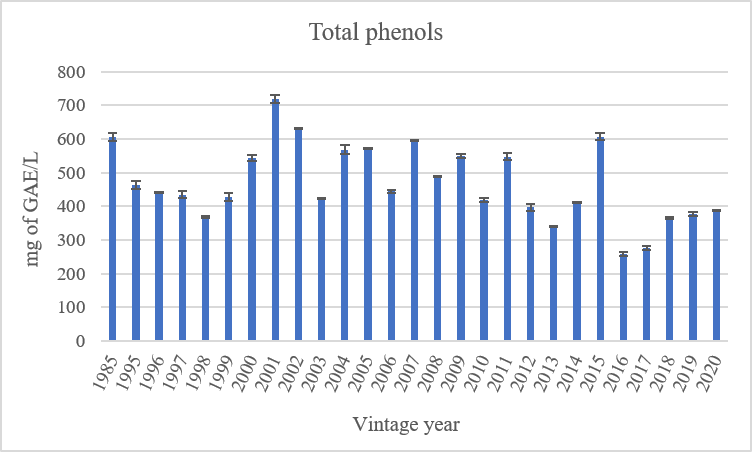
Figure 4. Mean values and standard deviation of total phenols content of the 27 vintages of Moscatel de Setúbal fortified wines after ageing.
As previously mentioned, during the ageing stage of Moscatel de Setúbal fortified wine, it is placed in used oak barrels, which facilitate oxygen permeation and diffusion (Pasteur, 1873; Cutzach et al., 1999; Cutzach et al., 2000). Although successive use of the barrel reduces its capacity to enrich the wine with volatile compounds and hydrolysable tannins, the contribution of small amounts of hydrolysable tannins and other phenolic compounds, both volatile and non-volatile, cannot be completely excluded, even if their contribution is expected to be negligible (Cutzach et al., 2000; McCallum et al., 2019; Zamora, 2019). In addition, the potential contribution of volatile phenols remaining from beverages previously aged in the barrel should also be considered (Coelho et al., 2019). Also, the phenolic composition of grapes varies between vintages, since grape characteristics are influenced by the climatic conditions of each respective year (De Oliveira et al., 2019).
In addition to sweet fortified wines traditionally being aged in used barrels, these are often partially empty due to the evaporation of water and ethanol through the pores of the wood, and in cellars with variable temperatures (Pasteur, 1873; Cutzach et al., 1999; Cutzach et al., 2000; Gómez-Plaza & Bautista-Ortín, 2019; Pfahl et al., 2021). The evaporation of water and ethanol has the effect of concentrating the constituents present in the wine, and this phenomenon is possibly responsible for the trend observed in the total phenols content of Moscatel de Setúbal fortified wines. Indeed, it is known that there are no two equal barrels and the evaporation is, among other factors, dependent on it (construction, vedation) (Del Álamo-Sanza & Nevares, 2018; Pfahl et al., 2021). In addition, the differences in total phenol values may also be due to the harvest year (state of grape ripeness at harvest) and the variable maceration time, since these are located mostly in the solid parts of the bunch, and their transfer to the must and wine is mainly determined by maceration during the winemaking process (Sun et al., 1999; Cheynier, 2005; Feliciano et al., 2009). Franco and Singleton (1984) determined the total phenols content of 24 fortified Moscatel de Setúbal wines aged between 0 and 77 years in used oak barrels. The values ranged from 649 mg expressed as gallic acid/L in wines aged for 8 years to 718 mg expressed as gallic acid/L in wines aged for 41 years. When compared with those presented in Table 4, these values reveal the same trend as well as a similar order of magnitude, with the wine aged for 8 years (2017 harvest) presenting 276.56 mg expressed in gallic acid/ L and wine aged for 40 years (1985 harvest) 604.60 mg/L expressed in gallic acid. These values are slightly lower than those reported by Franco and Singleton (1984). Bravo et al. (2006), analysing wines from different producers, found values between 400 mg/L expressed in GAE/L (7 months of maceration) and 1700 mg/L expressed in gallic acid (8 months of maceration). Higher values were obtained in the wines from grapes harvested in earlier times and without complete destemming. Feliciano et al. (2009), in a study involving different producers and different vintages, found values between 796 and 1863 mg/L expressed in gallic acid. The authors suggest that this difference can be attributed to different winemaking techniques, but it must also be seen that the RSD associated with the mean values is, in the first case, 25.8 % and, in the second, 37.3 %. Mean values result from the analysis of different vintages from the same producer, so it can possibly be said that vintage year is also a factor of variability. However, a direct comparison between the results of this study and those reported in the literature is not possible, since, despite some methodological variations, most other authors used the Folin–Ciocalteu method.
According to Feliciano et al. (2009), the Folin–Ciocalteu method is widely used for the evaluation of total phenolic content in wines. However, it exhibits low selectivity owing to interference from non-phenolic compounds that can react with the Folin reagent, as well as sugar interference (Ricardo-da-Silva et al., 1987). In the study by Milheiro et al. (2023), the phenolic compound content of white Port wines aged 10 and 20 years was approximately 160 mg gallic acid/L and 136 mg gallic acid/L, respectively. The results for total phenols observed in this study (Table 4) for Moscatel de Setúbal fortified wines aged 10 years (2012 harvest) and 20 years (2002 harvest) were 397.36 mg of gallic acid/L and 632.24 mg of gallic acid/L, respectively. These values are higher and show a contrary trend to those reported in white Port wines. However, factors such as the state of ripeness of the grapes at harvest, the grape varieties used and possibly some more interactions with proteins, polysaccharides and phenols in specific years in the case of white Port wine, the little or no maceration time (Moreira & Guedes de Pinho, 2011), as well as the time spent in barrels (phenomena of oxidation, condensation, polymerisation, and concentration that occur with ageing in barrels) may be possible explanations for the opposite trend found in this study of white Port wine. Thus, using the Prussian Blue Method, by spectrophotometric measurement at 720 nm, it is not possible to compare the results obtained for total phenols with those of other white fortified wines due to the scarcity of information in the literature.
4. Tanning capacity
To estimate the potential astringency of Moscatel de Setúbal fortified wines, their tanning capacity was determined. The tanning capacity values observed in this study are shown in Table 4, ranging from 3.86 NTU (2013) to 25.78 NTU (2001). As shown in Figure 5, older vintages exhibit higher and more variable tanning capacity values, whereas more recent vintages display lower values that are relatively consistent. The trend observed for this parameter may be related to the grape characteristics across vintages, inherent differences among oak barrels, and fluctuations in temperature across the years, in addition to ageing time. Changes in the polymerisation profile of condensed tannins during ageing may also contribute to the observed trend, as the tannins that remain soluble in the wine may exhibit different reactivity because of their structural evolution. Another possible explanation is the prolonged extraction of hydrolysable tannins from the oak wood, which may remain relevant even when previously used barrels are employed.
It is not possible to compare these results with those of other Moscatel de Setúbal fortified wines due to a lack of information. However, comparisons can be made with studies of other white fortified wines that have used the same method to determine the parameter. McCallum et al. (2019) studied the effect of botanical species and barrel toasting conditions on Carcavelos fortified wines aged in barrels for 8 years, observing tanning capacity values between 3.58 NTU and 0.49 NTU (converting from NTU/mL, as indicated in the original reference to Freitas and Mateus (2001), to NTU, the form of expression used in this study). These values are lower than the tanning capacity observed in Moscatel de Setúbal wine aged for 8 years (2014 harvest), equal to 4.20 NTU. In contrast to Carcavelos fortified wines, Moscatel de Setúbal has a long maceration time, during which the solid parts of the grape are extracted, leading to the diffusion of phenolic compounds, contributors to the sensation of astringency (Feliciano et al., 2009; IVV, 2026).
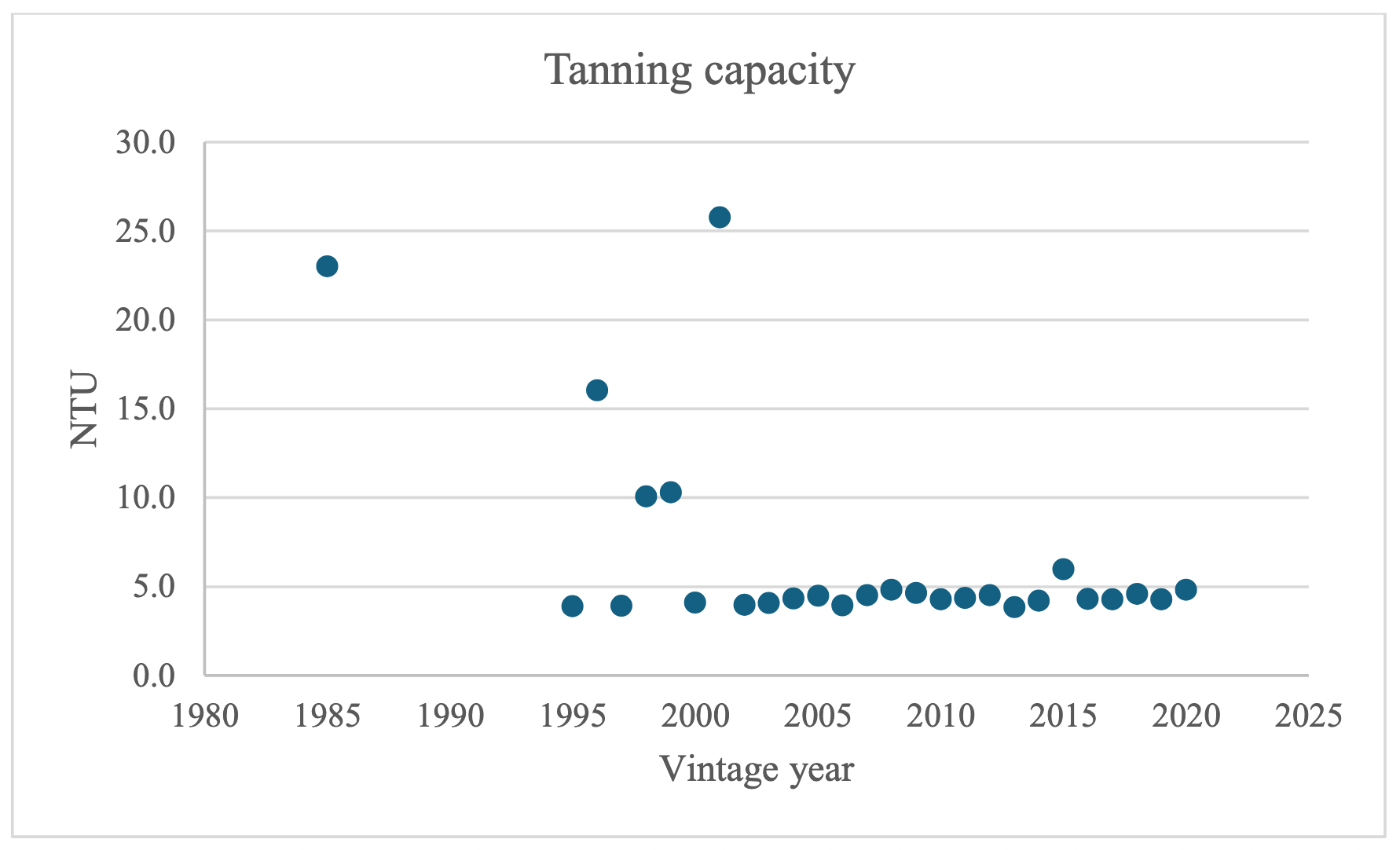
Figure 5. Tanning capacity of the 27 vintages of Moscatel de Setúbal fortified wines after ageing.
5. Monomeric flavanols and proanthocyanidins
For a better characterisation of the phenolic composition of Moscatel de Setúbal fortified wines, monomeric flavanols and condensed proanthocyanidins/tannins were determined according to their degree of polymerisation, namely: the monomeric fraction (F1), the oligomeric fraction (F2) and the polymeric fraction (F3). The monomeric flavanol contents found in the fortified wines analysed are shown in Table 4, ranging from 16 mg/L (2006) to 445 mg/L (2000), with significant differences among vintages. The monomeric fraction of the older vintages showed higher values, although they vary among themselves, unlike the monomeric fraction of the more recent vintages, which have lower values and are generally close to each other. The 1985 wine has a concentration of monomeric flavanols close to the values obtained for the most recent harvests (Figure 6).
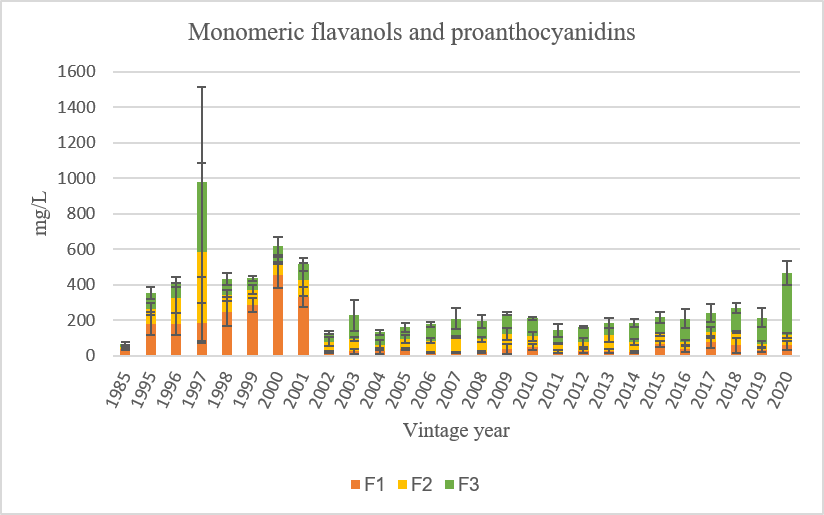
Figure 6. Flavanols (F1) and oligomeric and polymeric proanthocyanidins (F2) and (F3) content of the 27 vintages of Moscatel de Setúbal fortified wines after ageing. Standard deviations are presented as error bars.
The levels of condensed oligomeric tannins present in Moscatel de Setúbal wines are shown in Table 3. Statistically, the samples are not significantly different from each other (p > 0.05). The levels of condensed oligomeric tannins found in Moscatel de Setúbal vary between 8 mg/L (1985) and 400 mg/L (1997), with the latter value standing out from the rest as it is much higher than the average of the results obtained. In general, the older vintages show higher values when compared to the more recent ones, except for 1985, which has the lowest value of condensed oligomeric tannins (Figure 6). The levels of condensed polymeric tannins present in Moscatel de Setúbal are shown in Table 4. Statistically, the samples are not significantly different from each other (p < 0.05). The condensed polymeric tannins obtained for Moscatel de Setúbal fortified wines vary between 20 mg/L (1985) and 396 mg/L (1997). As can be seen in Figure 6, the concentration of condensed polymerised tannins tends to be lower in wines with longer ageing periods. According to Somers and Pocock (1991), white wines produced without maceration contain very low amounts of proanthocyanidins. However, the production of wine from white grapes with maceration promotes their extraction from the solid parts of the grape, resulting in wines with higher levels of these compounds, leading to their precipitation.
The dominance of the monomeric and oligomeric fraction over the polymeric fraction in older wines may be related to the occurrence of depolymerisation phenomena during barrel ageing. In fact, the depolymerisation of tannins in an acidic environment (pH 3.40), resulting in the release of monomeric units, has been reported (Haslam, 1980). Over time, tannins polymerise until they reach such a high molecular weight that they precipitate, with older wines having a lower importance of the polymeric fraction, with only tannins with low molecular weight, namely oligomeric tannins and monomeric flavanols, being soluble (Haslam, 1980; Dallas et al., 2003; Sun et al., 2013). In the case of the 1985 wine, the long ageing period of 37 years may explain the overall decrease in all flavanol fractions. Thus, there appear to be two distinct profiles among the 27 vintages of Moscatel de Setúbal fortified wine (Table 4). A first profile, covering the 1985 and 1995 to 2001 vintages, except 1997, where the monomeric fraction (F1) dominates, and a second profile, covering the 1997 and 2003 to 2020 vintages, except 2002, where the polymeric fraction (F3) dominates. While the second profile is the one most commonly observed and described in the literature, the first profile seems to reveal the consequences of prolonged ageing in used oak barrels on the degree of polymerisation of tannins, although bearing in mind also the possible influence of grape characteristics from each vintage, inherent differences among oak barrels, and fluctuations in temperature across the years in addition to ageing time.
6. Principal Component Analysis (PCA)
The Principal Components Analysis provided further perspective into the variables contributing to the differentiation of the wines (Figure 7). The first principal component (PC1) explained 65.37 % of the total variance, while the second principal component (PC2) accounted for a further 12.09 %, together explaining 77.46 % of the total variance.
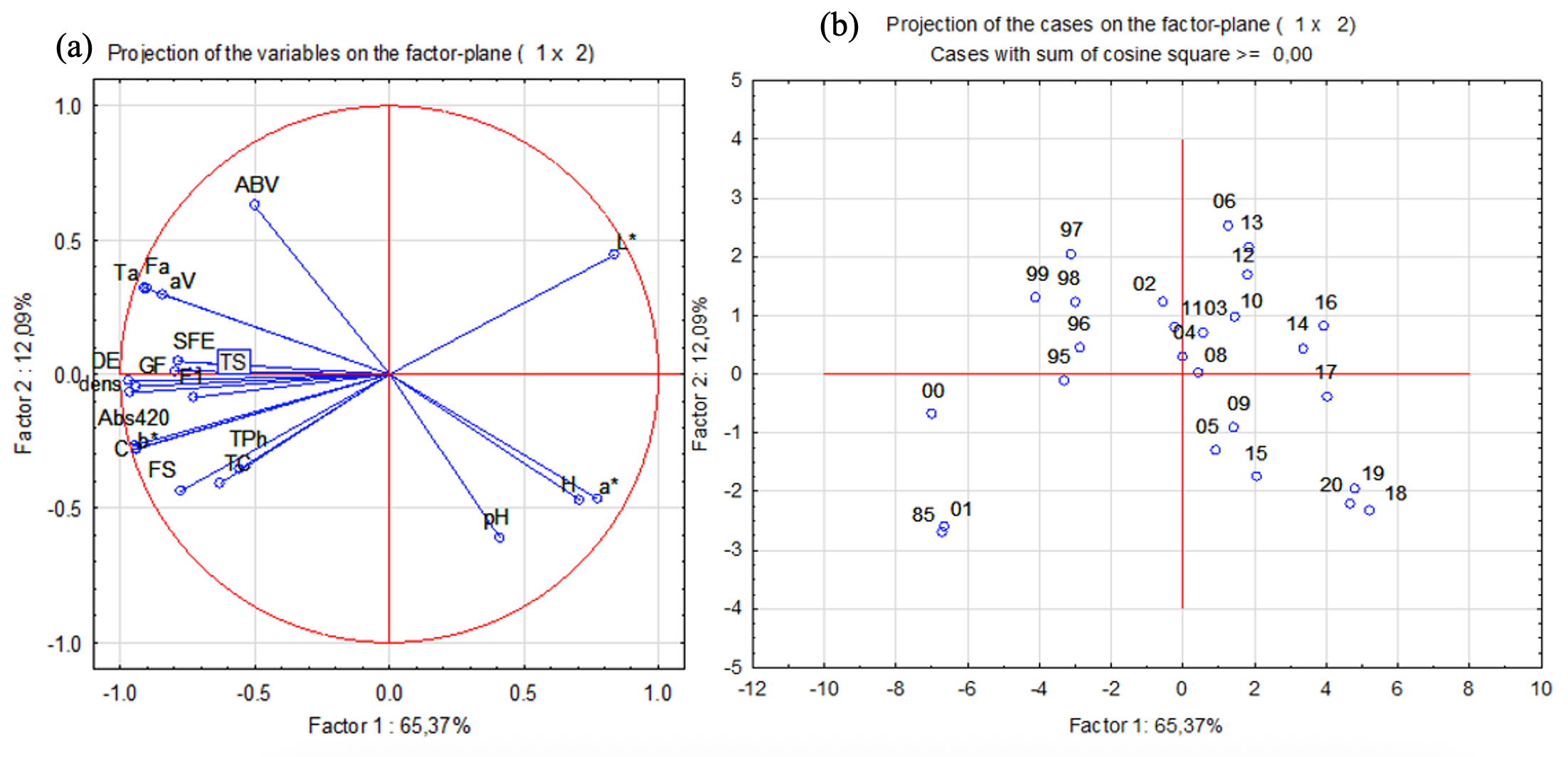
Figure 7. PCA analysis, projection of parameters and expanded view of the left quadrants (a): ABV—alcoholic strength by volume, Fa—fixed acidity, Ta—titratable acidity, Va—volatile acidity, GF—Glucose plus fructose; FS—free sulphur, TS—total sulphur, TPh—total phenols, TC—tanning capacity, D—density, DE—dry extract, SFE—sugar free extract, Abs420— absorbance at 420 nm; L*, a*, b*, C* and H* – CIELab parameters; and projection of samples (b) of Moscatel de Setúbal fortified wines. Numbers in the graph (85, 95, 00, 01…20) correspond to the wines from the 1985, 1995, 2000, 2001…2020 vintages.
PC1 was mainly associated with the physicochemical and chromatic characteristics of the wines. Most physicochemical parameters, with the exception of ABV and pH, together with absorbance at 420 nm, the CIELab parameters, tanning power, flavanols and total phenols, influence the special distribution of the samples along this component. The parameters exerting the greatest influence on this distribution, in descending order of importance, were dry extract, density, colour at 420 nm, glucose plus fructose, chroma (C*), b*, total acidity, fixed acidity, volatile acidity, L*, total sulphur, free sulphur, a*, monomeric flavanols (F1) and H*. The variables associated with the negative side of PC1 included total acidity, volatile acidity, sugar-free extract and colour-related parameters, particularly absorbance at 420 nm, b* and chroma (C*), as well as tanning capacity (TC), flavanols (F1) and total phenols (TPh). In contrast, L* was strongly associated with the right side of PC1. This pattern allows the differentiation between the older vintages (1985 and 1995–2001), which were generally characterised by higher colour intensity, a more pronounced yellow hue, higher chroma, higher tanning capacity and a higher proportion of monomeric flavanols, and the more recent vintages (2002–2020), which were mainly associated with higher lightness (L*).
PC2 explained 12.09 % of the total variance and was mainly associated with ABV and pH. The wines from 1997–1999 were mainly located in the upper-left region of the score plot, whereas the wines from 1985 and 1995 were positioned towards the lower-left region. Among the more recent vintages, 2006, 2010, 2012 and 2013 were mainly located in the upper-right region, while 2005, 2009 and 2015 were positioned in the lower-right region. The most recent vintages, particularly 2018–2020, were also located in the lower-right region.
Overall, the PCA suggests that the differentiation of the wines was primarily associated with their physicochemical, chromatic and phenolic characteristics, with PC1 largely reflecting the distinction between older and more recent vintages. Nevertheless, the dispersion observed within each vintage group, particularly along PC2, indicates that wine age alone does not fully explain the variability. This pattern may also reflect vintage-related differences in grape characteristics and composition that reflect environmental and climatic conditions, as well as slight variations in the winemaking conditions between vintages.
Conclusions
Considering the variability in maceration length and ageing conditions permitted for production of this wine, the coexistence of distinct profiles within the region is expected. Within this context, the present study contributes to the scientific knowledge on Moscatel de Setúbal fortified wines by providing a characterisation of the physicochemical and phenolic characteristics associated with its production and ageing processes. Regarding colour, a parameter of utmost importance for quality perception, the results suggest that, under ageing conditions involving thermal fluctuations, the initial glucose plus fructose contents may contribute to the observed colour differences between vintages. However, further investigation is needed to better understand the factors underlying this relationship. Other aspects may include phenolic compounds derived from maceration and, possibly, to a lesser extent, from the barrels (despite the use of previously used wood), as well as grape-specific characteristics associated with the vintage year.
Wines from vintages up to 2001 exhibited higher absorbance at 420 nm, higher L* values, more positive b* values, as well as Glucose plus Fructose, dry extract and a higher proportion of monomeric flavanols. In the latter case, the tannic fractions display a distinctive profile, which contrasts markedly with that observed in the youngest vintages. The observed differences among the wines appear to be primarily associated with ageing time, although grape characteristics and vintage-related effects may also have contributed to the observed variability. Furthermore, differences in the thermal amplitudes during the ageing between years may also have influenced the physicochemical characteristics of the wines.
These insights are useful for supporting decision-making in quality control, process optimisation, and product differentiation strategies that can be extended to other fortified wines. Also, it would be interesting to study how maceration length and different materials other than wood for ageing can impact the profile of this fortified wine. In this line, volatile and sensory studies would be of major interest to complement the information provided. Furthermore, the analytical framework and interpretative approach adopted herein may be extended to other wine styles beyond fortified wines.
Funding
This work was supported by FCT – Fundação para a Ciência e Tecnologia, I.P. through project reference UID/04129/2025.
Acknowledgements
The authors thank Bacalhôa Vinhos de Portugal, S.A., for providing the Moscatel de Setúbal fortified wines analysed in this work.
References
- Abreu, T., Perestrelo, R., Bordiga, M., Locatelli, M., Daniel Coïsson, J., & Câmara, J. S. (2021). The flavor chemistry of fortified wines—A comprehensive approach. Foods, 10(6), 1239. https://doi.org/10.3390/foods10061239
- Aleixandre-Tudo, J.L.; Weightman, C.; Panzeri, V.; Nieuwoudt, H.H., & Du Toit, W.J. (2015). Effect of skin contact before and during alcoholic fermentation on the chemical and sensory profile of South African Chenin blanc white wines. South African Journal of Enology and Viticulture, 36(3), 366-377. https://doi.org/10.21548/36-3-969
- Almadanim, M.C.; Baleiras-Couto, M.M.; Pereira, H.S.; Carneiro, L.C.; Fevereiro, P.; Eiras-Dias, J.E.; Morais Cecílio, L.; Viegas, W. & Veloso, M.M. (2007). Genetic diversity of the grapevine (Vitis vinifera L.) cultivars most utilized for wine production in Portugal. Vitis-Geilweilerhof, 46(3), 116–119.
- Aragón-García, F., Ruíz-Rodríguez, A., & Palma, M. (2021). Changes in the aromatic compounds content in the muscat wines as a result of the application of ultrasound during pre-fermentative maceration. Foods, 10(7), 1462. https://doi.org/10.3390/foods10071462
- Bavčar, D., Baša Česnik, H., Čuš, F., & Košmerl, T. (2011). The influence of skin contact during alcoholic fermentation on the aroma composition of Ribolla Gialla and Malvasia Istriana Vitis vinifera (L.) grape wines. International Journal of Food Science and Technology, 46(9), 1801-1808. https://doi.org/10.1111/j.1365-2621.2011.02679.x
- Bene, Z. S. & Kállay, M. (2019). Polyphenol contents of skin-contact fermented white wines. Acta Alimentaria, 48(4), 515-524. https://doi.org/10.1556/066.2019.48.4.13
- Bestulić, E., Rossi, S., Plavša, T., Horvat, I., Lukić, I., Bubola, M., ... & Radeka, S. (2022). Comparison of different maceration and non-maceration treatments for enhancement of phenolic composition, colour intensity, and taste attributes of Malvazija istarska (Vitis vinifera L.) white wines. Journal of food composition and analysis, 109, 104472. https://doi.org/10.1016/j.jfca.2022.104472
- Bouça, C. M. R. (2016). Consolidação dum Sistema de Gestão da Qualidade e Segurança Alimentar numa ótica da melhoria continua: Caso de estudo José Maria da Fonseca. Dissertação de Mestrado, Universidade NOVA de Lisboa.
- Boulton, R. (1995). Red wines. In A. G. H. Lea & J. R. Piggott (Eds.), Fermented beverage production (pp. 121–158). Springer.https://doi.org/10.1007/978-1-4757-5214-4_6
- Bravo, M. N., Feliciano, R., Silva, S., Coelho, A. V., Boas, L. V., & Bronze, M. R. (2008). Analysis of trans-resveratrol: Comparison of methods and contents in Muscatel fortified wines from Setúbal region in Portugal. Journal of food composition and analysis, 21(8), 634-643. https://doi.org/10.1016/j.jfca.2008.04.007
- Bravo, M. N., Silva, S., Coelho, A. V., Boas, L. V., & Bronze, M. R. (2006). Analysis of phenolic compounds in Muscatel wines produced in Portugal. Analytica Chimica Acta, 563(1-2), 84-92. https://doi.org/10.1016/j.aca.2005.11.054
- Câmara, J. D. S., Alves, M. A., & Marques, J. C. (2006). Changes in volatile composition of Madeira wines during their oxidative ageing. Analytica chimica acta, 563(1-2), 188-197. https://doi.org/10.1016/j.aca.2005.10.031
- Carvalho, M. J., Pereira, V., Pereira, A. C., Pinto, J. L., & Marques, J. C. (2015). Evaluation of wine colour under accelerated and oak-cask ageing using CIELab and chemometric approaches. Food and Bioprocess Technology, 8(11), 2309-2318. https://doi.org/10.1007/s11947-015-1585-x
- Chaves, M., Zea, L., Moyano, L., & Medina, M. (2007). Changes in color and odorant compounds during oxidative aging of Pedro Ximénez sweet wines. Journal of Agricultural and Food Chemistry, 55(9), 3592-3598. https://doi.org/10.1021/jf063506v
- Chen, P. X., Tang, Y., Zhang, B., Liu, R., Marcone, M. F., Li, X., & Tsao, R. (2014). 5-Hydroxymethyl-2-furfural and derivatives formed during acid hydrolysis of conjugated and bound phenolics in plant foods and the effects on phenolic content and antioxidant capacity. Journal of agricultural and food chemistry, 62(20), 4754-4761. https://doi.org/10.1021/jf500518r
- Cheynier, V. (2005). Polyphenols in foods are more complex than often thought. The American Journal of Clinical Nutrition, 81(1), 223S-229S. https://doi.org/10.1093/ajcn/81.1.223S
- Cheynier, V. & Ricardo-da-Silva, J. M. (1991). Oxidation of grape procyanidins in model solutions containing trans-caffeoyltartaric acid and polyphenol oxidase. Journal of Agricultural and Food Chemistry, 39(6), 1047-1049. https://doi.org/10.1021/jf00006a008
- Coelho, E., Teixeira, J. A., Domingues, L., Tavares, T., & Oliveira, J. M. (2019). Factors affecting extraction of adsorbed wine volatile compounds and wood extractives from used oak wood. Food Chemistry, 295, 156-164. https://doi.org/10.1016/j.foodchem.2019.05.093
- Commission Delegated Regulation (EU) 2019/934. (2019). Commission Delegated Regulation (EU) 2019/934 of 12 March 2019 supplementing Regulation (EU) No 1308/2013 of the European Parliament and of the Council as regards winegrowing areas where the alcoholic strength may be increased, authorised oenological practices and restrictions applicable to the production and conservation of grapevine products, the minimum percentage of alcohol for by-products and their disposal, and publication of OIV files. https://eur-lex.europa.eu/eli/reg_del/2019/934/oj/eng
- Cosme, F. (2025). Personal communication.
- Cutzach, I., Chatonnet, P., & Dubourdieu, D. (1999). Study of the formation mechanisms of some volatile compounds during the aging of sweet fortified wines. Journal of Agricultural and Food Chemistry, 47(7), 2837-2846. https://doi.org/10.1021/jf981224s
- Cutzach, I., Chatonnet, P., & Dubourdieu, D. (2000). Influence of storage conditions on the formation of some volatile compounds in white fortified wines (Vins doux Naturels) during the aging process. Journal of Agricultural and Food Chemistry, 48(6), 2340-2345. https://doi.org/10.1021/jf9913209
- CVRPS. (2025). Península de Setúbal. Available at: https://vinhosdapeninsuladesetubal.org/moscatel-de-setubal
- Dallas, C., Hipólito-Reis, P., Ricardo-da-Silva, J. M., & Laureano, O. (2003). Influence of acetaldehyde, pH, and temperature on transformation of procyanidins in model wine solutions. American Journal of Enology and Viticulture, 54(2), 119-124. https://doi.org/10.5344/ajev.2003.54.2.119
- Darias-Martı́n, J. J., Rodrı́guez, O., Dı́az, E., & Lamuela-Raventós, R. M. (2000). Effect of skin contact on the antioxidant phenolics in white wine. Food Chemistry, 71(4), 483-487. https://doi.org/10.1016/S0308-8146(00)00177-1
- Decreto-Lei N. 326/88. (1988). Decreto-Lei N. 326/88, de 23 de Setembro de 1988. Estabelece normas relativas a vinhos licorosos. Diário da República No 221/1988, Série I de 1988-09-23, 3907-3909.
- De Freitas, V. & Mateus, N. (2001). Structural features of procyanidin interactions with salivary proteins. Journal of Agricultural and Food Chemistry, 49(2), 940-945. https://doi.org/10.1021/jf000981z
- Del Álamo-Sanza, M. & Nevares, I. (2018). Oak wine barrel as an active vessel: A critical review of past and current knowledge. Critical Reviews in Food Science and Nutrition, 58(16), 2711-2726. https://doi.org/10.1080/10408398.2017.1330250
- De Oliveira, J. B., Egipto, R., Laureano, O., de Castro, R., Pereira, G. E., & Ricardo-da-Silva, J. M. (2019). Chemical characteristics of grapes cv. Syrah (Vitis vinifera L.) grown in the tropical semiarid region of Brazil (Pernambuco state): influence of rootstock and harvest season. Journal of the Science of Food and Agriculture, 99(11), 5050-5063. https://doi.org/10.1002/jsfa.9748
- Di Lecce, G., Boselli, E., D'Ignazi, G., & Frega, N. G. (2013). Evolution of phenolics and glutathione in Verdicchio wine obtained with maceration under reductive conditions. LWT-Food Science and Technology, 53(1), 54-60. https://doi.org/10.1016/j.lwt.2013.03.006
- Dos Santos, J. R. M. & Kempka, A. P. (2025). White wine vinification and an expanded insight into pellicular macerations: bibliometric and bibliographic review. Journal of the Science of Food and Agriculture, 105(1), 19-41. https://doi.org/10.1002/jsfa.13685
- Durán-Guerrero, E., Castro, R., García-Moreno, M. D. V., Rodríguez-Dodero, M. D. C., Schwarz, M., & Guillén-Sánchez, D. (2021). Aroma of sherry products: A review. Foods, 10(4), 753. https://doi.org/10.3390/foods10040753
- Fabios, M., Lopez-Toledano, A., Mayen, M., Merida, J., & Medina, M. (2000). Phenolic compounds and browning in sherry wines subjected to oxidative and biological aging. Journal of Agricultural and Food Chemistry, 48(6), 2155-2159. https://doi.org/10.1021/jf9908502
- Feliciano, R. P., Bravo, M. N., Pires, M. M., Serra, A. T., Duarte, C. M., Boas, L. V., & Bronze, M. R. (2009). Phenolic content and antioxidant activity of moscatel dessert wines from the setúbal region in portugal. Food Analytical Methods, 2(2), 149-161. https://doi.org/10.1007/s12161-008-9059-7
- Ferreira-Lima, N. E., Burin, V. M., Caliari, V., & Bordignon-Luiz, M. T. (2016). Impact of pressing conditions on the phenolic composition, radical scavenging activity and glutathione content of Brazilian Vitis vinifera white wines and evolution during bottle ageing. Food and Bioprocess Technology, 9(6), 944-957. https://doi.org/10.1007/s11947-016-1680-7
- Fraga, H., Guimarães, N., & Santos, J. (2023). Vintage Port prediction and climate change scenarios. OENO One, 57(4). https://doi.org/10.20870/oeno-one.2023.57.4.7694
- Francisquini, J. D. A., Martins, E., Silva, P. H. F., Schuck, P., Perrone, Í. T., & Carvalho, A. F. (2017). Reação de Maillard: uma revisão. Revista do Instituto de Laticínios Cândido Tostes, 72(1), 48-57. https://doi.org/10.14295/2238-6416.v72i1.541
- Franco, D. S. & Singleton, V. L. (1984). The changes in certain components of Setúbal wines during aging. American Journal of Enology and Viticulture, 35(3), 146-150. https://doi.org/10.5344/ajev.1984.35.3.146
- Garcia, V. P. (2001). Vinhos da Península de Setúbal. In: Os Vinhos da Península de Setúbal; Vol. No.VII, Pp 102-129, Eds.; Chaves Ferreira – Publicações, S.A., Lisboa, 2001
- Gómez-Plaza, E. & Bautista-Ortín, A.B. (2019). Emerging technologies for aging wines: use of chips and micro-oxygenation. In: Red wine technology. Pp.149-162. Morata A. (Ed.), Academic Press, Elsevier Inc., Oxford. https://doi.org/10.1016/B978-0-12-814399-5.00010-4
- González-Centeno, M. R., Chira, K., & Teissedre, P. L. (2016). Ellagitannin content, volatile composition and sensory profile of wines from different countries matured in oak barrels subjected to different toasting methods. Food Chemistry, 210, 500-511. https://doi.org/10.1016/j.foodchem.2016.04.139
- Granja-Soares, J., Ricardo-da-Silva, J. M., & Catarino, S. (2025). An overview on Moscatel de Setúbal fortified wine. Ciência e Técnica Vitivinícola, 40(2), 78-93. https://doi.org/10.1051/ctv/20254002078
- Gutiérrez-Escobar, R., Aliaño-González, M. J., & Cantos-Villar, E. (2021). Wine polyphenol content and its influence on wine quality and properties: A review. Molecules, 26(3), 718. https://doi.org/10.3390/molecules26030718
- Haslam, E. (1980). In vino veritas: Oligomeric procyanidins and the ageing of red wines. Phytochemistry, 19(12), 2577-2582. https://doi.org/10.1016/S0031-9422(00)83922-9
- IVV. (2025). Declaração de Colheita e Produção. Manual de utilização. Available at: . https://www.ivv.gov.pt/documentos/manual-de-apoio-ao-preenchimento-da-declaracao-de-colheita-e-producao-2-a-edicao/
- IVV. (2026). Caderno de Especificações. Available at: https://www.ivv.gov.pt/wp-content/uploads/2026/02/DO_Setubal.pdf
- JKI. (2025). Julius Kühn-Institut. Vitis international variety catalogue. Available at: www.vivc.de
- Jordão, A.M. & Ricardo-da-Silva, J.M. (2019). Evolution of proanthocyanidins during grape maturation, winemaking, and aging process of red wines. pp. (177-193) In: Red wine technology. Morata A. (Ed.), Academic Press, Elsevier Inc., Oxford. https://doi.org/10.1016/B978-0-12-814399-5.00012-8
- Kyraleou, M., Tzanakouli, E., Kotseridis, Y., Chira, K., Ligas, I., Kallithraka, S., & Teissedre, P. L. (2016). Addition of wood chips in red wine during and after alcoholic fermentation: Differences in color parameters, phenolic content and volatile composition. OENO One, 50(4), 209-222. https://doi.org/10.20870/oeno-one.2016.50.4.885
- Li, H., Guo, A., & Wang, H. (2008). Mechanisms of oxidative browning of wine. Food chemistry, 108(1), 1-13. https://doi.org/10.1016/j.foodchem.2007.10.065
- Li, L. & Sun, B. (2019). Grape and wine polymeric polyphenols: Their importance in enology. Critical Reviews in Food Science and Nutrition, 59(4), 563-579. https://doi.org/10.1080/10408398.2017.1381071
- Lopes, M. S., Sefc, K. M., Eiras Dias, E., Steinkellner, H., Laimer Câmara Machado, M., & Câmara Machado, A. D. (1999). The use of microsatellites for germplasm management in a Portuguese grapevine collection. Theoretical and Applied Genetics, 99(3), 733-739. https://doi.org/10.1007/s001220051291
- Lukić, I., Jedrejčić, N., Ganić, K. K., Staver, M., & Peršurić, Đ. (2015). Phenolic and aroma composition of white wines produced by prolonged maceration and maturation in wooden barrels. Food Technology and Biotechnology, 53(4), 407. https://doi.org/10.17113/ftb.53.04.15.4144
- Marchal, J., & Waters, E.J. (2010). New directions in stabilization clarification and fining of white wines. In: A. G. Reynolds (Ed.) Managing wine quality: Volume 2: Oenology and wine quality. (pp. 188-225). Woodhead Publishing. https://doi.org/10.1533/9781845699987.1.188
- McCallum, M.J., Lopes-Correia, T.,& Ricardo-da-Silva, J.M. (2019). Chemical evaluation of Carcavelos fortified wine aged in Portuguese (Quercus pyrenaica) and French (Quercus robur) oak barrels at medium and high toast. OENO One 53, 561-572. https://doi.org/10.20870/oeno-one.2019.53.3.2284
- Merkytė, V., Longo, E., Windisch, G., & Boselli, E. (2020). Phenolic compounds as markers of wine quality and authenticity. Foods, 9(12), 1785. https://doi.org/10.3390/foods9121785
- Mesquita, P. R., Piçarra-Pereira, M. A., Monteiro, S., Loureiro, V. B., Teixeira, A. R., & Ferreira, R. B. (2001). Effect of wine composition on protein stability. American Journal of Enology and Viticulture, 52(4), 324-330. https://doi.org/10.5344/ajev.2001.52.4.324
- Milheiro, J., Filipe-Ribeiro, L., Cosme, F., & Nunes, F. M. (2023). Discrimination of Port wines by style and age using chromatic characteristics, phenolic, and pigment composition. Food Research International, 172, 113181. https://doi.org/10.1016/j.foodres.2023.113181
- Miranda, A., Pereira, V., Pontes, M., Albuquerque, F., & Marques, J. C. (2017). Acetic acid and ethyl acetate in Madeira wines: Evolution with ageing and assessment of the odour rejection threshold. Ciência e Técnica Vitivinícola, 32(1), 1-11. https://doi.org/10.1051/ctv/20173201001
- Monagas, M., Bartolomé, B., & Gómez-Cordovés, C. (2005). Updated knowledge about the presence of phenolic compounds in wine. Critical Reviews in Food Science and Nutrition, 45(2), 85-118. https://doi.org/10.1080/10408690490911710
- Morata, A.; González, C.; Tesfaye, W.; Loira, I.; Suárez-Lepe, J.A. (2019). Maceration and Fermentation: New Technologies to Increase Extraction. In: Red wine technology. Pp.(35-49). Morata A. (Ed.), Academic Press, Elsevier Inc., Oxford. https://doi.org/10.1016/B978-0-12-814399-5.00003-7
- Moreira, N., & Guedes de Pinho, P. (2011). Port wine. In R. S. Jackson (Ed.), Advances in food and nutrition research (Vol. 63, pp. 119-146). Academic Press. https://doi.org/10.1016/B978-0-12-384927-4.00005-1
- OIV. (2025). Codex Oenologique International. Organisation Internationale de la Vigne et du Vin. Dijon, France. Available at: https://www.oiv.int/sites/default/files/publication/2025- 04/CODEX%20oenologique%202025%20FR.pdf
- Oliveira, C.M.D.M. (2014). Pathways of oxidative degradation of wine. Dissertação de Doutoramento, Universidade de Aveiro.
- Pasteur, L. (1873). Études sur le vin: ses maladies, causes qui les provoquent, procédés nouveaux pour le conserver et pour le vieillir. Simon Raçou et Comp.
- Pereira, V., Albuquerque, F., Cacho, J., & Marques, J. C. (2013). Polyphenols, antioxidant potential and color of fortified wines during accelerated ageing: The Madeira wine case study. Molecules, 18(3), 2997-3017. https://doi.org/10.3390/molecules18032997
- Pereira, V., Albuquerque, F. M., Ferreira, A. C., Cacho, J., & Marques, J. C. (2011). Evolution of 5-hydroxymethylfurfural (HMF) and furfural (F) in fortified wines submitted to overheating conditions. Food Research International, 44(1), 71-76. https://doi.org/10.1016/j.foodres.2010.11.011
- Pereira, V., Cacho, J., & Marques, J. C. (2014). Volatile profile of Madeira wines submitted to traditional accelerated ageing. Food Chemistry, 162, 122-134. https://doi.org/10.1016/j.foodchem.2014.04.039
- Pereira, V., Leça, J. M., Freitas, A. I., Pereira, A. C., Pontes, M., Albuquerque, F., & Marques, J. C. (2022). Unveiling the evolution of Madeira wine key metabolites: a three-year follow-up study. Processes, 10(5), 1019. https://doi.org/10.3390/pr10051019
- Perestrelo, R., Jaouhari, Y., Abreu, T., Castillo, M. M., Travaglia, F., Pereira, J. A., ... & Bordiga, M. (2023). The fingerprint of fortified wines—from the sui generis production processes to the distinctive aroma. Foods, 12(13), 2558. https://doi.org/10.3390/foods12132558
- Pérez-Magariño, S., & González-Sanjosé, M. L. (2003). Application of absorbance values used in wineries for estimating CIELAB parameters in red wines. Food Chemistry, 81(2), 301-306. https://doi.org/10.1016/S0308-8146(02)00509-5
- Pérez-Navarro, J., Izquierdo-Cañas, P. M., Mena-Morales, A., Chacón-Vozmediano, J. L., Martínez-Gascueña, J., García-Romero, E., ... & Gómez-Alonso, S. (2020). Comprehensive chemical and sensory assessment of wines made from white grapes of Vitis vinifera cultivars Albillo Dorado and Montonera del Casar: A comparative study with Airén. Foods, 9(9), 1282. https://doi.org/10.3390/foods9091282
- Pfahl, L., Catarino, S., Fontes, N., Graça, A., & Ricardo-da-Silva, J. (2021). Effect of barrel-to-barrel variation on color and phenolic composition of a red wine. Foods, 10(7), 1669. https://doi.org/10.3390/foods10071669
- Pilet, A., Sousa, R. D., Ricardo-da-Silva, J. M., & Catarino, S. (2019). Barrel-to-barrel variation of phenolic and mineral composition of red wine. In BIO Web of Conferences (Vol. 12, p. 02011). EDP Sciences. https://doi.org/10.1051/bioconf/20191202011
- Portaria Nº 793/2009. (2009). Portaria nº 793/2009 de 28 de Julho. Reconhece como denominação de origem (DO) a designação «Setúbal» para identificação do vinho licoroso. Diário da República n.º 144/2009, Série I de 2009-07-28. https://diariodarepublica.pt/dr/detalhe/portaria/793-2009-492980
- Portaria Nº 118/2014. (2014). Portaria Nº 118/2014 de 3 de Junho de 2014. Define o regime de produção e comércio dos vinhos e demais produtos vitivinícolas da denominação de origem (DO) «Setúbal», incluindo as suas designações tradicionais equivalentes «Moscatel de Setúbal» e «Moscatel Roxo de Setúbal». Diário da República n.º 106/2014, Série I de 2014-06-03, 3047-3050. https://diariodarepublica.pt/dr/detalhe/portaria/118-2014-25345927
- Price, M. L. & Butler, L. G. (1977). Rapid visual estimation and spectrophotometric determination of tannin content of sorghum grain. Journal of Agricultural and Food Chemistry, 25(6), 1268-1273. https://doi.org/10.1021/jf60214a034
- Ribéreau-Gayon, P., Glories, Y., Maujean, A., & Dubourdieu, D. (2006). In Handbook of enology, volume 2: The chemistry of wine stabilization and treatments (2nd ed.). John Wiley and Sons Ltd.https://doi.org/10.1002/0470010398
- Ricardo-da-Silva, J.M, Spranger-Garcia, M.I. & Curvelo-Garcia, A.S. (1987). Contribuição para o estudo dos métodos de determinação dos polifenóis totais em vinhos tintos. Ciência e Técnica Vitivinícola, 6(1), 29-44.
- Salvador, J.A. (2010). Moscatel de Setúbal: O príncipe dos moscatéis. Edições Afrontamento.
- Serra-Cayuela, A., Aguilera-Curiel, M. A., Riu-Aumatell, M., Buxaderas, S., & López-Tamames, E. (2013). Browning during biological aging and commercial storage of Cava sparkling wine and the use of 5-HMF as a quality marker. Food Research International, 53(1), 226-231. https://doi.org/10.1016/j.foodres.2013.04.010
- Setford, P. C., Jeffery, D. W., Grbin, P. R., & Muhlack, R. A. (2017). Factors affecting extraction and evolution of phenolic compounds during red wine maceration and the role of process modelling. Trends in Food Science & Technology, 69, 106-117. https://doi.org/10.1016/j.tifs.2017.09.005
- Silva, E. L. (2011). Identificação de turvação/precipitado num vinho generoso Moscatel de Setúbal. Dissertação de Mestrado, Instituto Superior de Agronomia da Universidade de Lisboa.
- Silva, S. D., Feliciano, R. P., Boas, L. V., & Bronze, M. R. (2014). Application of FTIR-ATR to Moscatel dessert wines for prediction of total phenolic and flavonoid contents and antioxidant capacity. Food chemistry, 150, 489-493. https://doi.org/10.1016/j.foodchem.2013.11.028
- Singleton, V. L. & Kramling, T. E. (1976). Browning of white wines and an accelerated test for browning capacity. American Journal of Enology and Viticulture, 27(4), 157-160. https://doi.org/10.5344/ajev.1976.27.4.157
- Somers, T. C., & Pocock, K. F. (1991). Phenolic assessment of white musts: varietal differences in free-run juices and pressings. Vitis, 30, 189-201.
- Starowicz, M. & Zieliński, H. (2019). How Maillard reaction influences sensorial properties (color, flavor and texture) of food products?. Food Reviews International, 35(8), 707-725. https://doi.org/10.1080/87559129.2019.1600538
- Stratil, P., Kuban, V., & Fojtova, J. (2008). Comparison of the phenolic content and total antioxidant activity in wines as determined by spectrophotometric methods. Czech Journal of Food Sciences, 26(4), 242-253. https://doi.org/10.17221/1119-CJFS
- Sun, B., Leandro, C., Ricardo-da-Silva, J. M., & Spranger, I. (1998a). Separation of grape and wine proanthocyanidins according to their degree of polymerization. Journal of Agricultural and Food Chemistry, 46(4), 1390-1396. https://doi.org/10.1021/jf970753d
- Sun, B., Ricardo-da-Silva, J. M., & Spranger, I. (1998b). Critical factors of vanillin assay for catechins and proanthocyanidins. Journal of Agricultural and Food Chemistry, 46(10), 4267-4274. https://doi.org/10.1021/jf980366j
- Sun, B., Sá, M. D., Leandro, C., Caldeira, I., Duarte, F. L., & Spranger, I. (2013). Reactivity of polymeric proanthocyanidins toward salivary proteins and their contribution to young red wine astringency. Journal of Agricultural and Food Chemistry, 61(4), 939-946. https://doi.org/10.1021/jf303704u
- Sun, B. S., Pinto, T., Leandro, M. C., Ricardo-Da-Silva, J. M., & Spranger, M. I. (1999). Transfer of catechins and proanthocyanidins from solid parts of the grape cluster into wine. American Journal of Enology and Viticulture, 50(2), 179-184. https://doi.org/10.5344/ajev.1999.50.2.179
- Teissedre, P.L. & Jourdes, M. (2013). Tannins and Anthocyanins of Wine: Phytochemistry and Organoleptic Properties. In: Natural Products. Ramawat K., Mérillon J.M. (Eds.), pp. 2255-2274 Berlin, Heidelberg: Springer Berlin Heidelberg. https://doi.org/10.1007/978-3-642-22144-6_73
- Teissedre, P. L. & Landrault, N. (2000). Wine phenolics: contribution to dietary intake and bioavailability. Food Research International, 33(6), 461-467. https://doi.org/10.1016/S0963-9969(00)00070-3
- Tian, B., Harrison, R., Morton, J., & Jaspers, M. (2020). Influence of skin contact and different extractants on extraction of proteins and phenolic substances in Sauvignon Blanc grape skin. Australian Journal of Grape and Wine Research, 26(2), 180-186. https://doi.org/10.1111/ajgw.12428
- Tredoux, A.G.J & Silva Ferreira, A.C. (2012). Fortified wines: styles, production and flavour chemistry. In: Alcoholic beverages: sensory evaluation and consumer research. pp. (159-174). Piggott, J. (Eds.), Woodhead Publishing Limited, UK. https://doi.org/10.1533/9780857095176.2.159
- Vilar-Bustillo, J., Ruiz-Rodríguez, A., Carrera, C. A., Piñeiro, Z., & Palma, M. (2023). Effects of different freezing treatments during the winemaking of a varietal white wine with regard to its phenolic components. Foods, 12(10), 1963. https://doi.org/10.3390/foods12101963
- Waterhouse, A. L. (2002). Wine phenolics. Annals of the New York Academy of Sciences, 957(1), 21-36. https://doi.org/10.1111/j.1749-6632.2002.tb02903.x
- Zamora, F. (2019). Barrel aging; types of wood. In: Red wine technology. 125-147. Morata A. (Ed.), Academic Press, Elsevier Inc., Oxford. https://doi.org/10.1016/B978-0-12-814399-5.00009-8
 Views: 180
 XML: 6