

VITICULTURE / Original research article
Abstract
Terpenoids, especially monoterpenes and C13-norisoprenoids, constitute the aromatic backbone of many grape varieties. One such variety, known for the complexity of its aroma, is Riesling, which has historically been grown on sites facing increasing frequencies of drought stress. Water deficit has long been known to enhance terpenoid synthesis in grapevines, as in other species. Drought stress, however, also limits grapevine vigour, leading to changes in canopy porosity and microclimate, which might bias results of experiments designed to test effects of water deficit. To disentangle the relationship between drought stress, sun exposure, and grapevine terpenoid synthesis, we collected data from several experiments on Riesling grapevines conducted from 2021 to 2024 in a cool-moderate maritime climate (Geisenheim, Germany; four years) and a dry continental climate (Prosser, WA, USA; one year), combining aroma analyses, δ13C measurements, water balance models and water potential measurements. To separate the effects of light and/or temperature from those of water deficit, most experiments used leaf removal in the bunch zone to ensure comparable microclimatic conditions across irrigation treatments. During the growing season, particularly during the lag phase, drought stress stimulated monoterpene and, to a lesser extent, norisoprenoid accumulation in grapes and wine. The impact of drought stress on monoterpene and norisoprenoid composition was comparable to that of full leaf removal in the bunch zone. Drought stress reduced the effects of leaf removal, especially in years with a hot early ripening phase. These results increase our understanding of how “terroir” factors and cultural practices interact to shape grape and wine aromatic composition.
Introduction
Terpenoids are an important and diverse group of plant secondary metabolites. Up to 10 % of recently fixed carbon may be dedicated to de novo terpenoid biosynthesis (Peñuelas & Staudt, 2010). Terpenoids are structurally derived from isoprene units. All terpenoids are synthesised from isopentenyl diphosphate (IPP) and its isomer dimethylallyl diphosphate (DMAPP). The terpenoids of wine grapes have long been known to contribute substantially to the varietal typicity and sensory quality of wines (Rapp & Mandery, 1986; Wüst, 2018). Monoterpenes and terpenoid degradation products, such as carotenoid-derived C13-norisoprenoids, are powerful odorants that shape the sensory quality of grapes and wine, particularly in aromatic grape varieties such as Gewürztraminer, Muscat varieties, and Riesling.
The majority of terpenoids in grapes are present in their glycosylated form (Günata et al., 1985), linked to either glucose alone or glucose and a second sugar moiety (Mateo & Jiménez, 2000). Glycosylation increases the water solubility of terpenes, making the storage of large amounts of terpenoids possible without risking toxicity. The release of glycosylated compounds may occur in response to external stimuli in plant tissues, but also post-harvest during grape processing, fermentation, and wine storage.
Terpenoids are thought to play a key role in plant communication and are associated with general stress and defence responses (Gershenzon & Dudareva, 2007). Plants have been demonstrated to increase the emissions of volatile organic compounds (VOCs) under abiotic stress (drought, salinity, heat, and high light) and biotic stress in a straightforward way, leading Holopainen and Gershenzon (2010) to generalise that “stress brings VOC release”. Similarly, de novo terpenoid biosynthesis is upregulated by environmental stress (Boncan et al., 2020). This response is strongly mediated by jasmonic acid signalling in grapes (D'Onofrio et al., 2018; Wang et al., 2022) and other crops (Wüst, 2018).
During the ongoing process of climate change, drought stress is arguably the single most important factor threatening viticultural yields in many traditionally dry-farmed regions of Europe, where viticulturists see drought stress as one of the major risks to their economic sustainability (Loose & Pabst, 2019). Apart from a perceived or actual loss of yield, it has also been reported that growers fear decreased typicity and sensory quality of wines due to drought stress (Loose & Kiefer, 2020).
Several recent publications have investigated the effects of drought stress on the accumulation of aroma compounds in wine grapes (Palai et al., 2023; Savoi et al., 2020; Savoi et al., 2016; Wang et al., 2019; Kovalenko et al., 2021). While the general conclusion of these studies is that drought stress increased the accumulation of individual monoterpenes, its effects could often not be discriminated from microclimatic effects induced by reduced vigour due to drought stress. In this paper, we combined a set of experimental data gathered on the Vitis vinifera L. cultivar Riesling over four years and in two different climate zones. Our objectives were to confirm the increase of aroma compounds associated with better wine quality under drought stress in Riesling grapes and wines and to separate the direct effect of drought stress on the accumulation of terpenoids in grapes from its indirect effect, which increases aroma compound biosynthesis via increased light interception by the grapes due to lower vigour. To do so, we maximised light interception by the grapevines using total leaf removal in and around the bunch zone on vines with different water status to exclude light exposure of the bunches as a confounding factor for the drought stress effect. We compared these treatments with vines without leaf removal to assess drought and leaf-removal effects and their interaction.
Materials and methods
1. Field experiments
Field experiments were conducted from 2021 to 2024 in two research vineyards located in Germany (Experiment 1, 2021–2024) and the United States (Experiment 2, only 2022). As irrigation was not applied every year in Experiment 1, this experiment was further subdivided into years with (Experiment 1a, 2022) and without (Experiment 1b, 2021, 2023–2024) irrigation.
1.1. Experiment 1
The vineyard is located in the south-facing Rüdesheimer Berg Schlossberg (49.97° N, 7.88° E, 100‒160 m a.s.l.) in the Rheingau region of Hesse, Germany. The region has a mean annual precipitation of 525.4 mm with an average annual temperature of 11 °C, and an average growing season (April‒October) temperature of 15.7 °C (1991‒2020; DWD, 2025). The vineyard is owned and managed by the state winery of Hesse, Kloster Eberbach. The site is characterised as a steep slope vineyard on a quartzite-weathered slate soil with an available water content (AWC) of 75‒150 mm, increasing from east to west (HLNUG, 2008). The undervine space and every other midrow were kept free from cover crops.
The vineyard was planted in 1983 with an estate-sourced Riesling clone grafted to 5C rootstock. Row spacing is 1.6 m and vine spacing within rows is 1.1 m. Row orientation is north-south (downhill), and vines are trained to a vertical shoot-positioning (VSP) trellising system. The vineyard was divided into three sub-plots (“blocks”) differing in their AWC, each consisting of four unirrigated rows (control) and 12‒17 drip-irrigated rows (two drippers per vine). Block 1, located on the east side of the vineyard, had an AWC of 75 mm, block 2 (middle) an AWC of 115 mm, and block 3 (west) an AWC of 150 mm.
Experiment 1a: In 2022, irrigation was applied between 10 May (modified Eichhorn-Lorenz (E-L) stage 15, Coombe (1995)) and 3 August (E-L 34; Table S1). A partial leaf removal treatment (pLR, ~2 leaves shoot–1, eastern side) was applied to the entire vineyard on 16 June (E-L 29). This treatment was compared with full bunch-zone leaf removal (LR, all leaves and suckers providing shade to the bunches removed, about 5 primary leaves per shoot), applied on 26 June on six vines within each block, and an irrigation treatment. Irrigation was managed by the winery staff in collaboration with the Department of Viticulture of Geisenheim University. Generally, irrigation was applied when pre-dawn leaf water potential (ΨPD) dropped below the irrigation threshold of ΨPD < ‒0.3 MPa. Irrigation amounted to 163.6 mm in 2022. Irrigation dates and amounts are listed in Table S1.
Experiment 1b: No irrigation was applied in 2021, 2023, and 2024 as growers perceived the amount of rainfall to be sufficient during the growing season. However, to investigate the effects of drought stress on aroma development in these years, we made use of the spatial variability of AWC in the vineyard sub-plots and sampled the same sub-plots as in experiment 1a.
Spatial patterns of N distribution as a potential confounding factor were checked by investigating juice amino acids concentration and by using a handheld Chl meter in one year. No differences were detected among blocks (data not shown). To investigate carry-over effects from the previous irrigation season, previously irrigated and unirrigated blocks were sampled in 2021 and 2023. In 2024, only the unirrigated blocks were sampled. An LR treatment was applied in all years as described above on six vines within each block × treatment combination shortly after berries reached peppercorn size (E-L 29) and compared to a control with no leaf removal.
Berry samples were taken immediately before harvest. In both experiments, 100 berries were sampled equally from the east side and the west side of the canopy and randomly across bunches (pooled sample from the six LR and control vines of each block). The berries were cut at the pedicel without damaging the berry skin, transferred into 200-ml polyethylene plastic containers, immediately frozen in liquid nitrogen and weighed. Samples were stored at ‒80 °C until analysis.
Winemaking: On 20 September 2022, about 100 kg of grapes were harvested from irrigated and unirrigated vines of each block, destemmed and pressed in a semi-open tank press (Europress PX3, Scharfenberger, Germany) with a capacity of 300 L, using a standard pressing program. After pressing, 50 mg L–1 of SO2 was added to the juice, which was left in a 100-L tank overnight. After settling, the juice was racked to a 50-L and a 10-L stainless steel fermentation vessel and fermented with Saccharomyces cerevisiae ‘Oenoferm Freddo’ (Erbslöh AG, Geisenheim, Germany). After fermentation was completed, the wine was racked from the lees (November 2022), topped with the wine from the 10-L vessel, racked from the fine lees (February 2023), sterile-filtered, and bottled. SO2 was adjusted to 40 mg L–1 free SO2 prior to bottling. Wine analysis was conducted shortly after bottling.
1.2. Experiment 2
The experiment was conducted in 2022 in a vineyard planted in 2010 at the Irrigated Agriculture Research and Extension Center (46.29° N; 119.73° W; 365 m a.s.l.) near Prosser, Washington, USA. In this arid climate zone in the Yakima Valley, the mean annual precipitation is 193 mm, with an average annual temperature of 12 °C and an average growing season (April‒October) temperature of 16.5 °C (20-year average, Groenveld et al., 2023). The rows planted with own-rooted Riesling (clone FPS 09) were north‒south oriented. Vines were trained to VSP and spaced 1.82 m apart with row spacing of 2.74 m. The soil is a Warden silt loam with a variable depth limited by a caliche layer at 0.5 to 1 m, pH of ~8, and 0.26 m3 m–3 soil moisture at field capacity and 0.08 m3 m–3 at the permanent wilting point (Diverres et al., 2024), corresponding to an AWC of approximately 180 mm for a soil depth of 1 m.
The field experiment included two irrigation treatments (main plots) and three leaf removal treatments (sub-plots), in a split-plot design with five replicate blocks. Each replicate block consisted of 6 consecutive vines in each of 4 adjacent rows; the two outer vines served as a buffer to the neighbouring blocks. A full irrigation treatment (FI, no water stress) and a drought stress treatment (DS) were established using drip irrigation. Vines were irrigated weekly to a target soil moisture of 0.16 m3 m–3 and a vine water status, measured as midday leaf water potential (ΨMD), ranging from ‒0.8 to ‒1.0 MPa. The DS vines were not irrigated from 13 June to 8 August (E-L 27 to E-L 35). Before budbreak and after harvest, soil water was replenished to field capacity to avoid water stress before bloom and during winter.
Within each irrigation treatment, three leaf removal treatments were applied to six vines per replicate: early leaf removal (ELR, E-L 27, 10 days after fruit set), late leaf removal (LLR, E-L 32, 25 days after fruit set) and a control without leaf removal. Only the fruit zone on the east side of the canopy was defoliated to avoid excessive heat on the bunches on the west side (Müller et al., 2023). Two to three leaves were removed manually from the base of each shoot so that the bunches were exposed to sunlight during the morning hours.
100 berries were sampled on 8 October 2022 equally from the east side and the west side of the canopy and randomly across bunches. They were sealed in plastic bags, placed inside a cooler, immediately transported to the laboratory (15 min), and frozen at ‒80 °C.
2. Water status assessment
Grapevine water status was determined using either leaf water potential measurements at pre-dawn (ΨPD, Experiment 1) or midday (ΨMD, Experiment 2), carbon isotope ratio (δ13C) measurements in the harvested fruit extracts and the resulting wine ethanol (2022 only), and water status modelling with the model of Hofmann et al. (2022).
2.1. Leaf water potential
Predawn leaf water potential (ΨPD) was measured prior to sunrise with a portable pressure chamber (Soil Moisture Corporation, Santa Barbara, California, USA) according to Scholander et al. (1965). Leaves used for measurements (n = 6) were covered with plastic bags shortly before excision. In Experiment 2, ΨMD was measured after solar noon as described by Diverres et al. (2024).
2.2. Modelling
Predawn leaf water potential (ΨPD) for unirrigated treatments of Experiment 1 was modelled with the water balance model of Hofmann et al. (2022) and Hofmann et al. (2014), which had previously been validated at the site of Experiment 1. This model calculates the fraction of the AWC in daily time steps. We then applied the van Genuchten water retention model (van Genuchten, 1980) with parameters for sandy loam (Ls4; AG Boden, 2024) from Renger et al. (2008) and a pF-value for the soil matric potential at field capacity (assumed to be equal to spring field moisture; Dehner et al., 2015) from AG Boden (2024) to infer the soil matric potential from the modelled fraction of the AWC. Based on the assumption that ΨPD is in balance with the soil matric potential, the soil matric potential was used as a proxy for ΨPD (but see Groenveld et al. 2023 for limitations of this approach).
The soil water storage capacity is mainly represented by two parameters in the water balance model. One parameter describes the available water content (AWC) of the effective rooting zone, which contains a sub-reservoir for the water extractable by the cover crop (AWCCC); the second parameter is AWCCC. To reflect different field conditions in Experiment 1, the model was run with an AWC of 150 mm and an AWCCC of 110 mm for block 3 (west), and an AWC of 115 mm and an AWCCC of 100 mm for block 2 (centre). For block 1 (east), the AWC and the AWCCC were both set to 75 mm, because of shallow soil, where grapevines and cover crops share the same soil moisture reservoir. All other model input parameters were kept unchanged.
Phenological stages in Experiment 1 were assessed either visually or by modelling. Budburst dates were modelled using the Riesling parameterisation for Bad Kreuznach (~20 km from the experimental site) of the model of Nendel (2010) with a base temperature of 0 °C; flowering and veraison dates were modelled with the Riesling parameterisation of the grapevine flowering and veraison model of Parker et al. (2011). In 2022, 2 shoots per row in Experiment 1b were digitised according to the protocol published by Schmidt et al. (2019) for leaf area estimation.
2.3. Weather data
Weather data for Experiment 1 (temperature, solar radiation, relative humidity, precipitation, and wind speed) were recorded by a nearby weather station (100 m distance). These data were used to run the water balance model and the phenological models.
3. Juice and wine composition analysis
3.1. Berry extract preparation
The berries were defrosted overnight at 4 °C, and approximately 100 mg of SO2 per L of berry extract was added. Whole berries were minced in a juice mixer for 10 s at the highest speed and then centrifuged (g-force 18.100 g, 15 min, 4 °C). The supernatant was carefully decanted, centrifuged again and analysed for total soluble solids (TSS) with a digital refractometer (DS 101-60, A. Kruess, Germany). The remaining clean juice was stored at ‒20 °C prior to analysis.
3.2. δ13C isotope ratio measurements
The carbon isotope analysis of grape juice was conducted as described by Strack and Stoll (2022). The carbon isotope analysis of wine ethanol obtained by distillation (90 °C, 400 mbar, 15 min) was performed using an elemental analyser suitable for the simultaneous stable isotope analysis of carbon, nitrogen, and sulphur (Pyrocube, Elementar Analysensysteme GmbH, Hanau, Germany). Ethanol content of the distillates was calculated from density measured with a density meter (DMA 35N, Anton Paar Germany GmbH). 3 μl of ethanol were combusted in gas-tight tin capsules, at least in triplicate, at 1150 °C using tungsten oxide as the combustion catalyst. The mass spectrometer used for carbon isotope measurement was an Isoprime VisIon (Isoprime Ltd., Cheadle Hulme, UK). Calibration was conducted as described by Lehn et al. (2020), using NBS 22 (oil) and IRMM-BCR 657 (glucose) as references. Results were expressed as ‰ Vienna Pee-Dee Belemnite (VPDB).
3.3. Free and bound terpenoid analysis
Free and bound terpenoids and C13-norisoprenoids of juice and wine were analysed by means of headspace solid phase microextraction (HS-SPME) in connection with gas chromatography and mass spectrometry (GC-MS) according to the method described by Brandt (2021). A 5-mL aliquot of juice was transferred to a 20 mL amber headspace vial containing 1.7 g of NaCl. 10 μL of an internal standard mix (30 μg L–1 of 3-octanol, 30 μg L–1 of linalool-d3, 40 μg L–1 of α-terpineol-d3, 10 μg L–1 of β-damascenone-d4, 16 μg L–1 of β-ionone-d3, and 12.5 μg L–1 of naphthalene-d8 in ethanol solution) was added. The vials were closed and kept at 7 °C prior to analysis. HS-SPME sampling was carried out with a polydimethylsiloxane-coated SPME fibre (100 μm, 23 ga, Supelco, Bellefonte, PA, USA). After an incubation time of 10 min (agitation at 500 rpm, 40 °C), samples were extracted for 20 min.
An Agilent 6890 GC coupled to a quadrupole mass spectrometer, Agilent 5973 N (Agilent Technologies, Palo Alto, CA, USA), was used for GC-MS analysis. Chromatographic separation was achieved with a 30 m DB-WAX column (internal diameter 0.25 mm, film thickness 0.5 μm; J&W Scientific, Agilent Technologies, Palo Alto, CA, USA). Thermal desorption took place at 240 °C for 4 min in splitless mode. The initial temperature of the GC was set to 40 °C (4 min), raised to 190 °C at 5 °C min–1, further ramped to 240 °C at 10 °C min–1 and held for 15 min. Helium was used as the carrier gas at 1.2 mL min–1 at a constant flow.
Sample preparation for the analysis of bound terpenoids and C13-norisoprenoids of juice was conducted by SPE followed by acid hydrolysis. 200-mg SPE cartridges (SDB-L, Phenomenex®) were conditioned (4 mL MeOH, 4 mL MeOH:H2O (1:1, v v–1) and 4 mL H2O). 5 mL sample was diluted with 5 mL H2O and applied onto the SPE cartridge. After washing with 10 mL H2O, the cartridge was dried for 30 min under vacuum and a nitrogen flow. Free terpenoids and C13-norisoprenoids were eliminated by washing the cartridges with 4 mL of pentane:dichloromethane (2:1, v v–1). Then 4 mL of ethyl acetate was used for elution of the bound compounds. The fraction was collected in 20-mL amber HS vials and dried at 40 °C under slow nitrogen flow. For acid hydrolysis, the residue was redissolved in 5 mL of 0.2 M citric acid buffer (pH 2.5) in an ultrasonic bath. Vials were sealed and heated to 100 °C for 60 min before cooling in ice water. Analogous to the analysis of free terpenoids and C13-norisoprenoids, 1.7 g of NaCl and 10 μL internal standard mix were added to the vials as described earlier. The prepared samples were stored at 7 °C until analysis by HS-SPME-GC-MS.
4. Data analysis
All data analysis was carried out using R (R Core Team, 2023) and the RStudio GUI (RStudio Team, 2020). Data visualisation was performed using the ggplot2 package (version 3.5.1; Wickham, 2016). Statistical analyses were carried out utilising the nlme package for linear mixed-effects models (v3.1-168; Pinheiro et al., 2025). Aroma data were analysed using linear mixed‑effects models with δ13C and leaf removal (LR) as fixed effects, including the LR × δ13C interaction. Block (Exp. 1a) served as a random effect. For Exp. 1b, block nested within year was treated as a random effect (~1 | year/block), reflecting the annual renewal of block locations. Type I ANOVA p-values for δ13C, LR, and δ13C × LR were extracted and rounded to three decimals. Wine quality was modelled with δ13C as a fixed effect, and block as random. The data from Exp. 2 were analysed using a linear mixedeffects model with irrigation, leaf removal, and their interaction as fixed effects. To account for the splitplot structure, block and the block × main plot interaction (i.e., mainplot error) were included as random intercept terms. Significance was tested using Satterthwaite‑adjusted degrees of freedom. All calculations were performed for compound concentration in juice and wine and for content per berry.
After confirming that plant water status was a highly significant factor for aroma compound biosynthesis, we strove to determine which period of the growing season was the most critical for aroma development. To do so, we calculated cross-validated (50-fold, three leave-out samples) correlations between target variables and simulated Ψ moving averages with window sizes of 15, 20, 30, 45, 60, and 75 days, using the zoo package (Zeileis & Grothendieck, 2005).
Results
Experiment 1a: The 2022 growing season in the Rheingau region was characterised by severe drought stress, particularly in shallow soils such as the one in the experimental vineyard, accompanied by extreme temperatures during the growing season. August was the most extreme month in this regard, with an average temperature of 23.9 °C (+ 5.1 °C compared to 2021) and only 3.7 mm of precipitation (Figure 1).
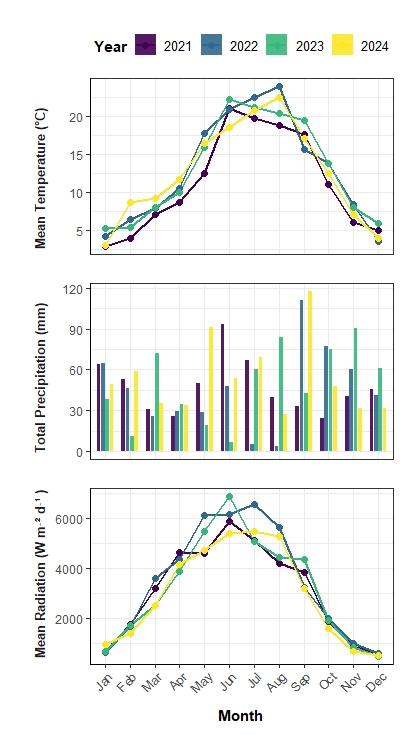
Figure 1. Daily mean temperature, monthly precipitation, and daily mean global radiation taken from a weather station at the experimental site in Rüdesheim, Germany, for the years 2021‒2024.
Drought stress in the experimental vineyard increased progressively from ΨPD = ‒0.26 MPa at bloom to ‒0.67 MPa at veraison in the unirrigated treatment (‒0.17 and ‒0.34 MPa in the irrigated treatment) and was only alleviated by substantial rainfall in the first half of September, close to harvest (Figures S1 and S2). The difference in ΨPD between irrigation treatments resulted in a reduction of leaf area (27 % lower total leaf area on 28.07.2022; Figure S3) and a substantial decrease in berry size from > 1.5 g in the irrigated treatment blocks to < 1 g in the unirrigated treatment blocks (Table 1), but berry temperatures were not affected by irrigation (Figure S4).
Leaf removal |
| partial | partial | full | full | δ13C | LR | INT | |||||||||
Irrigated | no | yes | no | yes | |||||||||||||
|
|
|
|
|
|
|
|
|
|
|
|
|
|
|
|
|
|
Juice Quality | |||||||||||||||||
TSS (°Brix) | 18.3 | ± | 0.72 | 17.37 | ± | 0.23 | 18.73 | ± | 0.75 | 18.07 | ± | 0.8 | 0.076 | 0.154 | 0.502 | ||
Berry weight (g) | 1.05 | ± | 0.14 | 1.61 | ± | 0.04 | 0.99 | ± | 0.12 | 1.52 | ± | 0.03 | < 0,001 | 0.045 | 0.353 | ||
δ13C (‰) vs V-PDB | -20.25 | ± | 0.29 | -22.43 | ± | 0.5 | -20.26 | ± | 0.33 | -22.57 | ± | 0.47 | NA | NA | NA | ||
Free Monoterpenes [µg L–1] | |||||||||||||||||
α-Terpineol | 52.57 | ± | 5.02 | 25 | ± | 3.24 | 38.63 | ± | 11.32 | 36.77 | ± | 6.55 | 0.017 | 0.893 | 0.034 | ||
β-Myrcene | n.d | n.d | n.d | n.d | |||||||||||||
Citronellol | n.d | n.d | n.d | n.d | |||||||||||||
Geraniol | 7.2 | ± | 2.43 | 5.27 | ± | 2.37 | 5.93 | ± | 0.49 | 4.73 | ± | 1.4 | 0.137 | 0.344 | 0,698 | ||
Hotrienol | 40.43 | ± | 5.12 | 27.2 | ± | 7.96 | 40.97 | ± | 16.07 | 38.4 | ± | 10.55 | 0.096 | 0.186 | 0,309 | ||
Limonene | n.d | n.d | n.d | n.d | |||||||||||||
Linalool oxide 1 | 2.33 | ± | 0.31 | 1.43 | ± | 0.4 | 2.3 | ± | 0.92 | 1.97 | ± | 0.59 | 0.093 | 0.415 | 0.404 | ||
Linalool | 116.97 | ± | 9.33 | 58.83 | ± | 7.21 | 112.83 | ± | 44.36 | 84.13 | ± | 8.99 | 0.025 | 0.43 | 0.385 | ||
Nerol | 2.47 | ± | 0.31 | 1.77 | ± | 0.15 | 2.13 | ± | 0.51 | 1.83 | ± | 0.21 | 0.053 | 0.576 | 0.449 | ||
Nerol oxide | n.d | n.d | n.d | n.d | |||||||||||||
Total | 214.77 | ± | 19.32 | 114.23 | ± | 16.63 | 196.87 | ± | 71.11 | 163.1 | ± | 24.2 | 0.027 | 0.501 | 0.241 | ||
Free C13 Norisoprenoids [µg L–1] | |||||||||||||||||
β-Damascenone | 0.9 | ± | 0.35 | 0.4 | ± | 0.1 | 0.83 | ± | 0.71 | 0.4 | ± | 0.17 | 0.067 | 0.926 | 0.906 | ||
Glycosylated Monoterpenes [µg L–1] | |||||||||||||||||
α-Terpineol | 509.13 | ± | 110.81 | 330 | ± | 35.4 | 499.43 | ± | 64.43 | 458.57 | ± | 85.93 | 0.017 | 0.1 | 0.082 | ||
β-Myrcene | n.d | n.d | n.d | n.d | |||||||||||||
Hotrienol | 90.87 | ± | 21.63 | 89,63 | ± | 12,53 | 87.7 | ± | 24.19 | 114.1 | ± | 22.71 | 0.026 | 0.081 | 0.032 | ||
Limonene | n.d | n.d | n.d | n.d | |||||||||||||
Linalool | 38.43 | ± | 7.02 | 36.07 | ± | 6.96 | 36.43 | ± | 11.97 | 38.3 | ± | 8.54 | 0.683 | 0.993 | 0.638 | ||
Nerol oxide | 76.5 | ± | 18.52 | 73.5 | ± | 12.22 | 82.83 | ± | 15.97 | 97.23 | ± | 14.91 | 0.098 | 0.007 | 0.072 | ||
Total | 714.93 | ± | 144.73 | 529.2 | ± | 62.01 | 706.4 | ± | 107.93 | 708.2 | ± | 101.9 | 0.079 | 0.065 | 0.058 | ||
Glycosylated C13 Norisoprenoids [µg L–1] | |||||||||||||||||
TDN | 115.2 | ± | 29.27 | 98.27 | ± | 21.61 | 140.93 | ± | 15.28 | 146.93 | ± | 19.71 | 0.765 | 0.03 | 0.534 | ||
Vitispirane | 146.67 | ± | 27.66 | 106.07 | ± | 20.29 | 175.17 | ± | 26.42 | 163.6 | ± | 25.65 | 0.395 | 0.036 | 0.397 | ||
β-Damascenone | 11.1 | ± | 1.39 | 7.77 | ± | 1.1 | 8.8 | ± | 2.33 | 7.37 | ± | 1.07 | 0.108 | 0.265 | 0.503 | ||
Total |
| 272.97 | ± | 57.39 | 212.1 | ± | 42.38 | 324.9 | ± | 43.03 | 317.9 | ± | 46.3 | 0.685 | 0.038 | 0.449 | |
Additionally, some leaf shedding was observed during the ripening phase (Figure S3). δ13C was 2.25 ‰ lower in berry extracts from irrigated vines. The effects of drought stress on berry extract aroma compound concentration in 2022 showed some interactions with the leaf removal treatments, with strong irrigation effects: irrigation reduced aroma compounds only where partial leaf removal was conducted, but not where full leaf removal was conducted (Table 1, Figure 2, Table S7).
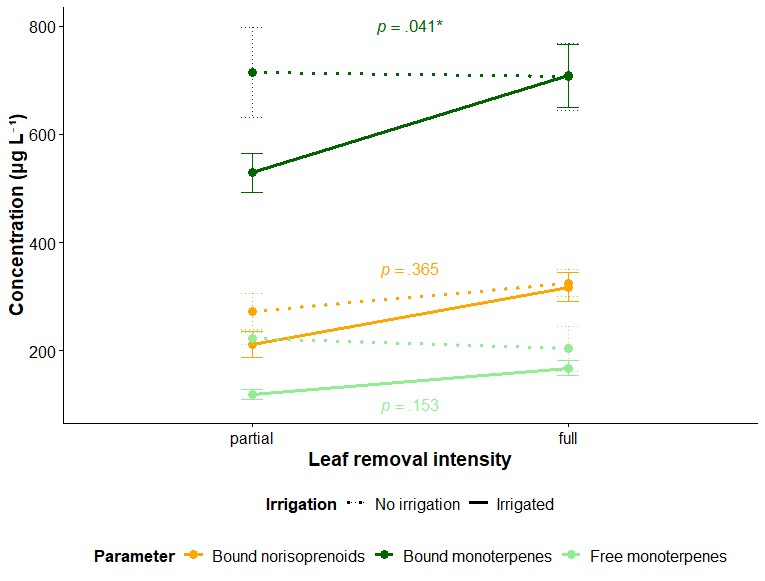
Figure 2. Interaction plot showing the effects of leaf removal intensity on free and glycosylated monoterpene and glycosylated norisoprenoid concentration (µg L–1) in Riesling grape extracts as a function of irrigation. Data from an irrigation trial in the Rüdesheimer Berg, Germany, in the growing season 2022 (Experiment 1a). In unirrigated grapevines, full leaf removal had no effect on aroma compound concentration. In full LR vines, the irrigation effect on aroma compounds was small. P-values of the irrigation × leaf removal interaction calculated with an ANOVA (irrigation × leaf removal + block, Table S7) are shown in the plot.
Vice versa, drought stress (i.e., the unirrigated treatment) increased the concentration of free monoterpenes, bound monoterpenes, and bound C13-norisoprenoids by 88 %, 35 %, and 29 % when only partial leaf removal was conducted but had the same levels as the irrigated treatment under full leaf removal. In comparison, only free monoterpenes increased (20 %) in the unirrigated vines compared to the irrigated vines when full leaf removal was conducted (Figure 2). Leaf removal effects in the unirrigated vines were much weaker in 2022 than in Experiment 1b (same site; seasons 2021, 2023, 2024; Figure 3) and were mostly restricted to glycosylated norisoprenoids (Table 1). Full leaf removal of irrigated vines raised free and bound terpenoid compounds to similar levels as did withholding irrigation with only partial leaf removal (Table 1) but did not increase overall monoterpene concentration above the levels of partial leaf removal in the unirrigated vines. In contrast, the content (i.e., amount per berry) of glycosylated monoterpenes and norisoprenoids was higher in berries with low δ13C (i.e., from the irrigation treatment; Table S2).
Grapes for winemaking were sourced from the irrigated and unirrigated treatments with only partial leaf removal. The effect of drought stress on the wines was comparable to its effect observed in the grapes, except that a larger fraction of norisoprenoids and monoterpenes was present in their free form in wine (Table S3) and the concentration of bound monoterpenes and norisoprenoids was substantially lower than in berry extracts (Table 1). The concentration of free and bound monoterpenes and free and bound norisoprenoids was 48, 16, 56, and 37 % higher, respectively, in wines from unirrigated grapes compared to wines from the irrigated treatment, while the ratio of monoterpenes to norisoprenoids was unaffected by irrigation (Table S3). Similar to Rossmann et al. (1996), δ13C was about 2 ‰ higher in grapes than in ethanol of the corresponding wines, while the difference between irrigated and control treatments was comparable (~2 ‰).
Experiment 1b: The years 2021, 2023, and 2024 were all characterised by above-average precipitation (+42 to +122 mm compared to the annual average for 1991–2020). Hence, the irrigation system was not put into operation in these seasons, and the vineyard remained dry-farmed. In all years, however, long dry periods around the time of veraison led to drought stress during the ripening phase (Average minimum ΨPD = ‒0.74, ‒0.81, and ‒0.47 MPa for 2021, 2023, and 2024, respectively; Figure S1). A high spatial variability of drought stress was observed in the experimental vineyard, with block 1 showing higher juice δ13C, more negative water potentials and lower berry weights compared to blocks 2 and 3 (Table S4, Figure S1). Although these spatial differences were relatively small compared to the irrigation-induced differences in other experiments presented here (e.g., the coefficient of variance of berry weight across the vineyard was 8 % without irrigation in 2021 and 23 % with irrigation in 2022), the concentration of practically all aroma compounds was significantly higher in berries with high δ13C values, while the content of aroma compounds per berry was little affected (Tables S4 and S5). The effect of drought stress was more pronounced on free and bound monoterpenoids than on bound norisoprenoids (Table S4). A PCA of the data set showed that terpenoids and δ13C values were tightly associated with the first PC, on which leaf removal treatments were also separated (Figure 3). Vintage differences were modelled on PC2 and were associated with berry weight and TSS accumulation.
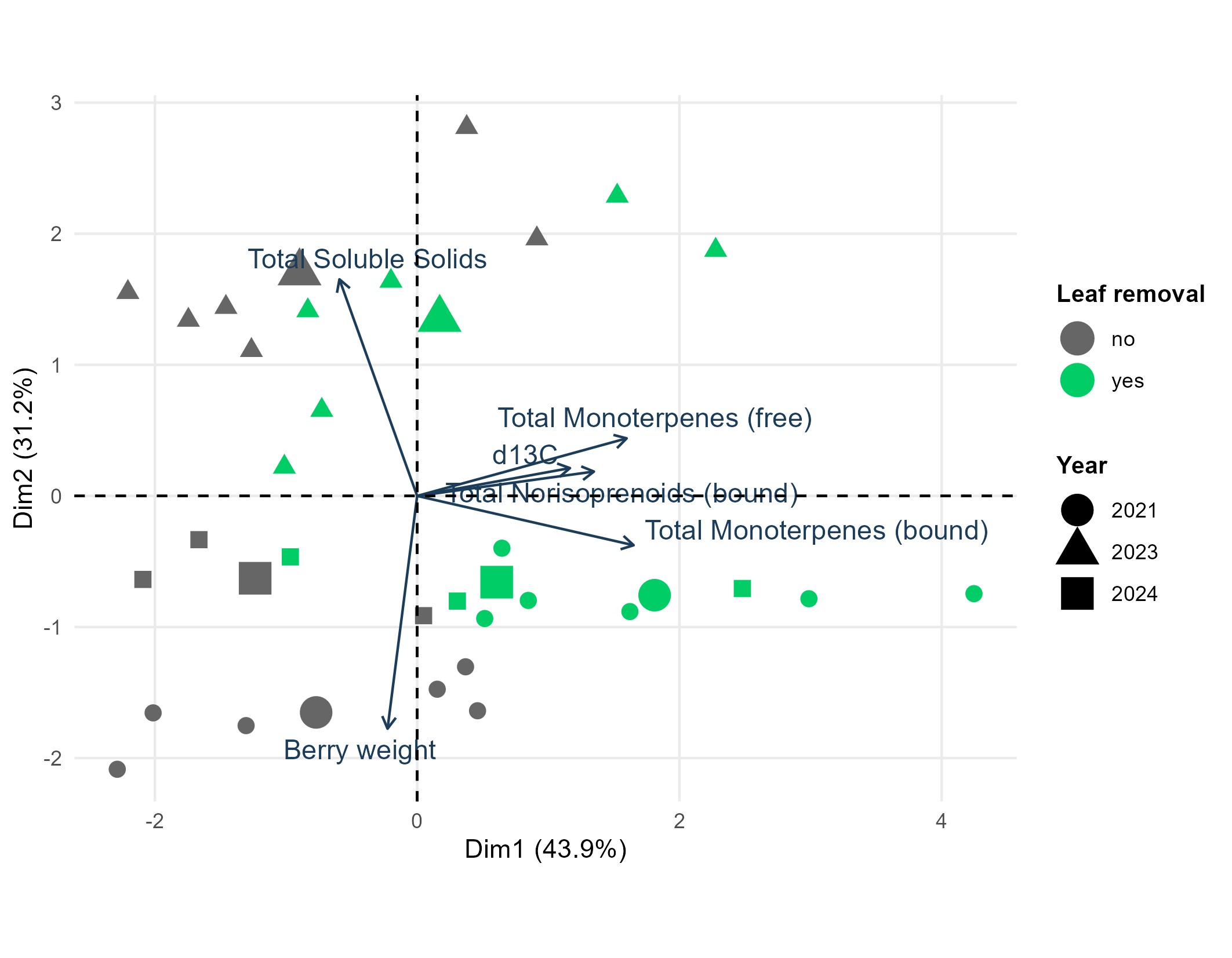
Figure 3. PCA biplot of glycosylated C13-norisoprenoids as well as free and glycosylated monoterpenes, TSS, berry weight, and δ13C values for Riesling grapevines with and without leaf removal. Data from Experiment 1b, vintages 2021 (12 samples), 2023 (12 samples), and 2024 (6 samples).
The effect of leaf removal observed in Experiment 1b (years 2021, 2023, and 2024) was stronger than in Experiments 1a and 2 (year 2022). The effect was particularly pronounced in the 2021 growing season, which was characterised by low temperatures and low global radiation during berry development (Figure 1). Leaf removal increased monoterpenes and C13-norisoprenoids to a similar extent (38 % and 29 %, respectively), with free monoterpenes being the most strongly affected (+67 %, Table S4).
Although no irrigation was applied in the 2021 and 2023 growing seasons, samples were taken from the previously irrigated and unirrigated blocks to test for drought stress-induced carry-over effects. Although carry-over effects on yield were detected (mean yield decrease –25.1 %, p = 0.0057; data not shown), there were no such effects on aroma composition.
An optimisation procedure (Figure 4) was used to uncover crucial time points for drought stress influence on the biosynthesis of aroma compound groups and other drought-sensitive berry traits measured at harvest.
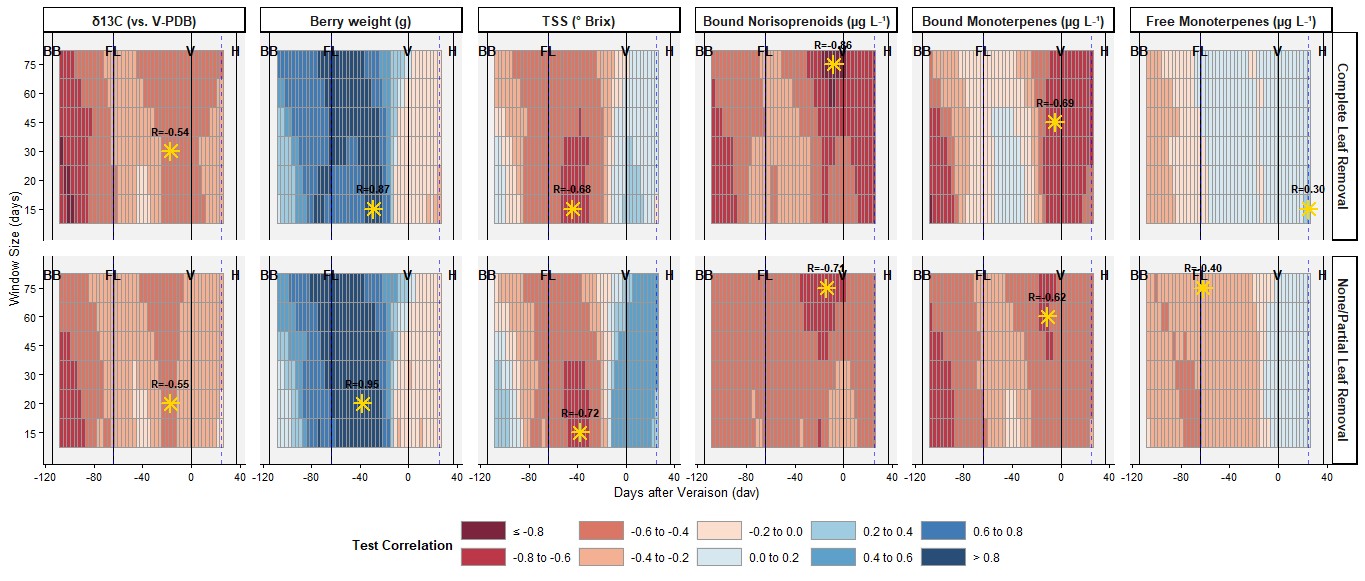
Figure 4. Heatmaps of cross-validated (50-fold, 3 leave-out samples, n = 18) test correlations (Rcv) between ΨPD and six berry quality parameters across moving window sizes (15–75 days) and timing (dav). Correlations are shown for complete (upper panel) and none/partial (lower panel) leaf removal treatments. Phenological stages (BB = budburst, FL = flowering, V = veraison, H = harvest) are indicated. Golden stars (★) mark the optimal window (highest |Rcv|) for each variable and treatment, with corresponding R-values displayed.
Positive correlations were observed between modelled mean ΨPD in the post-flowering phase and berry weight, as well as TSS in the post-veraison period (Figure 4). All other parameters were negatively correlated with Ψ (i.e., increasing under increasing drought stress) at certain phenological stages: δ13C was most strongly correlated with water deficit roughly two weeks before veraison (‒22 dav, window size 20 d, Rcv = 0.55 for undefoliated vines, Figures 4 and S6) and during shoot development. Bound norisoprenoids were also most strongly (R = ‒0.86 with LR) correlated with water deficit shortly before veraison, irrespective of leaf removal. Correlations of bound and free monoterpenes with ΨPD showed different minima, depending on the leaf removal treatment. Without leaf removal, the strongest correlations of free monoterpenes were observed for a window roughly spanning the entire vegetative development phase (centre = ‒39 dav, size = 75 d). Bound monoterpenes were most strongly associated with pre-veraison water deficits. When leaf removal was conducted, free monoterpenes were uncorrelated with water status (Figures 4 and S6). The strongest correlations with bound monoterpenes were observed shortly before Veraison, with large window sizes of 45 and 60 days (R = ‒0.69 and ‒0.62) for LR and no/partial LR, respectively. The correlation of ΨPD during the pre-veraison period and harvest TSS showed a pattern inverse to that with berry weight.
Experiment 2: A strong effect of drought stress on monoterpene and norisoprenoid concentration was observed in Experiment 2 (Table 2), with free monoterpene concentration increasing by 30 % and bound norisoprenoids by 40 %.
Irrigation | DS | Full | δ13C | LR | INT | |||||||||||||||||
Treatment | Control | ELR | LLR | Control | ELR | LLR | ||||||||||||||||
Juice Quality | ||||||||||||||||||||||
TSS (°Brix) | 20.1 | ± | 0.37 | 20.82 | ± | 1.08 | 20.22 | ± | 1.07 | 19.18 | ± | 0.93 | 19.72 | ± | 0.37 | 19.58 | ± | 0.41 | 0.228 | 0.325 | 0.93 | |
Berry weight (g) | 1.04 | ± | 0.04 | 1.15 | ± | 0.15 | 1.16 | ± | 0.11 | 1.62 | ± | 0.2 | 1.5 | ± | 0.12 | 1.57 | ± | 0.05 | <0.001 | 0.341 | 0.324 | |
δ13C (‰) vs V-PDB | -25.38 | ± | 0.27 | -25.79 | ± | 0.42 | -25.33 | ± | 0.28 | -27.41 | ± | 0.18 | -27.4 | ± | 0.28 | -27.47 | ± | 0.08 | NA | NA | NA | |
Free Monoterpenes (µg L–1) | ||||||||||||||||||||||
α-Terpineol | 14.38 | ± | 4.64 | 15.34 | ± | 4.23 | 16.52 | ± | 3.83 | 6.08 | ± | 1.24 | 7.86 | ± | 2.45 | 9.4 | ± | 1.91 | <0.001 | 0.105 | 0.809 | |
β-Myrcene | 1.34 | ± | 0.3 | 1.36 | ± | 0.38 | 1.4 | ± | 0.29 | 1.5 | ± | 0.35 | 1.34 | ± | 0.47 | 1.5 | ± | 0.44 | 0.734 | 0.815 | 0.695 | |
Citronellol | 0.96 | ± | 0.17 | 0.96 | ± | 0.09 | 0.96 | ± | 0.09 | 1.8 | ± | 0.23 | 1.92 | ± | 0.18 | 1.98 | ± | 0.45 | 0.14 | 0.686 | 0.682 | |
Geraniol | 8.42 | ± | 4.15 | 8.74 | ± | 2.72 | 10.08 | ± | 2.38 | 14.9 | ± | 2.7 | 14.14 | ± | 1.94 | 17 | ± | 6.02 | <0.001 | 0.249 | 0.99 | |
Hotrienol | 47.48 | ± | 12.81 | 46.98 | ± | 9.04 | 47.9 | ± | 10.59 | 26.2 | ± | 7.37 | 35.2 | ± | 12.38 | 32.78 | ± | 9.55 | 0.344 | 0.623 | 0.451 | |
Limonene | 0.92 | ± | 0.19 | 0.94 | ± | 0.34 | 0.94 | ± | 0.11 | 0.58 | ± | 0.16 | 0.62 | ± | 0.22 | 0.74 | ± | 0.18 | 0.001 | 0.612 | 0.422 | |
Linalool oxide 1 | 3.04 | ± | 0.96 | 3 | ± | 0.62 | 3.04 | ± | 0.8 | 2.12 | ± | 0.39 | 2.56 | ± | 0.48 | 2.8 | ± | 0.4 | 0.154 | 0.4 | 0.294 | |
Linalool | 26.96 | ± | 10.79 | 29.32 | ± | 10.31 | 32.38 | ± | 9.97 | 8.04 | ± | 4.08 | 12.98 | ± | 6.57 | 18.98 | ± | 6.18 | 0.001 | 0.059 | 0.646 | |
Nerol | 1.7 | ± | 0.64 | 1.68 | ± | 0.24 | 1.84 | ± | 0.4 | 1.92 | ± | 0.27 | 2.08 | ± | 0.13 | 2.28 | ± | 0.67 | 0.042 | 0.408 | 0.731 | |
Nerol oxide | 0.56 | ± | 0.11 | 0.58 | ± | 0.08 | 0.58 | ± | 0.08 | 0.38 | ± | 0.04 | 0.38 | ± | 0.04 | 0.42 | ± | 0.11 | 0.451 | 0.724 | 0.812 | |
Total | 105.76 | ± | 32.4 | 108.9 | ± | 22.51 | 115.64 | ± | 26.04 | 63.52 | ± | 13.3 | 79.08 | ± | 14 | 87.88 | ± | 18.83 | 0.006 | 0.185 | 0.639 | |
Free C13 Norisoprenoids (µg L–1) | ||||||||||||||||||||||
β-Damascenone | 0.72 | ± | 0.11 | 0.76 | ± | 0.22 | 0.74 | ± | 0.15 | 0.36 | ± | 0.09 | 0.36 | ± | 0.15 | 0.36 | ± | 0.19 | 0.382 | 0.991 | 0.987 | |
Glycosylated Monoterpenes (µg L–1) | ||||||||||||||||||||||
α-Terpineol | 109.38 | ± | 30.97 | 115.92 | ± | 20.68 | 128.78 | ± | 38.41 | 64.6 | ± | 12.94 | 92.36 | ± | 22.87 | 106.8 | ± | 43.27 | 0.034 | 0.055 | 0.647 | |
β-Myrcene | 2.3 | ± | 0.49 | 2.24 | ± | 0.33 | 2.56 | ± | 0.43 | 1.56 | ± | 0.21 | 1.82 | ± | 0.44 | 2.5 | ± | 0.67 | 0.027 | 0.011 | 0.171 | |
Hotrienol | 83.42 | ± | 23.08 | 92.08 | ± | 12.52 | 107.2 | ± | 35.22 | 83.24 | ± | 14.11 | 94.16 | ± | 17.97 | 108.9 | ± | 30.03 | 0.93 | 0.06 | 0.955 | |
Limonene | 3.78 | ± | 0.64 | 3.56 | ± | 0.56 | 4.02 | ± | 0.72 | 2.86 | ± | 0.36 | 3.38 | ± | 0.45 | 3.92 | ± | 1.08 | 0.107 | 0.08 | 0.28 | |
Linalool | 5.26 | ± | 1.68 | 6.06 | ± | 1.09 | 6.98 | ± | 2.34 | 2.2 | ± | 0.75 | 3.12 | ± | 1.68 | 4.64 | ± | 2.2 | 0.002 | 0.022 | 0.639 | |
Nerol oxide | 38.02 | ± | 7.18 | 37.72 | ± | 6.69 | 42.7 | ± | 11.52 | 42.3 | ± | 7.32 | 48.56 | ± | 5.14 | 60.46 | ± | 10.8 | 0.011 | 0.008 | 0.212 | |
Total | 242.16 | ± | 62.23 | 257.58 | ± | 38.96 | 292.24 | ± | 86.21 | 196.76 | ± | 33.95 | 243.4 | ± | 35.88 | 287.22 | ± | 86.4 | 0.394 | 0.034 | 0.71 | |
Glycosylated C13 Norisoprenoids (µg L–1) | ||||||||||||||||||||||
TDN | 29.48 | ± | 5.18 | 28.12 | ± | 5.61 | 32.16 | ± | 4.23 | 11.7 | ± | 3.72 | 13.36 | ± | 10.81 | 18.9 | ± | 4.5 | <0.001 | 0.164 | 0.442 | |
Vitispirane | 50.2 | ± | 12.55 | 55.6 | ± | 12.06 | 56.3 | ± | 20.61 | 25.42 | ± | 8.04 | 28.24 | ± | 21.83 | 38.9 | ± | 11.13 | 0.009 | 0.291 | 0.388 | |
β-Damascenone | 4.7 | ± | 0.93 | 4.14 | ± | 0.96 | 5.78 | ± | 1.44 | 7.1 | ± | 2.25 | 5.74 | ± | 1.65 | 7.36 | ± | 1.16 | 0.319 | 0.058 | 0.732 | |
Total | 84.38 | ± | 17.03 | 87.86 | ± | 18.46 | 94.24 | ± | 24.64 | 44.22 | ± | 13.22 | 47.34 | ± | 34.07 | 65.16 | ± | 14.91 | 0.003 | 0.221 | 0.425 | |
This experiment was carried out in a hot and dry summer (2022), in which irrigation was completely withheld from flowering to veraison in the DS (drought stress) treatment, leading to strong water deficits (ΨMD up to ‒1.5 MPa) before irrigation was reinitiated (Figure S5). The water deficit strongly affected berry size (‒40 % berry weight), with variance similar to the experiment carried out at the Rüdesheim site in the same year (CV 19 % and 23 %, respectively; Table 2). Besides berry size, δ13C was also strongly affected by the pre-veraison water deficit (Table 2). This was surprising, as δ13C is normally associated with water deficit during the ripening phase, but it was in line with the results of Experiment 1. There was a significant positive relationship between δ13C and 1,1,6-trimethyl-1,2-dihydronaphthalene (TDN), vitispirane, and total bound norisoprenoids, as well as some free and glycosylated monoterpenes, and a negative relationship with three monoterpenes (free geraniol, nerol, and bound nerol oxide) in berry extracts. The leaf removal effect was relatively weak, and mostly limited to glycosylated monoterpenes, similar to the experiment carried out at the Rüdesheim site in the same year. Another similarity between the two experiments was that the effects of leaf removal were small when carried out in the drought stress treatment, compared to the fully irrigated treatment. Late leaf removal (LLR) had a larger effect on aroma compound concentration than early leaf removal (ELR, Table 2). Likely due to the strong effect of the drought treatment on berry size, there were no effects of irrigation on free monoterpene and bound norisoprenoid content per berry (Table S6), while the bound monoterpene content was elevated in berries from fully irrigated vines.
Discussion
To dissect drought- and sun exposure-induced effects on the monoterpenoid and C13-norisoprenoid content of Riesling grapes, we collected data from three experiments combining irrigation and leaf removal treatments and δ13C measurements under different climatic conditions and drought stress levels.
1. Drought stress is a key determinant of terpenoid accumulation in grapes
One key finding of our study is that drought stress increases grape aroma compound accumulation, independent of its effects on the canopy microclimate. In all data sets investigated, drought stress turned out to explain a large fraction of the variance of terpenoid concentration of berry extracts and wine. Our observations were consistent across multiple seasons and on two continents, although experimental conditions were not always consistent. The berry juice and wine δ13C generally was positively related to the concentration of almost all aroma compounds. Because δ13C is typically higher (i.e., less negative) in berries from drought-stressed vines, this finding is in line with a number of publications showing a positive impact of drought stress on grape aroma volatile concentration and an up-regulation of terpenoid biosynthetic pathway genes (Savoi et al., 2016; Savoi et al., 2017; Palai et al., 2023). The drought-related increase in monoterpene concentration, however, was stronger in the data presented here (up to 80 %) compared to other studies (e.g., Kovalenko et al., 2021; Wang et al., 2019, up to 40 %). Discrepancies among studies might be attributed to the fact that drought stress was stronger and appeared earlier in our study, which was also reflected in a stronger drought effect on berry weight in our study compared to the cited studies. Moreover, some of the studies mentioned above were conducted on non-aromatic cultivars, and some studies did not quantify glycosylated aroma compounds.
Using simulated water potentials at high temporal resolution enabled us to investigate critical points in berry development for aroma compound synthesis under field conditions. It has been postulated that severe and early (i.e., pre-veraison) water deficits lead to stronger increases in the aroma compound concentration in grapes compared to late or sustained water deficits (Palai et al., 2023; Diverres et al., 2024). Data from our study corroborated this finding: In vines without leaf removal, simulated ΨPD correlated strongly with aroma compound concentration throughout the berry development and ripening phase, but the strongest correlations were observed during the lag phase. However, both intermittent (2023 in Experiment 1b, DS in Experiment 2) and terminal drought (2021 and 2024 in Experiment 1b, as well as Experiment 1a) similarly affected aroma compound concentration in the harvested berries. In fact, aroma compound concentration in LR vines correlated more strongly with simulated ΨPD in the early ripening phase (bound monoterpenes), while free monoterpenes were largely uncorrelated with drought stress except for the late ripening phase. The discrepancy between LR and control vines may possibly be explained by the hypothesis that earlier stress triggered a rather indirect, light-exposure-driven (Savoi et al., 2016) effect in addition to the drought-related effect itself.
The effects of drought stress on the concentration of monoterpenes seemed to be linear, with no clear maximum visible. Only in the year 2022, when the simulated ΨPD reached < ‒1.2 MPa in all blocks of the Rüdesheim vineyard (Figure S1), did monoterpene concentration appear to deviate from linearity in LR vines. More data will be needed to establish clearer optima of ΨPD for aroma compound synthesis. Within ΨPD ranges common in practical viticulture, our data suggest a linear relationship.
Drought stress also increased the C13-norisoprenoid concentration of the berries, as shown in other studies (Bindon et al., 2007; Song et al., 2012). Norisoprenoid biosynthesis was strongly related to water deficit during the lag phase, irrespective of leaf removal. This is consistent with findings of Palai et al. (2023), who showed that pre-veraison water deficits increase norisoprenoid biosynthesis. Kwasniewski et al. (2010) showed that pre-veraison light exposure is crucial for increasing norisoprenoid concentration in Riesling grapes without leaf removal. Leaf removal shifted the phase of strongest correlation with simulated ΨPD towards the ripening phase. This effect was similar (in wine) to or somewhat less pronounced (in grapes) than the effect of drought stress on monoterpenoid concentration, in contrast to the findings of Palai et al. (2023) on Sangiovese, who reported that norisoprenoid biosynthesis was induced more strongly than monoterpene biosynthesis under drought stress. The effects of drought on norisoprenoid concentration were less pronounced when leaf removal was conducted.
2. Leaf removal effects are attenuated by drought stress and, potentially, heat
Leaf removal increased the concentration of almost all investigated aroma compounds, though the magnitude of the effect was greater in Germany than in Washington. It has long been known that the interception of solar radiation increases the accumulation of (potentially) volatile compounds in grape bunches (Friedel et al., 2016a; Sasaki et al., 2016; Zhang et al., 2023). There is strong evidence that in shade-avoiding plants such as grapevines, light quality plays a central role in partitioning plant resources between shade avoidance (i.e., growth/morphology) and defense/stress tolerance (i.e., accumulation of secondary metabolites) (Chico et al., 2014; Liu et al., 2021; González et al., 2021). Photoreceptors present in the grape berry have been shown to play a role in the biosynthesis of some secondary metabolites (González et al., 2015). Consequently, leaf removal increases monoterpene accumulation in grapevines in temperate climates (e.g., Reynolds & Wardle, 1989; Skinkis et al., 2010; Young et al., 2016). In warmer climates, exposed bunches had lower or equal monoterpene concentration than bunches grown under canopy cover (Bureau et al., 2000) or artificial shade (Belancic et al., 1997). In our study, LR in Experiment 2, which was conducted in a climate with hot summers, led to an increase in aroma compound concentration, albeit to a lesser extent than in all other experiments. This may be due to the moderate LR conducted only on the eastern side of the canopy, but it is also similar to the results of Experiment 1a, where LR effects were small and it was the hottest year in the trials conducted in Germany. A putative detrimental effect of high bunch temperature on monoterpene concentration, as shown in a recent study comparing bunch postharvest dehydration under two temperature regimes (Shmuleviz et al., 2023), might potentially explain this phenomenon, but this topic clearly merits additional research. In the present study, the concentrations of both monoterpenes and glycosylated C13-norisoprenoids in Riesling berries from Washington (warmer climate) were considerably lower than those from Germany (cooler climate). Whether these differences are indeed due to differences in temperature, or are instead caused by clonal differences or some other unknown effect, remains to be investigated.
Water deficit exerts both direct and indirect positive effects on aroma compounds, but the interaction between them is antagonistic. In our study, the magnitude of the effect of leaf removal on the aroma compound concentration varied with the climatic zone and the intensity of leaf removal and drought stress. The strongest effects of leaf removal were observed in Experiment 1b, where water supply and vine vigour were relatively high for all treatments. The leaf removal treatments applied in the other experiments had weaker effects, especially in the drought stress/unirrigated treatments. For example, leaf removal led to a 2.5- and 4.1-fold higher relative increase in glycosylated and free aroma compounds, respectively, in fully irrigated compared to deficit-irrigated vines in Experiment 1b, while in Experiment 1a, full leaf removal even decreased monoterpene concentration in unirrigated vines. The observation that leaf removal effects were stronger in vigorous, well-irrigated vines was consistent in all trials. This is a hint that the microclimatic effects related to reduced vigour in drought-stressed vines (i.e., increased light penetration into the bunch zone) comprise a substantial part of the effects of drought stress observed in other studies, as mentioned by Savoi et al. (2020). This observation might also explain why, in the absence of LR, monoterpene and norisoprenoid concentrations were more strongly influenced by early drought stress, which typically has a greater influence on canopy growth compared with late stress.
In a study conducted in the same vineyard as Experiment 2, Diverres et al. (2024) showed that deficit irrigation led to a reduction in canopy size, an increase in light penetration into the bunch zone and an increase in monoterpenes and TDN compared with full irrigation. However, the idea that the effect of drought stress on aroma compounds goes beyond a mere microclimatic effect is supported by the fact that the monoterpene levels were correlated with δ13C and ΨPD even in full LR treatments, in which light penetration into the bunch zone can be assumed to be high irrespective of vine water status. Removing leaves in the bunch zone would have led to greater sun exposure of the bunches even when drought stress was absent, suggesting that targeted canopy management practices can partly substitute for deficit irrigation management.
Due to the reduced shoot growth under drought, microclimate might be further influenced by reduced canopy density above the bunch zone, an effect that cannot be excluded by LR in the bunch zone. This would slightly bias our results so that the drought stress effect might be overestimated and the bunch exposure effect underestimated. Berry temperature measurements taken at midday show that there was no effect of irrigation, but these data are restricted to one particularly hot day in 2022 (Figure S4).
3. Berry size is likely not the driving factor for the increase in aroma compounds
Drought stress strongly limits cell expansion in developing grape berries, while cell division seems to remain unaltered (Ojeda et al., 2001). This effect was reflected in a moderate (Experiment 1b) to strong (Experiments 1a and 2) reduction in berry size under drought stress in our study that paralleled the increase in aroma compound concentration. Similarly, Palai et al. (2023) reported the strongest drought stress effect on monoterpene concentration in treatments that had the strongest reduction of berry size. Hence, the reason for the increased concentration of aroma compounds in berry extracts and wines under drought stress may not be an effect of drought stress per se, but rather its impact on the berry diameter and skin/flesh ratio.
In an earlier study, however, we found that monoterpene concentration in Riesling wine from non-stressed grapes was uncorrelated or positively correlated with berry diameter, while C13-norisoprenoid concentration was uncorrelated or (slightly) negatively correlated with berry diameter (Friedel et al., 2016b). Experimental wines from the present study had significantly increased concentrations of free and glycosylated aroma compounds compared with wines from drought-stressed berries. This outcome is in line with results presented by Matthews and Nuzzo (2007), who postulated that it is the source of variation for yield and berry size, rather than yield or berry size per se, that affects fruit quality. Palai et al. (2023) have shown that drought-induced increases in aroma compound concentration were accompanied by little to no effects on skin/flesh ratio. Therefore, the drought stress effects on aroma compounds observed here are likely to have occurred independently of its effect on berry size.
4. Drought effects are consistent in berries and wine
Experimental winemaking in 2022 showed that the effect of drought stress is not limited to grapes and that effects of similar magnitude can be expected in the resulting wines. As in the berry extracts, the concentration of C13-norisoprenoids and monoterpenes in the wines was also increased by drought stress. This is in accordance with Willwerth et al. (2018), who demonstrated that Riesling wines from vineyard zones with lower Ψ had fruiter and more kerosene-like flavours. For viticultural practice, this outcome confirms that positive effects of drought stress on grape and wine quality are not limited to red wine cultivars. Indeed, isoprenoid and anthocyanin biosynthesis are similarly upregulated in response to drought and high light stress, with isoprenoids showing a stronger response to stress when anthocyanins are not present (Zhang et al., 2023). Pre-veraison deficit irrigation strategies such as RDI, with some re-watering after veraison, will ensure maximum aromatic quality as well as rapid sugar accumulation at the expense of some reduction in berry size and yield. Deficit irrigation strategies reaching their stress peaks during the lag phase might limit yield losses while maximising the effects on aroma accumulation. Increasing sun exposure by bunch zone leaf removal will further enhance aromatic composition, especially in climates with a cool to moderate ripening phase. In warm climates, however, care must be taken not to overexpose bunches on the hot afternoon side of the canopy to avoid sunburn injury or a potential loss of aroma compounds (Gambetta et al., 2021).
Conclusion
By combining drought stress experiments with leaf removal treatments, we showed that drought stress and increased bunch sun exposure via leaf removal both increase the concentration of monoterpenes and C13-norisoprenoids in Riesling grapes. The indirect effect of drought stress on aroma compound concentration – a reduction of canopy density – was reduced by leaf removal, and similarly, the effects of leaf removal were reduced in drought-stressed vines. Correlations between glycosylated aroma compounds and simulated drought stress were particularly strong ~14 days before veraison. Wines made from the grapes of an irrigation trial showed that the effects measured in the berries can be expected in wines to a similar extent. Drought stress, whether as a terroir factor or as part of a quality-oriented management and irrigation strategy, can therefore be considered a positive factor for wine quality through an indirect, microclimatic effect as well as a direct effect on aroma compound biosynthesis. Leaf removal can support quality-oriented management strategies, but its effect appears to decrease with increasing drought stress.
Acknowledgements
We thank the students Carl Baumberger, Alena Mosbacher, Gianna Kozlovic, and Nicola Sorrenti, who did much of the fieldwork for the project in 2021-2024. The laboratory team of the HGU Department of Viticulture is acknowledged for their assistance in the project. The wineries "Hessische Staatsweingüter Kloster Eberbach" and "Weingut Peter Jakob Kühn" are acknowledged for their valuable collaboration in the field experiments. The team at WSU Prosser is thanked for their assistance in conducting the irrigation trial in Washington and processing the samples from the experiments conducted there. The authors also thank Christian Borsch and Silvia Rudloff of JLU Giessen for their support in δ13C analysis.
References
- AG Boden. (2024). Bodenkundliche Kartieranleitung KA6-in 2 Bänden.
- Belancic, A., Agosin, E., Ibacache, A., Bordeu, E., Baumes, R., Razungles, A., & Bayonove, C. (1997). Influence of sun exposure on the aromatic composition of Chilean Muscat grape cultivars Moscatel de Alejandria and Moscatel rosada. American Journal of Enology and Viticulture, 48, 181–186. https://doi.org/10.5344/ajev.1997.48.2.181
- Bindon, K. A., Dry, P. R., & Loveys, B. R. (2007). Influence of plant water status on the production of C13-norisoprenoid precursors in Vitis vinifera L. cv. Cabernet Sauvignon grape berries. Journal of Agricultural and Food Chemistry, 55, 4493–4500. https://doi.org/10.1021/jf063331p
- Boncan, D. A. T., Tsang, S. S. K., Li, C., Lee, I. H. T., Lam, H.-M., Chan, T.-F., & Hui, J. H. L. (2020). Terpenes and terpenoids in plants: Interactions with environment and insects. International Journal of Molecular Sciences, 21, 7382. https://doi.org/10.3390/ijms21197382
- Bureau, S. M., Baumes, R. L., & Razungles, A. J. (2000). Effects of vine or bunch shading on the glycosylated flavor precursors in grapes of Vitis vinifera L. cv. Syrah. Journal of Agricultural and Food Chemistry, 48, 1290–1297. https://doi.org/10.1021/jf990507x
- Chico, J.-M., Fernández-Barbero, G., Chini, A., Fernández-Calvo, P., Díez-Díaz, M., & Solano, R. (2014). Repression of jasmonate-dependent defenses by shade involves differential regulation of protein stability of MYC transcription factors and their JAZ repressors in Arabidopsis. The Plant Cell, 26, 1967–1980. https://doi.org/10.1105/tpc.114.125047
- Coombe, B. G. (1995). Growth stages of the grapevine: Adoption of a system for identifying grapevine growth stages. Australian Journal of Grape and Wine Research, 1, 104-110. https://doi.org/10.1111/j.1755-0238.1995.tb00086.x
- Dehner, U., Renger, M., Bräunig, A., Lamparter, A., Bauriegel, A., Burbaum, B., ... & Waldmann, F. (2015). Neue Kennwerte für die Wasserbindung in Böden - Ergebnisse der Abstimmung zwischen dem Personenkreis Wasserhaushaltstabellen der Ad-hoc-AG Boden und dem DWA. In Jahrestagung der DBG 2015: Unsere Böden - unser Leben.
- Deloire, A., Carbonneau, A., Wang, Z., & Ojeda, H. (2004). Vine and water: a short review. OENO One, 38(1), 1–13. https://doi.org/10.20870/oeno-one.2004.38.1.932
- Diverres, G., Fox, D. J., Harbertson, J. F., Karkee, M., & Keller, M. (2024). Response of Riesling grapes and wine to temporally and spatially heterogeneous soil water availability. American Journal of Enology and Viticulture, 75, 750019. https://doi.org/10.5344/ajev.2024.23073
- DWD. (2025). Daily station observations for Germany (Version v24.3) [Data set]. https://opendata.dwd.de/
- D’Onofrio, C., Matarese, F., & Cuzzola, A. (2018). Effect of methyl jasmonate on the aroma of Sangiovese grapes and wines. Food Chemistry, 242, 352–361. https://doi.org/10.1016/j.foodchem.2017.09.084
- Friedel, M., Frotscher, J., Nitsch, M., Hofmann, M., Bogs, J., Stoll, M., & Dietrich, H. (2016a). Light promotes expression of monoterpene and flavonol metabolic genes and enhances flavour of winegrape berries (Vitis vinifera L. cv. Riesling). Australian Journal of Grape and Wine Research, 22, 409–421. https://doi.org/10.1111/ajgw.12229
- Friedel, M., Sorrentino, V., Blank, M., & Schüttler, A. (2016b). Influence of berry diameter and colour on some determinants of wine composition of Vitis vinifera L. cv. Riesling. Australian Journal of Grape and Wine Research, 22, 215–225. https://doi.org/10.1111/ajgw.12210
- Gambetta, J. M., Holzapfel, B. P., Stoll, M., & Friedel, M. (2021). Sunburn in grapes: A review. Frontiers in Plant Science, 11, 2123. https://doi.org/10.3389/fpls.2020.604691
- Gershenzon, J., & Dudareva, N. (2007). The function of terpene natural products in the natural world. Nature Chemical Biology, 3, 408–414. https://doi.org/10.1038/nchembio.2007.5
- González, C. V., Fanzone, M. L., Cortés, L. E., Bottini, R., Lijavetzky, D. C., Ballaré, C. L., & Boccalandro, H. E. (2015). Fruit-localized photoreceptors increase phenolic compounds in berry skins of field-grown Vitis vinifera L. cv. Malbec. Phytochemistry, 110, 46–57. https://doi.org/10.1016/j.phytochem.2014.11.018
- González, C. V., Prieto, J. A., Mazza, C., Jeréz, D. N., Biruk, L. N., Jofré, M. F., & Giordano, C. V. (2021). Grapevine morphological shade acclimation is mediated by light quality whereas hydraulic shade acclimation is mediated by light intensity. Plant Science, 307, 110893. https://doi.org/10.1016/j.plantsci.2021.110893
- Groenveld, T., Obiero, C., Yu, Y., Flury, M., & Keller, M. (2023). Predawn leaf water potential of grapevines is not necessarily a good proxy for soil moisture. BMC Plant Biology, 23, 369, https://doi.org/10.1186/s12870-023-04378-6
- Günata, Y. Z., Bayonove, C. L., Baumes, R. L., & Cordonnier, R. E. (1985). The aroma of grapes. Localisation and evolution of free and bound fractions of some grape aroma components c.v. Muscat during first development and maturation. Journal of the Science of Food and Agriculture, 36, 857–862. https://doi.org/10.1002/jsfa.2740360915
- HLNUG. (2008). Bodenflächendaten weinbauliche Nutzfläche 1:5000 BFD5W [Data set]. Hessisches Landesamt für Naturschutz, Umwelt und Geologie, Wiesbaden, Germany. https://www.hlnug.de/?id=7664
- Hofmann, M., Lux, R., & Schultz, H. R. (2014). Constructing a framework for risk analyses of climate change effects on the water budget of differently sloped vineyards with a numeric simulation using the Monte Carlo method coupled to a water balance model. Frontiers in Plant Science, 5, 645. https://doi.org/10.3389/fpls.2014.00645
- Hofmann, M., Volosciuk, C., Dubrovský, M., Maraun, D., & Schultz, H. R. (2022). Downscaling of climate change scenarios for a high-resolution, site-specific assessment of drought stress risk for two viticultural regions with heterogeneous landscapes. Earth Systems Dynamics, 13, 911–934. https://doi.org/10.5194/esd-13-911-2022
- Holopainen, J. K., & Gershenzon, J. (2010). Multiple stress factors and the emission of plant VOCs. Trends in Plant Science, 15, 176–184. https://doi.org/10.1016/j.tplants.2010.01.006
- Kovalenko, Y., Tindjau, R., Madilao, L. L., & Castellarin, S. D. (2021). Regulated deficit irrigation strategies affect the terpene accumulation in Gewürztraminer (Vitis vinifera L.) grapes grown in the Okanagan Valley. Food Chemistry, 341(Pt 2), 128172. https://doi.org/10.1016/j.foodchem.2020.128172
- Kwasniewski, M. T., Vanden Heuvel, J. E., Pan, B. S., & Sacks, G. L. (2010). Timing of cluster light environment manipulation during grape development affects C13 norisoprenoid and carotenoid concentrations in Riesling. Journal of Agricultural and Food Chemistry, 58, 6841–6849. https://doi.org/10.1021/jf904555p
- Lehn, C., Rossmann, A., & Mayr, C. (2020). Stable isotope relationships between apatite phosphate (δ18 O), structural carbonate (δ18 O, δ13 C), and collagen (δ2 H, δ13 C, δ15 N, δ34 S) in modern human dentine. Rapid communications in mass spectrometry : RCM, 34(8), e8674. https://doi.org/10.1002/rcm.8674
- Liu, Y., Jafari, F., & Wang, H. (2021). Integration of light and hormone signaling pathways in the regulation of plant shade avoidance syndrome. aBIOTECH, 2(2), 131–145. https://doi.org/10.1007/s42994-021-00038-1
- Loose, S., & Kiefer, C. (2020). Auswirkungen des Klimawandels auf deutsche Winzer. Das Deutsche Weinmagazin, 22, 34-36.
- Loose, S., & Pabst, E. (2019). Prowein business report 2019 “Climate change.”. https://www.hs-geisenheim.de/fileadmin/redaktion/HOCHSCHULE/Presse_und_Medien/ProWein_Media_Summit_Nov_2019/PDFs/ProWein_Business_Report_final.pdf
- Mateo, J., & Jiménez, M. (2000). Monoterpenes in grape juice and wines. Journal of Chromatography A, 881, 557–567. https://doi.org/10.1016/S0021-9673(99)01342-4
- Matthews, M. A., & Nuzzo, V. (2007). Berry size and yield paradigms on grapes and wine quality. Acta Horticulturae, 754, 423–436. https://doi.org/10.17660/ActaHortic.2007.754.56
- Müller, K., Keller, M., Stoll, M., & Friedel, M. (2023). Wind speed, sun exposure and water status alter sunburn susceptibility of grape berries. Frontiers in Plant Science, 14, 1145274. https://doi.org/10.3389/fpls.2023.1145274
- Nendel, C. (2010). Grapevine bud break prediction for cool winter climates. International Journal of Biometeorology, 54(3), 231–241. https://doi.org/10.1007/s00484-009-0274-8
- Ojeda, H., Deloire, A., & Carbonneau, A. (2001). Influence of water deficits on grape berry growth. Vitis, 40, 141–146. https://doi.org/10.5073/vitis.2001.40.141-145
- Palai, G., Caruso, G., Gucci, R., & D’Onofrio, C. (2023). Water deficit before veraison is crucial in regulating berry VOCs concentration in Sangiovese grapevines. Frontiers in Plant Science, 14, 1117572. https://doi.org/10.3389/fpls.2023.1117572
- Parker, A., de Cortázar-Atauri, I. G., van Leeuwen, C., & Chuine, I. (2011). General phenological model to characterise the timing of flowering and veraison of Vitis vinifera L. Australian Journal of Grape and Wine Research, 17, 206–216. https://doi.org/10.1111/j.1755-0238.2011.00140.x
- Peñuelas, J., & Staudt, M. (2010). BVOCs and global change. Trends in Plant Science, 15, 133–144. https://doi.org/10.1016/j.tplants.2009.12.005
- Pinheiro, J., Bates, D., & R Core Team. (2025). nlme: Linear and Nonlinear Mixed Effects Models. R package version 3.1-168
- Rapp, A., & Mandery, H. (1986). Wine aroma. Experientia, 42, 873–884. https://doi.org/10.1007/BF01941764
- R Core Team. (2023). R: A language and environment for statistical computing (Version R version 4.3.2) [Computer software]. R Foundation for Statistical Computing. https://www.R-project.org/
- Renger, M., Bohne, K., Facklam, M., Harrach, T., Riek, W., Schäfer, W., Wessolek, G., & Zacharias, S. (2008). Ergebnisse und Vorschläge der DBG-Arbeitsgruppe „Kennwerte des Bodengefüges“ zur Schätzung bodenphysikalischer Kennwerte. Technische Universität Berlin Selbstverlag.
- Reynolds, A. G., & Wardle, D. A. (1989). Influence of fruit microclimate on monoterpene levels of Gewürztraminer. American Journal of Enology and Viticulture, 40, 149-154. https://doi.org/10.5344/ajev.1989.40.3.149
- Rossmann, A., Schmidt, H.-L., Reniero, F., Versini, G., Moussa, I., & Merle, M. H. (1996). Stable carbon isotope content in ethanol of EC data bank wines from Italy, France and Germany. Zeitschrift für Lebensmittel-Untersuchung und Forschung, 203, 293–301. https://doi.org/10.1007/BF01192881
- RStudio Team. (2020). RStudio: integrated development environment for R [Computer software]. RStudio, PBC. http://www.rstudio.com/
- Sasaki, K., Takase, H., Matsuyama, S., Kobayashi, H., Matsuo, H., Ikoma, G., & Takata, R. (2016). Effect of light exposure on linalool biosynthesis and accumulation in grape berries. Bioscience, Biotechnology, and Biochemistry, 80, 2376–2382. https://doi.org/10.1080/09168451.2016.1217148
- Savoi, S., Herrera, J. C., Carlin, S., Lotti, C., Bucchetti, B., Peterlunger, E., … Mattivi, F. (2020). From grape berries to wines: drought impacts on key secondary metabolites. OENO One, 54, 569–582. https://doi.org/10.20870/oeno-one.2020.54.3.3093
- Savoi, S., Wong, D. C. J., Arapitsas, P., Miculan, M., Bucchetti, B., Peterlunger, E., Fait, A., Mattivi, F., Castellarin, S.D. (2016). Transcriptome and metabolite profiling reveals that prolonged drought modulates the phenylpropanoid and terpenoid pathway in white grapes (Vitis vinifera L.). BMC Plant Biology, 16(1), 67. https://doi.org/10.1186/s12870-016-0760-1
- Savoi, S., Wong, D. C. J., Degu, A., Herrera, J. C., Bucchetti, B., Peterlunger, E., Fait, A., Mattivi, F., Castellarin, S.D. (2017). Multi-omics and integrated network analyses reveal new insights into the systems relationships between metabolites, structural genes, and transcriptional regulators in developing grape berries (Vitis vinifera L.) exposed to water deficit. Frontiers in Plant Science, 8, 1124. https://doi.org/10.3389/fpls.2017.01124
- Schmidt, D., Bahr, C., Friedel, M., & Kahlen, K. (2019). Modelling approach for predicting the impact of changing temperature conditions on grapevine canopy architectures. Agronomy, 9, 426. https://doi.org/10.3390/agronomy9080426
- Scholander, P. F., Bradstreet, E. D., Hemmingsen, E. A., & Hammel, H. T. (1965). Sap pressure in vascular plants: Negative hydrostatic pressure can be measured in plants. Science, 148(3668), 339–346. https://doi.org/10.1126/science.148.3668.339
- Shmuleviz, R., Amato, A., Commisso, M., D’Incà, E., Luzzini, G., Ugliano, M., Fasoli, M., Zenoni, S., Tornielli, G.B. (2023). Temperature affects organic acid, terpene and stilbene metabolisms in wine grapes during postharvest dehydration. Frontiers in Plant Science, 14. https://doi.org/10.3389/fpls.2023.1107954
- Skinkis, P. A., Bordelon, B. P., & Butz, E. M. (2010). Effects of sunlight exposure on berry and wine monoterpenes and sensory characteristics of Traminette. American Journal of Enology and Viticulture, 61, 147–156. https://doi.org/10.5344/ajev.2010.61.2.147
- Song, J., Shellie, K. C., Wang, H., & Qian, M. C. (2012). Influence of deficit irrigation and kaolin particle film on grape composition and volatile compounds in Merlot grape (Vitis vinifera L.). Food Chemistry, 134, 841–850. https://doi.org/10.1016/j.foodchem.2012.02.193
- Strack, T., & Stoll, M. (2022). Soil water dynamics and drought stress response of Vitis vinifera L. in steep slope vineyard systems. Agricultural Water Management, 274, 107967. https://doi.org/10.1016/j.agwat.2022.107967
- van Genuchten, M. T. (1980). A closed-form equation for predicting the hydraulic conductivity of unsaturated soils. Soil Science Society of America Journal, 44, 892–898. https://doi.org/10.2136/sssaj1980.03615995004400050002x
- Wang, J., Abbey, T., Kozak, B., Madilao, L. L., Tindjau, R., Del Nin, J., & Castellarin, S. D. (2019). Evolution over the growing season of volatile organic compounds in Viognier (Vitis vinifera L.) grapes under three irrigation regimes. Food Research International, 125, 108512. https://doi.org/10.1016/j.foodres.2019.108512
- Wang, J., VanderWeide, J., Yan, Y., Tindjau, R., Pico, J., Deluc, L., Zandberg, W.F., Castellarin, S.D. (2022). Impact of hormone applications on ripening-related metabolites in Gewürztraminer grapes (Vitis vinifera L.): The key role of jasmonates in terpene modulation. Food Chemistry, 388, 132948. https://doi.org/10.1016/j.foodchem.2022.132948
- Wickham, H. (2016). ggplot2: Elegant graphics for data analysis. Springer. https://ggplot2.tidyverse.org
- Willwerth, J., Reynolds, A., & Lesschaeve, I. (2018). Sensory analysis of Ontario Riesling wines from various water status zones. OENO One, 52(2), 145–171. https://doi.org/10.20870/oeno-one.2018.52.2.1669
- Wüst, M. (2018). Smell of stress: Identification of induced biochemical pathways affecting the volatile composition and flavor quality of crops. Journal of Agricultural and Food Chemistry, 66, 3616–3618. https://doi.org/10.1021/acs.jafc.8b00522
- Young, P. R., Eyeghe-Bickong, H. A., du Plessis, K., Alexandersson, E., Jacobson, D. A., Coetzee, Z., Deloire, A., & Vivier, M. A. (2016). Grapevine plasticity in response to an altered microclimate: Sauvignon blanc modulates specific metabolites in response to increased berry exposure. Plant Physiology, 170, 1235-1254. https://doi.org/10.1104/pp.15.01775
- Zeileis, A., & Grothendieck, G. (2005). zoo: S3 infrastructure for regular and irregular time series. Journal of Statistical Software, 14(6). https://doi.org/10.18637/jss.v014.i06
- Zhang, C., Dai, Z., Ferrier, T., Orduña, L., Santiago, A., Peris, A., Wong, D.C.J., Kappel, C., Savoi, S., Loyola, R., Amato, A., Kozak, B., Li, M., Liang, A., Carrasco, D., Meyer-Regueiro, C., Espinoza, C., Hilbert, G., Figueroa-Balderas, R., …, Matus, J.T. (2023). MYB24 orchestrates terpene and flavonol metabolism as light responses to anthocyanin depletion in variegated grape berries. The Plant Cell, 35, 4238–4265. https://doi.org/10.1093/plcell/koad228
 Views: 39