

ENOLOGY / Original research article
Abstract
The increasing prevalence of wildfire smoke in vineyards presents a challenge for red wine production due to smoke-derived volatile phenols (VPs) and their glycosylated precursors. During fermentation, yeast glycosidases can release free VPs, contributing to smoke taint. Although non-Saccharomyces yeasts are often linked to greater glycoside hydrolysis, their role in smoke-affected wines is not well understood. This study evaluated the effect of selected non-Saccharomyces yeasts on the release of VPs, terpenoids, and colour development in smoke-exposed Pinotage wines, and examined whether yeast activity influences the efficiency of activated charcoal remediation. Sequential fermentations were conducted with Lachancea thermotolerans SAGWRI Y940, Wickerhamomyces anomalus SAGWRI Y541, or Starmerella bacillaris SAGWRI Y550, followed by Saccharomyces cerevisiae NT112. A mixed consortium, a pure S. cerevisiae fermentation, and a non-smoked control were included for comparison. Free VPs and volatile terpenoids were quantified by GC–MS, while wine colour density and hue were assessed spectrophotometrically. At early fermentation stages, non-Saccharomyces treatments generally released fewer VPs than S. cerevisiae alone. However, final VP concentrations were similar across all smoke-exposed wines, indicating a dominant role of S. cerevisiae later in fermentation. Activated charcoal significantly reduced VP levels in all wines, with greater removal observed in treatments with initially lower VP concentrations. However, charcoal also substantially reduced terpenoids, highlighting its non-selective impact on aroma compounds. Terpenoid release did not consistently correlate with VP liberation, suggesting differences in yeast glycosidase specificity. Sequential fermentations also reduced colour density compared to S. cerevisiae, likely due to effects on anthocyanin stability, although L. thermotolerans maintained comparable colour levels. Overall, the results show that non-Saccharomyces yeasts do not necessarily increase VP release in smoke-affected wines. Yeast selection influences aroma, colour, and remediation outcomes, underscoring the need to integrate fermentation strategies with mitigation approaches. Further studies under more realistic smoke exposure conditions are required to confirm these findings.
Introduction
The increasing frequency of wildfires in wine-producing regions such as Australia, South Africa, The United States and southern Europe poses a challenge to wineries due to the negative impact of subsequent smoke exposure of grapes and potential smoke taint in wine (Summerson et al., 2021; Oberholster et al., 2022; Szeto et al., 2024a; Szeto et al., 2024b). Smoke-exposed grapes can produce wines exhibiting undesirable sensory attributes described as “smoky”, “ashy”, and “burnt”, which are mainly associated with the presence of volatile phenols (VPs) such as guaiacol, 4-methylguaiacol, 4-ethylguaiacol, 4-ethylphenol and cresols (Kennison et al., 2008; Hayasaka et al., 2010; Parker et al., 2012). These compounds, formed via the pyrolysis of lignin during wildfires, are absorbed by grape berries and glycosylated within the skins and pulp – rendering them non-volatile and sensorially inactive (Dungey et al., 2011). During fermentation, however, yeast and bacterial enzymatic activity can hydrolyse bound VPs and release the respective free forms, leading to the emergence of smoke taint faults within wines (Mayr et al., 2014; Krstic et al., 2015). The instability of glycosylated VPs is an issue for winemakers, because strategies for minimising VP release or removal of these compounds are only partially effective (Mirabelli-Montan et al., 2021; Modesti et al., 2021; Oberholster et al., 2022; Wilkinson et al., 2022; Huo et al., 2024).
Previous research on yeast selection for smoke tainted wine fermentations has been limited. Several studies evaluated commercial Saccharomyces cerevisiae strains and their ability to release VPs (Noestheden et al., 2018; du Plessis et al., 2021; Whitmore et al., 2021; Oberholster et al., 2022) but the glycosidase enzyme activity responsible for hydrolysing VPs was not directly measured. There have been contrasting claims on the glycosidase activity of this yeast species, initially studies in the 1990’s concluded that S. cerevisiae generally exhibited low or no -glucosidase activity (Rosi et al., 1994; Herscovics, 1999), but subsequent studies reported significant activity in this species (Strauss et al., 2001; Cordero Otero et al., 2003; Wanapu et al., 2012). The main focus of yeast glycosidase research lately has been related to non-Saccharomyces yeasts and their ability to release terpenoids in aromatic wine grape cultivars, since it was thought that S. cerevisiae had little potential for such an application (Hu et al., 2016; Maicas & Mateo, 2016; Porter et al., 2019; Li et al., 2020; Qin et al., 2021). Glycosidase enzymatic activity can also influence anthocyanin stability in red wines, reducing colour density (Manzanares et al., 2000; Yuan et al., 2024). The link between VP release in smoke-exposed wines and terpenoids has not yet been uncovered, and the differences between commercial S. cerevisiae and non-Saccharomyces wine yeasts glycosidase activity in a smoke taint context has yet to be investigated in-depth.
The effective removal of free VPs by activated charcoal and molecularly imprinted polymers was demonstrated in recent studies (Dang et al., 2020; Huo et al., 2024), but the bound VPs were mostly unaffected. In this context, a new unconventional approach should be assessed: selection of yeast strains that release high amounts of VPs in smoke tainted wine fermentation that would improve the removal of VPs via subsequent activated charcoal addition. Previously, 30 non-Saccharomyces yeast strains were screened in smoke-exposed grape juice to identify those with the highest release of VPs from their glycosidic precursors (Zieff et al., 2025). The following yeast species were selected as candidates due to their elevated VP release: Lachancea thermotolerans, Wickerhamomyces anomalus, and Starmerella bacillaris. The current study evaluates these selected strains in sequential fermentations with S. cerevisiae NT112 in smoke-exposed red grape must at larger scale in conditions closer to typical winemaking than the screening experiments. Wines were also combined with activated charcoal treatments to determine whether VP reduction was improved, since charcoal fining has been established as one of the more effective mitigation agents (Fudge et al., 2012). The impact of the selected yeast strains on (i) the liberation of VPs and terpenoids from smoke-exposed red grape must and (ii) the effect on wine colour, while (iii) reduction of VPs after charcoal addition were also tested. Understanding the combined effects on different glycosylated compound classes may contribute to developing yeast-based strategies for mitigating smoke taint and maintaining wine quality in the face of climate change and increased wildfire events.
Materials and methods
1. Yeast strains and culture conditions
Three yeast strains, L. thermotolerans SAGWRI Y940, W. anomalus SAGWRI Y541, and S. bacillaris SAGWRI Y550, were obtained from the culture collection of the South African Grape and Wine Research Institute, Stellenbosch University, South Africa. Strains were streaked from freeze cultures stored at –80 °C in yeast extract 10 g/L, peptone 20 g/L, glucose 20 g/L, and glycerol 15 % v/v onto Wallerstein laboratory nutrient (WLN) agar (Merck-Millipore, Burlington, MA) and incubated at 30 °C for 48 h. Single colonies of all strains, except for S. bacillaris, were transferred to 5 mL sterile YPD broth (yeast extract 10 g/L, peptone 20 g/L, glucose 20 g/L, pH 6.5) in test tubes and placed on a rotating test tube wheel (40 rpm) for 16 h at 30 °C. In the case of S. bacillaris, fructose was substituted for glucose at an equivalent concentration to account for its fructophilic metabolism. Cultures were transferred by pipetting 1 mL into 100 mL YPD broth in 250 mL Erlenmeyer flasks fitted with rubber stoppers and S-type airlocks. The flasks were incubated for 24 h at 30 °C. A final transfer of 10 mL culture to 1 L YPD broth in 2 L Erlenmeyer flasks was carried out similarly to the previous transfer and incubated for 24 h at 30 °C. Yeast cells were centrifuged (9,000 × g) and rinsed with 0.9 % w/v NaCl prior to inoculation. Saccharomyces cerevisiae strain NT 112 (Anchor Oenology, Cape Town, South Africa) in its commercial active dry form was rehydrated according to the producer’s instructions for sequential inoculation.
2. Smoke treatment of grapes
Ripe Pinotage grapes were harvested in February 2025 from the Welgevallen Experimental Farm (Stellenbosch University), at a total sugar concentration of 230 g/L, which is consistent with typical harvest parameters for Pinotage in the Stellenbosch region. Grape bunches were packed into greenhouse tents for post-harvest smoke application, an approach that has been validated as producing comparable levels of volatile phenol glycosides to pre-harvest, on-vine smoke exposure and is therefore appropriate for winemaking trials (Culbert et al., 2021). Smoke application was carried out as follows: dried grass and vegetation from the farm's surrounding area was packed into a commercial bee smoker and ignited, while smoke was pumped continuously into the tents for one hour. The greenhouse tents had a maximum capacity of ca. 50 kg grapes; thus smoke treatments were performed on several batches of grapes sequentially. It should be noted that smoke density and fuel mass were not measured during the treatment, which is acknowledged as a limitation of the current study. Smoke-treated grapes were then transported to Stellenbosch University's experimental cellar and stored at 4 °C for approximately 18 hours before processing.
3. Winemaking
A small portion of non-treated Pinotage grapes were processed separately in the same manner as smoke-treated grapes to serve as a control for winemaking trials. Smoke treated grapes were crushed and destemmed into food-grade plastic buckets. Then, 30 mg/L SO2 and 2 g/hL Rapidase® Extra Fruit (Oenobrands, Montpellier, France) were added to the crushed grapes and stored at 4 °C for 48 h to extract bound volatile phenols into the must. The crushed grapes were placed into a pneumatic press and juice was collected on dry ice and pumped into 300 L settling tanks, while the pressure was gradually increased to 120 kPa. The juice was clarified at 10 °C for 48 h, racked off the sediment into a new tank and homogenised by pump-over before aliquoting into 4.5 L glass fermentation bottles fitted with S-type airlocks and rubber stoppers. Yeast strains were cultured as described in section 1 and various inoculation combinations were applied as listed in Table 1. Wine fermentations were carried out at 25 °C in triplicate. Prior to addition of S. cerevisiae NT112 at 48 h in sequential treatments, 25 g/hL Fermaid K (Lallemand Oenology, Montreal, QC, Canada) was added to each wine and samples were taken for analysis.
Strains | Matrix | Inoculum dose | Treatment code |
L. thermotolerans Y940a and S. cerevisiae NT112b | Smoked | 3 × 10⁶ CFU/mLa and 1 × 10⁶ CFU/mLb | Lt |
W. anomalus Y541a and S. cerevisiae NT112b | Smoked | 3 × 10⁶ CFU/mLa and 1 × 10⁶ CFU/mLb | Wa |
S. bacillaris Y550a and S. cerevisiae NT112b | Smoked | 3 × 10⁶ CFU/mLa and 1 × 10⁶ CFU/mLb | Sb |
L. thermotolerans Y940a, W. anomalus Y541a, S. bacillaris Y550a, and S. cerevisiae NT112b | Smoked | 1 × 10⁶ CFU/mL for each strain | M |
S. cerevisiae NT112a with Rapidase® Revelation Aroma (Oenobrands) | Smoked | 1 × 10⁶ CFU/mL | E |
S. cerevisiae NT112a | Smoked | 1 × 10⁶ CFU/mL | Sc |
S. cerevisiae NT112a | Non-Smoked | 1 × 10⁶ CFU/mL | C |
Inoculated at a0 h and b48 h.
The progress of wine fermentations was monitored by tracking weight loss over time. Upon reaching a plateau in weight loss, the sugar concentration was estimated by FTIR spectroscopy (OenoFoss, FOSS, Hilleroed, Denmark) and bottles were moved to 15 °C once total sugars dropped below 5 g/L. Each replicate was split into two 1.8 L bottles where one was left untreated and the other received 50 g/hL activated charcoal (Qi SmokeTM, Institut Œnologique de Champagne, Mardeuil, France). The charcoal treated wines were rolled/shaken twice daily for five days to resuspend the sediment and then clarified at –4 °C along with untreated wines. The wines were racked off the sediment, sampled for analysis then siphoned into 750 mL wine bottles and sealed with screw caps.
4. Quantification of volatile phenols by Gas chromatography – mass spectrometry
Six volatile phenol compounds, guaiacol, 4-methylguaiacol, o-cresol, phenol, 4-ethylguaiacol, and 4-ethylphenol, were quantified as described in Zieff et al. (2025). While m- and p-cresol standards were included in the analytical method and their peaks were chromatographically resolved from o-cresol, reliable quantification of these compounds could not be achieved. Authentic analytical standards for syringol and 4-methylsyringol were not available at the time of analysis, precluding their quantification. The absence of these compounds is acknowledged as a limitation of the current study. The estimation of total volatile phenols (bound + free) was achieved through the enzymatic release of bound volatile phenols as follows: smoke-exposed juice was adjusted to pH 3 with 1 M HCl and supplemented with 0.03 g/L Rapidase® Revelation Aroma (Oenobrands), which contains -glucosidase enzymes, then incubated at 50 °C for one hour. This enzymatic hydrolysis approach was selected as a practical and validated alternative to acid hydrolysis, which is subject to known limitations including sensitivity to precise pH control and potential degradation of acid-labile VP aglycones (Cui et al., 2024). The treated juice was analysed by Gas chromatography – mass spectrometry (GC-MS) in the same manner as wine samples.
5. Quantification of volatile organic compounds by Gas chromatography – mass spectrometry
All available authentic standards used in this study including linalool, α-terpineol, citronellol, geranylacetone, geraniol, β-damascenone, and β-ionone were purchased from Sigma Aldrich (Steinheim, Germany). Samples (2 mL) were added into a 20 mL SPME vials and 8 mL of tartaric acid buffer (2 g/L pH.3.2) containing preservatives (2 g/L ascorbic acid and 0.2 mg/L sodium azide, NaN3) was added to each vial. Then, 20 µL of the internal standard (IS, 3-Octanol, 0.5 ppm) and 0.5 g of NaCl was added to each vial before the vials were closed and vortexed for few minutes. Samples were put on the auto-sampler before analysis. Volatile organic compounds in samples were extracted with SPME using a 50/30 µm grey DVB/CAR/PDMS fiber (Supelco, Bellefonte, PA). Vials were first pre-incubated for 5 min at 60 °C before the fiber was exposed to the head space for another 30 min at 60 °C. After incubation the fiber was injected to GC inlet (7890B GC System, Agilent Technology, USA) to release the trapped compounds into the column at 250 ℃ in splitless mode for 5 min. The system was fitted with a non-polar HP MS-5 UI capillary column (30 m × 250 µm ID, 0.25 µm film thickness, Agilent Technology, USA). The GC was coupled to a single quadrupole mass spectrometer detector (5977B Inert Plus EI MSD, Agilent Technology, USA) operating on the full scan mode from m/z 50 to 500. The analysis was carried out with a gradient temperature program starting at 40 °C to 250 °C at a rate of 6 °C/min.
6. Wine colour analysis
Wine samples were centrifuged at 3,000 × g for 5 minutes and 1 mL pipetted into cuvettes; absorbance measurements were taken at 420 nm and 520 nm with an Eins Sci E-SP1000-V-P spectrophotometer (Babincev et al., 2016). Wine colour density was determined by adding A420nm + A520nm, while colour hue was calculated as the ratio A420nm/A520nm.
7. Statistical Analyses
All figures and a Pearson correlation matrix on combined volatile phenol and terpenoid data were created with GraphPad Prism software (Ver. 10.3.1). Statistical tests were carried out in R (Ver. 4.5.1 R Core Team 2025). For volatile phenol and terpenoid concentration data, for compounds where the assumptions of normality and homoscedasticity for a parametric ANOVA were violated, differences in compound concentration between treatments were assessed using the non-parametric Kruskal-Wallis test. Subsequently, a Dunn’s post-hoc test with a p-value adjustment for multiple comparisons was applied to identify specific pairwise differences, implemented with the dunn.test package (Dinno, 2024). The results of post-hoc analysis are presented using the compact letter displays from the rcompanion package (Mangiafico, 2025). For colour density data, log transformation resulted in normality of residuals and homogeneity, therefore a Tukey HSD was performed from the emmeans package (Lenth, 2025).
Results
The grape juice parameters prior to inoculation were determined: 230 g/L total sugars and pH 3.4, while a temperature of 25 °C was maintained during alcoholic fermentation. Fermentations were split into two groups for analysing the kinetics: (1) monoculture inoculations with S. cerevisiae, which included a control treatment carried out in non-smoke exposed grape juice and two treatments in smoked grape juice, and (2) sequential inoculations with non-Saccharomyces yeasts followed by S. cerevisiae, carried out in smoke-exposed grape juice. The individual inoculations of S. cerevisiae (Figure 1a) displayed similar kinetics in both grape juice matrices; there was no variation in the lag phase and the time until a plateau was reached for cumulative weight loss for the three treatments.
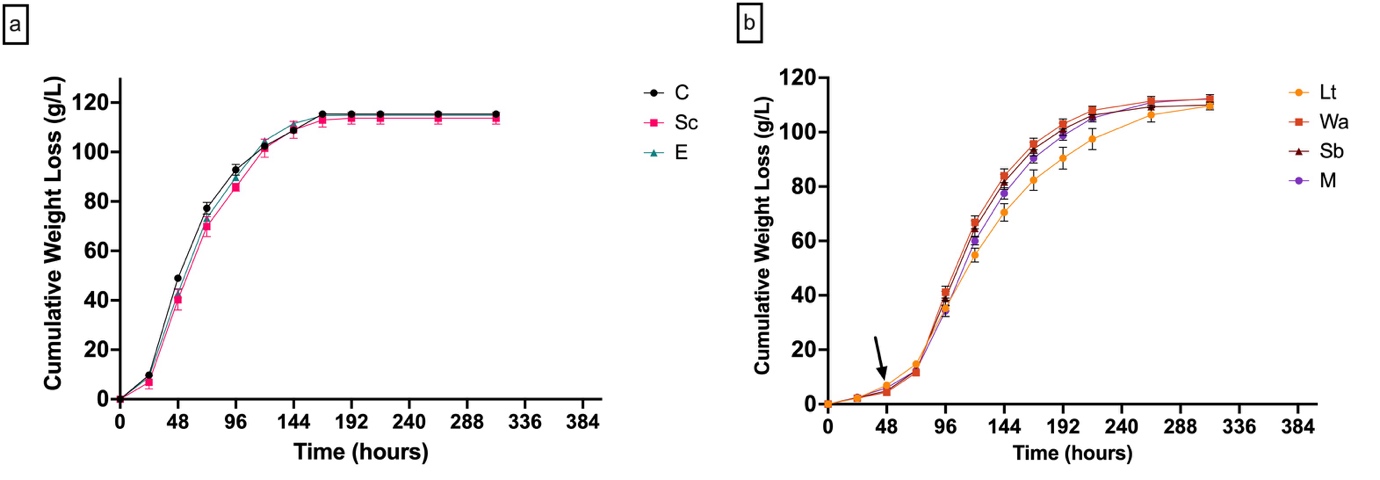
Figure 1. Cumulative weight loss over time for (a) individual S. cerevisiae inoculations in control grape juice not exposed to smoke (C), smoke-exposed grape juice (Sc), and glycosidase supplemented smoked grape juice (E) and (b) for sequential inoculations in smoke-exposed grape juice with S. cerevisiae and L. thermotolerans (Lt), W. anomalus (Wa), S. bacillaris (Sb), and a mixed consortium of all three non-Saccharomyces strains (M). The addition time point of S. cerevisiae is indicated with an arrow. Mean values of triplicate measurements are shown with error bars representing the standard deviations.
Fermentations involving sequential inoculation of non-Saccharomyces yeasts 48 h prior to S. cerevisiae displayed a proportionally longer lag phase of 72 h compared to 24 h before an exponential increase in cumulative weight loss (Figure 1b). There was a clear difference in the shape of the kinetic curve for the Lt treatment, which took longer to reach dryness. The other treatments had little variation in the shape of their respective kinetic curves, and all treatments finished at a very similar end point for cumulative weight loss. The residual sugar concentration was below 5 g/L at the final time point (data not shown) for all treatments.
The smoke-exposed juice and control juice were analysed for free VP concentrations, while the total bound + free VP concentration for smoke exposed juice was estimated (533 µg/L) by treating samples with a commercial glycosidase enzyme at low pH and high temperature (See section 4). This set of data is indicated on the left side of Figure 2a and separated by a red line from the other samples. The wines were sampled at 48 h, immediately before S. cerevisiae inoculation in sequential treatments to compare the release of free VPs with individual S. cerevisiae fermentations at this stage. Six volatile phenol compounds were quantified (guaiacol, 4-methylguaiacol, o-cresol, phenol, 4-ethylguaiacol, and 4-ethylphenol) in the wine samples. Sc (143 µg/L) and E (129 µg/L) treatments released the highest concentration of combined free VPs, followed by Sb (104 µg/L) and M (107 µg/L). The two treatments with the lowest combined VP release at this stage were Lt (75 µg/L) and Wa (84 µg/L) wines. Phenol was detected at the highest concentrations (52 ± 10.1 µg/L mean concentration), followed by guaiacol (22 ± 3.1 µg/L mean concentration) in all smoked wine treatments. Comprehensive data available in the supplementary section (Tables S1 and S2).

Figure 2. Free volatile phenol concentrations in (a) juice samples analysed prior to fermentation, including untreated juice (J), smoke-exposed juice (SJ), and total release (TR) of bound + free VPs via enzymatic glycosidase hydrolysis of smoke-exposed juice (indicated on the left-hand side, separated by the red line), and wine samples at 48 h for individual S. cerevisiae inoculations in control grape juice (C), smoke-exposed grape juice (Sc), and glycosidase supplemented smoked grape juice (E). Also shown are sequential inoculations at 48 h, representing VP release by the non-Saccharomyces yeasts only, prior to sequential inoculation of S. cerevisiae, for fermentations with L. thermotolerans (Lt), W. anomalus (Wa), S. bacillaris (Sb) and a mixed consortium of all three non-Saccharomyces strains (M). Free volatile phenol concentrations at the end of alcoholic fermentation for both untreated and charcoal-treated wines are displayed in (b). Mean values of triplicate measurements are shown with error bars representing the standard deviations.
At the end of fermentation, the wines were racked and half the volume received charcoal addition while the other half remained untreated. The concentrations of free VPs were then quantified in both treated and untreated wines (Figure 2b). The combined release of free VPs was similar (419 ± 23.6 µg/L mean concentration) for all treatments in untreated smoke exposed grape juice at the end of alcoholic fermentation, with M treatment higher than others (457 µg/L) and Lt (385 µg/L) being the lowest. The charcoal treated wines had a reduced combined free VP concentration to varying extents, Lt was reduced to the lowest total VP concentration (239 µg/L) and M treatment had the highest final free VP concentration (349 µg/L).
Wine samples were analysed for volatile organic compounds at the end of alcoholic fermentation and nine terpenoid compounds were detected: linalool, trans-β-farnesene, α-farnesene, trans-β-damascenone, β-ionone, α-terpineol, geranyl acetate, limonene, and β-citronellol. Since terpenoids are glycosylated in the grape berry in the same manner as VPs, the different yeast treatments were investigated to determine whether free terpenoid release was proportional to VP release. β-citronellol (12.3 ± 0.26 µg/L) and α-terpineol (7.5 ± 0.42 µg/L) were the most abundant detected terpenoids across all samples in untreated wines. The non-smoke exposed control wine had the lowest combined terpenoid concentration (29.9 µg/L) compared to smoke-exposed wine treatments (Figure 3), while the Sc treatment had the highest combined terpenoid concentration (57.2 µg/L). Among sequentially inoculated treatments, Wa wines had the lowest overall terpenoid concentration (40.1 µg/L), while Lt (49.8 µg/L) and Sb (49.6 µg/L) had the highest. Linalool and β-ionone showed no significant differences between yeast treatments (Kruskal-Wallis, p = 0.59), while significant differences were observed for the remaining terpenoids (p < 0.001). Comprehensive data are available in the supplementary section (Table S3).
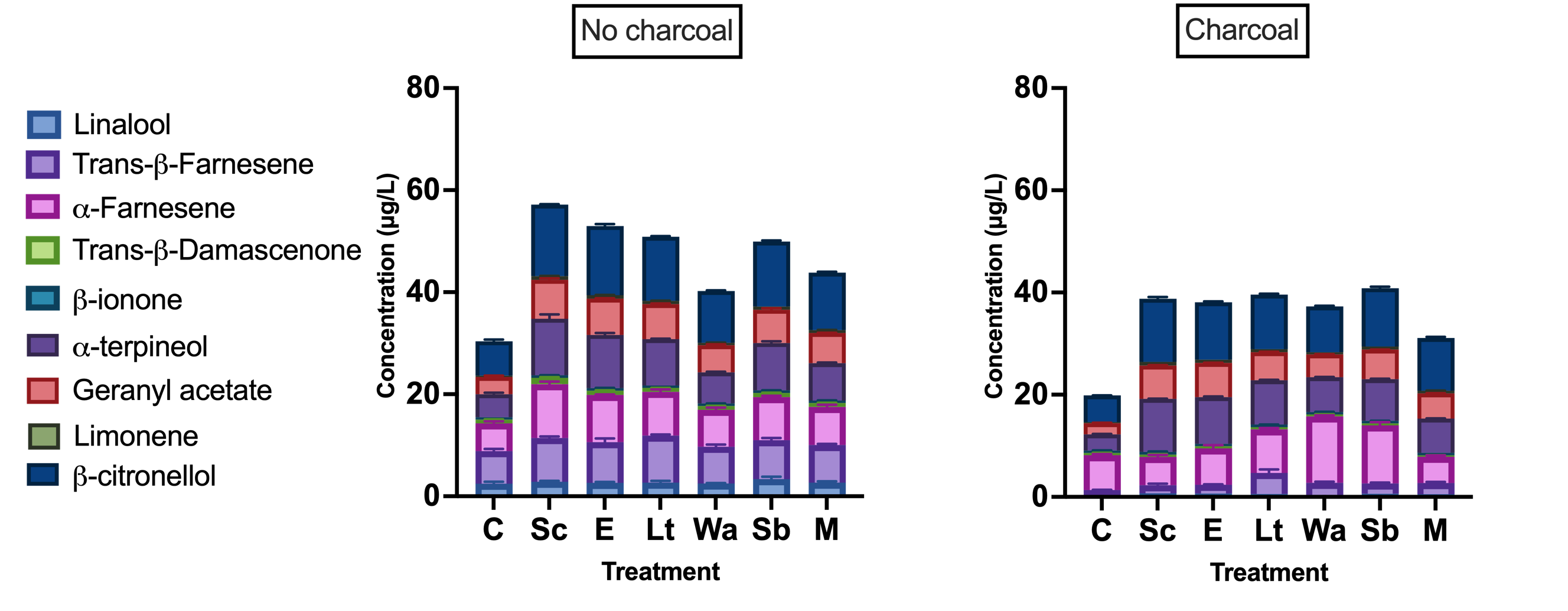
Figure 3. Concentrations of detected free-terpenoid compounds in wines with no charcoal treatment (left) and charcoal treatment (right) for individual S. cerevisiae inoculations in control grape juice (C), smoke-exposed grape juice (Sc), glycosidase supplemented smoked grape juice (E), and sequential inoculations with S. cerevisiae and L. thermotolerans (Lt), W. anomalus (Wa), S. bacillaris (Sb) and a mixed consortium of all three non-Saccharomyces strains (M). Mean values of triplicate measurements are shown with error bars representing the standard deviations.
Charcoal treatment significantly reduced combined terpenoid concentrations across all wine treatments (p < 0.001), consistent with the non-selective adsorption properties of activated charcoal. β-citronellol showed the largest absolute reductions following charcoal addition across all treatments, while trans-β-damascenone was also substantially reduced. The greatest overall reduction in combined terpenoid concentration following charcoal treatment was observed in the Sc treatment, while the C treatment showed the smallest absolute reduction, consistent with its lower initial terpenoid concentrations. Notably, no significant differences in linalool concentrations were observed between yeast treatments in charcoal-treated wines, mirroring the pattern observed in untreated wines. These results indicate that while charcoal fining is effective at reducing VP concentrations, it also results in considerable loss of potentially beneficial terpenoid aroma compounds, which has important practical implications for winemakers considering charcoal addition as a smoke taint mitigation strategy. Comprehensive data are available in the supplementary section (Table S4).
To investigate whether VP and terpenoid glycosides share sufficient structural and enzymatic overlap to predict correlated release patterns across yeast treatments, a Pearson correlation matrix was constructed for combined VP and terpenoid datasets across all fermentation treatments of final wines without charcoal addition (Figure 4). The analysis was performed on treatment means averaged across triplicates, with the non-smoke-exposed control (C) and enzymatic hydrolysis reference (TR) treatments excluded, as these were not considered appropriate comparators for assessing yeast-driven differences in glycoside release. If yeast glycosidases act broadly on glycosylated substrates regardless of aglycone identity, positive correlations between VP and terpenoid release would be expected across treatments. Conversely, the absence of consistent positive correlations – or the presence of negative correlations for specific compound pairs – would suggest aglycone-specific or linkage-specific modulation of glycosidase activity.
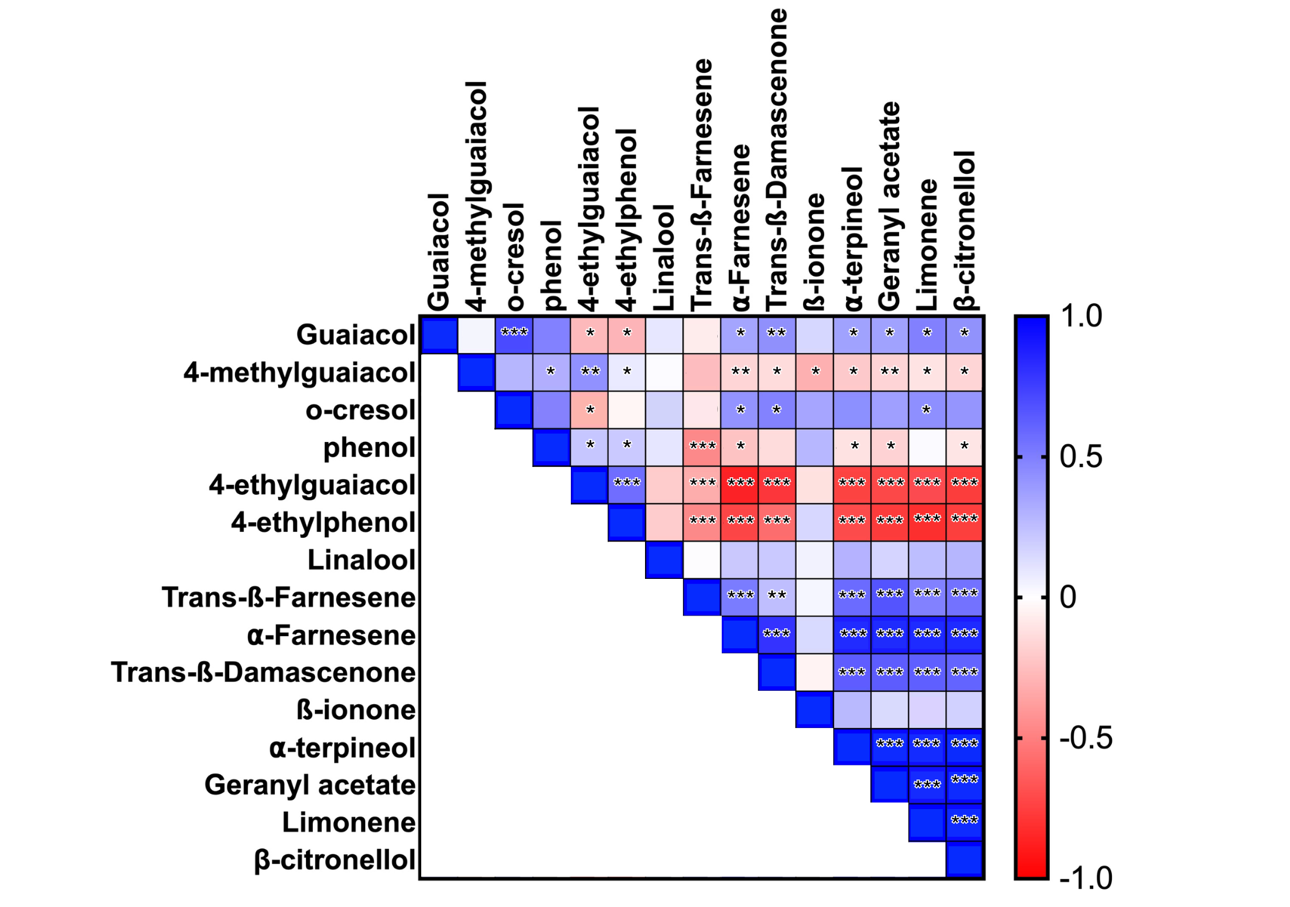
Figure 4. Pearson correlation matrix of volatile phenol and terpenoid concentrations for all treatments carried out in smoke-exposed grape juice. Significant codes (p < 0.0001)***, (p < 0.001)**, (p < 0.05)*.
Guaiacol and o-cresol displayed the strongest positive correlation amongst VPs (p < 0.0001), while 4-methylguaiacol and 4-ethylguaiacol exhibited a moderate positive correlation (p < 0.001). Terpenoids had a strong positive correlation with each other (p < 0.0001) with the exception of linalool and β-ionone, which had weak positive correlation with other terpenoids without statistical significance. Guaiacol had a moderate positive correlation (p < 0.05) with most terpenoids, except for linalool and β-ionone. Both 4-ethylguaiacol and 4-ethylphenol displayed a strong negative correlation (p < 0.0001) with most terpenoids, suggesting that the release of these ethyl-substituted VPs may be inversely associated with terpenoid liberation across yeast treatments, consistent with potential competitive inhibition at the glycosidase active site as discussed further below.
Wines were sampled and analysed spectrophotometrically at 420 nm and 520 nm to determine colour density and hue (Figure 5). The colour density decreased overall for smoked wines treated with charcoal compared to non-charcoal wines. A two-way ANOVA was performed on the colour density data, which indicated a significant effect of charcoal treatment on all samples (p < 0.0001). The effect of yeast treatments on colour density was separated from charcoal impact, which indicated significant differences for Wa, Sb, and M from Sc, E and Lt. (p < 0.05). Comprehensive data available in the supplementary section (Tables S5 – S8).
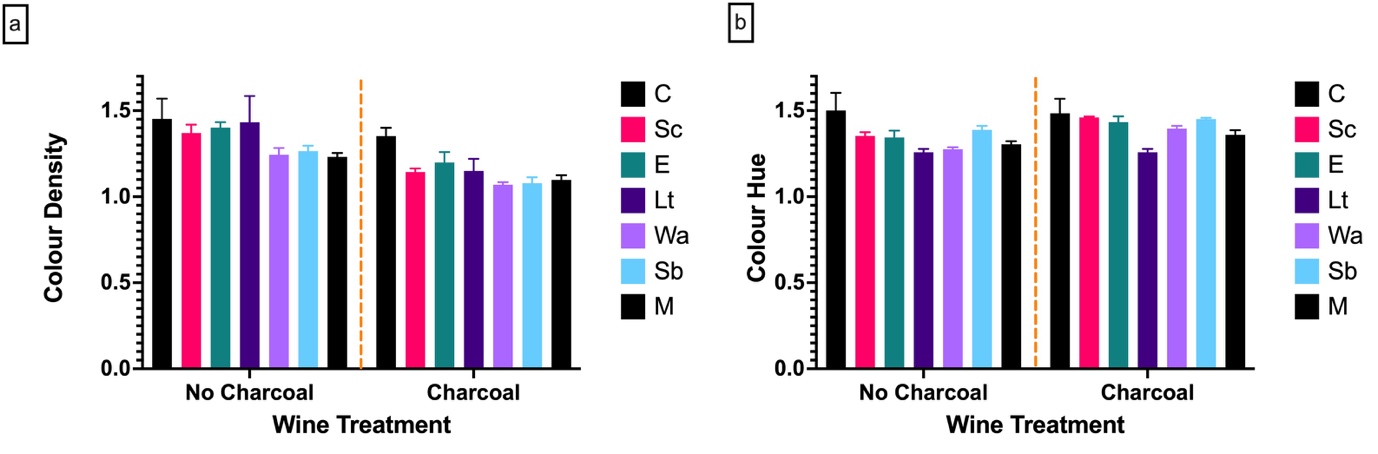
Figure 5. (a) Colour density (A420nm + A520nm) and (b) Colour hue (A420nm/A520nm) comparison of wines treated with charcoal vs. no charcoal. Mean values of triplicate measurements are shown with error bars representing the standard deviations.
Discussion
The use of non-Saccharomyces yeasts in mixed consortia wine fermentations with commercial S. cerevisiae has been extensively researched and implemented over recent decades. The benefits range from enhancing wine aroma, improving mouthfeel, reducing volatile acidity, bioprotection, and control of spoilage organisms (Maicas & Mateo, 2016). In the context of smoke taint, the role of yeast selection has been limited to investigating commercial S. cerevisiae strains that release low concentrations of VPs to ensure wines do not exhibit sensory faults associated with severe smoke exposure. The substrate specificity of yeast glycosidases has not been compared between VPs and terpenoids in a wine context. This study aimed to explore the effects of sequential inoculation of S. cerevisiae with three previously selected non-Saccharomyces strains isolated from the wine environment by Zieff et al. (2025) in smoke-exposed grape juice – evaluating the release of VPs, terpenoids, and subsequent effectiveness of removal by activated charcoal addition.
The fermentation kinetics of sequential treatments in smoke-exposed grape juice were similar with the exception of the L. thermotolerans co-inoculation (Figure 2). The cumulative weight loss deviated after 96 h with a more gradual slope and reached dryness later than other treatments. This effect has been reported previously as the fermentative ability of L. thermotolerans is stronger than that of W. anomalus and S. bacillaris and it has been shown to have similar nutritional requirements to those of S. cerevisiae, thereby making it a direct competitor (Gobbi et al., 2013; Hall et al., 2017; Gatto et al., 2020). A commercial strain of L. thermotolerans assimilated nitrogen faster than other non-Saccharomyces yeasts in synthetic grape must, while sequential inoculation with S. cerevisiae led to impaired fermentation kinetics and aroma compound reduction (Prior et al., 2019). Similar trends were seen in this study for fermentation kinetics, while Lt wines displayed lower VP and terpenoid concentrations than pure Sc wines. The W. anomalus and S. bacillaris co-inoculations did not negatively influence the kinetics of S. cerevisiae, which agrees with existing literature as both species are generally poor fermenters and, in some cases, may even accelerate the rate of ethanol production in mixed culture fermentations (Wang et al., 2023). Sequential fermentations involving S. bacillaris have been evaluated using a 48 h inoculation delay, since shorter delays adversely affected S. bacillaris growth but not that of S. cerevisiae. (Englezos et al., 2016). Ultimately, all sequential treatments were able to complete alcoholic fermentation despite the slightly inhibited Lt treatment kinetics.
The release of free VPs from their glycoconjugate counterparts varied between treatments after 48 h, with the S. cerevisiae and S. cerevisiae + glycosidase treatments releasing higher concentrations of VPs than sequential treatments with non-Saccharomyces strains (Figure 2a) – which was an unexpected outcome based on previous studies which report enhanced aroma compound release from mixed culture fermentations in wine (Gobbi et al., 2013; Englezos et al., 2018; Shi et al., 2019; Li et al., 2020; Han et al., 2021). At this stage, S. cerevisiae had not yet been inoculated into the sequential treatments, so the release of VPs in these fermentations is associated with the respective non-Saccharomyces strains. The free VP concentrations at the end of alcoholic fermentation were less varied between treatments than at 48 h, where the mixed consortia wine had the highest release and Lt wine the lowest for all smoke-exposed treatments (Figure 2b). The contribution of S. cerevisiae within sequential treatments could explain why the combined VP release converged across treatments by the end of fermentation. Indeed, it has been reported that even low to medium β-glucosidase activity in yeast can enhance VP hydrolysis when high cell populations are reached (Ristic et al., 2011; Krstic et al., 2015).
It should be noted that the total VP concentrations measured in this study substantially exceed those typically reported in wines produced from grapes exposed to natural wildfire smoke events. For example, studies examining wines from vineyards exposed to natural bushfire smoke have reported combined free VP concentrations generally below 100 µg/L in finished wines (Kennison et al., 2008; Whitmore et al., 2021), while the smoke-exposed treatments in the current study reached combined free VP concentrations of approximately 400–460 µg/L at the end of fermentation. These elevated concentrations are attributable to the experimental smoke treatment, which involved exposing harvested grape bunches to intense smoke within enclosed tents – an approach deliberately designed to ensure sufficient VP uptake and glycosylation to enable meaningful detection of differences in VP release between yeast treatments, given that only a single smoke treatment opportunity was available within the annual harvest window. Post-harvest experimental smoke exposure under enclosed conditions is known to produce substantially higher VP and VP glycoside concentrations than field-based natural wildfire exposure, where smoke density, duration, and distance from the fire source are highly variable (Culbert et al., 2021).
The elevated substrate concentrations in this study may have influenced glycosidase enzyme kinetics during fermentation, potentially inducing substrate saturation or causing product inhibition, which could have contributed to the convergence of VP concentrations across treatments by the end of fermentation and may have affected the observed rates of terpenoid release relative to VPs. This represents an important limitation of the current study and should be considered when interpreting conclusions regarding glycosidase substrate specificity. Future work conducted under more moderate smoke exposure conditions that better reflect natural wildfire scenarios would help clarify the relative contributions of yeast glycosidase activity to VP and terpenoid release at environmentally relevant substrate concentrations.
Reports on S. cerevisiae VP release in smoke tainted wines are limited, but a study by Whitmore et al. (2021) evaluated six commercial strains in smoke exposed Pinot noir to investigate potential differences in VP release during alcoholic fermentation. All the strains released a similar degree of VPs overall, while there were some differences in relative VP proportions between strains. Results from this study indicated similar VP proportions between yeast combinations, which could be explained by the presence of only one S. cerevisiae strain in all treatments by the end of alcoholic fermentation. Meanwhile, du Plessis et al. (2021) evaluated 15 commercial S. cerevisiae strains in smoked Merlot fermentations and compared the VP release with a spontaneous fermentation treatment. Interestingly, the wine obtained from spontaneous fermentation was most correlated with many of the VPs, while all strains released comparable amounts of VPs. Nevertheless, the VP concentrations from the latter study were much lower than the levels reported in this study which may be due to the smoke treatment that was applied directly to the grape juice and not grape bunches after harvest, which could affect the degree of VP-glycosylation (Szeto et al., 2020). The β-glucosidase enzyme activity responsible for hydrolysing bound VPs was originally thought to be less frequent in S. cerevisiae strains than non-Saccharomyces yeasts (Strauss et al., 2001; Cordero Otero et al., 2003). It was also suggested by Ugliano et al. (2006) that S. cerevisiae may appear to display low glycosidase activity in wine fermentations due to glycosylated compounds receiving exposure to glycosidases arising from grape berries, indigenous microorganisms and grape processing enzyme additives during juice preparation – limiting the available pool of glycosylated precursors for alcoholic fermentation. However, several studies have identified S. cerevisiae strains with comparatively high β-glucosidase activity, suggesting that this trait is strain dependent (Vernocchi et al., 2011; Wanapu et al., 2012).
Although both volatile phenols and terpenoids occur in grapes predominantly as glycosylated precursors, the correlation analysis revealed that their release across yeast treatments was not uniformly positively correlated (Figure 4). This finding addresses the hypothesis that if yeast glycosidases act broadly on glycosylated substrates regardless of aglycone identity, positive correlations between VP and terpenoid release would be expected. The partial support for this hypothesis – reflected in the moderate positive correlation between guaiacol and most terpenoids – suggests that some degree of shared glycosidase activity exists, but that aglycone-specific and linkage-specific factors substantially modulate the hydrolysis of individual compound classes. This lack of consistent association across all VP and terpenoid pairs indicates that, while β-glucosidase activity drives the liberation of both compound classes, additional factors likely modulate their hydrolysis in wine. These may include substrate specificity of yeast glycosidases, the chemical nature and linkage type of the glycosides involved, or differences in the intracellular/extracellular localisation and expression of the relevant enzymes (Qin et al., 2021; Cui et al., 2024; Yuan et al., 2024). The strong negative correlation between 4-ethylguaiacol/4-ethylphenol and most terpenoids is a particularly notable finding, as it suggests that the release of these ethyl-substituted VPs may actively compete with or inhibit terpenoid glycoside hydrolysis. This could be explained by the longer ethyl side chain of these compounds, which may lead to competitive inhibition with structurally similar terpenoids at the substrate binding site of glycosidase enzymes (Pesaresi, 2023). It is also worth noting that the elevated VP concentrations in this study relative to natural wildfire scenarios may have exacerbated such inhibitory effects, and the observed correlation patterns should therefore be interpreted with appropriate caution in the context of more moderate smoke exposure conditions. Moreover, the wine matrix itself – through its varying pH, ethanol concentration, and phenolic composition – may differentially influence the stability of terpenoid and phenolic conjugates (Black et al., 2015; Song et al., 2018; Gao et al., 2022).
Charcoal treatment significantly reduced terpenoid concentrations across all wine treatments, with β-citronellol and trans-β-damascenone showing the largest absolute reductions. This is consistent with the non-selective adsorption properties of activated charcoal, which has been shown to remove a broad range of aroma-active compounds in addition to VPs (Fudge et al., 2012). The collateral loss of terpenoids following charcoal addition is an important practical consideration for winemakers, as these compounds contribute positively to wine aroma complexity. Notably, the pattern of terpenoid reduction following charcoal treatment did not mirror the VP reduction pattern across yeast treatments, suggesting that the adsorption of terpenoids by activated charcoal is influenced by compound-specific physicochemical properties rather than simply reflecting the initial concentration of aroma compounds in the wine. Linalool showed no significant differences between yeast treatments in either charcoal or non-charcoal treated wines, consistent with its distinct biosynthetic origin and structural properties relative to the other detected terpenoids. These findings highlight that yeast selection influences not only the release of VPs and terpenoids during fermentation but also the extent of collateral aroma compound loss during post-fermentation charcoal remediation, which should be considered when integrating yeast choice with downstream mitigation strategies.
Interestingly, Lt treatments did not significantly reduce wine colour density, while all other sequential treatments did, and these wines showed the lowest volatile phenol release which is consistent with the activity of β-glucosidases on glycosylated anthocyanins and VPs. Furthermore, L. thermotolerans Y940 was previously evaluated in Muscat fermentations in sequential inoculations with S. cerevisiae, which released a lower concentration of total terpenoids than the pure S. cerevisiae fermentation, despite the elevated β-glucosidase activity of L. thermotolerans when tested with p-nitrophenyl-β-D-glucopyranoside (Porter et al., 2019).
The use of artificial substrates to test β-glucosidase activity, differences between solid and liquid media assays and the limited understanding of VP-specific hydrolysis by yeasts could explain the results obtained in this study. Indeed, most β-glucosidase activity assays use synthetic substrates such as p-nitrophenyl-β-D-glucopyranoside, which contains a single glucose moiety and therefore does not accurately reflect the structural complexity of natural grape glycosides (Liu et al., 2017). In contrast, glycosylated aroma precursors in grapes and wine, such as those derived from volatile phenols and terpenoids, are frequently diglycosides consisting of a glucose molecule linked to another sugar residue such as apiose, arabinose, xylose, or rhamnose (Culbert et al., 2021; Liang et al., 2022). Hydrolysis of these conjugates therefore requires multiple, sequential enzymatic activities (e.g., β-D-apiosidase, α-L-arabinofuranosidase, or β-D-xylosidase) in addition to β-glucosidase. The absence or low expression of such complementary enzymes in many yeast species likely limits their ability to fully liberate these compounds during fermentation.
This study provides new insights into the role of non-Saccharomyces yeasts in modulating smoke-derived volatile phenols, terpenoids, and colour development during red wine fermentation. While the selected strains – L. thermotolerans SAGWRI Y940, W. anomalus SAGWRI Y541, and S. bacillaris SAGWRI Y550 – demonstrated enhanced VP release during a screening by Zieff et al. (2025), their application in sequential fermentations with S. cerevisiae did not consistently result in higher volatile phenol release. This finding challenges the prevailing assumption that non-Saccharomyces species invariably enhance the hydrolysis of glycosidically bound precursors and highlights the complexity of yeast-substrate interactions under realistic winemaking conditions. The absence of a clear correlation between volatile phenol and terpenoid release suggests that hydrolysis of these compound classes may be influenced by differences in aglycone structure and accessibility within the wine matrix. Collectively, these results refine our understanding of the enzymatic behaviour of both S. cerevisiae and non-Saccharomyces yeasts in smoke-affected wine fermentations and indicate that S. cerevisiae exhibits improved β-glucosidase activity under winemaking conditions. The findings of this study contribute to the knowledge of yeast glycosidase activity within smoke-exposed grape juice fermentations and the combined effect on various glycosylated compound classes.
Acknowledgements
The authors would like to acknowledge Stellenbosch University and Oenobrands (Montpellier, France) for their financial support, Dr Hans Eyéghé-Bickong and Prof Antonio Ferreira of the chemical analytical laboratory of the South African Grape and Wine Research Institute for technical assistance related to the chemical analyses, as well as Marisa Nell and Courtneigh Frolicks from the Stellenbosch University Experimental Cellar.
References
- Babincev, L. M., Gurešić, D. M., & Simonović, R. M. (2016). Spectrophotometric characterization of red wine color from the vineyard region of Metohia. Journal of Agricultural Sciences (Belgrade), 61, 281–290. https://doi.org/10.2298/JAS1603281B
- Black, C., Parker, M., Siebert, T., Capone, D., & Francis, I. (2015). Terpenoids and their role in wine flavour: Recent advances. Australian Journal of Grape and Wine Research, 21, 582–600. https://doi.org/10.1111/ajgw.12186
- Cordero Otero, R., Ubeda Iranzo, J., Briones-Perez, A., Potgieter, N., Villena, M., Pretorius, I., & van Rensburg, P. (2003). Characterization of the β-glucosidase activity produced by enological strains of non-Saccharomyces yeasts. Journal of Food Science, 68, 2564–2569. https://doi.org/10.1111/j.1365-2621.2003.tb07062.x
- Cui, Y., Riley, M., Moreno, M. V., Cepeda, M. M., Perez, I. A., Wen, Y., Lim, L. X., Andre, E., Nguyen, A., Liu, C., Lerno, L., Nichols, P. K., Schmitz, H., Tagkopoulos, I., Kennedy, J. A., Oberholster, A., & Siegel, J. B. (2024). Discovery of potent glycosidases enables quantification of smoke-derived phenolic glycosides through enzymatic hydrolysis. Journal of Agricultural and Food Chemistry, 72, 11617–11628. https://doi.org/10.1021/acs.jafc.4c01247
- Culbert, J. A., Jiang, W., Ristic, R., Puglisi, C. J., Nixon, E. C., Shi, H., & Wilkinson, K. L. (2021). Glycosylation of volatile phenols in grapes following pre-harvest (on-vine) vs. post-harvest (off-vine) exposure to smoke. Molecules, 26, 5277. https://doi.org/10.3390/molecules26175277
- Dang, C., Jiranek, V., Taylor, D. K., & Wilkinson, K. L. (2020). Removal of volatile phenols from wine using crosslinked cyclodextrin polymers. Molecules, 25, 910. https://doi.org/10.3390/molecules25040910
- Dungey, K. A., Hayasaka, Y., & Wilkinson, K. L. (2011). Quantitative analysis of glycoconjugate precursors of guaiacol in smoke-affected grapes using liquid chromatography–tandem mass spectrometry based stable isotope dilution analysis. Food Chemistry, 126, 801–806. https://doi.org/10.1016/j.foodchem.2010.11.094
- Du Plessis, H. W., Hoff, J. W., Mokwena, L., van der Rijst, M., & Jolly, N. P. (2021). Impact of yeast selection on volatile phenol levels of wines produced from smoked-exposed juice. Fermentation, 7, 240. https://doi.org/10.3390/fermentation7040240
- Englezos, V., Rantsiou, K., Cravero, F., Torchio, F., Ortiz-Julien, A., Gerbi, V., Rolle, L., & Cocolin, L. (2016). Starmerella bacillaris and Saccharomyces cerevisiae mixed fermentations to reduce ethanol content in wine. Applied Microbiology and Biotechnology, 100, 5515–5526. https://doi.org/10.1007/s00253-016-7413-z
- Englezos, V., Rantsiou, K., Cravero, F., Torchio, F., Pollon, M., Fracassetti, D., Ortiz-Julien, A., Gerbi, V., Rolle, L., & Cocolin, L. (2018). Volatile profile of white wines fermented with sequential inoculation of Starmerella bacillaris and Saccharomyces cerevisiae. Food Chemistry, 257, 350–360. https://doi.org/10.1016/j.foodchem.2018.03.018
- Fudge, A. L., Schiettecatte, M., Ristic, R., Hayasaka, Y., & Wilkinson, K. L. (2012). Amelioration of smoke taint in wine by treatment with commercial fining agents. Australian Journal of Grape and Wine Research, 18, 302–307. https://doi.org/10.1111/j.1755-0238.2012.00200.x
- Gao, P. P., Sam, F. E., Zhang, B., Peng, S., Li, M., & Wang, J. (2022). Enzymatic characterization of purified β-glucosidase from non-Saccharomyces yeasts and application on Chardonnay aging. Foods, 11, 852. https://doi.org/10.3390/foods11060852
- Gatto, V., Binati, R. L., Lemos Junior, W. J. F., Basile, A., Treu, L., de Almeida, O. G. G., Innocente, G., Campanaro, S., & Torriani, S. (2020). New insights into the variability of lactic acid production in Lachancea thermotolerans at the phenotypic and genomic level. Microbiological Research, 238, 126525. https://doi.org/10.1016/j.micres.2020.126525
- Gobbi, M., Comitini, F., Domizio, P., Romani, C., Lencioni, L., Mannazzu, I., & Ciani, M. (2013). Lachancea thermotolerans and Saccharomyces cerevisiae in simultaneous and sequential co-fermentation: A strategy to enhance acidity and improve the overall quality of wine. Food Microbiology, 33, 271–281. https://doi.org/10.1016/j.fm.2012.10.004
- Hall, H., Zhou, Q., Qian, M. C., & Osborne, J. P. (2017). Impact of yeasts present during prefermentation cold maceration of Pinot noir grapes on wine volatile aromas. American Journal of Enology and Viticulture, 68, 81–90. https://doi.org/10.5344/ajev.2016.16046
- Han, X., Qing, X., Yang, S., Li, R., Zhan, J., You, Y., & Huang, W. (2021). Diversity of non-Saccharomyces yeasts in Chinese wine regions and their potential in improving wine aroma through β-glucosidase activity analyses. Food Chemistry, 360, 129886. https://doi.org/10.1016/j.foodchem.2021.129886
- Hayasaka, Y., Baldock, G. A., Parker, M., Pardon, K. H., Black, C. A., Herderich, M. J., & Jeffery, D. W. (2010). Glycosylation of smoke-derived volatile phenols in grapes as a consequence of grapevine exposure to bushfire smoke. Journal of Agricultural and Food Chemistry, 58, 10989–10998. https://doi.org/10.1021/jf103045t
- Herscovics, A. (1999). Processing glycosidases of Saccharomyces cerevisiae. Biochimica et Biophysica Acta – General Subjects, 1426, 275–285. https://doi.org/10.1016/S0304-4165(98)00129-9
- Hu, K., Qin, Y., Tao, Y. S., Zhu, X. L., Peng, C. T., & Ullah, N. (2016). Potential of glycosidase from non-Saccharomyces isolates for enhancement of wine aroma. Journal of Food Science, 81, M935–M943. https://doi.org/10.1111/1750-3841.13253
- Huo, Y., Ristic, R., Puglisi, C., Wang, X., Muhlack, R., Baars, S., Herderich, M. J., & Wilkinson, K. L. (2024). Amelioration of smoke taint in wine via addition of molecularly imprinted polymers during or after fermentation. Journal of Agricultural and Food Chemistry, 72, 18121–18131. https://doi.org/10.1021/acs.jafc.4c03912
- Kennison, K. R., Gibberd, M. R., Pollnitz, A. P., & Wilkinson, K. L. (2008). Smoke-derived taint in wine: Release of smoke-derived volatile phenols during fermentation of Merlot juice following grapevine exposure to smoke. Journal of Agricultural and Food Chemistry, 56, 7379–7383. https://doi.org/10.1021/jf800927e
- Krstic, M., Johnson, D., & Herderich, M. (2015). Review of smoke taint in wine: Smoke-derived volatile phenols and their glycosidic metabolites as biomarkers for smoke exposure and their role in sensory perception. Australian Journal of Grape and Wine Research, 21, 537–553. https://doi.org/10.1111/ajgw.12183
- Li, N., Wang, Q. Q., Xu, Y. H., Li, A. H., & Tao, Y. S. (2020). Increased glycosidase activities improve production of varietal odorants in mixed fermentation of P. fermentans and antagonistic S. cerevisiae. Food Chemistry, 332, 127426. https://doi.org/10.1016/j.foodchem.2020.127426
- Liang, Z., Fang, Z., Pai, A., Luo, J., Gan, R., Gao, Y., Lu, J., & Zhang, P. (2022). Glycosidically bound aroma precursors in fruits: A comprehensive review. Critical Reviews in Food Science and Nutrition, 62, 215–243. https://doi.org/10.1080/10408398.2020.1813684
- Liu, J., Zhu, X. L., Ullah, N., & Tao, Y. S. (2017). Aroma glycosides in grapes and wine. Journal of Food Science, 82, 248–259. https://doi.org/10.1111/1750-3841.13598
- Maicas, S., & Mateo, J. J. (2016). Microbial glycosidases for wine production. Beverages, 2, 20. https://doi.org/10.3390/beverages2030020
- Manzanares, P., Rojas, V., Genovés, S., & Vallés, S. (2000). Preliminary search for anthocyanin-β-D-glucosidase activity in non-Saccharomyces wine yeasts. International Journal of Food Science and Technology, 35, 95–103. https://doi.org/10.1046/j.1365-2621.2000.00364.x
- Mayr, C. M., Parker, M., Baldock, G. A., Black, C. A., Pardon, K. H., Williamson, P. O., Herderich, M. J., & Francis, I. L. (2014). Importance of in-mouth release of volatile phenol glycoconjugates to the flavour of smoke-tainted wines. Journal of Agricultural and Food Chemistry, 62, 2327–2336. https://doi.org/10.1021/jf405327s
- Mirabelli-Montan, Y. A., Marangon, M., Graça, A., Mayr Marangon, C. M., & Wilkinson, K. L. (2021). Techniques for mitigating the effects of smoke taint while maintaining wine quality: A review. Molecules, 26, 1672. https://doi.org/10.3390/molecules26061672
- Modesti, M., Szeto, C., Ristic, R., Jiang, W., Culbert, J., Bindon, K., Catelli, C., Mencarelli, F., Tonutti, P., & Wilkinson, K. (2021). Potential mitigation of smoke taint in wines by post-harvest ozone treatment of grapes. Molecules, 26, 1798. https://doi.org/10.3390/molecules26061798
- Noestheden, M., Dennis, E. G., & Zandberg, W. F. (2018). Quantitating volatile phenols in Cabernet Franc berries and wine after on-vine smoke exposure. Journal of Agricultural and Food Chemistry, 66, 695–703. https://doi.org/10.1021/acs.jafc.7b04946
- Oberholster, A., Wen, Y., Dominguez Suarez, S., Erdmann, J., Cauduro Girardello, R., Rumbaugh, A., Neupane, B., Brenneman, C., Cantu, A., & Heymann, H. (2022). Investigation of different winemaking protocols to mitigate smoke taint. Molecules, 27, 1732. https://doi.org/10.3390/molecules27051732
- Parker, M., Osidacz, P., Baldock, G. A., Hayasaka, Y., Black, C. A., Pardon, K. H., Jeffery, D. W., Geue, J. P., Herderich, M. J., & Francis, I. L. (2012). Contribution of volatile phenols and their glycoconjugates to smoke-related sensory properties of red wine. Journal of Agricultural and Food Chemistry, 60, 2629–2637. https://doi.org/10.1021/jf2040548
- Pesaresi, A. (2023). Mixed and non-competitive enzyme inhibition: Underlying mechanisms and mechanistic irrelevance of the formal two-site model. Journal of Enzyme Inhibition and Medicinal Chemistry, 38, 2245168. https://doi.org/10.1080/14756366.2023.2245168
- Porter, T. J., Divol, B., & Setati, M. E. (2019). Biochemical and fermentation attributes of Lachancea species and strains: Contribution to wine chemical composition. International Journal of Food Microbiology, 290, 273–287. https://doi.org/10.1016/j.ijfoodmicro.2018.10.025
- Prior, K. J., Bauer, F. F., & Divol, B. (2019). Utilisation of nitrogenous compounds by commercial non-Saccharomyces yeasts associated with wine. Food Microbiology, 79, 75–84. https://doi.org/10.1016/j.fm.2018.12.002
- Qin, T., Liao, J., Zheng, Y., Zhang, W., & Zhang, X. (2021). Oenological characteristics of four non-Saccharomyces yeast strains with β-glycosidase activity. Frontiers in Microbiology, 12, 626920. https://doi.org/10.3389/fmicb.2021.626920
- Ristic, R., Osidacz, P., Pinchbeck, K. A., Hayasaka, Y., Fudge, A. L., & Wilkinson, K. L. (2011). Effect of winemaking techniques on intensity of smoke taint in wine. Australian Journal of Grape and Wine Research, 17(S1), S29–S40. https://doi.org/10.1111/j.1755-0238.2011.00146.x
- Rosi, I., Vinella, M., & Domizio, P. (1994). Characterization of β-glucosidase activity in yeasts of oenological origin. Journal of Applied Bacteriology, 77, 519–527. https://doi.org/10.1111/j.1365-2672.1994.tb04396.x
- Shi, W. K., Wang, J., Chen, F. S., & Zhang, X. Y. (2019). Effect of Issatchenkia terricola and Pichia kudriavzevii on wine flavour and quality through co-fermentation with Saccharomyces cerevisiae. LWT, 116, 108477. https://doi.org/10.1016/j.lwt.2019.108477
- Song, C., Hartl, K., McGraphery, K., Hoffmann, T., & Schwab, W. (2018). Attractive but toxic: Emerging roles of glycosidically bound volatiles and glycosyltransferases. Molecular Plant, 11, 1225–1236. https://doi.org/10.1016/j.molp.2018.09.001
- Strauss, M. L., Jolly, N. P., Lambrechts, M. G., & van Rensburg, P. (2001). Screening for extracellular hydrolytic enzyme production by non-Saccharomyces wine yeasts. Journal of Applied Microbiology, 91, 182–190. https://doi.org/10.1046/j.1365-2672.2001.01379.x
- Summerson, V., Viejo, C. G., Pang, A., Torrico, D. D., & Fuentes, S. (2021). Effects of grapevine smoke exposure and technologies to assess smoke taint in grapes and wine: A review. Beverages, 7, 7. https://doi.org/10.3390/beverages7010007
- Szeto, C., Feng, H., Sui, Q., Blair, B., Mayfield, S., Pan, B., & Wilkinson, K. (2024a). Variation in grape and wine volatile phenol glycoconjugates to improve smoke taint risk evaluation. American Journal of Enology and Viticulture, 0750013. https://doi.org/10.5344/ajev.2024.23060
- Szeto, C., Lloyd, N., Nicolotti, L., Herderich, M. J., & Wilkinson, K. L. (2024b). Beyond volatile phenols: Untargeted metabolomics reveals additional markers of smoke taint in Merlot grapes. Journal of Agricultural and Food Chemistry, 72, 2018–2033. https://doi.org/10.1021/acs.jafc.2c09013
- Szeto, C., Ristic, R., Capone, D., Puglisi, C., Pagay, V., Culbert, J., Jiang, W., Herderich, M., Tuke, J., & Wilkinson, K. (2020). Uptake and glycosylation of smoke-derived volatile phenols by Cabernet Sauvignon grapes and fate during winemaking. Molecules, 25, 3720. https://doi.org/10.3390/molecules25163720
- Ugliano, M., Bartowsky, E. J., McCarthy, J., Moio, L., & Henschke, P. A. (2006). Hydrolysis and transformation of grape glycosidically bound volatile compounds during fermentation with three Saccharomyces strains. Journal of Agricultural and Food Chemistry, 54, 6322–6331. https://doi.org/10.1021/jf0607718
- Vernocchi, P., Ndagijimana, M., Serrazanetti, D. I., López, C. C., Fabiani, A., Gardini, F., Guerzoni, M. E., & Lanciotti, R. (2011). Use of Saccharomyces cerevisiae strains with β-glucosidase activity for Sangiovese wine production. World Journal of Microbiology and Biotechnology, 27, 1423–1433. https://doi.org/10.1007/s11274-010-0594-1
- Wanapu, C., Sripunya, P., & Boonkerd, N. (2012). Selection of yeast strains containing β-glucosidase for improving wine aroma. Journal of Agricultural Science and Technology B, 2, 691.
- Wang, J., Yan, J., Zhang, W., Zhang, Y., Dong, Z., Luo, H., Liu, M., & Su, J. (2023). Potential of Wickerhamomyces anomalus to improve Cabernet Sauvignon wine quality in mixed fermentation with S. cerevisiae. LWT, 173, 114285. https://doi.org/10.1016/j.lwt.2022.114285
- Whitmore, B. A., McCann, S. E., Noestheden, M., Dennis, E. G., Lyons, S. M., Durall, D. M., & Zandberg, W. F. (2021). Glycosidically bound volatile phenols linked to smoke taint: Stability during fermentation and in finished wine. Molecules, 26, 4519. https://doi.org/10.3390/molecules26154519
- Wilkinson, K. L., Ristic, R., Szeto, C., Capone, D. L., Yu, L., & Losic, D. (2022). Activated carbon fabric for mitigating smoke taint in grapes and wine. Australian Journal of Grape and Wine Research, 28, 500–507. https://doi.org/10.1111/ajgw.12548
- Yuan, K., Wu, G., Li, X., Zeng, Y., Wen, X., Liu, R., Jiang, X., Tian, L., Sun, J., & Bai, W. (2024). Anthocyanin degradation mediated by β-glycosidase contributes to color loss during fermentation in a structure-dependent manner. Food Research International, 175, 113732. https://doi.org/10.1016/j.foodres.2023.113732
- Zieff, D., du Toit, M., Schneider, R., & Divol, B. (2025). Screening of oenological yeasts for volatile phenol release in smoke-exposed red wine. South African Journal of Enology and Viticulture, 46, 70–79. https://doi.org/10.21548/46-6965
 Views: 906
 XML: 69