

ENOLOGY / Original research article
Abstract
Sensory characteristics determine wine acceptance. In Peru, the heritage grape variety Negra Criolla is widely cultivated for winemaking; however, the evolution of its sensory and chemical profile during bottle storage remains unexplored. Accordingly, this study aimed to evaluate changes in the sensory profile of Negra Criolla red wine during bottle storage and relate these changes to the evolution of dissolved gases (free SO2, CO2, and O2). Before bottling, free SO2 levels of wines from the Tacna (2021 vintage) and Moquegua (2022 vintage) terroirs were adjusted to target doses of 15, 30, and 45 mg/L. Sensory characterisation was evaluated using the Check-All-That-Apply (CATA) acceptance test, and dissolved gases were quantified. The results showed that bottle storage time influenced SO2 and O2 levels, thereby affecting the sensory profile and acceptance. Wines with 15 mg/L free SO2 showed a faster depletion of free SO2, higher dissolved O2 concentrations, loss of fruity aromas, and colour shifts towards garnet and brick-red hues. In contrast, wines with 30 and 45 mg/L maintained lower O2 levels and desirable attributes. Overall acceptance decreased slightly from the fourth month onwards. However, these results should not be generalised, as the initial state of the wine may have been influenced by uncontrolled factors prior to bottling. In conclusion, under the conditions of this study, an integrated assessment of the sensory profile and the evolution of SO2 and O2 levels during the first year of storage is essential to determine the ageing potential of this wine.
Introduction
Wine production in Peru began in the early 16th century with the arrival of Spanish colonisers and missionaries, who introduced Vitis vinifera to the Americas (Lacoste, 2004; Toro-Lira, 2018). Historically, grape cultivation in Peru developed in the coastal and Andean valleys (Gade, 2005; Huertas Vallejos, 2004). Currently, wine production extends along the coastal strip of Peru, encompassing the valleys of La Libertad, Ancash, Lima, Ica, Arequipa, Moquegua, and Tacna, as well as inter-Andean valleys such as Apurímac and Cusco (Peruvino, 2026). According to statistical reports, wine production in Peru increased from 15.1 to 19.2 million litres between 2019 and 2024 (OIV, 2026).
One of the most widely cultivated grape varieties in Peru’s wine-growing valleys is ‘Negra Criolla’ or ‘Negra Corriente’, a descendant of Listán Prieto (VIVC 6860), according to the Vitis International Variety Catalogue (Röckel et al., 2026). This variety is also known as ‘País’ or ‘Mission’, or ‘Criolla Chica’ in other American countries (Lacoste, 2021; Martínez et al., 2006; Tapia et al., 2007). In Peru, it is currently cultivated for the production of both wine and pisco (Palma et al., 2025; Saldaña et al., 2025) and has been described as robust, resilient, highly productive, and possessing oenological potential (Gutiérrez-Gamboa et al., 2019). However, available research remains limited and has primarily focused on factors influencing phenolic compound extraction during winemaking (Coaguila, 2019; Delgado, 2017; Georffino, 2016), whereas the sensory evolution of these wines during bottle storage is still poorly understood.
From a sensory perspective, wine quality at the point of consumption depends not only on the winemaking process but also on its evolution during bottle storage (Hidalgo, 2018). During storage, chemical reactions modify the wine’s colour, aroma, flavour, and mouthfeel, thereby affecting its ageing potential (Mercanti et al., 2024). These changes are influenced by the initial composition of the wine (Jackson, 2020; Waterhouse et al., 2024) and by storage conditions such as time, ambient temperature and humidity, light exposure, bottle volume, bottle position, and closure type (Mercanti et al., 2024; Zhang et al., 2023).
Some of the reported modifications in sensory attributes during bottle storage include: (i) visual changes, such as a reduction in violet hues and a progressive shift towards orange and yellowish tones, as observed in Malbec wines after 24 months and in Plavac Mali red wines after 38 months of storage (Ćurko et al., 2021; Giuffrida de Esteban et al., 2019); (ii) changes in taste attributes, where young Cabernet-Sauvignon red wine after 3 to 6 months of storage, exhibited a fresh character and good aftertaste, and developed a more pleasant flavour after 15 months (Gao et al., 2015), with greater improvement when stored horizontally (Venturi et al., 2017). Regarding astringency, several studies have shown that both astringency and bitterness decrease during bottle ageing, as observed in Plavac Mali wine after 38 months and in Aglianico red wine after 42 months (Ćurko et al., 2021; Gambuti et al., 2012). Similarly, after five years of storage, Aglianico and Casevecchia wines sealed with Nomacorc Select 300 closures exhibited softer, silkier, and velvety astringency, with a slight dryness in the mouth (Gambuti et al., 2020); (iii) evolution of olfactory attributes: Malbec wines stored for 24 months at 25 °C developed aromas of dried fruits and dried vegetables (Giuffrida de Esteban et al., 2019). Likewise, Meili rosé wine exposed to ultraviolet light for 160 days showed a decrease in floral and fruity aromas and an increase in cooked and oxidative notes, whereas wine stored in darkness retained red-fruit aromas (Lan et al., 2021).
On the other hand, several studies have shown that during bottle storage, a continuous gas exchange occurs between the inside and outside of the bottle, allowing small amounts of oxygen (O2) to enter and alter the sensory quality of wine (Crouvisier-Urion et al., 2018; Echave et al., 2021; Lopes et al., 2007; Lopes et al., ,2009; Zhang et al., 2023). Therefore, sulfur dioxide (SO2) is added due to its antioxidant and antimicrobial properties (Ferrer-Gallego et al., 2018; Giacosa et al., 2019). However, excessive SO2 produces reductive off-odours such as rotten egg, truffle, garlic, cabbage, burnt rubber, or onion (Ailer et al., 2022; Siebert et al., 2010), while low SO2 combined with high dissolved O2 promotes oxidation, anthocyanin degradation (responsible for the violet colour of red wine), and loss of fruity aromas and freshness (Echave et al., 2021; Gabrielli et al., 2021). Consequently, maintaining an appropriate balance between O2 and SO2 is essential. A free SO2 range of 20–40 mg/L is considered adequate for red wines, with approximately 30 mg/L recommended as optimal (OIV, 2021; Waterhouse et al., 2024).
Overall, scientific evidence confirms that bottle storage alters a wine's sensory profile and that maintaining appropriate dissolved gas concentrations helps preserve desirable sensory attributes. However, in the context of Peruvian wines, there is a significant knowledge gap regarding the sensory evolution of the Negra Criolla variety during bottle storage. Furthermore, the management of SO2 as a preservative remains a challenge for small wineries in Peru. Therefore, this study aimed to evaluate the sensory profile of Negra Criolla red wine during bottle storage and its relationship with various chemical components.
Materials and methods
1. Samples
The samples were selected using non-probability, criterion-based sampling, considering the soil and climatic conditions of the Tacna (18° 04′ 26.0″ S, 70° 19′ 41.5″ W) and Moquegua (17° 09′ 40.5″ S, 70° 55′ 33.0″ W) terroirs. To ensure sensory authenticity, wines produced by spontaneous fermentation with indigenous yeasts were selected, preserving the microbial typicity of each area. The selected wine from Tacna (2021 vintage) was produced from Negra Criolla grapes harvested from 10-year-old vines trained under a Spanish pergola system and managed with gravity irrigation. Grapes were manually harvested at a potential alcohol content ≈14.15 % (v/v) and a titratable acidity of 5.5 g/L (as tartaric acid), with an average yield of 15.0 t/ha. Vinification was carried out by spontaneous fermentation in 1,200 L stainless steel tanks. Alcoholic fermentation lasted two weeks, followed by malolactic fermentation for three weeks, during which the wine was racked three times. After completion of fermentation, the wine was clarified and filtered prior to further analysis. The selected wine from Moquegua (2022 vintage) was produced from grapes harvested from vines over 30 years old, trained on a vertical trellis system, and managed under gravity irrigation. Harvesting was carried out manually at a potential alcohol content ≈13.11 % (v/v) and a titratable acidity of 5.3 g/L (as tartaric acid), with an average yield of 10.2 t/ha. Vinification was conducted via spontaneous fermentation in 2,750 L high-density polyethylene (HDPE) tanks for two weeks. The wine subsequently underwent malolactic fermentation for four weeks, followed by three rackings. Finally, the wine was clarified and filtered prior to analysis. Neither wine was in contact with oak during vinification or storage.
2. Reagents
The following reagents were used: potassium metabisulfite (K2S2O5), 0.1 N sodium hydroxide solution, 5 N sodium hydroxide solution, 0.30 M sodium hydroxide solution, 0.025 M potassium chloride, 1 % phenolphthalein indicator, activated carbon, 0.1 N sodium thiosulfate solution, phosphoric acid, 0.3 % hydrogen peroxide, and 0.02 N sodium hydroxide.
3. Sample conditioning and preparation
The sample conditioning and preparation process was carried out in four stages (Figure 1):
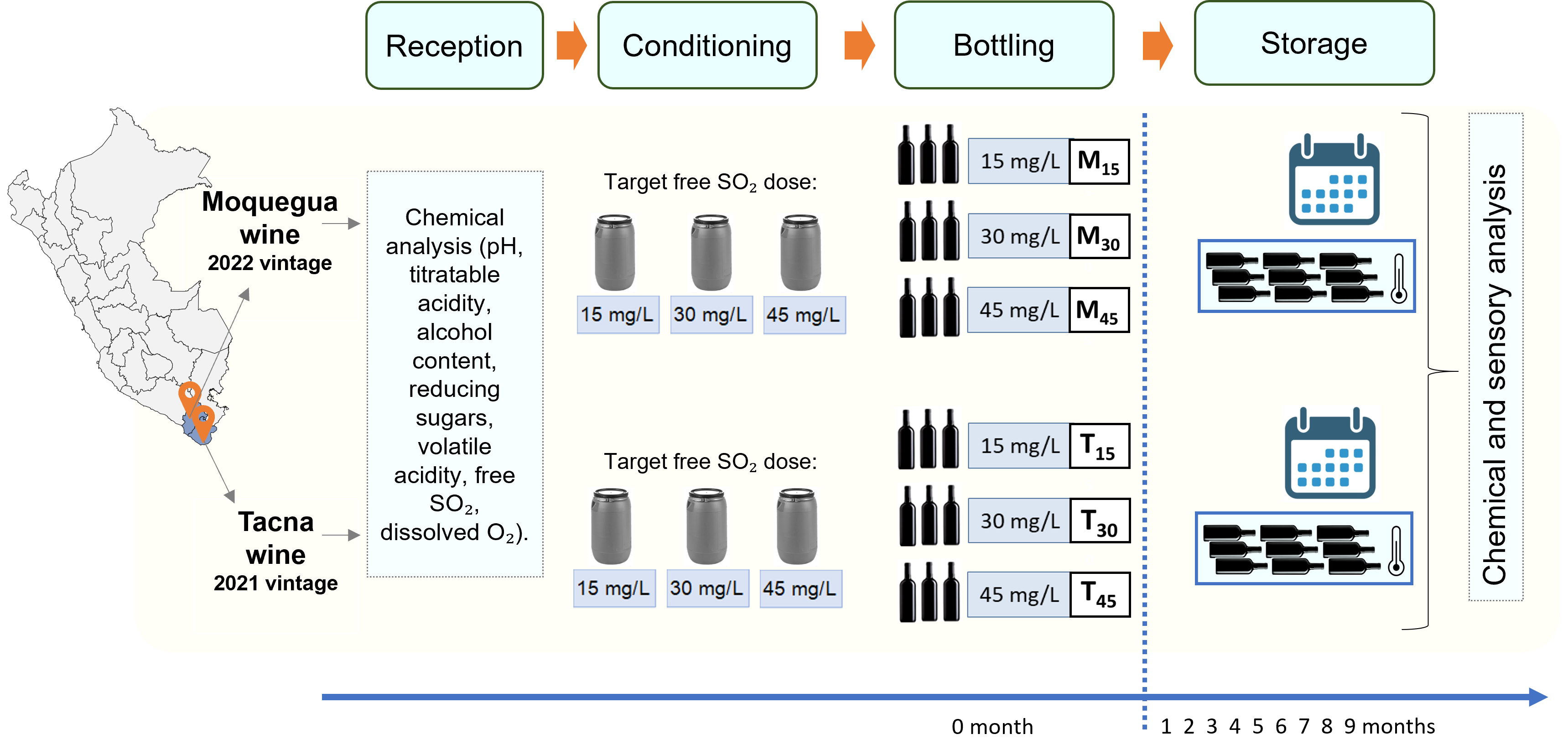
Figure 1. Diagram of conditioning and preparation of dry red wine samples of the Negra Criolla variety from Moquegua and Tacna.
3.1. Reception
A total of 120 L of dry red wine (Negra Criolla variety) was obtained from terroirs in Tacna and Moquegua, after completion of malolactic fermentation. The Tacna wine (2021 vintage) was acquired in August 2022, whereas the Moquegua wine (2022 vintage) was obtained in October 2022. Prior to acquisition, the wines had been stored in 2750 L HDPE tanks under commercial winery conditions at ambient temperature. Upon receipt, the samples were stored under controlled conditions (16 °C, in darkness) for two months (Tacna wine) and two weeks (Moquegua wine).
Although vintage and prior storage history were not considered experimental factors, a rigorous standardisation protocol was implemented before the addition of potassium metabisulfite to minimise initial variability. This included conducting baseline chemical analyses of pH, titratable acidity, alcohol content, reducing sugars, volatile acidity, free SO2, and dissolved O2 for both wines.
3.2. Conditioning
Subsequently, 120 L of each wine were transferred into three 40 L HDPE vessels, in which free SO2 and dissolved O2 levels were rechecked to ensure homogeneous initial conditions. This protocol minimised initial variability; consequently, the trends observed during storage could be attributed to SO2 behaviour and oxygen evolution in the bottle. On the same day, before bottling, potassium metabisulfite was added to achieve target free SO2 doses of 15, 30, and 45 mg/L, corresponding to treatments T15, T30, and T45, for Tacna wines, and M15, M30, and M45, for Moquegua wines. This adjustment was performed by adding an aqueous K2S2O5 solution standardised by specific gravity at 20 °C (Zoecklein et al., 1995). The SO2 partitioning approach (Peynaud, 1999) was applied, taking into account that a fraction of the added SO2 binds to wine constituents. The pH values of Tacna (3.55) and Moquegua (3.71) wines were also considered to achieve a molecular SO2 concentration of 0.5 mg/L, thereby ensuring microbiological stability in red wines.
3.3. Bottling
The wine was bottled in 0.75 L olive-green, Bordeaux-style glass bottles. Before bottling, each bottle was purged with inert gas (CO2) for 1 s to minimise oxygen contamination. Corking was performed using a manual corking machine, with one-piece, cylindrical first-grade corks (45 × 24 mm) purchased from Cork Peru. The Tacna wine was bottled on 3 November 2022 and the Moquegua wine on 17 November 2022. Bottling day (day 0) was defined as the starting point of the study, and all subsequent days were considered part of the bottle storage period. Data reported as ‘day 0’ correspond to the initial wine analysed prior to the addition of K2S2O5 and the bottling process.
3.4. Storage
Storage was carried out under controlled conditions at 16 °C, in darkness, with bottles stored horizontally. The storage periods for chemical analyses were 259 days for the Tacna wine and 244 days for the Moquegua wine, whereas those for sensory analyses were 265 days and 251 days, respectively. During storage, at each sampling point, three independent bottles per treatment were analysed for the determination of dissolved gases (free SO2, CO2, and O2) and sensory analysis, with each wine bottle considered an experimental unit.
4. Chemical analysis of the wine
The following parameters were determined:
- The pH was measured potentiometrically using a precision portable pH meter (Hanna Instruments, model HI98128, pHep®5, Woonsocket, RI, USA) (OIV, 2025).
- Titratable acidity was determined by acid–base titration using 0.1 N NaOH. A 5 mL aliquot of previously degassed wine was diluted with 25 mL of distilled water, followed by the addition of three drops of phenolphthalein as an indicator. The solution was then titrated until a blue–violet colour change was observed in red wines (García-Barceló, 1990).
- Alcoholic strength by volume was determined by densimetric (aerometric) measurement following prior distillation, using an alcoholometer calibrated at 20 °C (OIV, 2025).
- Volatile acidity was quantified using the García-Tena method, based on the fractional distillation of an 11.00 mL wine sample to obtain two consecutive fractions (5.1 mL and 3.2 mL), followed by titration of the second fraction with 0.02 N NaOH, using phenolphthalein as an indicator (García-Barceló, 1990).
- Reducing sugars were determined using the Luff method, based on the oxidation of an aliquot of defecated wine with an alkaline copper solution (Luff reagent). The excess unreduced cupric ions were quantified by iodometric titration after the addition of potassium iodide under acidic conditions. The liberated iodine was then titrated with sodium thiosulfate, using starch as a colourimetric indicator (Bordeu & Scarpa, 1998).
- Free SO2 was determined by the aspiration method, in which molecular SO2 in an acidic medium is removed by a stream of air. The volatilised SO2 was recovered in a neutral hydrogen peroxide solution, where it was oxidised to sulfuric acid. The resulting acid was then titrated with a standardised 0.01 N NaOH solution (Bordeu & Scarpa, 1998).
- Dissolved CO2 was determined using the Janny volumetric method with a Carbodoseur (Laborglass, São Paulo, Brazil; standard model, 100 mL ± 1.0 mL at 20 °C; range 0–2.0 g/L). The method is based on measuring the volume of wine displaced by gas released during degassing by mechanical agitation. When the sample is agitated in a closed system, the released CO2 generates internal pressure that expels a portion of the wine through a hollow rod. This decrease in liquid level allows the concentration of dissolved gas to be quantified (Bordeu & Scarpa, 1998).
- Dissolved O2 was measured using an electrochemical system with a dissolved oxygen meter (Hanna Instruments, model HI9146, Woonsocket, RI, USA) (Bordeu & Scarpa, 1998).
To ensure the reliability of dissolved gas measurements and minimise contact with atmospheric oxygen during bottle opening, a standardised protocol was implemented. Sample temperature was stabilised at 20 °C by pre-conditioning the laboratory the day before analysis. The sequence of measurements was dissolved O2, then dissolved CO2, and finally free SO2. Dissolved O2 was measured immediately after bottle opening and probe insertion, taking advantage of the rapid response of the electrochemical sensor to minimise gas exchange. For each treatment, three independent units were analysed individually and sequentially.
5. Sensory analysis
The study was conducted in accordance with the World Medical Association Code of Ethics (Declaration of Helsinki). Participation was anonymous and voluntary. Before the test, participants provided informed consent by accepting the statement ‘I agree to participate in the sensory evaluation’ (Supplementary material), with an affirmative response required to proceed. Participants were also informed that they could withdraw from the study at any time without providing justification. Sensory analysis was conducted throughout the bottle storage period in five sessions for each wine at different time points (days 15, 48, 139, 201, and 265 for the Tacna wine, and days 1, 34, 125, 187, and 251 for the Moquegua wine). Evaluations were carried out in individual booths under controlled conditions, with white lighting and an ambient temperature of 20 ± 1.0 °C. Samples were served in ISO 3591:1977 tasting glasses (ISO, 1977) and coded with three random digits. Each participant received six 30 mL samples, presented individually, served at 18 ± 1.0 °C. Water was provided for palate cleansing.
The order of sample presentation was balanced using Williams' Latin squares design to minimise first-order and carry-over effects (Macfie et al., 1989). Approximately 50 participants were recruited for each evaluation session. Participants included students, academic staff, administrative staff, and external consumers from the Universidad Nacional de Moquegua (UNAM). During recruitment, only basic information about the study was provided. Before tasting, participants completed a brief questionnaire on sociodemographic data and wine consumption habits (Supplementary material).
Sensory quality was evaluated using an acceptance test based on a structured 9-point hedonic scale, anchored at the extremes by ‘1 = dislike extremely’ and ‘9 = like extremely’ (Peryam & Pilgrim, 1957). Participants then selected the attributes that best described each wine according to its visual, olfactory, and gustatory characteristics using the Check-All-That-Apply (CATA) method (Ares et al., 2010; Delarue & Lawlor, 2023), which included 29 sensory attributes: eight visuals (turbidity, colour intensity, clarity/transparency, bright, ruby-red, garnet, brown, brick-red), eight olfactory (sweet aroma, wood, grape, raisins, nuts, herbaceous, vinegar, red-fruit), seven gustatory (bitter, astringent, sour, spicy/alcoholic, fruity, sweet, grape skin), and six retronasal aroma (wood, acidic, yeast, fig, fruity, and raisin). These descriptors were generated by a panel of experts (winemakers and winery managers) and subsequently validated against the scientific literature (Biasoto et al., 2014; Koussissi et al., 2002; Mahieu et al., 2020; Obreque-Slier et al., 2024; Sivertsen et al., 2001).
6. Statistical analysis
The results of dissolved gases (free SO2, CO2, and O2) were analysed using two-way analysis of variance (ANOVA) considering storage time and target free SO2 dose (fixed effects). Tukey’s post-hoc test was applied when significant differences were detected (p < 0.05). Residual normality (Shapiro–Wilk test) and homogeneity of variances (Levene’s test) were verified prior to ANOVA.
Overall acceptance was analysed using ANOVA, considering storage time and target free SO₂ dose (fixed effects), and consumers (random effect). Residual normality (Shapiro–Wilk test) and homogeneity of variances (Levene’s test) were verified beforehand; as these assumptions were not met for the Tacna wine, the data were transformed using the Box–Cox method (Bergmeir et al., 2016). Subsequently, ANOVA was applied to the transformed data and, when significant differences were detected, Tukey’s post-hoc test was used (p < 0.05).
For the sensory profile obtained through the CATA method, Cochran’s Q test was applied (p < 0.05) to identify significant differences in attribute frequencies among samples (Cochran, 1950). Correspondence analysis (CA) was then performed (Aldas & Uriel, 2017). To assess the stability of the sensory profile in the CA space, 95 % confidence ellipses (α = 0.05) were constructed using bootstrap resampling (1000 replicates), applying Procrustes rotations to the significant axes (Cadoret & Husson, 2013; Saldaña et al., 2019). These ellipses represent the multidimensional stability of the samples, whose overlap indicates similarity.
All chemical and sensory analyses were conducted using R software (version 4.5.2).
Results
1. Chemical analysis of wine
Table 1 presents the general chemical parameters of the initial wines (prior to K2S2O5 addition) and at the end of the evaluation period.
Chemical parameters | Initial wine | 15 mg/L (T15/M15) | 30 mg/L (T30/M30) | 45 mg/L (T45/M45) | |||
Tacna wine (2021 vintage), final values (259 days) | |||||||
Titratable acidity (g/L tartaric acid) | 7.55 ± 0.09 a |
| 8.17 ± 0.21 b |
| 7.80 ± 0.30 a |
| 7.83 ± 0.25 a |
pH | 3.55 ± 0.05 a |
| 3.53 ± 0.01 a |
| 3.53 ± 0.01 a |
| 3.56 ± 0.01 a |
Alcohol content (% vol.) | 14.13 ± 0.12 a |
| 13.87 ± 0.06 b |
| 14.00 ± 0.10 ab |
| 14.10 ± 0.10 ab |
Reducing sugars (g/L glucose) | 3.81 ± 0.08 |
| N/D | N/D | N/D | ||
Volatile acidity (g/L acetic acid) | 0.88 ± 0.03 a |
| 0.93 ± 0.02 a |
| 0.78 ± 0.12 a |
| 0.79 ± 0.11 a |
Moquegua (2022 vintage), final values (244 days) | |||||||
Titratable acidity (g/L tartaric acid) | 5.58 ± 0.24 a |
| 5.67 ± 0.15 a |
| 5.47 ± 0.15 a |
| 5.35 ± 0.15 a |
pH | 3.71 ± 0.02 a |
| 3.77 ± 0.01 a |
| 3.77 ± 0.06 a |
| 3.74 ± 0.04 a |
Alcohol content (% vol.) | 12.70 ± 0.00 ab |
| 12.20 ± 0.10 c |
| 12.47 ± 0.06 b |
| 12.83 ± 0.15 a |
Reducing sugars (g/L glucose) | 2.67 ± 0.12 |
| N/D |
| N/D |
| N/D |
Volatile acidity (g/L acetic acid) | 0.69 ± 0.01 b |
| 0.82 ± 0.05 a |
| 0.81 ± 0.07 ab |
| 0.76 ± 0.04 ab |
Values are expressed as mean ± standard deviation (n = 3). Different lowercase letters within the same row indicate statistically significant differences (Tukey’s test, p < 0.05). Tacna wines (T15, T30, and T45) and Moquegua wines (M15, M30, and M45) correspond to target free SO2 doses of 15, 30, and 45 mg/L, respectively. N/D: not determined. Reducing sugars were not analysed at the end of the study period.
The Tacna wine (2021 vintage) showed residual sugar levels below 4 g/L, confirming its classification as a dry wine. Moreover, pH, titratable acidity, and volatile acidity remained stable throughout the study period, except that titratable acidity in treatment T15 increased slightly from 7.55 to 8.17 g/L. Alcohol content decreased slightly over time, particularly in T15, from 14.13 % to 13.87 %.
The high initial titratable acidity in Tacna wine can be attributed to the addition of tartaric acid, a common practice in the warm coastal valleys of southern Peru. However, the relatively high pH could be associated with the buffering capacity of the wine and the presence of cations, such as potassium (Rajković et al., 2007). The slight variation in acidity in T15 may be linked to hydrolysis reactions and the release of acids from phenolic degradation (Monagas et al., 2005). Additionally, the high titratable acidity values observed in the initial Tacna and Moquegua wines may have been slightly overestimated due to the visual titration method using phenolphthalein, whose endpoint occurs at pH 8.2.
The Moquegua wine (2022 vintage) was also classified as dry, with stable pH and titratable acidity throughout the study period. Alcohol content showed a slight decrease in treatment M15, from 12.70 % to 12.20 %. A minor increase in volatile acidity was observed at the end of the storage period in treatments M15 and M30.
1.1. Temporal evolution of free SO2, dissolved CO2, and dissolved O2 during storage
1.1.1. Free sulfur dioxide (SO2)
As anticipated, significant differences in free SO2 levels were maintained between treatments within each wine type (Tacna and Moquegua) throughout the storage period (Supplementary Material). These statistical differences confirm the distinct chemical evolution of each treatment level independently for both origins.
In the Tacna wine (2021 vintage), free SO2 levels in the initial wine (prior to K2S2O5 addition) were consistently low, ranging from 6.80 to 10.53 mg/L. Following the addition of K2S2O5 and post-bottling, concentrations reached maximum values on day 1, with mean values of 17.60 mg/L (T15), 33.60 mg/L (T30), and 58.00 mg/L (T45). Subsequently, a continuous decrease was observed across all treatments until the end of the study period (day 259), reaching final values of 4.33, 9.33, and 18.93 mg/L, respectively (Figure 2A).
For Moquegua wine (2022 vintage), initial free SO2 levels (prior to K2S2O5 addition) ranged from 10.37 to 13.20 mg/L. Following the addition of K2S2O5 and post-bottling, the highest values were recorded on day 7, with mean values of 20.67 mg/L (M15), 37.20 mg/L (M30), and 65.60 mg/L (M45). Thereafter, levels gradually declined, reaching final values on day 244 of 10.33, 14.67, and 31.30 mg/L, respectively (Figure 2B).
The free SO₂ concentrations measured on day 1 after bottling were slightly higher than the previously established theoretical target doses (15, 30, and 45 mg/L). These concentrations correspond to adjustments calculated prior to bottling by adding potassium metabisulfite and determined according to pH-dependent equilibrium conditions. However, the analytical values obtained on day 1 represent the effective free SO2 concentration after homogenisation of the wine matrix and initial oxygen exposure during bottling. In wine, free SO2 is distributed in dynamic equilibrium among its molecular, bisulfite, and sulfite forms, and it rapidly reacts with carbonyl compounds such as acetaldehyde and ketoacids (Tachtalidou et al., 2022). Simultaneously, oxygen incorporation during bottling initiates early redox reactions that may transiently influence the measurable free fraction. Therefore, the concentrations recorded on day 1 reflect the post-bottling equilibrium state rather than strictly the theoretical dose added.
From a dynamic perspective, the experimental relevance lies in the subsequent depletion pattern rather than in the initial absolute value. In both wines, all treatments showed a progressive decrease in free SO2 during bottle storage, indicating ongoing oxygen-related consumption reactions. The rate of decline depended on the treatment, being faster at 15 mg/L and slower with 45 mg/L. This behaviour suggests that antioxidant capacity during bottle ageing is determined by the balance between initial SO2 availability and oxygen ingress (Danilewicz & Standing, 2018; Sacks et al., 2020; Miao & Waterhouse, 2025).
The difference in total monitoring duration between Tacna (259 days) and Moquegua (244 days) wines reflects independent bottling dates, with each wine evaluated relative to its own bottling point (day 0), thereby ensuring internal consistency in the temporal analysis. Since the objective was to characterise storage dynamics rather than to establish a chronological equivalence between origins, this slight difference in total observation time does not affect the interpretation of SO2 depletion trends or dissolved oxygen behaviour.
Although vintage and pre-bottling storage conditions were not controlled variables, it is acknowledged that the initial redox state of each wine may have been influenced by factors such as winery-specific practices, SO2 levels, oxygen exposure, and temperature prior to standardisation. These factors may have affected both the initial oxidative state and subsequent SO2 behaviour. Consequently, the observed differences are interpreted in terms of the chemical evolution of each wine matrix under controlled conditions, while acknowledging the influence of prior history.
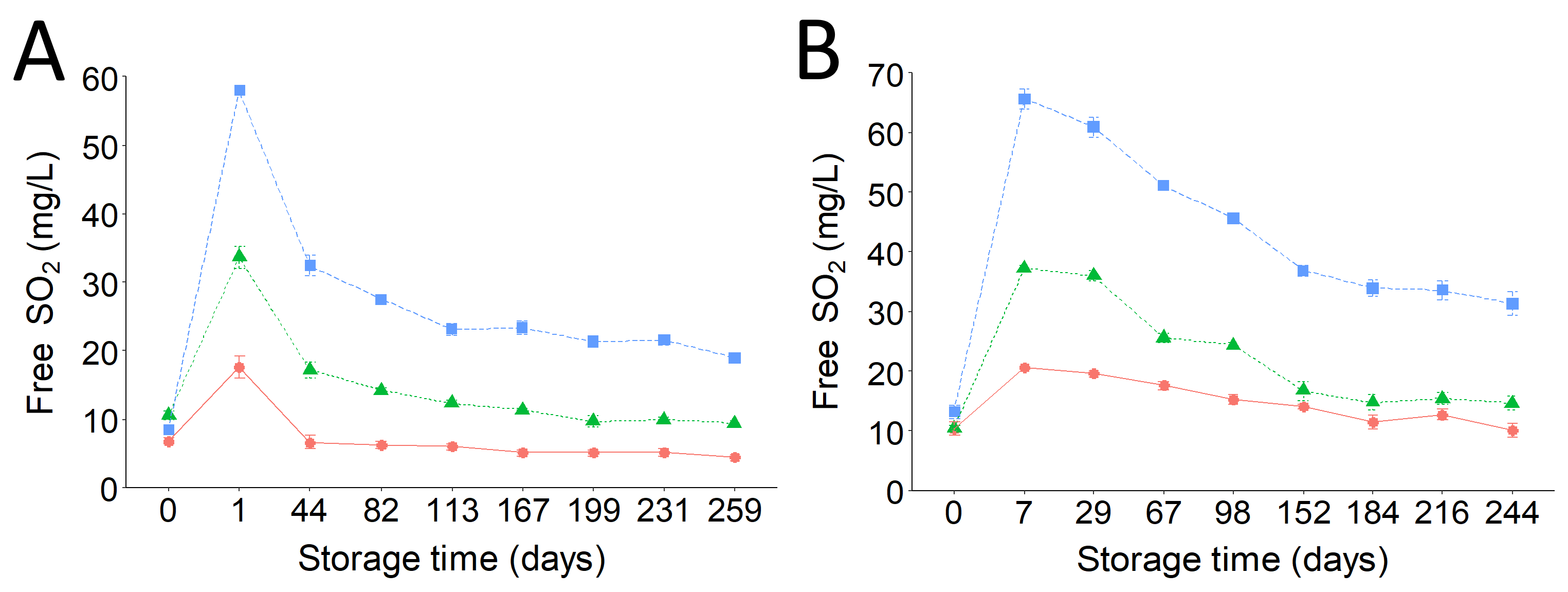
Figure 2. Evolution of free SO2 during bottle ageing in Negra Criolla red wines: Tacna (2021 vintage) (A) and Moquegua (2022 vintage) (B). Day 0 corresponds to the initial wine prior to K2S2O5 addition; subsequent points represent bottle storage. Lines represent wines treated with target free SO2 doses of 15 (●), 30 (▲), and 45 mg/L (■) prior to bottling.
1.1.2. Dissolved carbon dioxide (CO2)
Regarding dissolved CO2 in the Tacna wines, no statistically significant differences were observed among treatments (Supplementary material). However, a steady decrease was noted, reaching 0 g/L at 199 and 231 days in treatments T15 and T30, respectively (Figure 3A). In the Moquegua wines, statistically significant differences among treatments were observed (Supplementary material), with a gradual decrease throughout the storage period. Between the first and final evaluations, treatments M30 and M45 maintained relatively stable values, decreasing from 0.32 to 0.24 g/L and from 0.36 to 0.27 g/L, respectively, whereas M15 showed a marked reduction, from 0.34 to 0.08 g/L (Figure 3B).
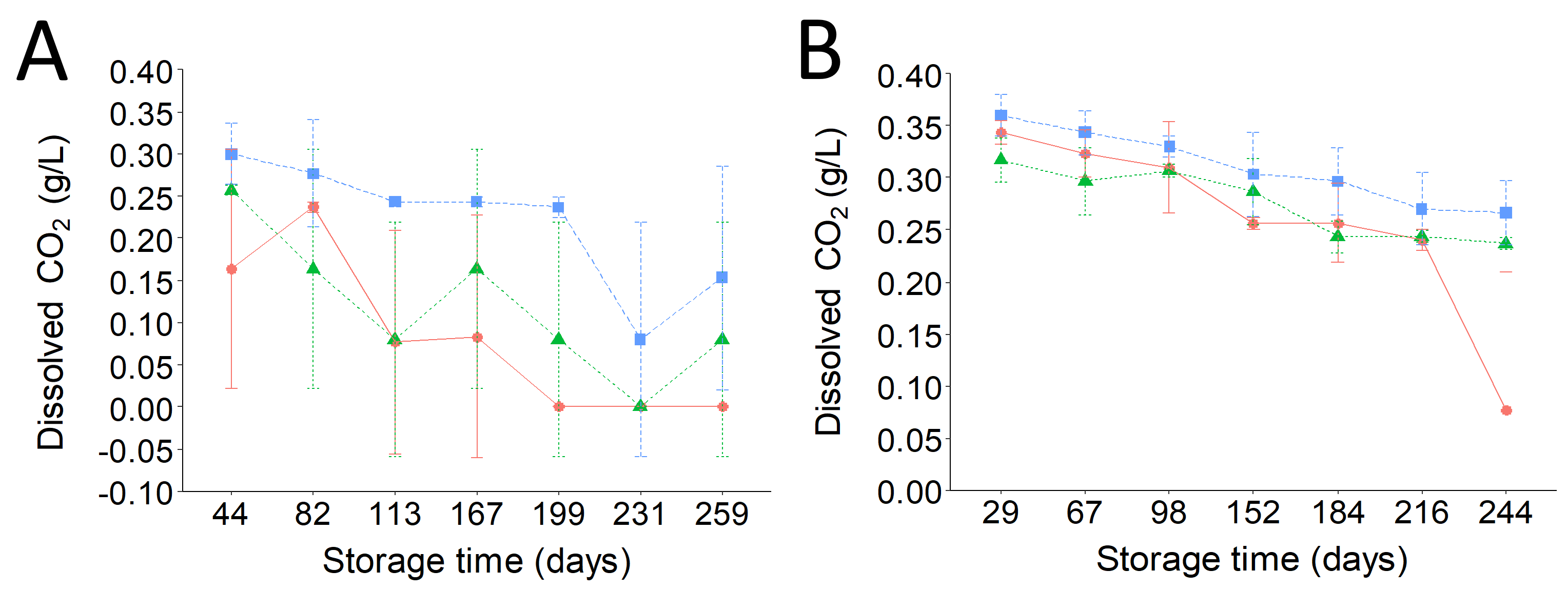
Figure 3. Evolution of dissolved CO2 during bottle ageing in Negra Criolla red wines: Tacna (2021 vintage) (A) and Moquegua (2022 vintage) (B). Lines represent wines treated with target free SO2 doses of 15 (●), 30 (▲), and 45 mg/L (■) prior to bottling.
1.1.3. Dissolved oxygen (O2)
Statistically significant differences were observed among treatments in both the Tacna and Moquegua wines (Supplementary material). In the Tacna wine (Figure 4A), initial dissolved O2 levels (prior to K2S2O5 addition) were consistently low, ranging from 0.47 to 0.53 mg/L. Following bottling, all treatments showed a rapid initial increase, followed by a decline between days 1 and 113, and a subsequent sharp rise until day 167. Thereafter, treatment T15 increased steadily to 3.31 mg/L (day 259), whereas T30 and T45 remained relatively stable, with final values of 2.82 and 2.53 mg/L, respectively.
For the Moquegua wine (Figure 4B), initial dissolved O2 levels (prior to K2S2O5 addition) were similarly low, ranging from 0.47 to 0.53 mg/L. Following a rapid post-bottling increase and a decline until day 98, a notable rise was observed until day 152, followed by a gradual upward trend until day 244. This increase was most pronounced in treatment M15 (3.01 mg/L) compared to M30 and M45, which averaged 2.90 and 2.44 mg/L, respectively.
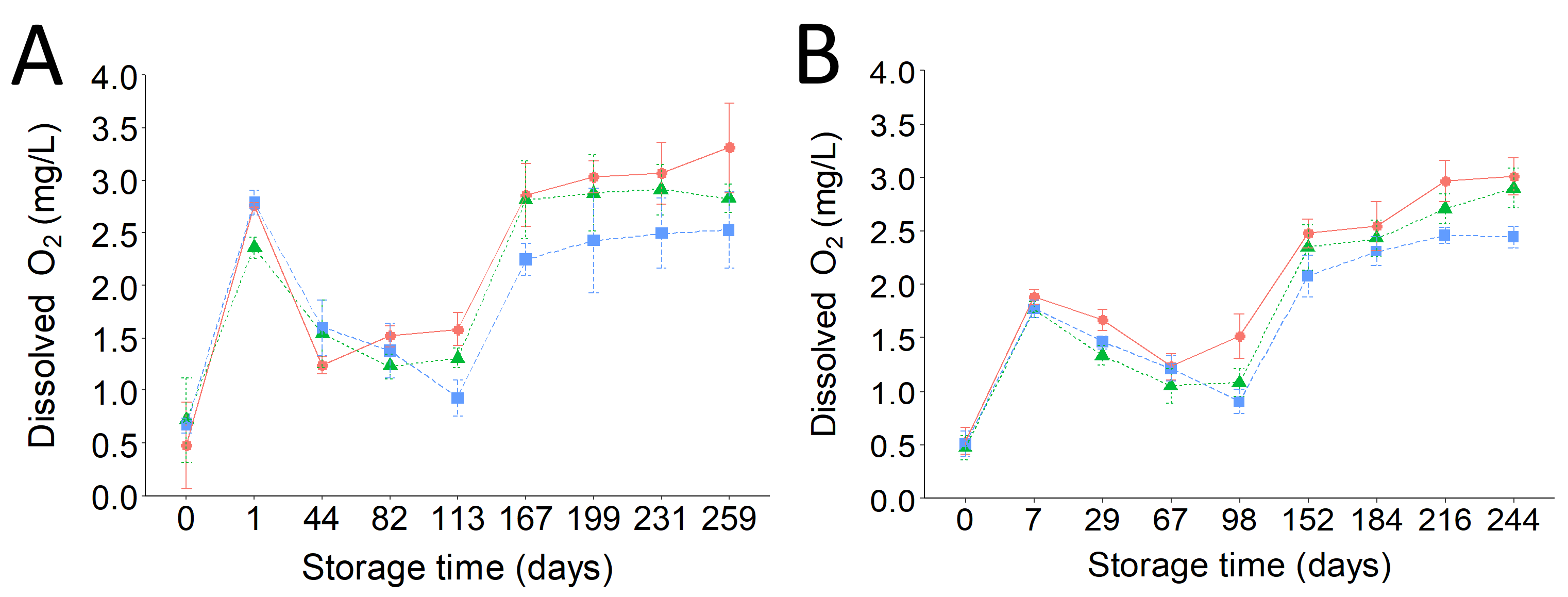
Figure 4. Evolution of dissolved O2 during bottle ageing in Negra Criolla red wines: Tacna (2021 vintage) (A) and Moquegua (2022 vintage) (B). Day 0 corresponds to the initial wine prior to K2S2O5 addition; subsequent points represent bottle storage. Lines represent wines treated with target free SO2 doses of 15 (●), 30 (▲), and 45 mg/L (■) prior to bottling.
2. Sensory analysis
A total of 234 consumers participated in the sensory evaluation. The sample consisted predominantly of individuals from Generation Z with incomplete university education, who reported occasional consumption of red and semi-dry wines. Participant characteristics are summarised in Table 2.
Sociodemographic characteristics | n = 234 | (%) | |
Sex | Female | 105 | 44.87 |
Male | 129 | 55.13 | |
Age (years) | 18–24 | 156 | 66.67 |
25–31 | 49 | 20.94 | |
32–38 | 20 | 8.55 | |
39–45 | 6 | 2.56 | |
46–52 | 3 | 1.28 | |
>53 | 0 | 0.00 | |
Educational level | Unfinished university education | 175 | 74.79 |
Completed technical or university education | 59 | 25.21 | |
Frequency of consumption | Daily | 6 | 2.56 |
1 to 2 times per week | 50 | 2.37 | |
1 to 2 times per month | 149 | 63.68 | |
1 to 2 times per year | 29 | 12.39 | |
What type of wine do you drink? | Red wine | 232 | 56.72 |
White wine | 95 | 23.23 | |
Rosé wine | 64 | 15.65 | |
Sparkling wine | 18 | 4.40 | |
Based on sugar content, what type of wine do you drink? | Dry | 101 | 25.31 |
Semi-dry | 183 | 45.86 | |
Sweet | 115 | 28.82 | |
Overall hedonic acceptance of Negra Criolla wines, assessed using a 9-point hedonic scale with consumers, showed significant differences associated with bottle storage in both Tacna and Moquegua wines, according to the ANOVA test. Tukey’s test indicated a slight decline in acceptance over time (Figure 5A–B). During the first two months of evaluation, acceptance of both wines remained slightly above the neutral point (4.5 on the 9-point hedonic scale). However, from the fourth month onwards, overall acceptance decreased, reaching levels corresponding to ‘slightly unpleasant’ on the hedonic scale.
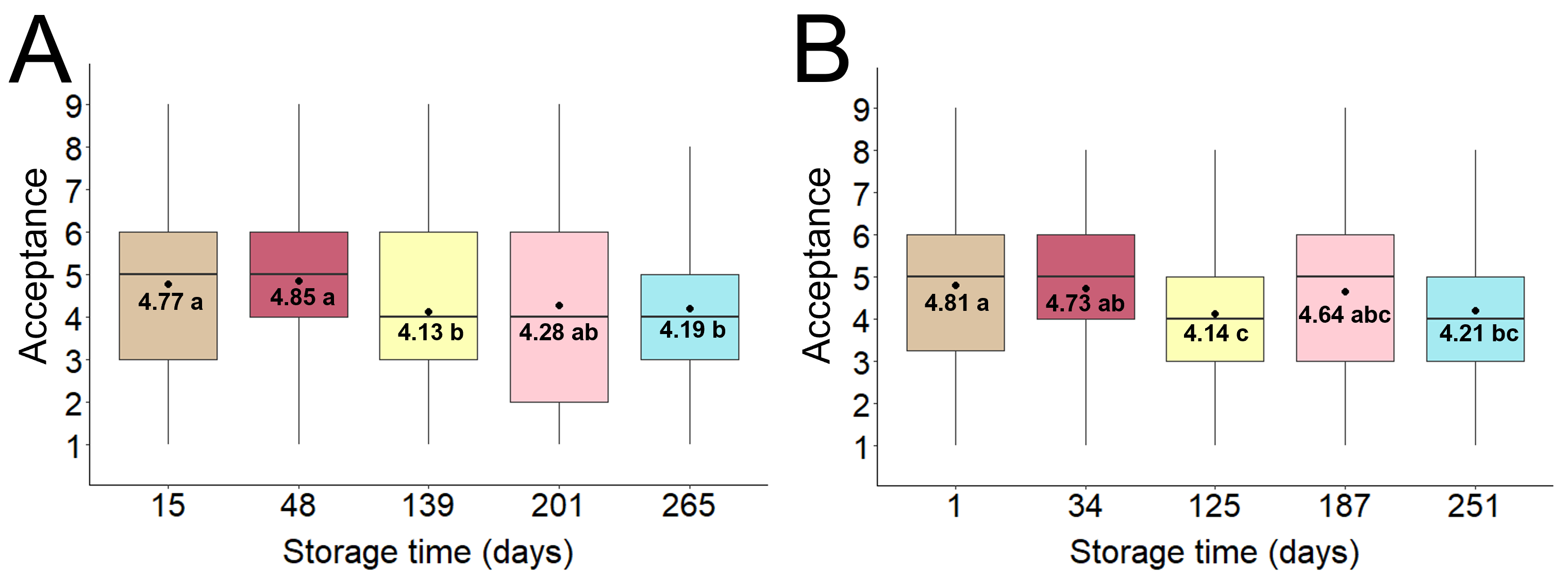
Figure 5. Effect of storage time on overall acceptance of Negra Criolla red wine: Tacna (2021 vintage) (A) and Moquegua (2022 vintage) (B). Different lowercase letters within the boxplots indicate statistically significant differences in the different storage times (Tukey’s test, p < 0.05).
Correspondence analysis (CA) was used to characterise the sensory evolution of Negra Criolla wine during bottle storage (Figure 6). The reliability of the 234 evaluators was assessed using Cochran’s Q test, which showed significant differences (p < 0.05) in attribute citation frequencies. This indicates good consumers discrimination among treatments, supporting the robustness of the CATA method.
Figure 6a illustrates the CA for the first evaluation session (first month), which identifies nine significant attributes based on Cochran’s Q test. Moquegua wine, the M45 treatment was associated with brown and brick-red colours, and a red-fruit aroma, whereas M15 and M30 showed similar sensory profiles, characterised by clarity/transparency. The Tacna wines (treatments T15, T30, and T45) exhibited similar sensory attributes, including ruby-red and garnet colour, high colour intensity, and a wood retronasal aroma.
Figure 6b presents the CA of the second evaluation session (second month), in which five significant attributes were identified using Cochran’s Q test. The three Tacna wines (treatments T15, T30, and T45) shared a similar sensory profile, characterised by a ruby-red colour, high colour intensity, and red-fruit aroma. Moquegua wines showed an evolved profile, with M15 and M45 associated with brown hues, while M30 was characterised by a bitter taste.
Figure 6c shows the CA for the third evaluation session (fourth month), indicating ten significant attributes based on Cochran’s Q test. Moquegua wines were characterised by clarity/transparency, brown and brick-red colour (M30 and M45), and raisin and acidic aromas (M15). Tacna wines were associated with high colour intensity and ruby-red colour (T15 and T30), while fruity and wood retronasal aromas were linked to T45, and turbidity to T30.

Figure 6. Perceptual maps of correspondence analysis (CA) of CATA data during bottle storage of Negra Criolla red wine from Tacna (2021) and Moquegua (2022). The first to fifth assessment dates (a–e) are presented. T15, T30, and T45 (Tacna) and M15, M30, and M45 (Moquegua) correspond to target free SO2 doses of 15, 30, and 45 mg/L, respectively.
Figure 6d depicts the CA for the fourth evaluation session (sixth month), showing six significant attributes according to Cochran’s Q test. For the Tacna wine, the T15 treatment was characterised by colour intensity, garnet colour, and a vinegar aroma, while treatments T30 and T45 were associated with a sour taste. In the Moquegua wine, treatments M30 and M45 were distinguished by clarity/transparency. The red-fruit aroma was positioned equidistantly between T30 and M30.
Finally, Figure 6e illustrates the CA for the fifth evaluation session (ninth month), with only three significant attributes according to Cochran’s Q test. Tacna wines (treatments T15, T30, and T45) were characterised by colour intensity. Moquegua wines (treatments M15, M30, and M45) were associated with clarity/transparency and brick-red colour.
The differences observed in the sensory profiles during bottle storage, although partly attributable to terroir, may also have been influenced by pre-existing oenological factors such as vintage (Tacna, 2021; Moquegua, 2022), winemaking practices (e.g., vessel type and spontaneous fermentation), and pre-bottling conditions (particularly the prolonged storage in an HDPE tank of the Tacna wine).
Discussion
Unlike previous studies focused on traditional grape varieties, this is the first study to evaluate the association between the changes in the sensory profile of Negra Criolla dry red wine and the evolution of dissolved gases (free SO2, CO2, and O2) during bottle storage.
1. Relationship between free SO2, dissolved CO2, and dissolved O2 during bottle storage
A preliminary observation from this study suggests a close relationship among free SO2, dissolved CO2, and dissolved O2 during bottle storage. Immediately post-bottling, an initial increase in both free SO2 and dissolved O2 was observed in the Tacna and Moquegua wines. As expected, the increase in free SO2 resulted from the addition of K2S2O5 prior to bottling, whereas the rise in dissolved O2 is associated with wine agitation and direct contact with air during this process, which can introduce between 0.5 and 1.5 mg/L of dissolved O2 (Day et al., 2015; Ferrer-Gallego et al., 2018; Gabrielli et al., 2021).
After bottling, free SO2 declined continuously throughout the nine-month storage in both wines. This decline is consistent with oxygen consumption reactions, as several studies have demonstrated a direct relationship between oxygen uptake and free SO2 loss (Danilewicz, 2016; du Toit et al., 2006; Miao & Waterhouse, 2025). Similar behaviour has been reported in Malbec, Cabernet-Sauvignon, and Merlot wines, where the most pronounced reductions in free SO2 occurred between 6 and 12 months of bottle ageing (Giuffrida de Esteban et al., 2019; Sacks et al., 2020).
According to the International Organisation of Vine and Wine (OIV), a free SO2 concentration of 25 mg/L is recommended to ensure adequate molecular SO2 during bottle storage (OIV, 2021). In this study, after nine months of storage, all Tacna wines (T15, T30, and T45) and Moquegua wines M15 and M30 exhibited free SO2 levels below this threshold. Notably, Tacna treatments T15 and T30 showed free SO2 concentrations below 10 mg/L, a level associated with an increased risk of oxidation in red wines (Godden et al., 2001; Reeves, 2009; Vidal et al., 2015). In the Moquegua wines, all treatments maintained free SO2 concentrations above 10 mg/L, indicating greater antioxidant protection.
Regarding dissolved O2 concentrations, these decreased during the first three months of storage (day 113 for Tacna wines and day 98 for Moquegua wines), particularly in treatments with higher free SO2 levels (30 and 45 mg/L). This initial decline suggests active consumption of oxygen by the antioxidant system of the wine (Pérez-Magariño et al., 2023). Subsequently, dissolved O2 levels increased from day 167 (Tacna) and day 152 (Moquegua) until the end of the study; this rise is attributed to the gradual ingress of oxygen through the cork by diffusion, driven by a partial pressure gradient (Echave et al., 2021). This oxygen transfer has been reported to range between 1.7 and 2.3 mL/month, depending on the type of natural cork used (Lopes et al., 2006). The disparity in dissolved oxygen between treatments (15 mg/L compared with 30 and 45 mg/L) lay in their antioxidant capacity; higher free SO2 levels (30 and 45 mg/L) promoted dissolved oxygen consumption, preventing its accumulation in the liquid phase. In contrast, the 15 mg/L treatment exceeded the critical oxidation risk threshold of 3 mg/L proposed by Ferrer-Gallego et al. (2018), reaching 3.31 mg/L in Tacna and 3.01 mg/L in Moquegua by the end of the study period. Additionally, treatments with lower K2S2O5 addition showed a slight decrease in alcohol content together with a slight increase in volatile acidity after approximately nine months of bottle storage (Table 1). These observations suggest a relevant role of sulfur dioxide in the chemical equilibrium of wine, given that the free SO2 fraction interacts with compounds such as anthocyanins, sugars, and acetaldehyde (Waterhouse & Laurie, 2006; Sacks et al., 2020). Acetaldehyde is generated through the oxidative conversion of ethanol and may subsequently lead to the formation of acetic acid, thereby contributing to an increase in volatile acidity (Waterhouse & Laurie, 2006; Bartowsky & Henschke, 2008). This behaviour may have been favoured by the elevated dissolved O2 levels observed in treatments T15 and M15 during the storage period. In this context, the results of the present study suggest that lower availability of free SO2 could favour oxidative processes associated with the conversion of ethanol into acetaldehyde and subsequently into acetic acid. Nevertheless, in the absence of microbiological and volatile compound analyses, the reactions underlying these changes cannot be conclusively established.
Although the addition of different target free SO2 doses (15, 30, and 45 mg/L) did not result in clear differences in dissolved CO2, storage time led to a progressive decline in both wines. In particular, the 15 mg/L treatment showed near-complete CO2 depletion (0.00 g/L in Tacna and 0.08 g/L in Moquegua), indicating substantial loss under low free SO2 conditions. Considering that recommended dissolved CO2 levels in bottled wines with light pigmentation range from 0.5 to 1.8 g/L (Boulton et al., 1999), these values suggest a progressive loss of CO2-related protection over time. This behaviour supports its use as an indirect indicator of closure tightness and gas exchange. However, dissolved CO2 should be interpreted as a parameter associated with physical processes rather than as an independent marker of the chemical or compositional changes of the wine.
2. Evolution of sensory characteristics and acceptance during bottle storage
A second finding of this study indicates that the sensory characteristics of the wines change significantly during bottle storage, which in turn influences consumer acceptance. During the first two months of storage, the Tacna wine (2021 vintage) exhibited a typical young red-wine profile, characterised by ruby-red and garnet colours, high colour intensity, and a predominance of red-fruit aromas with subtle wood aromas. Regarding the Moquegua wine (2022 vintage), it initially displayed brown and brick-red colour and pleasant red-fruit aromas, but later evolved towards less desirable characteristics, such as bitter taste and brown colour. The colour changes are mainly attributed to the wine ageing time (Laqui-Estaña et al., 2019; Vazallo-Valleumbrocio et al., 2017). During this period, polymerisation and condensation reactions occur between anthocyanins and tannins, along with oxidative pigment degradation, promoting colour stabilisation (Baris et al., 2024; Escribano-Bailón et al., 2019). Furthermore, the presence of red-fruit aromas, characteristic of young red wines (Etaio et al., 2009), indicates a youthful sensory profile in both wines. This same characteristic was observed in the wine of the ‘País’ variety grown on hill vineyards, which showed high colour intensity and red-fruit aromas and flavours (Obreque-Slier et al., 2024). The woody aroma, particularly perceived in the Tacna wine, should be interpreted cautiously, as it may reflect either a distinctive feature of the terroir-related sensory profile or the oxidative evolution in the wine during prior storage in HDPE tanks for over a year, which may have favoured the formation of resinous notes associated with woody descriptors (del Alamo-Sanza et al., 2015).
Over months 4–6, Moquegua wines exhibited a progressive sensory evolution, characterised by the development of brown and brick-red hues and a raisin aroma, while retaining some freshness through acidic and red-fruit notes. Over the same period, Tacna wines also evolved, exhibiting garnet hues and vinegar aroma, while maintaining sour taste, red-fruit notes, and colour intensity. The vinegar aroma may also indicate the evolution of Tacna wines, which showed acetic acid levels above 0.78 g/L, within or exceeding the sensory detection threshold for volatile acidity (0.5–0.9 g/L), depending on the variety (Grainger, 2021).
After approximately nine months of storage (day 265 for Tacna and day 251 for Moquegua), the Tacna wines still retained colour intensity. The Moquegua wines were characterised by clarity/transparency and brick-red hues, indicative of oxidative processes and structural degradation.
These findings suggest a relatively rapid evolution of the sensory profile in each wine. This behaviour may be modulated by pre-existing oenological factors such as vintage, winemaking practices, and pre-bottling conditions. Previous studies have shown that these factors determine the chemical matrix and its oxidative behaviour during bottle storage (Avizcuri et al., 2016; Etaio et al., 2009; Garrido-Bañuelos et al., 2021). This oxidative process involves the degradation of fruity aroma compounds, the formation of aldehydic notes, and pigment degradation, leading to browning, and the development brick-red hues (Escudero et al., 2002; He et al., 2012; Lambropoulos & Roussis, 2007). Future studies should integrate polyphenolic and volatile compound characterisation to better link molecular changes with sensory evolution.
Astringency was not perceived as a relevant sensory attribute in Negra Criolla wines from either origin. Bitterness, however, was detected only in the Moquegua wines during the early months of storage. This may be related to the presence of tannins in young wines, which contribute bitter and astringent sensations but progressively react with other compounds (e.g., anthocyanins and acetaldehyde) to form more stable polymeric structures that are sensorially less aggressive and smoother on the palate (Teissedre & Jourdes, 2013). Furthermore, consumer experience should be considered. In this study, 66 % of the participants were young and consumed wine only once or twice per month. A previous study has shown that consumers tend to describe astringency as ‘coating in the mouth’, whereas experts use descriptors such as ‘persistent’ or ‘full-bodied’ (Rinaldi et al., 2021). Considering the relevance of astringency at the time of consumption, it is crucial to monitor its equilibrium point during bottle ageing. The use of consumers with greater sensory experience is recommended to improve assessment accuracy, particularly for this attribute.
With regard to overall acceptance, both wines reached their highest scores at the initial stage, followed by a decline from the fourth month of storage onwards. These results contrast with the maturation curve described by Hidalgo (2018) and Zhang et al. (2023), who propose an inverted bell-shaped model with three stages: evolution toward sensory maturity, a peak in sensory quality, and a final decline. However, they are consistent with the findings of Lan et al. (2021) and Linsenmeier et al. (2010), who report that wine does not necessarily improve in the bottle but instead tends to lose fruity aromas and develop oxidative notes. This declining behaviour in the early stages is possibly attributable to the pre-bottling storage history. Consequently, given the initial characteristics of the wines, sensory monitoring during the first year is essential to determine their commercial potential.
Unlike previous studies that used wines with standard stability during bottle storage, this study focused on the evolution of dissolved gases (free SO2, O2, and CO2) and their sensory impact at early stages, using a potentially sensitive wine characterised by low levels of free SO2 (15 mg/L), different vintages (2021 vs 2022) and a pre-bottling storage history (prolonged storage in HDPE tanks for the Tacna wine). These conditions may have accelerated the evolution of wine. Nevertheless, future studies should consider longer ageing periods using wines bottled immediately after malolactic fermentation to confirm the chemical and sensory stability of the wines.
Furthermore, although this study focuses on wines from Tacna and Moquegua, the findings provide a relevant precedent for understanding the evolution of the sensory profile of the Negra Criolla variety during bottle storage; however, further multi-regional studies are required for national-level characterisation.
3. Association between sensory properties and free SO2, dissolved CO2, and dissolved O2
Taken together, a third finding of this study indicates that the evolution of the sensory characteristics of Negra Criolla wines was associated with the dynamics of dissolved gases (free SO2, CO2, and O2) during bottle storage, with visual and aromatic changes being the most perceptible to the participants.
From the first to the ninth month of storage, wine colour evolved from ruby-red to garnet in the Tacna wine and to brick-red in the Moquegua wine, particularly in wines with a target free SO2 dose of 15 mg/L (T15). In the Tacna wine, T15 fell below the 10 mg/L free SO2 threshold by the second month, which is associated with an increased risk of oxidation (Godden et al., 2001; Reeves, 2009; Vidal et al., 2015). The appearance of brick-red and brown hues, together with perceived clarity and/or transparency in both wines, suggests premature oxidation due to insufficient SO2 protection. Similar trends have been reported for Cabernet-Sauvignon wines, where lower initial free SO2 concentrations (10 mg/L) resulted in reduced sensory scores for colour, aroma, and flavour after 12 months of bottle storage compared with wines adjusted to 25 mg/L (Lukić et al., 2020). Under low free SO2 conditions, oxygen can generate reactive oxygen species that promote the oxidation of wine constituents, thereby altering the sensory profile (Echave et al., 2021; Elias et al., 2009; Waterhouse & Laurie, 2006). Consistent with this, the 15 mg/L treatment showed the highest dissolved O2 values (3.31 mg/L in the Tacna wine and 3.01 mg/L in the Moquegua wine), whereas the 30 and 45 mg/L treatments maintained values below 3 mg/L, a threshold above which the risk of wine oxidation increases (Ferrer-Gallego et al., 2018). Although the effect of dissolved CO2 on wine colour remains unclear, after nine months of storage, the wines showed almost complete loss of CO2, particularly in treatment T15, which also exhibited the greatest colour evolution. Although colour evolution was one of the most perceptible changes, it was assessed only sensorially, without instrumental measurements, which limits its characterisation.
Consumers also perceived changes in the aromatic profile of Negra Criolla wine during storage, with red-fruit and sweet notes evolving into raisin and vinegar descriptors. Wines with a target dose of 15 mg/L free SO2 showed lower free SO2 levels and higher dissolved oxygen concentrations at the end of the storage period. According to Ferreira et al. (2014) and Ferreira et al. (2015), the degradation of wine aromas is directly linked to SO2 depletion and the oxidation of aromatic compounds. In contrast, wines with target free SO2 of 30 and 45 mg/L preserved pleasant aromas for up to the sixth month and exhibited greater oxygen consumption, maintaining dissolved oxygen levels below 3 mg/L. This behaviour is consistent with the findings of Manuel Aragón-Capone et al. (2025), who reported that wines that rapidly consume oxygen exhibit fewer oxidation-related aromas. Similarly, Garnacha wines with low oxygen levels (< 3.0 mg/L) exhibited better expression of fruity attributes (Ugliano, 2013). Regarding dissolved CO2, its influence on the aroma and flavour of the wine after nine months of storage appears limited, given the low concentrations observed in both wines (Tacna and Moquegua), except for treatment M45, which had a final content of 0.27 g/L. It should be noted that the sensory detection threshold of CO2 in water is approximately 0.26 g/L and is associated with sensations such as tingling, prickling, burning, fizzy and spritzy (Gawel et al., 2020); therefore, its sensory impact on both wines was likely negligible.
Finally, under the conditions of this study, Negra Criolla wine showed a relatively short sensory acceptance period in bottle. However, these findings should not be generalised to all wines of this variety, as factors such as vintage, winemaking practices, and prolonged uncontrolled storage conditions prior to bottling may have influenced the initial state of the wine. Although varieties such as Cabernet-Sauvignon, Syrah and Merlot can tolerate longer bottle ageing without sensory deterioration (Gao et al., 2015; Marquez et al., 2014; Pons et al., 2022), comparative studies under equivalent conditions are required.
Conclusion
Under the conditions of this study, the sensory profile of Negra Criolla red wine was influenced by bottle storage time and was associated with the evolution of dissolved gases, mainly free SO2 and dissolved O2. At the end of the approximately nine-month study period, the evolution of colour toward garnet and brick-red hues was the most notable visual change perceived by consumers, being more pronounced in wines with low free SO2 and high dissolved oxygen. Regarding aroma, a transition from red-fruit notes to raisin and vinegar notes was observed, particularly in wines with 15 mg/L free SO2. This evolution of the sensory profile was reflected in overall acceptance, which showed a slight decrease a few months after bottling. However, these findings should not be generalised to all wines of this variety, as the reduced sensory stability observed may be associated with the initial redox state of each wine prior to bottling, influenced by factors such as vintage and winemaking practices.
Although this study focused on sensory characterisation, future research could integrate instrumental measurements to more precisely correlate molecular changes with sensory evolution and dissolved gases. Furthermore, longer ageing periods should be considered to confirm the chemical and sensory stability of the wines.
In addition, while this study is based on wines from Tacna and Moquegua, the results provide a relevant precedent for understanding the sensory evolution of this variety during bottle storage; however, multi-regional studies are required for national-level characterisation.
Acknowledgements
This research was supported by projects funded by the Universidad Nacional de Moquegua (C.O. No. 428-2021-UNAM). Jaime Laqui-Estaña thanks the Coordenação de Aperfeiçoamento de Pessoal de Nível Superior (CAPES—Brazil, finance code 001) for his doctoral assistantship.
References
- Ailer, Š., Jakabová, S., Benešová, L., & Ivanova-Petropulos, V. (2022). Wine Faults: State of Knowledge in Reductive Aromas, Oxidation and Atypical Aging, Prevention, and Correction Methods. Molecules, 27, 3535. https://doi.org/10.3390/molecules27113535
- Aldas, J., & Uriel, E. (2017). Applied multivariate analysis. (2nd ed.). ESIC Editorial.
- Ares, G., Barreiro, C., Deliza, R., Giménez, A., & Gámbaro, A. (2010). Application of a check-all-that-apply question to the development of chocolate milk desserts. Journal of Sensory Studies, 25(1), 67–86. https://doi.org/10.1111/j.1745-459X.2010.00290.x
- Avizcuri, J. M., Sáenz-Navajas, M. P., Echávarri, J. F., Ferreira, V., & Fernández-Zurbano, P. (2016). Evaluation of the impact of initial red wine composition on changes in color and anthocyanin content during bottle storage. Food Chemistry, 213, 123–134. https://doi.org/10.1016/j.foodchem.2016.06.050
- Baris, F., Castro Marin, A., & Chinnici, F. (2024). Oxidative Evolution of different model rosé wines affected by distinct anthocyanin and tannin contents. Beverages, 10(2), 43. https://doi.org/10.3390/beverages10020043/s1
- Bartowsky, E. J., & Henschke, P. A. (2008). Acetic acid bacteria spoilage of bottled red wine—A review. International Journal of Food Microbiology, 125(1), 60–70. https://doi.org/10.1016/j.ijfoodmicro.2007.10.016
- Bergmeir, C., Hyndman, R. J., & Benítez, J. M. (2016). Bagging exponential smoothing methods using STL decomposition and Box-Cox transformation. International Journal of Forecasting, 32(2), 303–312. https://doi.org/10.1016/j.ijforecast.2015.07.002
- Biasoto, A. C. T., Netto, F. M., Marques, E. J. N., & Da Silva, M. A. A. P. (2014). Acceptability and preference drivers of red wines produced from Vitis labrusca and hybrid grapes. Food Research International, 62, 456–466. https://doi.org/10.1016/j.foodres.2014.03.052
- Bordeu, E., & Scarpa, J. (1998). Análisis Químico del Vino (1st ed.). Pontificia Universidad Católica de Chile.
- Boulton, R. B., Singleton, V. L., Bisson, L. F., & Kunkee, R. E. (1999). The role of sulfur dioxide in wine. Principles and Practices of Winemaking, 448–473. https://doi.org/10.1007/978-1-4757-6255-6_12
- Cadoret, M., & Husson, F. (2013). Construction and evaluation of confidence ellipses applied at sensory data. Food Quality and Preference, 28(1), 106–115. https://doi.org/10.1016/j.foodqual.2012.09.005
- Coaguila, M. M. (2019). Evaluación de compuestos fenólicos en la elaboración de vino tinto por efecto del congelado de uva (Vitis vinifera) Negra Criolla. Undergraduate thesis. Universidad Nacional de Moquegua, Moquegua, Peru.
- Cochran, W. G. (1950). The comparison of percentages in matched samples. Biometrika, 37(3–4), 256–266. https://doi.org/10.1093/BIOMET/37.3-4.256
- Crouvisier-Urion, K., Bellat, J. P., Gougeon, R. D., & Karbowiak, T. (2018). Gas transfer through wine closures: A critical review. Trends in Food Science & Technology, 78, 255–269. https://doi.org/10.1016/J.TIFS.2018.05.021
- Ćurko, N., Ganić, K. K., Tomašević, M., Gracin, L., Jourdes, M., & Teissedre, P. L. (2021). Effect of enological treatments on phenolic and sensory characteristics of red wine during aging: Micro-oxygenation, sulfur dioxide, iron with copper and gelatin fining. Food Chemistry, 339, 127848. https://doi.org/10.1016/j.foodchem.2020.127848
- Danilewicz, J. C. (2016). Reaction of oxygen and sulfite in wine. American Journal of Enology and Viticulture, 67(1), 13–17. https://doi.org/10.5344/ajev.2015.15069
- Danilewicz, J. C., & Standing, M. J. (2018). Reaction mechanisms of oxygen and sulfite in red wine. American Journal of Enology and Viticulture, 69(3), 189–195. https://doi.org/10.5344/ajev.2018.17095
- Day, M. P., Schmidt, S. A., Smith, P. A., & Wilkes, E. N. (2015). Use and impact of oxygen during winemaking. Australian Journal of Grape and Wine Research, 21, 693–704. https://doi.org/10.1111/AJGW.12199
- del Alamo-Sanza, M., Laurie, V. F., & Nevares, I. (2015). Wine evolution and spatial distribution of oxygen during storage in high-density polyethylene tanks. Journal of the Science of Food and Agriculture, 95(6), 1313–1320. https://doi.org/10.1002/jsfa.6824
- Delarue, J., & Lawlor, J. B. (2023). Rapid sensory profiling techniques: Applications in new product development and consumer research (Megan R. Ball, Ed.; 2nd ed.). Woodhead Publishing. Doi: 10.1016/C2019-0-02170-X
- Delgado, N. T. (2017). Efecto del tiempo de fermentación con orujos del mosto de uva Negra Criolla (Vitis vinifera L.) en el contenido de antocianos totales del vino tinto de Magollo, Tacna Undergraduate thesis. Universidad Nacional Jorge Basadre Grohmann, Tacna, Peru.
- du Toit, W. J., Marais, J., Pretorius, I. S., & du Toit, M. (2006). Oxygen in Must and Wine: A review. South African Journal of Enology and Viticulture, 27(1), 76–94. https://doi.org/10.21548/27-1-1610
- Echave, J., Barral, M., Fraga-Corral, M., Prieto, M. A., & Simal-Gandara, J. (2021). Bottle Aging and Storage of Wines: A Review. Molecules, 26(3), 713. https://doi.org/10.3390/molecules26030713
- Elias, R. J., Andersen, M. L., Skibsted, L. H., & Waterhouse, A. L. (2009). Identification of Free Radical Intermediates in Oxidized Wine Using Electron Paramagnetic Resonance Spin Trapping. Journal of Agricultural and Food Chemistry, 57(10), 4359–4365. https://doi.org/10.1021/JF8035484
- Escribano-Bailón, M. T., Rivas-Gonzalo, J. C., & García-Estévez, I. (2019). Wine Color Evolution and Stability. Red Wine Technology, 195–205. https://doi.org/10.1016/B978-0-12-814399-5.00013-X
- Escudero, A., Asensio, E., Cacho, J., & Ferreira, V. (2002). Sensory and chemical changes of young white wines stored under oxygen. An assessment of the role played by aldehydes and some other important odorants. Food Chemistry, 77(3), 325–331. https://doi.org/10.1016/S0308-8146(01)00355-7
- Etaio, I., Pérez Elortondo, F. J., Albisu, M., Gaston, E., & Schlich, P. (2009). Sensory attribute evolution in bottled young red wines from Rioja Alavesa. European Food Research and Technology, 228(5), 695–705. https://doi.org/10.1007/S00217-008-0980-1
- Ferreira, V., Bueno, M., Franco-Luesma, E., Culleré, L., & Fernández-Zurbano, P. (2014). Key changes in wine aroma active compounds during bottle storage of Spanish red wines under different oxygen levels. Journal of Agricultural and Food Chemistry, 62(41), 10015–10027. https://doi.org/10.1021/jf503089u
- Ferreira, V., Carrascon, V., Bueno, M., Ugliano, M., & Fernandez-Zurbano, P. (2015). Oxygen consumption by red wines. Part I: consumption rates, relationship with chemical composition, and role of SO2. Journal of Agricultural and Food Chemistry, 63(51), 10928–10937. https://doi.org/10.1021/acs.jafc.5b02988
- Ferrer-Gallego, R., Puxeu, M., Martín, L., Nart, E., Hidalgo, C., & Andorrà, I. (2018). Microbiological, Physical, and Chemical Procedures to Elaborate High-Quality SO2-Free Wines. In A. M. Jordão and F. Cosme (Eds.), Grapes and Wines - Advances in Production, Processing, Analysis and Valorization (pp. 165–182). IntechOpen. DOI: 10.5772/intechopen.71627
- Gabrielli, M., Fracassetti, D., Romanini, E., Colangelo, D., Tirelli, A., & Lambri, M. (2021). Oxygen-induced faults in bottled white wine: A review of technological and chemical characteristics. Food Chemistry, 348, 128922. https://doi.org/10.1016/j.foodchem.2020.128922
- Gade, D. W. (2005). Vitivinicultura andina: difusión, medio ambiente y adaptación cultural. Treballs de La Societat Catalana de Geografia, 58, 69–87. https://dialnet.unirioja.es/servlet/articulo?codigo=10378322&info=resumen&idioma=CAT
- Gambuti, A., Picariello, L., Rinaldi, A., Ugliano, M., & Moio, L. (2020). Impact of 5-year bottle aging under controlled oxygen exposure on sulfur dioxide and phenolic composition of tannin-rich red wines. OENO One, 54(3), 623–636. https://doi.org/10.20870/oeno-one.2020.54.3.3527
- Gambuti, A., Rinaldi, A., Ugliano, M., & Moio, L. (2012). Evolution of phenolic compounds and astringency during aging of red wine: effect of oxygen exposure before and after Bottling. Journal of Agricultural and Food Chemistry, 61(8), 1618–1627. https://doi.org/10.1021/JF302822B
- Gao, Y., Tian, Y., Liu, D., Li, Z., Zhang, X. X., Li, J. M., Huang, J. H., Wang, J., & Pan, Q. H. (2015). Evolution of phenolic compounds and sensory in bottled red wines and their co-development. Food Chemistry, 172, 565–574. https://doi.org/10.1016/j.foodchem.2014.09.115
- García Barceló, J. (1990). Técnicas analíticas para vinos (1st ed.). GAB.
- Garrido-Bañuelos, G., Buica, A., Kuhlman, B., Schückel, J., Zietsman, A. J. J., Willats, W. G. T., Moore, J. P., & du Toit, W. J. (2021). Untangling the impact of red wine maceration times on wine ageing. A multidisciplinary approach focusing on extended maceration in Shiraz wines. Food Research International, 150, 110697. https://doi.org/10.1016/j.foodres.2021.110697
- Gawel, R., Schulkin, A., Smith, P. A., Espinase, D., & McRae, J. M. (2020). Effect of dissolved carbon dioxide on the sensory properties of still white and red wines. Australian Journal of Grape and Wine Research, 26(2), 172–179. https://doi.org/10.1111/ajgw.12429
- Georffino, V. L. (2016). Evaluación del tiempo de maceración para la extracción de antocianos en orujos del mosto de uva Negra Criolla (Vitis vinifera L) durante la fermentación en Pocollay Undergraduate thesis. Universidad Privada de Tacna, Tacna, Peru.
- Giacosa, S., Río Segade, S., Cagnasso, E., Caudana, A., Rolle, L., & Gerbi, V. (2019). SO2 in wines: Rational use and possible alternatives. Red Wine Technology, 309–321. https://doi.org/10.1016/B978-0-12-814399-5.00021-9
- Giuffrida de Esteban, M. L., Ubeda, C., Heredia, F. J., Catania, A. A., Assof, M. V, Fanzone, M. L., & Jofre, V. P. (2019). Impact of closure type and storage temperature on chemical and sensory composition of Malbec wines (Mendoza, Argentina) during aging in bottle. Food Research International, 125, 108553. https://doi.org/10.1016/j.foodres.2019.108553
- Godden, P., Francis, L., Field, J., Gishen, M., Coulter, A., Valente, P., Høj, P., & Robinson, E. (2001). Wine bottle closures: Physical characteristics and effect on composition and sensory properties of a Semillon wine I. Performance up to 20 months post-bottling. Australian Journal of Grape and Wine Research, 7(2), 64–105. https://doi.org/10.1111/j.1755-0238.2001.tb00196.x
- Grainger, K. (2021). Excessive volatile acidity and ethyl acetate. In Wine Faults and Flaws, A practical guide (1st ed., pp. 257–285). Wiley & Sons. https://doi.org/10.1002/9781118979082.CH7
- Gutiérrez-Gamboa, G., Liu, S.-Y., & Pszczólkowski, P. (2019). Resurgence of minority and autochthonous grapevine varieties in South America: a review of their oenological potential. Journal of the Science of Food and Agriculture, 100, 465–482. https://doi.org/10.1002/jsfa.10003
- He, F., Liang, N. N., Mu, L., Pan, Q. H., Wang, J., Reeves, M. J., & Duan, C. Q. (2012). Anthocyanins and their variation in red wines II. Anthocyanin derived pigments and their color evolution. Molecules, 17(2), 1483–1519. https://doi.org/10.3390/molecules17021483
- Hidalgo, J. (2018). Tratado de Enología (3rd ed.). Ediciones Mundi-Prensa.
- Huertas Vallejos, L. (2004). Historia de la producción de vinos y piscos en el Perú. Universum (Talca), 19(2), 44–61. https://doi.org/10.4067/S0718-23762004000200004
- ISO (1977). Sensory analysis — Apparatus — Wine-tasting glass. ISO 3591:1977, International Organization for Standardization, Geneva, Switzerland. https://www.iso.org/standard/9002.html
- Jackson, R. S. (2020). Chemical constituents of grapes and wine. In Wine Science: Principles and Applications (5th ed., pp. 375–459). https://doi.org/10.1016/B978-0-12-381468-5.00006-3
- Koussissi, E., Paterson, A., & Cristovam, E. (2002). Sensory Discrimination of Dry Red Wines from Greece. Journal of Wine Research, 13(2), 165–179. https://doi.org/10.1080/0957126022000018007
- Lacoste, P. (2004). La vid y el vino en América del Sur: el desplazamiento de los polos vitivinícolas (siglos XVI al XX). Universum (Talca), 19(2), 62–93. https://doi.org/10.4067/S0718-23762004000200005
- Lacoste, P. (2021). La variedad de uva País (Listán Prieto) en el Cono Sur de América: trayectoria histórica. Idesia (Arica), 39(2), 75–84. https://doi.org/10.4067/S0718-34292021000200075
- Lambropoulos, I., & Roussis, I. G. (2007). Inhibition of the Decrease of volatile esters and terpenes during storage of wines and a model wine medium by wine phenolic extracts. Food Technology and Biotechnology, 40, 176–181. https://hrcak.srce.hr/27132
- Lan, H., Li, S., Yang, J., Li, J., Yuan, C., & Guo, A. (2021). Effects of light exposure on chemical and sensory properties of storing Meili Rosé wine in colored bottles. Food Chemistry, 345, 128854. https://doi.org/10.1016/j.foodchem.2020.128854
- Laqui-Estaña, J., López-Solís, R., Peña-Neira, Á., Medel-Marabolí, M., & Obreque-Slier, E. (2019). Wines in contact with oak wood: the impact of the variety (Carménère and Cabernet Sauvignon), format (barrels, chips and staves), and aging time on the phenolic composition. Journal of the Science of Food and Agriculture, 99(1), 436–448. https://doi.org/10.1002/JSFA.9205
- Linsenmeier, A. W., Rauhut, D., & Sponholz, W. R. (2010). Ageing and flavour deterioration in wine. Managing Wine Quality: Oenology and Wine Quality, 459–493. https://doi.org/10.1533/9781845699987.2.459
- Lopes, P., Saucier, C., Teissedre, P. L., & Glories, Y. (2006). Impact of storage position on oxygen ingress through different closures into wine bottles. Journal of Agricultural and Food Chemistry, 54(18), 6741–6746. https://doi.org/10.1021/jf0614239
- Lopes, P., Saucier, C., Teissedre, P. L., & Glories, Y. (2007). Main routes of oxygen ingress through different closures into wine bottles. Journal of Agricultural and Food Chemistry, 55(13), 5167–5170. https://doi.org/10.1021/jf0706023
- Lopes, P., Silva, M. A., Pons, A., Tominaga, T., Lavigne, V., Saucier, C., Darriet, P., Teissedre, P. L., & Dubourdieu, D. (2009). Impact of oxygen dissolved at bottling and transmitted through closures on the composition and sensory properties of a Sauvignon blanc wine during bottle storage. Journal of Agricultural and Food Chemistry, 57(21), 10261–10270. https://doi.org/10.1021/jf9023257
- Lukić, K., Ćurko, N., Tomašević, M., & Ganić, K. K. (2020). Phenolic and aroma changes of red and white wines during aging induced by high hydrostatic pressure. Foods, 9(8), 1034. https://doi.org/10.3390/FOODS9081034
- Macfie, H. J., Bratchell, N., Greenhoff, K., & Vallis, L. V. (1989). Designs to balance the effect of order of presentation and first-order carry-over effects in hall tests. Journal of Sensory Studies, 4(2), 129–148. https://doi.org/10.1111/j.1745-459x.1989.tb00463.x
- Mahieu, B., Visalli, M., Thomas, A., & Schlich, P. (2020). Free-comment outperformed check-all-that-apply in the sensory characterisation of wines with consumers at home. Food Quality and Preference, 84, 103937. https://doi.org/10.1016/j.foodqual.2020.103937
- Manuel Aragón-Capone, A., de-la-Fuente-Blanco, A., Sáenz-Navajas, M. P., Ferreira, V., & Bueno, M. (2025). Revisiting sensory and GC-olfactometric changes occurring in Spanish red wines during oxidation. European Food Research and Technology, 251(11), 3591–3603. https://doi.org/10.1007/s00217-025-04865-0
- Marquez, A., Serratosa, M. P., & Merida, J. (2014). Influence of bottle storage time on colour, phenolic composition and sensory properties of sweet red wines. Food Chemistry, 146, 507–514. https://doi.org/10.1016/j.foodchem.2013.09.103
- Martínez, L. E., Cavagnaro, P. F., Masuelli, R. W., & Zúñiga, M. (2006). SSR-based assessment of genetic diversity in South American Vitis vinifera varieties. Plant Science, 170(6), 1036–1044. https://doi.org/10.1016/j.plantsci.2005.12.006
- Mercanti, N., Macaluso, M., Pieracci, Y., Brazzarola, F., Palla, F., Verdini, P. G., & Zinnai, A. (2024). Enhancing wine shelf-life: Insights into factors influencing oxidation and preservation. Heliyon, 10(15), e35688. https://doi.org/10.1016/j.heliyon.2024.e35688
- Miao, Y., & Waterhouse, A. L. (2025). Rapid White Wine Shelf-Life Prediction by Forecasting Free SO2 Loss Post-Bottling. American Journal of Enology and Viticulture, 76(1), 760008. https://doi.org/10.5344/AJEV.2025.24057
- Monagas, M., Bartolomé, B., & Gómez-Cordovés, C. (2005). Evolution of polyphenols in red wines from Vitis vinifera L. during aging in the bottle. European Food Research and Technology, 220(3), 331–340. https://doi.org/10.1007/S00217-004-1109-9
- Obreque-Slier, E., López-Solís, R., Medina, F., Seguel, O., Valentin, D., Parr, W., & Medel-Marabolí, M. (2024). Diverse impact of topography and cultivation location on the polyphenolic profiles and certain sensory attributes of ‘País’ heritage wines from the Maule dryland region (Chile). Food Research International, 197(1), 115195. https://doi.org/10.1016/j.foodres.2024.115195
- OIV. (2021). SO2 and wine: A review. International Organisation of Vine and Wine. https://www.oiv.int/node/1636
- OIV. (2025). Compendium of International Methods of Wine and Must Analysis (Edition 2025, Vol. 1). International Organisation of Vine and Wine. https://www.oiv.int/standards/compendium-of-international-methods-of-wine-and-must-analysis
- OIV. (2026). International Organisation of Vine and Wine (OIV). https://www.oiv.int/what-we-do/statistics. Accessed November 6, 2025.
- Palma, J. C., Fabián-Campos, J., Dioses-Morales, J. J., Arias-Durand, A. D., Espinoza-Córdova, G., Gonzales-Uscamayta, M., Rengifo-Maravi, J. C., Chire-Murillo, E. T., Caro Sánchez-Benites, V. A., Jorge-Montalvo, P., & Visitación-Figueroa, L. (2025). Pisco, an Appellation of Origin from Peru: A review. Heliyon, 11(3), e42251. https://doi.org/10.1016/J.HELIYON.2025.E42251
- Pérez-Magariño, S., Martínez-Gil, A., Bueno-Herrera, M., Nevares, I., & del Alamo-Sanza, M. (2023). Kinetics of oxygen consumption, a key factor in the changes of young wines composition. LWT, 182, 114786. https://doi.org/10.1016/J.LWT.2023.114786
- Peruvino. (2026). Peruvino. https://peruvino.com.pe/nuestras-bodegas. Accessed November 6, 2025.
- Peryam, D. R., & Pilgrim, F. J. (1957). Hedonic scale method of measuring food preferences. Food Technology, 11, 9–14. https://api.semanticscholar.org/CorpusID:104837957
- Peynaud, E. (1999). Enología práctica: Conocimiento y elaboración del vino (3rd ed.). Ediciones Mundi-Prensa.
- Pons, A., Lavigne, V., Suhas, E., Thibon, C., Redon, P., Loisel, C., & Darriet, P. (2022). Impact of the closure oxygen transfer rate on volatile compound composition and oxidation aroma intensity of merlot and cabernet sauvignon blend: A 10 year study. Journal of Agricultural and Food Chemistry, 70(51), 16358–16368. https://doi.org/10.1021/acs.jafc.2c07475
- Rajković, M., Novakovic, I., & Petrovic, A. (2007). Determination of titratable acidity in white wine. Journal of Agricultural Sciences, Belgrade, 52(2), 169–184. https://doi.org/10.2298/JAS0702169R
- Reeves, M. (2009). Packaging and the shelf life of wine. Food Packaging and Shelf Life, 231–257. https://doi.org/10.1201/9781420078459-C13
- Rinaldi, A., Vecchio, R., & Moio, L. (2021). Differences in astringency subqualities evaluated by consumers and trained assessors on Sangiovese wine using Check-All-That-Apply (CATA). Foods, 10(2), 218. https://doi.org/10.3390/FOODS10020218
- Röckel, F., Maul, E., Eibach, R., & Töpfer, R. (2026). Vitis International Variety Catalogue (VIVC). Available at: www.vivc.de (Accessed March 15, 2026).
- Sacks, G. L., Howe, P. A., Standing, M., & Danilewicz, J. C. (2020). Free, bound, and total sulfur dioxide (SO2) during oxidation of wines. American Journal of Enology and Viticulture, 71(4), 266–277. https://doi.org/10.5344/AJEV.2020.19083
- Saldaña, E., Alvarez, J., Laqui-Estaña, J., Eduardo, K., Rios-Mera, J. D., Napa-Almeyda, C. A., & Mayta-Hancco, J. (2025). An overview of 20 years of pisco spirit research: trends and gaps revealed by a systematic review. Beverages, 11(3), 77. https://doi.org/10.3390/beverages11030077/s1
- Saldaña, E., Saldarriaga, L., Cabrera, J., Behrens, J. H., Selani, M. M., Rios-Mera, J., & Contreras-Castillo, C. J. (2019). Descriptive and hedonic sensory perception of Brazilian consumers for smoked bacon. Meat Science, 147, 60–69. https://doi.org/10.1016/j.meatsci.2018.08.023
- Siebert, T. E., Solomon, M. R., Pollnitz, A. P., & Jeffery, D. W. (2010). Selective determination of volatile sulfur compounds in wine by gas chromatography with sulfur chemiluminescence detection. Journal of Agricultural and Food Chemistry, 58, 9454–9462. https://doi.org/10.1021/jf102008r
- Sivertsen, H. K., Figenschou, E., Nicolaysen, F., & Risvik, E. (2001). Sensory and chemical changes in Chilean Cabernet Sauvignon wines during storage in bottles at different temperatures. Journal of the Science of Food and Agriculture, 81(15), 1561–1572. https://doi.org/10.1002/jsfa.971
- Tachtalidou, S., Sok, N., Denat, F., Noret, L., Schmit-Kopplin, P., Nikolantonaki, M., & Gougeon, R. D. (2022). Direct NMR evidence for the dissociation of sulfur-dioxide-bound acetaldehyde under acidic conditions: Impact on wines oxidative stability. Food Chemistry, 373(2), 131679. https://doi.org/10.1016/j.foodchem.2021.131679
- Tapia, A. M., Cabezas, J. A., Cabello, F., Lacombe, T., Martínez-Zapater, J. M., Hinrichsen, P., & Cervera, M. T. (2007). Determining the spanish origin of representative ancient american grapevine varieties. American Journal of Enology and Viticulture, 58(2), 242–251. https://doi.org/10.5344/AJEV.2007.58.2.242
- Teissedre, P. L., & Jourdes, M. (2013). Tannins and anthocyanins of wine: Phytochemistry and organoleptic properties. In K. G. Ramawat, & J.M. Mérillon (Eds.), Natural Products: Phytochemistry, Botany and Metabolism of Alkaloids, Phenolics and Terpenes (pp. 2255–2274). Springer.
- Toro-Lira, G. (2018). Las viñas de Lima: Inicios de la vitivinicultura sudamericana: 1539-1551. Editorial Universidad Ricardo Palma.
- Ugliano, M. (2013). Oxygen contribution to wine aroma evolution during bottle aging. Journal of Agricultural and Food Chemistry, 61(26), 6125–6136. https://doi.org/10.1021/jf400810v
- Vazallo-Valleumbrocio, G., Medel-Marabolí, M., Peña-Neira, Á., López-Solís, R., & Obreque-Slier, E. (2017). Commercial enological tannins: Characterization and their relative impact on the phenolic and sensory composition of Carménère wine during bottle aging. LWT - Food Science and Technology, 83, 172–183. https://doi.org/10.1016/J.LWT.2017.05.022
- Venturi, F., Sanmartin, C., Taglieri, I., Xiaoguo, Y., Quartacci, M. F., Sgherri, C., Andrich, G., & Zinnai, A. (2017). A kinetic approach to describe the time evolution of red wine as a function of packaging conditions adopted: Influence of closure and storage position. Food Packaging and Shelf Life, 13, 44–48. https://doi.org/10.1016/J.FPSL.2017.07.001
- Vidal, J.-C., Salmon, J.-M., & Toussaint, M. (2015). Estimation of wine’s shelf-life by monitoring free SO2 and total oxygen ingresses. Conference: 37th World Congress of Vine and Wine. https://www.researchgate.net/publication/341723209
- Waterhouse, A. L., & Laurie, V. F. (2006). Oxidation of wine phenolics: A critical evaluation and hypotheses. American Journal of Enology and Viticulture, 57(3), 306–313. https://doi.org/10.5344/ajev.2006.57.3.306
- Waterhouse, A. L., Sacks, G. L., & Jeffery, D. W. (2024). Understanding Wine Chemistry (2nd ed.). John Wiley & Sons. DOI:10.1002/9781394258406
- Zhang, D., Wei, Z., Han, Y., Duan, Y., Shi, B., & Ma, W. (2023). A review on wine flavour profiles altered by bottle aging. Molecules, 28(18), 6522. https://doi.org/10.3390/molecules28186522
- Zoecklein, B. W., Fugelsang, K. C., Gump, B. H., & Nury, F. S. (1995). Wine analysis and production. Aspen Publishers.
 Views: 858
 XML: 62