VITICULTURE / Original research article
- Published : 24 September 2026 (2)
- Published : 31 August 2026 (1)


Esca is one of the most damaging grapevine trunk diseases worldwide and it is closely associated with wood decay processes. While fungi involved in esca have been extensively studied, the role of wood-inhabiting yeasts still needs to be investigated. In this study, we investigated the diversity and potential antagonistic functional role of endophytic yeasts isolated from asymptomatic, necrotic, and white rot tissues of Vitis vinifera cv. Cabernet Sauvignon and Sauvignon Blanc. A total of 37 yeast strains belonging to four species (Aureobasidium pullulans, Papiliotrema terrestris, Rhodotorula glutinis, and Hanseniaspora uvarum) were identified, with white rot representing the main source of isolation. In vitro assays were used to evaluate yeasts strains and their metabolites (volatile and non-volatile) effect on Fomitiporia mediterranea mycelial growth and enzymatic activity. Results showed a strong strain-dependent inhibition of pathogen growth. Rhodotorula glutinis and P. terrestris were the most effective yeasts, with volatile compounds causing up to 83% mycelial pathogen growth reduction. Non-volatile metabolites also significantly inhibited fungal growth, while co-cultivation altered ligninolytic enzyme activity in F. mediterranea. Overall, our findings highlight white rot as a selective niche for antagonistic yeasts and suggest that yeast-derived volatile compounds and metabolites may play roles in limiting pathogen development, with potential applications in sustainable management of grapevine trunk diseases.
Corrected version (erratum): After publication, it was identified that an incorrect version of the article had been published by the editor. The article has therefore been updated with the correct version. This corrected version includes changes to the title and to the content of the article.
Esca is a major grapevine trunk disease (GTD) that heavily affects vineyards worldwide, with most scientific reports coming from the Northern Hemisphere (Kenfaoui et al., 2022). Symptoms in perennial tissues of esca-affected vines typically include brown wood streaking, necrotic lesions, and white rot. The main identifier of esca disease, in comparison to other diseases affecting the grapevine trunk, is the presence of white rot (Fontaine et al., 2025; Mondello et al., 2018). Symptoms at the leaf level may occasionally occur in esca-affected vines, as well as in plants affected by grapevine leaf stripe disease; both diseases are included in the esca complex (Surico, 2009). Leaves in single branches, entire spurs and arms, or the whole canopy may develop yellow or red pigmentation, distinctly based on the variety, and interveinal necrosis, often leading to leaf fall, in a symptom identified as ‘tiger stripes’ (Lecomte et al., 2012; Mugnai et al., 1999). There are numerous fungi known to induce brown wood streaking in grapevine wood (Mondello et al., 2018; Hrycan et al., 2020; Travadon et al., 2022), some of which are also associated with necrotic lesions. Conversely, only few basidiomycetes have been associated with white rot (Fischer & Gonzalez-Garcia, 2015; Cloete et al., 2015), and Fomitiporia mediterranea is the most prevalent. No causal relationship between etiological agents and leaf symptoms has been established, although several hypotheses are under discussion (Del Frari et al., 2022; Bortolami et al., 2023; Dell’Acqua et al., 2025). Esca-related pathogens are capable of infecting fresh pruning wounds in the vineyard (Martínez-Diz et al., 2021), colonising woody tissues and leading to the above-mentioned symptoms. The development of brown wood streaking can take anywhere from a few weeks to several months, while the process of necrotic lesions and white rot can take several months to years (Mugnai et al., 1999). In addition, recent studies have highlighted nursery material as a potential pathogen carrier, with infected rooted cuttings often reaching the market (Garcia et al., 2025; Carbone et al., 2022).
Since the late 1990s, numerous studies have examined the microbial composition of the woody tissues of healthy and esca-symptomatic grapevines. Many of these studies focused on the identification of pathogenic species (Almendros et al., 2019), while others also identified non-pathogenic fungi (de Almeida et al., 2020; Hofstetter et al., 2012; Dekrey et al., 2022; Gramaje & Eichmeier, 2026) and bacteria (Haidar et al., 2021; Haidar et al., 2025). Among the latter, reports of yeast and yeast-like fungi are limited to ubiquitous yeast-like fungus Aureobasidium pullulans (Pinto et al., 2018), and Rhodotorula glutinis (Hofstetter et al., 2012). The recent introduction of next-generation sequencing (NGS) has enabled culture-independent microbial profiling of grapevine wood and sap, revealing unexpected yeast diversity (Del Frari et al., 2019a, Del Frari et al., 2023; Deyett & Rolshausen, 2019; Adejoro et al., 2023).
Yeasts are well-established members of the microbiota associated with decaying wood (Lara et al., 2014; Cadete et al., 2017). Several yeast species have been reported to exhibit enzymatic activities such as cellulase, xylanase, and xylosidase (Lara et al., 2014); however, their involvement in lignin degradation remains unclear. Yeast diversity tends to be high in partly de-lignified wood, where growth is mainly supported by xylose released by lignin-degrading basidiomycetes. Some yeasts may also engage in mutualistic interactions with other microorganisms, enhancing mycelial growth and wood-decay activity of white and brown rot fungi (Cadete et al., 2017). Many of these microorganisms are widely studied as Biocontrol Agents (BCAs), with several demonstrating beneficial effects on plant health through the inhibition of fungal pathogens (Ali et al., 2024). The limited knowledge currently available regarding the presence and function of wood-inhabiting yeasts in the context of GTDs led us to conduct the present study. We set three main objectives: i) to assess the diversity of yeasts and yeast-like fungi present in the woody tissue of asymptomatic and symptomatic vines (with necrotic lesions and white rot) of two susceptible varieties: Cabernet-Sauvignon (CS) and Sauvignon blanc (SB); ii) to evaluate the interaction of all isolated yeasts against F. mediterranea by in vitro assays, including the effect of yeasts’ volatile and non-volatile metabolites on pathogen growth; iii) to assess the influence of selected yeasts on the pathogen laccase and peroxidase activities.
Plant material used in this study was derived from a vineyard located in Fossalon, Gorizia, Italy (45°44'56" N, 13°27'45" E). The vineyard has a density of 3831 plants/ha, and the soil is classified as silty-clayey. The field is managed under conventional agricultural practices with no irrigation system. Two varieties known for their susceptibility to esca were selected: CS and SB (Serra et al., 2021), respectively grafted on SO4 and Kober 5BB rootstocks (V. berlandieri × V. riparia). Both varieties were cordon-trained and spur-pruned, and 13 years old at the time of sampling. In the vineyard, plants displaying tiger stripe symptoms on almost one cane per plant were removed in the same year that the symptoms first appeared.
In September 2023, ten grapevines of CS and nine of SB were sampled. Trunks and arms were further divided into 2 to 3 pieces; each was longitudinally bisected using a chainsaw. Trunk and arm sections were photographed, and the surface area of asymptomatic, necrotic, and white rot tissues was measured using GIMP 3.02-1. Plant material was stored at 12 °C overnight and processed the following day.
From each grapevine, 15–20 portions of asymptomatic wood, wood affected by necrotic lesions and white rot were removed with a sterile scalpel. Each portion of asymptomatic wood and wood affected by necrotic lesions was cut into 4 mm3 pieces and surface sterilised. Briefly, wood sections were disinfected by flame, followed by immersion for 1 min in a NaClO solution (0.35 % w/w as active chlorine), double-rinsed in sterile distilled water (1 min) and dried with sterile filter paper. White rot samples were not surface sterilised due to the necrotic lesions; the friable nature of the tissue compromised structure and high porosity. To prevent environmental contamination, these samples were collected from the internal section of the white rot lesions with a sterile scalpel. Four to six wood pieces per grapevine and symptoms type per three replicates, were plated on Petri dishes containing three different growth media: NYDA (Nutrient broth 8 g, Yeast extract 5 g, Dextrose 10 g, Agar technical 25 g per 1 L of distilled water, Oxoid, UK), YMM (Yeast extract 3 g, Malt extract 3 g, Peptone 5 g, Glucose 10 g, Agar technical 15 g per 1 L of distilled water, Oxoid, UK), and YEPD (Yeast Extract 10 g, Peptone 20 g, Dextrose 20 g, Agar technical 15 g per 1 L of distilled water, Oxoid, UK). Inoculated Petri dishes were incubated at 20 °C for 48 h, in the dark. Colonies of yeast and yeast-like fungi emerging from wood pieces were isolated and streaked with the aid of sterile loops on NYDA plates. Plates were incubated at 25 °C for 48 h. Subsequently, single colonies were purified and stored at –80 °C until further processing. To produce yeast biomass for the gDNA extraction, a loop of cells from each isolate was inoculated into Potato Dextrose Broth (24 g per 1 L of distilled water, Oxoid, UK) in 200 mL sterile flasks for 48 hours under continuous agitation (250 rpm) at room temperature. Cell biomass was retrieved by centrifugation (4000 rpm, 15 min), washed with sterile distilled water, and subjected to further centrifugation. Cells were ground in sterile mortars with sterile pestles with liquid nitrogen, and 150 mg was used to extract DNA using the Plant Total DNA Kit (Sigma-Aldrich), following the manufacturer's instructions. Purified DNA was used to perform PCR, targeting the Internal Transcribed Spacer region (ITS), using primers ITS1 – ITS456. Go Taq® Flexi DNA Polymerase (Promega, USA) was used following manufacturer instructions; custom primers (ITS1-ITS4) and dNTPs were purchased from Thermo Fisher Scientific Baltics (Lithuania). The cycle conditions carried out in a VWR® XT96 thermocycler (Avantor Inc., USA) were 94 °C for 2 min, followed by 40 cycles at 94 °C for 40 s, 55 °C for 40 s, 72 °C for 60 s, and a final elongation at 72 °C for 5 min. Amplicons were sequenced by Eurofins Genomics (Germany), and the sequences were aligned to the NCBI database using BLASTn (Table S1). Species identity was established with a similarity of at least 99 %.
A strain of Fomitiporia mediterranea, named ‘Fmed-UD’ (hereafter referred to as ‘Fmed’), was obtained from the mycological collection of the University of Udine (Italy). The isolate was derived from white rot tissue of Vitis vinifera cv. Cabernet-Sauvignon, and it was used in all the assays described in the following sections. The pathogen was cultured every 10 d on Potato Dextrose Agar (PDA, 39 g per L; Oxoid, UK).
To evaluate the interaction between the 31 yeast strains isolated from symptomatic CS and SB grapevine and the pathogen, a dual culture assay was performed. On PDA plates (90 mm diameter), a mycelial plug (6 mm) of the pathogen (10 d old colony) was placed 25 mm from the edge of the plate, and a streak of each yeast strain (2 d old culture) was placed 25 mm from the other side of the plate. Plates were incubated at 25 °C. After 10 d, Fmed colony diameter was measured with a digital calliper. The sample unit for each strain consisted of three plates, and the experiment was repeated once.
Among the 31 strains isolated from symptomatic grapevine, tested in the dual culture assay, nine were selected based on their effectiveness (% inhibition) and categorised as having high (> 30 %), medium (15–30 %), or low (< 15 %) activity against the pathogen (Table S2). The selected strains were representative of their respective inhibition categories: R. glutinis strains 1 and 46, and P. terrestris strains 67 and 83 were in the high category; A. pullulans strain 78 and P. terrestris strains 8 and 76 were in the medium category, and H. uvarum strain 20 and A. pullulans strain 71 were in the low category. Volatile compounds produced by the selected strains were tested by the double Petri dish assay (Cignola et al., 2024) to verify their effect on Fmed mycelial colony growth. For this purpose, plates containing NYDA were inoculated by spreading 100 μL of each yeast cell suspension (108 cells/mL) and incubated at 25 °C for 48 h. The lid of the plates was replaced with PDA base plates of PDA inoculated with Fmed mycelial plugs (6 mm, Ø) placed in the centre of the plates. The two plates were sealed with a double layer of Parafilm and incubated at 25 °C for 10 d. The control consisted of plates without yeast cells. The sample unit for each condition was represented by 5 plates. The pathogen colony diameter was measured by a digital calliper. The percentage (%) of inhibition of the pathogen colony growth was calculated using the equation:
(Equation 1)
where d1 represents the control colony diameter (mm) and d2 the treated colony diameter (mm).
The volatile metabolites of the nine selected yeast strains (R. glutinis 1 and 46; A. pullulans 71 and 78; P. terrestris 8, 67, 76, and 83; and H. uvarum 20) were analysed by SPME-GC‐MS. Sterile glass vials containing 10 mL of NYDA were inoculated with 50 μL of each selected yeast strain suspension concentrated 108 cells/mL using a Thoma cell counting chamber (hemocytometer). Vials containing the media alone represented the control. Vials were incubated at 25 °C for 48 hours, and the VOCs were adsorbed by solid-phase microextraction (SPME) using a 2 cm PDMS/DVB/CAR fibre (Supelco, Milan, Italy). The fibre was exposed for 30 min, then VOCs were desorbed into the GC injector port for 5 min at 250 °C. The chromatographic separation was performed via a DB-WAX fused-silica capillary column (60 m, 0.25 mm i.d., 0.25 μm film thickness; Agilent Technologies). The GC oven temperature program was as follows: 40 °C for 3 min, raised from 40 to 220 at 4 °C/min, 220 °C for 1 min, raised from 220 to 250 at 10 °C/min and 250 °C for 1 min. Helium was used as the carrier gas with a constant column flow rate of 1.5 mL/min. The transfer line temperature was maintained constant at 250 °C, and the ion source and quadrupole were set at 230 and 150 °C, respectively. Upon exiting the column, compounds were ionised via electron impact at 70 eV and detected with a quadrupole mass spectrometer in the range of a mass/charge ratio (m/z) from 35 to 500. Chromatograms were processed and analysed by Mass Hunter (Agilent). Compound identification was achieved by comparing the spectra with the NIST Standard Reference Database, LOTUS (https://lotus.naturalproducts.net) (Rutz et al., 2022) and by linear retention indices (LRI) calculated under the same chromatographic conditions, injecting a C7–C30 n-alkane series (Supelco, Milan, Italy). The relative VOC content of each sample was reported as absolute peak area (Sadallah et al., 2025). These operations were performed by an automatic system (CTC Analysis AG, Zwingen, Switzerland). The sample unit was represented by five vials per yeast strain, and the experiment was conducted once.
The 9 selected yeast strains (R. glutinis 1 and 46; A. pullulans 71 and 78; P. terrestris 8, 67, 76, and 83; and H. uvarum 20) were tested for the production of non-volatile metabolites. Yeast cell suspension (100 μL; 108 cells/mL) was obtained from 48 h-old colonies grown on NYDA. The cell suspension aliquots were spread on a sterile cellophane layer (Safta, PC, Italy) previously positioned on PDA plates. Control plates were spread with 100 μL of sterile water. Plates were incubated at 25 °C for 48 h. Subsequently, the cellophane was removed, and Fmed mycelial plugs (6 mm diameter) were inoculated in the centre of each plate. Plates were incubated for 10 d at 25 °C; afterwards, the colony diameter was measured with a digital calliper. The sample unit consisted of five plates (replicates) used for each yeast strain and the control (sterile water). The experiment was conducted twice.
In order to better understand the interaction between the fungal pathogen and the yeasts, the activity of the Fmed enzymes was evaluated under different conditions, both in the presence and absence of four selected yeast strains that were identified as the most effective in previous in vitro assays (VOCs and non-VOCs). The selected strains were R. glutinis strain 1 and P. terrestris strain 8, isolated from white rot tissue in CS; P. terrestris strain 76 and A. pullulans strain 78, isolated from white rot tissue in SB (Table 1). The yeast strains were cultivated alone or together with Fmed in sterile flasks containing sterile liquid media consisting of Malt Extract Broth (MEB; 16 g/L; Oxoid, UK) amended with 2 % sawdust (0.5 mm diameter) (WB-wood broth) derived from CS or SB. The controls were represented by Fmed grown alone in both liquid media, as well as by yeasts grown alone in WB. The enzymatic activity of Fmed and each yeast strain grown on MEB and in WB was considered as a control. Three flasks were used for each treatment. After 10 d of fermentation at 25 °C, the broth was centrifuged (4000 rpm, 20 min) and subsequently the supernatant was filtered through a sterile Whatman filter paper (Cytiva, USA). Spectrophotometric determination of laccase and laccase-like multicopper oxidase activity was carried out at room temperature by evaluating the oxidation of 2 mM ABTS (2,2'-azino-bis (3-ethylbenzothiazoline-6-sulfonic acid)) in 100 mM phosphate-acetate buffer, pH 4.5. The formation of cation radical ABTS• + was evaluated by absorbance measurement after 10 minutes at 420 nm using a UV-Vis spectrophotometer (Infinite 200Pro, Tecan Trading AG, Switzerland) (Ghose et al., 2023). Manganese peroxidase (MnP) and MnP-like activity in the filtrates were determined using a method based on phenol red substrate. Specifically, 1 mL of the filtered supernatant of the experimental samples was mixed with the reaction mixture containing 0.5 mL of MnSO4 solution (10 mM), 1 mL of sodium malonate buffer (pH 4.5) and 0.5 mL of phenol red (0.25 mM). Afterwards, 300 μL of the reaction solution was added to a microplate well, and the initial absorbance was measured at 624 nm using the microplate reader (Infinite 200Pro, Tecan Trading AG, Switzerland); then 1 μL of H2O2 solution (30 % v/v) was added to the sample to start the reaction. The plate was incubated for 5 minutes at 30 °C, then 50 μL of NaOH solution (1 M) was added immediately to terminate the reaction. The final absorbance was measured at 624 nm. For the estimation of the enzyme activity, the following formula was used:
(Equation 2)
where ΔOD represents the difference in absorbance between the initial and final readings. V1 denotes the total volume of the enzyme reaction mixture, while V2 is the volume of the enzyme solution. ε is the molar absorption coefficient. Δt represents the reaction time. The experiment was performed three times.
The area of symptomatic woody tissue was calculated from pictures using Adobe Photoshop CC2014. Obtained values, expressed in percentages of necrotic and white rot tissue, were arcsin square root transformed and used to run a three-way ANOVA (p = 0.05), followed by Tukey’s HSD post-hoc test. This allowed us to evaluate statistical significance based on factors Variety (CS, SB), Position (Trunk, Arm), Symptom (Necrotic lesion, White rot), and the combinations Variety*Position, Variety*Symptom, Position*Symptom, and Variety*Position*Symptom. The data obtained from the in vitro assays were subjected to a one-way ANOVA. The statistical comparisons of the means were established by using Tukey’s HSD post-hoc test (p < 0.05). All the analyses were conducted using Minitab 17® statistical software (Minitab, USA) and R software 4.5.1 (R Foundation, Vienna, Austria). To characterise the volatilome of each strain, the total amount of VOCs, the peak area, and their respective chemical classes were determined. Hierarchical clustering of both strains and compounds was performed using Euclidean distance. To evaluate the correlation between alcohol compounds and fungal colony diameter, the Spearman correlation coefficient was calculated between the absolute peak area and the inhibition of Fmed colony diameter by yeast strains (p < 0.05).
Symptoms observed in the longitudinal sections of sampled plants consisted of brown wood streaking, necrotic lesions and white rot (Figure 1).
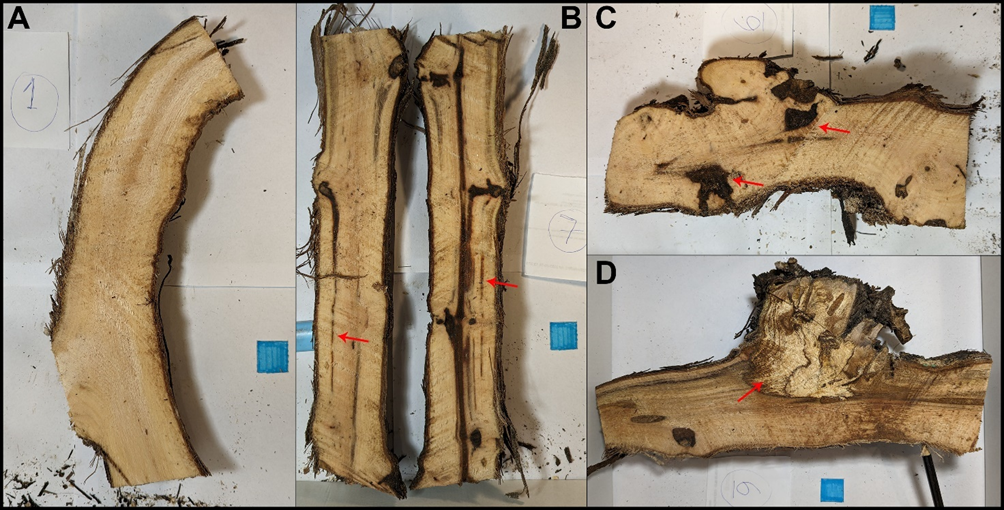
Figure 1. Asymptomatic trunk (A) and trunk affected by brown wood streaking (red arrows; B), in Cabernet-Sauvignon. Arms affected by necrotic lesions (red arrows; C), and white rot (red arrow; D), in Sauvignon blanc. The blue squares represent 1 cm2.
The three-way ANOVA analysis revealed significant differences for factors Position (Trunk, Arm; p < 0.001), Symptom (Necrotic lesion, White rot; p < 0.001), and the combination of Position*Symptom (p < 0.001). A strong trend for statistical significance was also observed for the combination Variety*Position*Symptom (p = 0.064). The Tukey post hoc test results, where significantly different groups are tagged with different letters (Figure 2), showed that, for both varieties, the percentage of white rot tissue present in the trunks was lower than that in the arms, as well as lower than the percentage of necrotic lesions, in both trunks and arms. Excluding the factor ‘Variety’, the average percentage of symptomatic wood in trunks was 4 % (3.8 % necrotic lesions and 0.2 % white rot), and in arms it was 13.9 % (6.6 % necrotic lesions and 7.3 % white rot).
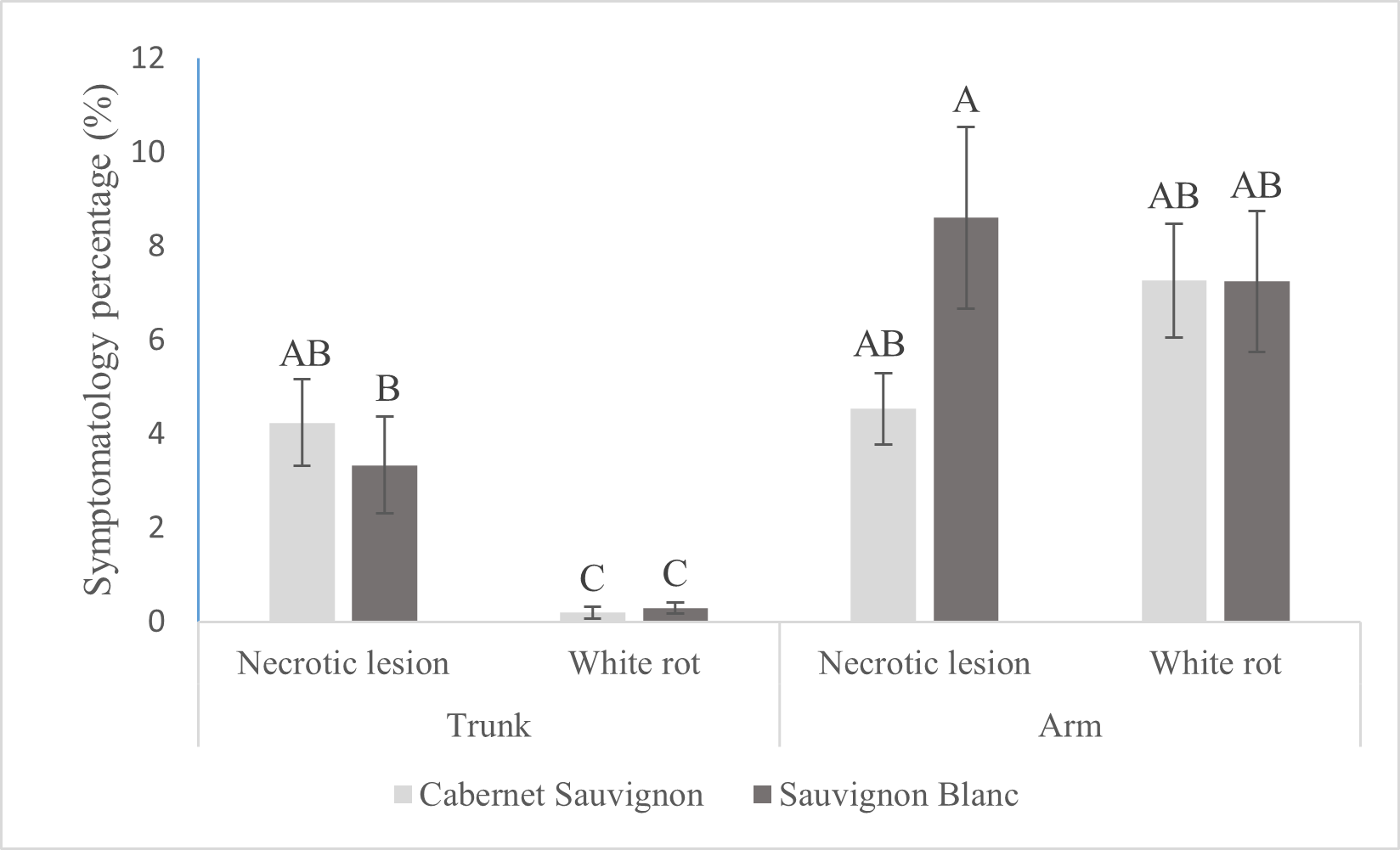
Figure 2. Percentage of symptomatic area (mm2) ± standard error in trunks and arms of Cabernet-Sauvignon (CS) and Sauvignon blanc (SB) for necrotic lesions and white rot symptoms. Different letters indicate significant differences (Tukey post hoc test, p ≤ 0.05).
YMM was the most effective growth medium for yeast isolation, yielding 59 % and 48 % of total yeasts from SB and CS, respectively. NYDA was more selective as a growth medium, with 28 % and 11 % of the yeasts isolated from the same varieties. Regarding YEPD, 13 % and 41 % of yeast isolates were obtained from SB and CS, respectively (data not shown). White rot tissue was the primary source for yeast isolation, accounting for 61 % and 54 % of the total in SB and CS, respectively (Table 1).
A) | Grapevine variety | Strain ID | Symptomatology status | Species | GenBank accession number on BLAST | |
ITS | ||||||
CS | 55 | Asymptomatic | Hanseniaspora uvarum | KY103558.1 | ||
CS | 10 | Asymptomatic | Hanseniaspora uvarum | MZ575155.1 | ||
CS | 51 | Asymptomatic | Hanseniaspora uvarum | KY103554.1 | ||
CS | 56 | Asymptomatic | Hanseniaspora uvarum | MK729660.1 | ||
CS | 61 | Asymptomatic | Hanseniaspora uvarum | KY103558.1 | ||
CS | 30 | Asymptomatic | Papiliotrema terrestris | MH201180.1 | ||
CS | 1 | White Rot | Rhodotorula glutinis | LC413754.1 | ||
CS | 5 | White Rot | Rhodotorula glutinis | LC413754.1 | ||
CS | 8 | White Rot | Papiliotrema terrestris | MH201180.1 | ||
CS | 11 | White Rot | Rhodotorula glutinis | LC413754.1 | ||
CS | 15 | White Rot | Rhodotorula glutinis | LC413754.1 | ||
CS | 16 | White Rot | Papiliotrema terrestris | MH201180.1 | ||
CS | 19 | White Rot | Papiliotrema terrestris | MH201180.1 | ||
CS | 26 | White Rot | Papiliotrema terrestris | MH201180.1 | ||
CS | 31 | White Rot | Rhodotorula glutinis | LC413754.1 | ||
CS | 32 | White Rot | Rhodotorula glutinis | LC413754.1 | ||
CS | 35 | White Rot | Papiliotrema terrestris | MH201180.1 | ||
CS | 46 | White Rot | Rhodotorula glutinis | PQ453748.1 | ||
CS | 50 | White Rot | Rhodotorula glutinis | LC413754.1 | ||
CS | 3 | Necrosis | Hanseniaspora uvarum | MK267568.1 | ||
CS | 20 | Necrosis | Hanseniaspora uvarum | LC413754.1 | ||
CS | 36 | Necrosis | Papiliotrema terrestris | MH201180.1 | ||
CS | 40 | Necrosis | Papiliotrema terrestris | MH201180.1 | ||
CS | 43 | Necrosis | Papiliotrema terrestris | MH201180.1 | ||
B) | Grapevine variety | Strain ID | Grape trunk symptom | Strain species | GenBank accession number on BLAST | |
ITS | ||||||
SB | 62 | Asymptomatic | Aureobasidium pullulans | MT573468.1 | ||
SB | 63 | Asymptomatic | Aureobasidium pullulans | MT573468.1 | ||
SB | 65 | Asymptomatic | Aureobasidium pullulans | MT573468.1 | ||
SB | 74 | Asymptomatic | Aureobasidium pullulans | MN077446.1 | ||
SB | 66 | White Rot | Papiliotrema terrestris | MH201180.1 | ||
SB | 69 | White Rot | Aureobasidium pullulans | MT573468.1 | ||
SB | 71 | White Rot | Aureobasidium pullulans | MT573468.1 | ||
SB | 75 | White Rot | Rhodotorula glutinis | KY512218.1 | ||
SB | 76 | White Rot | Papiliotrema terrestris | MH201180.1 | ||
SB | 77 | White Rot | Aureobasidium pullulans | OR810368.1 | ||
SB | 78 | White Rot | Aureobasidium pullulans | MT573468.1 | ||
SB | 83 | White Rot | Papiliotrema terrestris | MH201180.1 | ||
SB | 67 | Necrosis | Papiliotrema terrestris | MH201180.1 | ||
Asymptomatic wood accounted for 31 % of the isolates in SB and 25 % in CS, while necrotic lesions yielded 8 % and 21 % of the strains, respectively (Table 1). Sauvignon blanc accounted for 35 % of the total yeast isolates (n = 13; 3 species), while CS accounted for 65 % (n = 24; 3 species). Among the 37 strains, four species were identified: A. pullulans, Papiliotrema terrestris, R. glutinis, and Hanseniaspora uvarum. Aureobasidium pullulans was found exclusively in SB, whereas H. uvarum was isolated only from CS asymptomatic tissues or necrotic lesions. Conversely, R. glutinis was not found in necrotic tissue (Table 1). All the strains isolated from SB asymptomatic tissue belong to A. pullulans species. Most of the strains (35 %) belong to P. terrestris species, followed by R. glutinis (24 %), A. pullulans (22 %), and finally H. uvarum. This was the least represented species (19 %).
The results obtained from the dual culture assay after 10 days of incubation highlighted the strains with the highest inhibitory activity compared to the strains with medium and low activity (Figure 3).
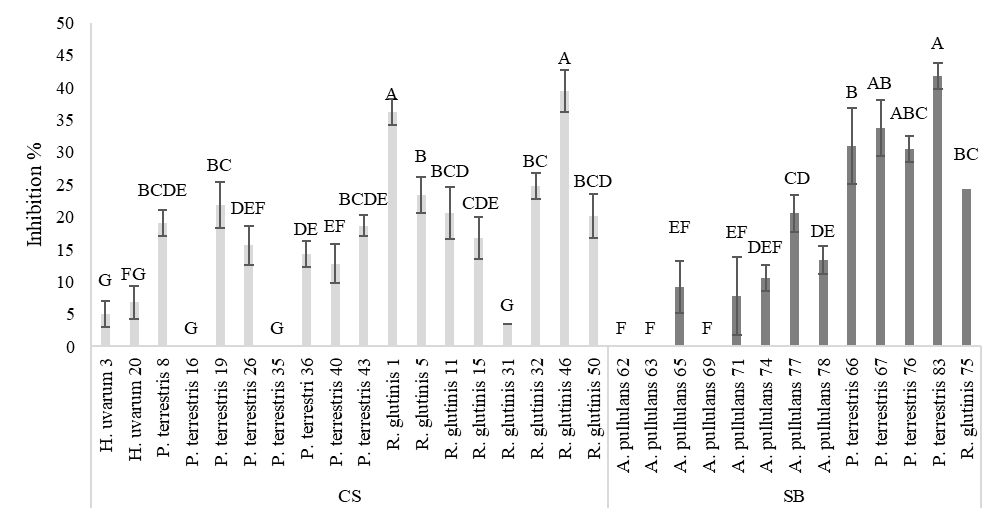
Figure 3. Inhibition percentage of Fomitiporia mediterranea mycelial colony growth (% ± standard deviation) by the yeasts isolated from Cabernet-Sauvignon (CS) and Sauvignon blanc (SB) grapevines, in the dual culture assay. Different letters indicate significant differences within each grapevine cultivar group (Tukey post hoc test, p ≤ 0.05).
Rodothorula glutinis strains 1 and 46 (CS) and P. terrestris 83 (SB) were the most effective yeasts in inhibiting Fmed growth, on average by 39.1 %. On the other hand, P. terrestris strains 67, 76, and 8 derived from CS showed, on average, an inhibition against the white rot agent of 27.7 %. Aureobasidium pullulans isolates 62, 63, and 69, from SB, as well as two isolates of P. terrestris (16 and 35) from CS, displayed no reduction in the pathogen's mycelial growth. Over the course of the ten-day incubation period, the pathogen grew by an average of 2.3 mm per day. Conversely, the yeast strains displayed pronounced growth starting from two days after inoculation.
Nine strains from both CS and SB grapevines were selected for further analysis. Strains displaying high (1, 46, and 83), medium (8, 67, 76), and low inhibition (20, 71, and 78) were subsequently analysed to compare their metabolite production and effects on Fmed growth.
The pathogen Fmed was strongly inhibited when grown in the presence of the non-volatile metabolites produced by H. uvarum strain 20, P. terrestris strains 8, 67, 76, 83, R. glutinis strains 1, 46, and A. pullulans strains 71, 78. All the strains isolated from CS, as well as those from SB, led to a similar growth inhibition, with no significant differences among examined isolates (Figure 4). The highest colony growth inhibition was achieved by the metabolites produced by the strains P. terrestris 67, A. pullulans 71 and 78, with an average inhibition of 63.1 % compared to the control.
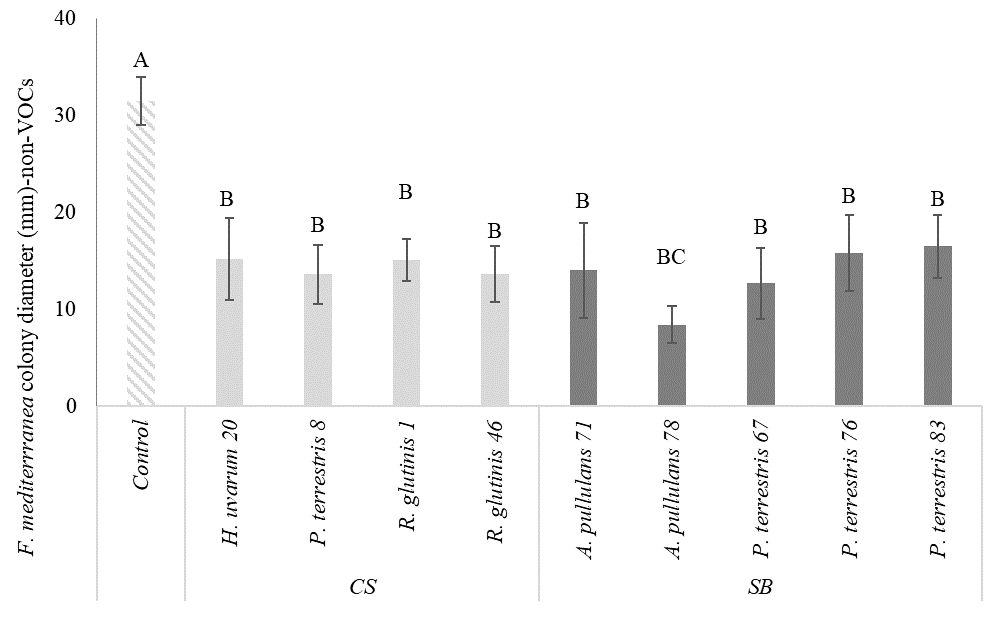
Figure 4. Colony diameter (mm ± standard deviation) of Fomitiporia mediterranea grown in the presence of non-volatile metabolites released by different yeast strains in PDA medium. Different letters indicate statistically significant differences within each grapevine cultivar group (Cabernet-Sauvignon, CS; Sauvignon blanc, SB) (Tukey post hoc test, p ≤ 0.05).
Exposure to VOCs produced by the selected strains heavily influenced Fmed mycelial growth (Figure 5), particularly the volatilome of R. glutinis strain 1, which caused 83 % inhibition of the pathogen. Papilotrema terrestris strains 67 and 76, and A. pullulans strain 78 were the most effective strains isolated from SB, inhibiting Fmed growth by 63 % on average. All the other strain volatilomes produced, on average, a reduction of 46.4 % with respect to the control.
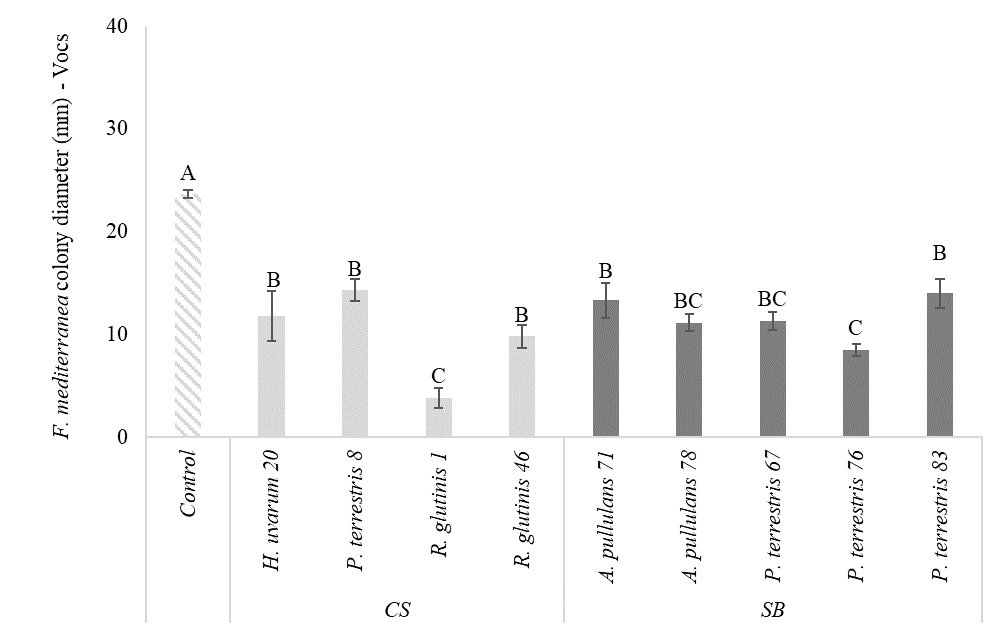
Figure 5. Fomitiporia mediterranea colony diameter (mm ± standard deviation) when exposed to the VOCs produced by the yeasts isolated from Cabernet-Sauvignon (CS) and Sauvignon blanc (SB) grapevines. Different letters indicate statistically significant differences within each grapevine cultivar group (Tukey post hoc test, p ≤ 0.05).
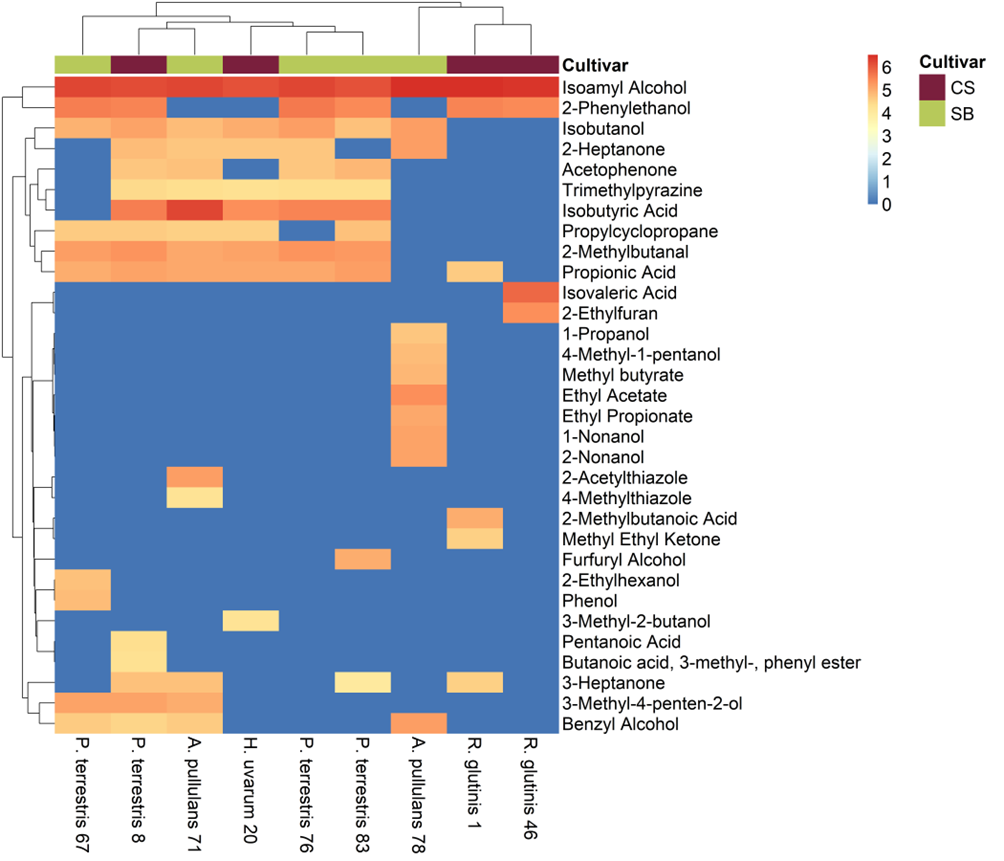
Figure 6. Heatmap of VOC profiles across yeast strains with hierarchical clustering values corresponding to the log10-transformed peak areas. Colour intensity reflects the relative abundance of each compound.
Thirty volatile metabolites produced by the selected strains were identified using SPME-GC‐MS. The volatile compounds have been characterised via the LOTUS database, with literature references supporting their biological origins and potential role in ecological systems. The heatmap (Figure 6) shows all the detected compounds produced by all the tested strains isolated from different cultivars (SB, CS).
The intensity of the colour is proportional to the logarithm of the absolute peak area. The hierarchical clusterisation of the heatmap did not reveal any clustering patterns associated with yeast species. Instead, VOC profiles appeared largely strain-specific, indicating substantial intra-species variability in volatile production. Isoamyl alcohol and 2-phenylethanol were the most abundant volatile compounds produced by the analysed yeasts. Aureobasidium pullulans 78 and R. glutinis 46 displayed the most distinctive VOC profiles: the former was characterised by the unique production of several esters and alcohols, including ethyl acetate, ethyl propionate, and 1-propanol; the latter was the only strain to produce isovaleric acid and 2-ethylfuran acid at detectable levels. Differences in the volatilome composition are reported in Figure 7, where the colour intensity in the palette reflects the relative abundance of molecules belonging to different chemical classes.
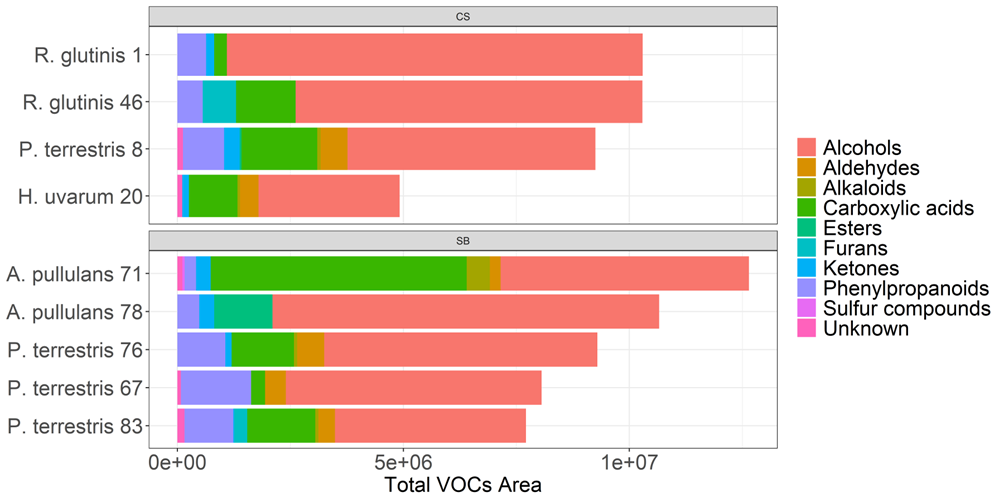
Figure 7. Composition of yeast strains' volatilome. Bars represent the absolute area of detected VOCs for each examined yeast strain. Different colours indicate different compounds' chemical classes. Yeast strains are grouped by grapevine cultivar (Cabernet-Sauvignon, CS; Sauvignon blanc, SB).
Alcohols were the most represented class, with percentages ranging from 43 % to 89 % depending on the yeast strain, followed by carboxylic acids, phenylpropanoids, and aldehydes. Large differences were also observed in the total amount of VOCs absolute area for each strain.
From the enzymatic assays, Fmed showed a higher Mn peroxidase-like activity with respect to laccase (Figure 8a and b). The presence of CS wood dust (WB) stimulated Fmed enzyme activity to a greater extent when compared to SB wood dust. All tested yeast strains demonstrated both Mn peroxidase-like and laccase activities similar to or lower than that of Fmed. Mn peroxidase-like enzymatic activity was heavily altered by the co-culturing of Fmed and selected yeasts. Specifically, the presence of P. terrestris strain 8 significantly stimulated (~7-fold increase) Fmed enzymatic activity when compared to the control (Fmed + WB; Figure 8a). Significant, albeit weaker, stimulating effects were recorded for R. glutinis 1 and P. terrestris 76. No alteration in Mn peroxidase-like activity was recorded when Fmed was co-cultured with A. pullulans 78. The laccase enzymatic activity was also significantly affected by co-culturing Fmed with two yeasts (Figure 8b), namely P. terrestris 8 and A. pullulans 78. The former led to a stimulation of the enzymatic activity (~7.5-fold increase), while the latter led to a reduction of 90 % with respect to the control Fmed + WB.
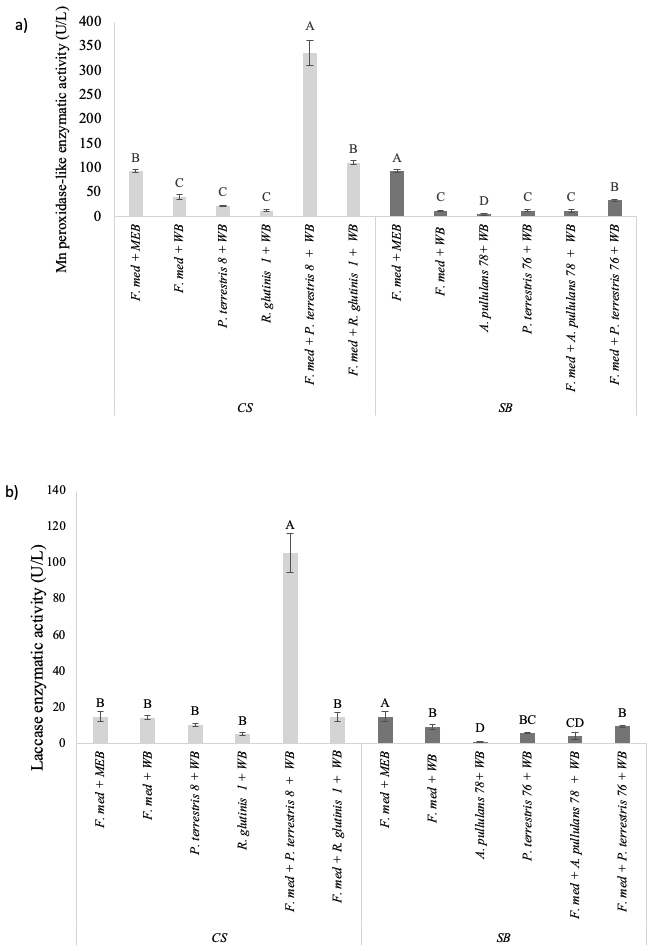
Figure 8. Mn peroxidase-like (a) and laccase-like (b) activity (U/L) ± standard deviation of Fomitiporia mediterranea (F. med) and endophytic yeasts grown in different media (MEB: Malt Extract Broth; WB: Wood Broth), alone or in co-culture. Different letters indicate statistically significant differences within each grapevine cultivar group (Cabernet-Sauvignon, CS; Sauvignon blanc, SB) (Tukey post hoc test, p ≤ 0.05).
The appearance of ‘tiger stripes’ on leaves is a distinctive feature of grapevines affected by esca (Del Frari et al., 2025). Foliar symptoms are generally associated with wood alterations such as necrotic lesions and frequently white rot (Del Frari et al., 2021; Gastou et al., 2025). Evidence supporting the involvement of white rot and associated fungi in leaf symptom development is increasing (Puca et al., 2025). White rot removal via trunk surgery or similar techniques (Sanna et al., , 2026; Lecomte et al., 2022), and the use of sodium arsenite, which accumulates in white rot (Larignon et al., 2008) and heavily affects F. mediterranea abundance (Bruez et al., 2021), can prevent symptom reappearance for several years after treatment. However, the causal mechanisms that link white rot to foliar symptoms remain unresolved. One hypothesis is that white rot may act as a source of metabolites such as fungal toxins or wood degradation byproducts, which, once translocated to the leaves, could trigger a hypersensitive-like response leading to tiger stripe formation (Del Frari et al., 2022; Gastou et al., 2025). In this study, grapevines exhibiting leaf symptoms for the first time consistently showed both necrotic lesions and white rot, supporting the correlation between white rot and foliar symptomatology. Wood symptoms were predominantly localised in grapevine arms, with white rot frequently detected in and below the spurs, suggesting that infections likely originated from pruning wounds. Our findings indicate that first-time leaf symptom expression does not require extensive wood symptomatology (< 5 % in trunks, < 15 % in arms; Figure 1), but may depend on localised affected tissue, particularly within and below spurs, in correspondence with pruning wounds (Mugnai et al., 1999). Yeasts and yeast-like fungi are common components of the wood microbiome in many perennial plant species, where these microorganisms occupy both early and advanced stages of decay and can use xylose and other sugars released from hemicellulose and cellulose degradation (Cadete et al., 2017). In grapevine, NGS-based studies indicate that yeasts are more prevalent than previously recognised, suggesting potential ecological roles as endophytes and within GTD pathosystems (Bekris et al., 2021; Del Frari et al., 2019a). In the present study, 31 yeast strains, belonging to four species, were isolated from grapevine woody tissues (Table 1). Aureobasidium pullulans, a ubiquitous yeast-like fungus frequently detected in grapevine wood of both esca symptomatic and asymptomatic plants (Pinto et al., 2018; Karacsony et al., 2023; Cobos et al., 2022), is a well-known BCA in multiple pathosystems (Di Francesco et al., 2024; Tulukoglu-Kunt et al., 2024; Lucci et al., 2025; Cignola et al., 2024), although evidence of its efficacy against GTD pathogens remains limited. Interestingly, it has been associated with increased leaf symptom severity, consistent with observations from leaf mycobiome studies (Karacsony et al., 2023; Del Frari et al., 2025). In this study, A. pullulans was isolated exclusively from the SB cultivar, in asymptomatic and white rot tissues. Papiliotrema terrestris has been reported as an epiphyte in the grapevine carposphere or as a soil microorganism (Bekris et al., 2025; Bougreau et al., 2019), and the genus Papiliotrema has recently been detected in grapevine wood through culture-independent approaches (Aleynova et al., 2022; Del Frari et al., 2023). In the present study, the first culture-based evidence of its presence in wood was obtained through its isolation from asymptomatic, necrotic, and white rot tissues of both examined cultivars. The genus Rhodotorula has been detected in grapevine wood (Adejoro et al., 2023; Del Frari et al., 2023) and is known from diverse plant-associated niches, including the leaf endosphere of Vitis labrusca and berries of V. vinifera ssp. sylvestris (de Lima et al., 2013; Cordero-Bueso et al., 2022). However, its isolation from grapevine wood remains rare, with only two reports to date (Hofstetter et al., 2012; Kirchmair et al., 2010). Here, R. glutinis was consistently isolated from white rot tissue in both cultivars, reinforcing its association with this niche. Hanseniaspora uvarum, commonly associated with the grapevine phyllosphere and berries (Mezzasalma et al., 2017), has not previously been reported in grapevine wood; thus, this study represents its first isolation from asymptomatic and necrotic woody tissues of CS. From a biocontrol perspective, both P. terrestris and H. uvarum have demonstrated antagonistic activity against multiple plant pathogens (Palmieri et al., 2022; Lopes et al., 2025), with the latter reported to inhibit Botrytis cinerea in grapevine. In contrast, although some evidence of biocontrol activity against Botrytis cinerea exists for R. glutinis (Ibrahim & Hassan, 2023), its potential in grapevine remains entirely unexplored. In the present study, we demonstrate that white rot constitutes a previously underexplored niche for yeasts and yeast-like fungi in grapevine, albeit with low species diversity. While their presence in white rot has been reported in other woody perennials (Cadete et al., 2017), in grapevine it had previously only been inferred from NGS-based mycobiome studies that included white rot tissue (Del Frari et al., 2019a; Bekris et al., 2021). Given that these yeasts coexist with key esca pathogens, particularly F. mediterranea, we investigated potential antagonistic interactions primarily through direct contact between microorganisms and through the production of metabolites, such as volatile and non-volatile compounds, and their role in the production of oxidative enzymes by the fungal pathogen. The dual-culture assay is a standard method for screening antagonistic interactions between BCA and pathogens, enabling a rapid evaluation of competition for space and resources, potential parasitism, and production of diffusible (non-VOC) or volatile metabolites. To date, different fungal genera have been tested against esca pathogens, with most studies focusing on Trichoderma spp.; some of these were tested specifically against F. mediterranea (Mannerucci et al., 2023; Riedle-Bauer et al., 2023; Mesguida et al., 2023). Moreover, different bacteria such as Bacillus spp., Pseudomonas fluorescens, and Serratia plymuthica were tested against F. mediterranea, displaying high fungal growth inhibition (Vaghari Souran et al., 2023). Among yeasts, only A. pullulans has been evaluated against an esca pathogen, P. chlamydospora (Karacsony et al., 2023), and none against F. mediterranea. The preliminary screening conducted in this study revealed a variable inhibition of Fmed growth (0–40 %), with substantial differences among strains belonging to the same species. In the dual culture assay, A. pullulans and H. uvarum strains were the least effective, whereas P. terrestris and R. glutinis achieved the strongest inhibition of Fmed mycelial growth. The most effective strains in the assay were R. glutinis 1 and 46, and P. terrestris 67 and 83, which reduced fungal colony growth by ~35–40 % (Figure 3), percentages similar to those reported for other fungal BCAs (Mannerucci et al., 2023; Del Frari et al., 2019b).
Nine yeast strains were chosen for further evaluation based on their performance in the dual culture assay. This evaluation looked at their non-volatile and volatile metabolites’ ability to inhibit Fmed mycelium growth. Metabolites of all nine yeast strains diffused in the medium (non-VOCs) significantly reduced Fmed growth by approximately 50 %, with A. pullulans 78 showing the strongest inhibition (~75 %; Figure 4). Aureobasidium pullulans is well known for its production of the polysaccharide pullulan and its biocontrol use in agriculture (Cignola et al., 2025). This yeast is also recognised for the production of a large spectrum of extracellular enzymes and antifungal peptides such as aureobasidin A that could justify its higher antagonism with respect to the other strains (Takesako et al., 1991). The metabolite profiles of R. glutinis and H. uvarum have been investigated in several studies, whereas little is known about that of P. terrestris. Li et al. (2024) reported that some strains of P. terrestris and H. uvarum exhibited extracellular lytic enzyme activity, including chitinase and β-1,3-glucanase. In addition, R. glutinis displays peroxidase activity, and the metabolite profiling of H. uvarum revealed several compounds with known or potential antifungal activity (Ibrahim & Hassan, 2023). These, along with other potentially unknown metabolites, may contribute to the observed Fmed growth reduction.
The volatilome of all endophytic yeasts evaluated in the in vitro assay significantly inhibited Fmed colony growth (Figure 5), underscoring the role of VOCs in pathogen suppression. Previous studies have attributed the biocontrol activity of several yeasts to their production of bioactive volatiles (Oztekin et al., 2023). For example, VOCs from A. pullulans effectively control postharvest pathogens of citrus fruit, apple, tomato, and table grape (Di Francesco et al., 2015; Di Francesco et al., 2020), while H. uvarum, P. terrestris, and R. glutinis volatiles significantly inhibit B. cinerea, as well as Alternaria alternata (Li et al., 2024). In this study, R. glutinis strain 1 showed the highest efficacy among the tested isolates. Although yeasts are widely recognised as BCAs, most evidence relates to postharvest diseases, and their application against F. mediterranea remains unexplored. The hierarchical clustering of the heatmap did not reveal patterns associated with yeast species (Figure 6). Indeed, the biochemical diversity of yeast VOCs does not necessarily reflect their phylogenetic relationships (Guo et al., 2021). This confirms that VOC production is not strictly species-specific, but may vary at finer taxonomic levels, such as among strains. Chemical classification of the detected compounds revealed that alcohols represented the dominant class within the volatilome (Figure 7). This is consistent with the literature, as numerous volatile compounds produced by fungi belong to this chemical class (Morath et al., 2012). This is especially true for yeasts, where 3-methyl-1-butanol (isoamyl alcohol) and phenylethyl alcohol have been reported as prevalent compounds (Ling et al., 2024). Specifically, A. pullulans is known to be a strong producer of ethanol, 3-methyl-1-butanol, and 2-methyl-1-propanol (Di Francesco et al., 2020). In the present research, the percentage of alcohols relative to the total peak area was found to be higher with respect to the other compound classes, in particular the isoamyl alcohol. This compound can inhibit fungal growth by damaging cell membranes, increasing permeability and inducing oxidative stress, while also impairing the fungi’s antioxidant system (Zhai et al., 2025). Furthermore, Di Francesco et al. (2020) reported an EC50 value of 0.09 mL L–1 for 3-methyl-1-butanol against B. cinerea, confirming its strong antifungal potential (Di Francesco et al., 2020). Among the VOCs identified in this study, several compounds, such as 2-phenylethanol, 2-heptanone, isobutyric acid, and propionic acid, have demonstrated antifungal activity (Liu et al., 2014; Yun & Lee, 2016; Stulanovic et al., 2025; Li et al., 2024), and their role against F. mediterranea should be further explored.
Fomitiporia mediterranea is a white-rot fungus possessing both enzymatic and non-enzymatic wood-degrading systems, including well-characterised laccases and MnPs, and enzyme activity varies significantly among strains (Pacetti et al., 2022; Moretti et al., 2023). MnP enzymes are generally absent in yeasts, although MnP-like activity has been reported in several species (Hofrichter, 2002; Mattila, 2022). In the absence of MnP genes, Mn2+-oxidising activity in yeasts is likely mediated by alternative systems, such as DyP-type peroxidases, unspecific heme peroxidases, or indirect oxidation via laccases or reactive oxygen species (Mattila, 2022; Ali et al., 2021). No confirmed MnP enzymes have been reported for A. pullulans, P. terrestris, or R. glutinis, and evidence for MnP-like activity in these species remains limited. Laccases and laccase-like multicopper oxidases are widespread in fungi, including some yeasts (Reiss et al., 2013; Janusz et al., 2020). A. pullulans shows strain-dependent laccase production, with some strains producing multiple isoforms and others lacking detectable activity (Rich et al., 2013). Laccase activity has not been clearly reported for P. terrestris or R. glutinis, although it is well documented in Cryptococcus spp., which are phylogenetically related to Papiliotrema (Ikeda et al., 2002). As expected, the Fmed strain used in this study exhibited both MnP and laccase-like activities. All tested yeast strains also showed MnP-like and laccase-like activities, generally at levels comparable to or lower than those of Fmed, with A. pullulans showing the lowest activity (Figure 8a). These results confirm the limited oxidative potential of A. pullulans and, to our knowledge, provide the first evidence of MnP-like and laccase-like activities in P. terrestris and R. glutinis. Interestingly, the co-cultivation with yeasts markedly affected MnP-like activity in Fmed. In particular, R. glutinis 1 and both P. terrestris isolates significantly increased MnP activity, with up to a 7-fold increase observed for P. terrestris 8. This strain also induced a significant increase in laccase activity (Figure 8b). Induction of MnP and laccase during fungal interactions is well documented, whereas evidence for interactions between white-rot fungi and yeasts remains limited (Zhang et al., 2020; Kumar et al., 2019). These findings support the view that ligninolytic enzymes are not solely involved in lignin degradation but are also upregulated during interspecific interactions, suggesting a role in competition and antagonism (Hiscox et al., 2010). Overall, the evidence provided in this study suggests that certain yeast strains may act as F. mediterranea antagonists, using multiple strategies for fungal inhibition. Among these, VOCs have been the least explored in the literature. To our knowledge, in the context of GTDs, only VOCs of bacterial origin have been tested against F. mediterranea, demonstrating a strong inhibitory effect (Haidar et al., 2021; Mesguida et al., 2025). Our results expand on this knowledge, showing that yeasts inhabiting white rot are capable of synthesising numerous VOCs with proven antifungal activity. VOCs may accumulate in white rot, woody tissue with a spongy consistency that has the potential to retain large amounts of gases (Mugnai et al., 1999), and create a selective niche for different microorganisms such as bacteria and fungi (Fukasawa, 2021). In addition, numerous VOCs of fungal origin have demonstrated phytotoxic activity (Macías-Rubalcava & Garrido-Santos, 2022), including 2-phenylethanol (Tena et al., 2021), a compound frequently found among our tested strains. Further research should focus on soluble VOCs to determine whether they can reach and dissolve in the xylem sap and be translocated to green tissues (e.g., shoots and leaves), contributing to the series of events that lead to the tiger stripe symptom.
This study confirms that yeasts and yeast-like fungi are common components of the grapevine wood microbiome, especially present in white rot tissue and in this case of CS and SB cultivars. The functional role of these microorganisms remains largely unresolved; however, several strains isolated in this study exhibited clear antagonistic activity against F. mediterranea, indicating their potential relevance in the esca pathosystem. In particular, the production of metabolites, such as VOCs (e.g., isoamyl alcohol and 2-phenylethanol), appears to play an important role in influencing pathogen growth. The presence of some of the studied yeast strains (P. terrestris and R. glutinis) was also found to influence the pathogen’s enzyme activities notably. These findings open new perspectives on the ecological role of yeasts in wood and their possible application as BCAs. Further research is required to elucidate their interactions within the wood microbiome and their impact on disease development.
The authors want to thank Alessandro Boato, Davide Scolari, Giuseppe Fratantonio, Enrico Daniso and Francesca Scanferla for the technical support in the laboratory analyses, as well as Nicola Vecchiato and Mario Del Frari for technical support during grapevine sampling and processing. This work was supported by the Regional Programme ESF+ 2021–2027 of the Autonomous Region of Friuli Venezia Giulia, PPO 2023, Specific Programme No. 22/23 – Support for higher education in the regional university system, Line A (CUP G23C23001130008) and partially funded by the European Union under a Marie Skłodowska-Curie Postdoctoral Fellowship, project WildWoodMicrobes (GA 101064232).
The authors declare no conflicts of interest.
These findings are supported by data that are available from the authors upon request.
 Views: 323
 XML: 19