

ENOLOGY / Original research article
Abstract
Understanding the respective roles of grape variety and terroir in wine composition remains a key issue in viticulture, particularly at the subregional scale. This study investigated the influence of variety and harvest location on red wine composition using three cultivars, Artaban (disease-resistant hybrid variety), Cabernet-Sauvignon, and Syrah (Vitis Vinifera), grown in three terroirs of Occitanie in France (La Clape, Domaine de Cazes, and Ouveillan), and vinified under standardised microvinification conditions. Principal component analysis revealed that wine colour and polyphenolic composition drove the most variation, followed by the balance between polysaccharides and anthocyanins. Artaban wine was clearly distinguished by its anthocyanin diglucoside profile, indicating a strong varietal signature and limited influence from harvest location. In contrast, Cabernet-Sauvignon and Syrah wines showed more pronounced harvest-location effects, especially for wines from Ouveillan. Statistical analyses showed that variety primarily affected anthocyanin composition and 3-sulfanylhexan-1-ol (3SH) expression, whereas harvest location significantly influenced pH, chromatic parameters, and total polyphenol index. Tannin composition was only weakly affected, except for dimers and short-chain tannins. Interestingly, harvest location altered absolute concentrations more than relative family proportions. Overall, when restricted to a close area, grape variety appears to define the biochemical identity of wine, whereas harvest location fine-tunes the quantitative expression of this compositional potential.
Introduction
In the vine and wine industry, the concept of terroir or harvest location, refers to the integrated effect of soil, climate, topography, and viticultural practices on grape and wine characteristics, and it is a well-known and well-studied topic. This interaction creates unique characteristics and builds recognition for goods originating from that area. Terroir includes specific landscape characteristics and territory values (OIV, 2010).
To summarise, terroir is a multi-parametric, interactive and geographically delimited ecosystem that groups agronomic characteristics such as soil, altitude, pedoclimatic conditions, and cultivar characteristics, as well as human management of viticultural and oenological practices (Seguin, 1986; van Leeuwen & Seguin, 2006).
Environmental factors affect several red wine quality markers. Indeed, light and temperature are known to modulate the polyphenol biosynthetic pathway, especially proanthocyanidin and anthocyanin accumulation (Cohen et al., 2012; Cortell & Kennedy, 2006; Downey et al., 2004; Guan et al., 2016; Koyama et al., 2012), even in close areas and subregions of growing (Argentero et al., 2026). Aroma composition, especially the varietal one, is influenced by several environmental factors within the same region (Argentero et al., 2024; Sabon et al., 2002). Thiol precursors, which lead to the highly characteristic varietal thiols – namely 3-sulfanylhexan-1-ol, its acetate, and 4-methyl-4-sulfanylpentan-2-one – are also influenced by nitrogen fertilization in the vineyard (Choné et al., 2006; Helwi et al., 2015) and by plant water stress (De Almeida et al., 2024; Peyrot Des Gachons et al., 2005), both of which modulate their biosynthesis in grapes (Kobayashi et al., 2011).
In addition, wine polysaccharides from grape or yeast, well-known modulators of wine quality and organoleptic perception (Brandão et al., 2020; Kuhlman et al., 2024; Quijada-Morín et al., 2014) through their interactions with other molecules (Boulet et al., 2024; Canalejo et al., 2023; Favieres et al., 2025), can be affected by terroir (Apolinar-Valiente et al., 2013; Apolinar-Valiente et al., 2014).
However, climate, soil, and cultivar can impact key marker compounds differently. Thus, terroir does not uniformly affect pH, total acidity, sugar, organic acid, and anthocyanin contents (van Leeuwen et al., 2018).
In 2021, Artaban was the first resistant variety planted in France (Dolet et al., 2024), and, to our knowledge, no reports describe its adaptation to different terroirs or how these terroirs impact its varietal composition. In comparison, two well-characterised Vitis vinifera varieties, Syrah and Cabernet-Sauvignon, emblematic of southern France, have been used to study these effects.
In this context, the Occitanie region (southern France) offers an ideal natural laboratory for these investigations because of its varied climate. Its Mediterranean climate, diverse soil types, and mosaic of terroirs in close geographic proximity create conditions to evaluate the variety and terroir effects at a subregional level. Additionally, the increasing cultivation of interspecific hybrids in response to climate change and disease pressure (downy mildew, powdery mildew) introduces a new dimension to variety-terroir studies, as hybrids often exhibit distinct biochemical signatures (e.g., anthocyanin diglucosides absent in Vitis vinifera varieties) that may or may not respond to environmental modulation. Therefore, this study aims to assess the relative contributions of cultivar and harvest location within a close area in Occitanie to the red wine quality markers and their modulators, comparing their effects on two Vitis vinifera and one interspecific hybrid. To this end, we performed a multiparametric analysis of varietal quality markers in red wines (polyphenols, varietal thiols, their non-volatile precursors, and polysaccharides) and classical oenological parameters across three locations within a close area (the French department of Aude).
Materials and methods
1. Grape material
The experimental design used three red grape varieties; two Vitis vinifera varieties (Cabernet-Sauvignon and Syrah) and one interspecific hybrid (Artaban). Varieties were harvested in 2022 at three different locations, each in the Occitanie region, Aude department, in the South of France: 1) Domaine de Cazes (Chambre de l’Agriculture de l’Aude), abbreviated as “Cazes”, 2) La Clape uplands, abbreviated as “Clape”, and 3) Canton de Ginestas (Mailhac/Ouveillan), abbreviated as “Ouveillan”. In the present study, we harvested according to technological maturity and sugar content. We defined modality as the conjunction of variety and harvest location. Thus, this study presents 9 modalities. Figure S1 shows a map of the different harvest locations.
2. Must analysis
We sampled 3 biological replicates of each modality as 1-kg batches sorted from 10 kg of harvested grapes, which were subsequently frozen and crushed. We analysed the resulting musts before fermentation, and we report the main grape maturity parameters in Table S1 to help assess the terroir effect on grape and macromolecular maturity. In the present study, we harvested all varieties at technological maturity. Technological maturity varies by variety, especially in initial sugars, acidity, and nitrogen distribution and origin.
For grape musts, we measured sugar content using a manual refractometer (°Brix) and converted it to concentration (g/L) and alcoholic strength by volume (ABV % v/v) using OIV-MA-AS2-02 tables (OIVa, n.d.). The pH and total acidity were measured using the AT1000 Titrator and Sampler Titralab AT1000 from Hach Lange (Lognes, France) using OIV-MA-AS313-15 (OIVb, n.d.) and OIV-MA-AS313-01 (OIVc, n.d.) as reference methods. Nitrogen content was analysed on a Gallery multianalyzer and spectrophotometer (Thermo Fisher Scientific, Waltham, Massachusetts, United States) at 340 nm as follows: α-amine was analysed using a colourimetric test with ortho-phtalaldehyde (OPA) and N-acetylcysteine (NAC) with the Thermo kit ref. 984342 (Thermo Fisher Scientific, Waltham, Massachusetts, United States), and ammonia was analysed using an enzymatic method with the Thermo kit ref.TR10601 (Thermo Fisher Scientific, Waltham, Massachusetts, United States). In grape musts, polyphenol indices were measured after extracting 100 crushed berries with a hydroalcoholic solution (12 % ethanol) and macerating for 1 h. We determined the total polyphenol index (TPI) and anthocyanin content (total red pigments, TRP) using a Thermo Fisher Evolution 300 spectrometer with a 1/100 dilution ratio in 1 M hydrochloric acid (HCl), according to a method previously described by Abi-Habib et al. (2021). The results were calculated from absorbance at 280 nm for the TPI and at 520 nm for the TRP.
3. Wine fermentations
Before fermentation, 400 µL of sulphur dioxide (SO2 10 %, 4 g/hL) was added to all musts. We adjusted the nitrogen status of the musts with a solution of Di-Ammonium Phosphate (DAP) to a final concentration of 200 mg/L. We calculated the ratio of nitrogen origin between organic and inorganic nitrogen (Organic/Inorganic nitrogen in Table S1), including DAP supplementation, to assess the impact of harvest location on nitrogen quality. Vinifications were performed in biological replicates (n = 3) using a 1 kg fermentation device (Vinimag) at the Experimental Unit of Pech Rouge (Occitanie, FR) following the method developed by Ducasse et al. (2024). All alcoholic fermentations were standardised at 23 °C and individually regulated for each fermenter. We inoculated with a single strain of Saccharomyces cerevisiae (XR Lamothe Abiet, dry active form, 20 g/hL). We monitored fermentation for 14 days of maceration to prevent alcoholic fermentation from affecting wine profiles. Fermentation kinetics were recorded and are available as supporting information (see Figure S2). After 14 days of maceration, fermenters were pressed using a standardised 1 kg press, Nano’PRESS (SOCMA, Montredon-des-Corbières, France), equipped with 9 pressing stations. All cap pressings used the same pressing cycle (12 minutes, with a 2-minute free-run at the beginning). Fermentation was monitored by residual sugar analysis (< 2 g/L). If residual sugars exceeded 2 g/L after pressing, fermentation occurred in the liquid phase. Samples were taken at the end of fermentation, when the wines achieved dryness (< 2 g/L).
4. Wine analysis
4.1. Oenological parameters
The colour parameters of the wines were determined using a Thermo Fisher Scientific EVOLUTION 300 spectrometer with 1 mm path-length cuvettes, as reported in OIV-MA-AS2-07B (OIVd, n.d.). We read absorbances at 420 nm (Abs420), 520 nm (Abs520), and 620 nm (Abs620). They were then corrected (Equation 1) for the calculation or multiplied by 10 to restore an optical path length of 10 mm (CI). Colour Intensity (CI) was calculated as the sum of the three absorbances (Equation 2):
(Equation 1)
(Equation 2)
The Total Polyphenol Index (TPI) was measured in 10 mm path-length cuvettes after diluting samples in 1 M HCl and calculated as the absorbance at 280 nm corrected for the dilution factor (Equation 1). Then, absorbance at 520 nm was measured in the presence of SO2 to report the quantity of non-bleachable pigments (NBP) according to Atanasova et al. (2002), corrected for the dilution factor.
The CIELab coordinates were determined using OIV-MA-AS2-11 (OIVa, n.d.) to measure the human-perceptible colour of the wines by integrating the UV spectra between 380 nm and 780 nm. L* reports clarity, a* refers to the colour ranging from green to red, and b* from blue to yellow (Equations 3 to 5):
(Equation 3)
(Equation 4)
(Equation 5)
Where X, Y, and Z are the chromatic coordinates of the sample, and Xn (94.825), Yn (100), and Zn (107.381) are the reference coordinates, for , , and all below 0.008856.
Lactic and malic acids were analysed using OIV standard methods (OIVc, n.d.; OIVe, n.d.). All parameters for our dataset are reported in Table S2.
4.2. Tannin analysis in wines
We determined the size distribution of polyphenols in the samples and the concentrations of polymeric tannins (in catechin equivalents) by HPSEC (Agilent, France), following the procedure described by Vernhet et al. (2020). Commercial epicatechin, B2 dimer, epigallocatechin gallate, malvidin, and home-prepared, characterised tannin fractions were used to evaluate retention times corresponding to monomers, oligomers, and polymers, allowing determination of the mean Degree of Polymerisation (DP) for each identified fraction (Gold, 2019).
4.3. Anthocyanin analysis in wines
Anthocyanin content was analysed using a 1290 Infinity II UHPLC (Agilent Technologies, Santa Clara, CA, USA) hyphenated to a 6470B Agilent Triple Quadrupole. Analytes were separated with a reversed-phase UPLC Acquity UPLC BEH C18 column (100 × 2.1 mm, 1.7 μm particle size) (Waters, Saint-Quentin-en-Yvelines, France). The flow rate was 0.5 mL min–1. The mobile phases were 1 % formic acid in water (solvent A) and 0.1 % formic acid in methanol (solvent B). The gradient conditions for solvent B were 5 % from 0 to 1 min, 5 % to 24 % from 1 to 18 min, 24 % to 50 % from 18 to 25 min, 50 % to 95 % from 25 to 26 min, isocratic at 95 % from 26 to 29 min, 95 % to 5 % from 29 to 30 min and isocratic at 5 % for 3 min. Injection volume was 0.1 µL. The oven temperature was set to 40 °C. Ionisation was performed by positive electrospray (ESI+), and detection was performed by Multiple Reaction Monitoring (MRM). Source parameters were optimised on the Source Optimiser; the final parameters were 260 °C drying gas temperature, 6 L/min drying gas flow, 35 psi nebuliser, 400 °C sheath gas temperature, 12 L/min sheath gas flow, 4000 V capillary voltage, and 0 V nozzle voltage. MRM transitions were optimised on Agilent’s Optimiser software. The five main anthocyanin glucosides (malvidin, cyanidin, delphinidin, peonidin, petunidin) and 4 diglucosides (malvidin, cyanidin, delphinidin, peonidin) were quantified using a standard calibration for each compound (9 standards). Petunidin diglucosides, acylated, p-coumaroyl, and caffeoyl anthocyanins were semi-quantified using their monoglucoside equivalent standard. Pelargonidin-3-O-rutinoside was used as an internal standard.
4.4. Polysaccharide analysis
Wine polysaccharides were purified by ethanolic precipitation. After being concentrated by 2 (v/v) under airflow, wines were mixed with acidified ethanol (0.5 % HCl v/v) to obtain a final ethanol concentration of 80 %, precipitated, and then centrifuged (33 min, 4500 rpm, 4 °C). The supernatant was removed, the precipitate was rinsed again with 1 mL absolute ethanol, and the supernatant was removed by centrifugation. The precipitate was dissolved in 1 mL ultrapure water. To remove the oligosaccharide fraction, a separation was performed using a column (1.2 cm × 4 cm) of Mixed Bed Resin AG-501-X8 (Bio-Rad, California, USA) and rinsed with 5 mL of ultrapure water. The collected fractions were freeze-dried, dissolved in 1mL of ultrapure water, and stored at –20 °C for further analysis (neutral glycosyl-residue composition and molar mass distribution by SEC-MALLS).
The neutral glycosyl-residue composition of wine polysaccharides was determined by GC after hydrolysis, reduction, and acetylation, as previously described by Apolinar-Valiente et al. (2013). The alditol acetates were quantified by GC with flame ionisation detection (GC 2010 Plus, Shimadzu, Kyoto, Japan) using a DB225 (30 m × 0.25 mm ID, 0.25 μm film, Agilent J&W, Santa Clara, USA) capillary column and hydrogen as carrier gas. Calibration was achieved with commercial monosaccharides. Inositol and allose were used as internal standards for quantification (Doco et al., 1999). The polysaccharide composition was estimated from the concentrations of individual glycosyl residues (Apolinar-Valiente et al., 2013). Molar mass distributions, molar weight, and number-average mass (Mw and Mn in g.mol–1), polydispersity index (Mw/Mn), and intrinsic viscosity ([ɳ] in mL.g–1) were determined at 25 °C by coupling size exclusion chromatography with a multi-angle light scattering device (MALLS), a differential viscometer, and a differential refractive index detector. SEC elution was performed on an OH-pack guard followed by two serial Shodex OH-pack KB-804 and KB-805 columns (0.8 × 30 cm; Shodex Showa Denkko, Japan) at a 1 mL/min flow rate in 0.1 M LiNO3 after filtration through a 0.1 µm filter unit. The MALLS photometer, a DAWN-HELEOS from Wyatt Technology Inc. (Wyatt Technology Corporation, Santa Barbara, CA, USA), was equipped with a GA‒AS laser (λ = 658 nm). The differential viscometer detector (Viscostar II, Wyatt Technology Inc., USA) was equipped with a 4-capillary bridge design. The concentration of each eluted polysaccharide was determined using a differential refractive index detector (Optilab TrEX, Wyatt Technology Inc., USA). All collected data were analysed using Astra V 6.0.6 software with the Zimm plot (order 1) technique to estimate molar mass, and the polymer’s differential refractive index increment r in the solvent was used. An average refractive index increment (dn/dc) of 0.146 mL.g–1 was used for the polysaccharide moiety (Redgwell et al., 2005).
4.5. Varietal thiols and their precursors analysis
Free cysteinylated and glutathionylated precursors of 3-sulfanylhexan-1-ol (3SH) and 4-methyl-4-sulfanyl-pentan-2-one (4MSP), as well as dipeptidic forms of 3SH, were analysed using a 1290 Infinity II UHPLC (Agilent Technologies, Santa Clara, CA, USA) hyphenated to a 6470B Agilent Triple Quadrupole following the published method (Dournes et al., 2023). Analytes were separated using a Hypersil Gold column (1.9 μm, 100 mm × 2.1 mm) from ThermoFisher (Waltham, MA, USA), with the column oven set at 40 °C and a total analysis time of 15 minutes. The mobile phases were (A) water and (B) methanol, both containing 0.1 % formic acid. The gradient program began with 5 % B for 1 minute, increased to 35 % over the next 9 minutes, then to 98 % within 3 minutes, held at 98 % for 2 minutes, and returned to 5 % in 10 seconds, which was maintained for an additional 2 minutes. The flow rate was set at 0.6 mL/min.
The analysis of 3SH and its acetate (3-sulfanylhexyl acetate, 3SHA) was performed using Stable Isotope Dilution Assay (SIDA) coupled with UPLC-MS/MS, employing a 1290 Infinity II UHPLC system (Agilent Technologies, Santa Clara, CA, USA) connected to an Agilent 6470B Triple Quadrupole mass spectrometer. Chromatographic separation was achieved on a Hypersil Gold column (1.9 μm, 100 mm × 2.1 mm) from ThermoFisher (Waltham, MA, USA), with the column temperature maintained at 40 °C and a total run time of 10 minutes. The mobile phases consisted of (A) water containing 0.1 % formic acid and (B) methanol containing 0.1 % formic acid. The gradient began at 20 % B, ramped to 80 % over 4 minutes, then to 99 % in 2 minutes, held for 1 minute, reduced back to 20 % in 1 minute, and held for an additional 2 minutes. The flow rate was maintained at 0.5 mL/min.
4.6. Fermentative aroma analysis
The analysis of fermentative aromas was performed following the method described by Rollero et al. (2015). First, the volatile compounds were extracted with dichloromethane. Then, the concentrations of fermentative aromas were measured via GC/MS in SIM mode using a DB-WAX GC column. Thirty-five compounds were quantified using internal deuterated standards.
5. Data treatment and statistical analysis
Statistical analyses were performed using R software (version 4.4.2) and the Multcomp library (R Core Team, 2024). For maturity parameters, a data set of 9 lines and 12 columns – corresponding to traditional maturity parameters such as refractometry, initial sugar content, ABV, pH, total acidity, nitrogen content (organic and inorganic), total assimilable nitrogen, DAP supplementation, nitrogen origin ratio, TPI, and anthocyanins on 9 modalities – was analysed.
For polyphenol composition, we analysed a dataset of 27 lines and 15 columns, corresponding to 8 anthocyanin families and 7 tannin size groups on 9 modalities replicated three times.
For aroma composition, we analysed 7 thiol precursors (G3SH, Cys3SH, γ-GluCys3SH, CysGly3SH, NAC3SH, G4SMP, Cys4SMP) in musts and 3 varietal thiols (3SH, 3SHA) in wines using a dataset of 9 modalities replicated three times (27 lines and 10 columns). Fermentative aromas were grouped into three chemical families: higher alcohols, ethyl esters and acetate esters across the 9 modalities replicated three times (27 lines and 3 columns).
For polysaccharide composition, we analysed 11 monosaccharides (2-O-Methyl-Fucose, Rhamnose, Fucose, 2-O-Methyl-xylose, Ribose, Arabinose, Apiose, Xylose, Mannose, Galactose, Glucose, and Inositol) in a dataset of 9 modalities, replicated three times (27 lines and 11 columns) for wines.
Descriptive graphics of the parameters of interest were generated in the form of bar plots showing means and standard deviations (SD) by variety.
We performed a one-way Analysis of Variance (ANOVA) to study the effects of variety and origin on several parameters. If the global effect was significant at a threshold of 0.05, we then used Tukey’s multiple-comparison test to identify pairwise significant comparisons at the same threshold.
Diagnostic graphics were examined for each one-way ANOVA to assess the model’s assumptions. When linearity or homoscedasticity assumptions were strongly violated, we assessed the impact of variety type using a nonparametric Kruskal-Wallis test.
Principal component analyses (PCA) were performed to examine the relationships among varieties, origin, and the different parameters. The number of relevant axes was determined using the eigenvalue criterion: all dimensions with eigenvalues > 1. We plotted individual maps and evaluated relationships between individuals based on proximity to assess relationships between varieties. For the parameters, we plotted correlation circles and evaluated relationships using cos2 and each parameter’s contribution to the axis construction.
Results and discussions
1. Qualitative impact of the harvest location effect on wines
To analyse the impact of harvest location on the wines, we qualitatively analysed all oenological and chemical parameters to assess the modality regrouping.
The first two PCA dimensions accounted for 58.1 % of the total variability, indicating that a limited number of underlying factors explain most compositional variation (Figure 1). The first dimension (Dim1) accounted for 33 % of the variability and is represented by wine colour and polyphenols. Indeed, absorbances at 420, 520, and 620 nm (Abs420, Abs520, and Abs620), representing the absorbance of wine at different wavelengths (yellow, red, and blue), Total Polyphenol Index (TPI), and tannins with a degree of polymerisation between 50 and 6 (50 > DP > 6) are the variables contributing most to the axis. However, Dim1 accounts for only 32.3 % of the variance, suggesting that non-phenolic components also substantially influence overall wine composition, as shown in the second dimension. The second dimension (Dim2), accounting for 25.1 % of the variability, is represented by ethanol content (ABV) and wine polysaccharides: Mannoproteins (MP) and Polysaccharides rich in Arabinose and Galactose (PRAG) on one side and, negatively correlated with it, anthocyanin content and anthocyanin families, especially diglucosides. The Dim2 therefore discriminates wines based on the polysaccharide-to-anthocyanin balance and anthocyanin glycosylation patterns. Notably, substituted anthocyanins (Caffeoyl and Coumaroyl) and varietal thiol (THIOL_3SH) are poorly represented on the first two axes but contribute most to the third dimension (Figure S3), accounting for 18.1 % of the total variability. These compounds, which contribute to wine aroma complexity and colour stability, varied orthogonally to both polyphenolic richness (Dim1) and polysaccharide-anthocyanin balance (Dim2), suggesting they are governed by independent biosynthetic or extraction mechanisms. Fermentative aromas, particularly ethyl esters and acetate esters, contribute to dimension 2.
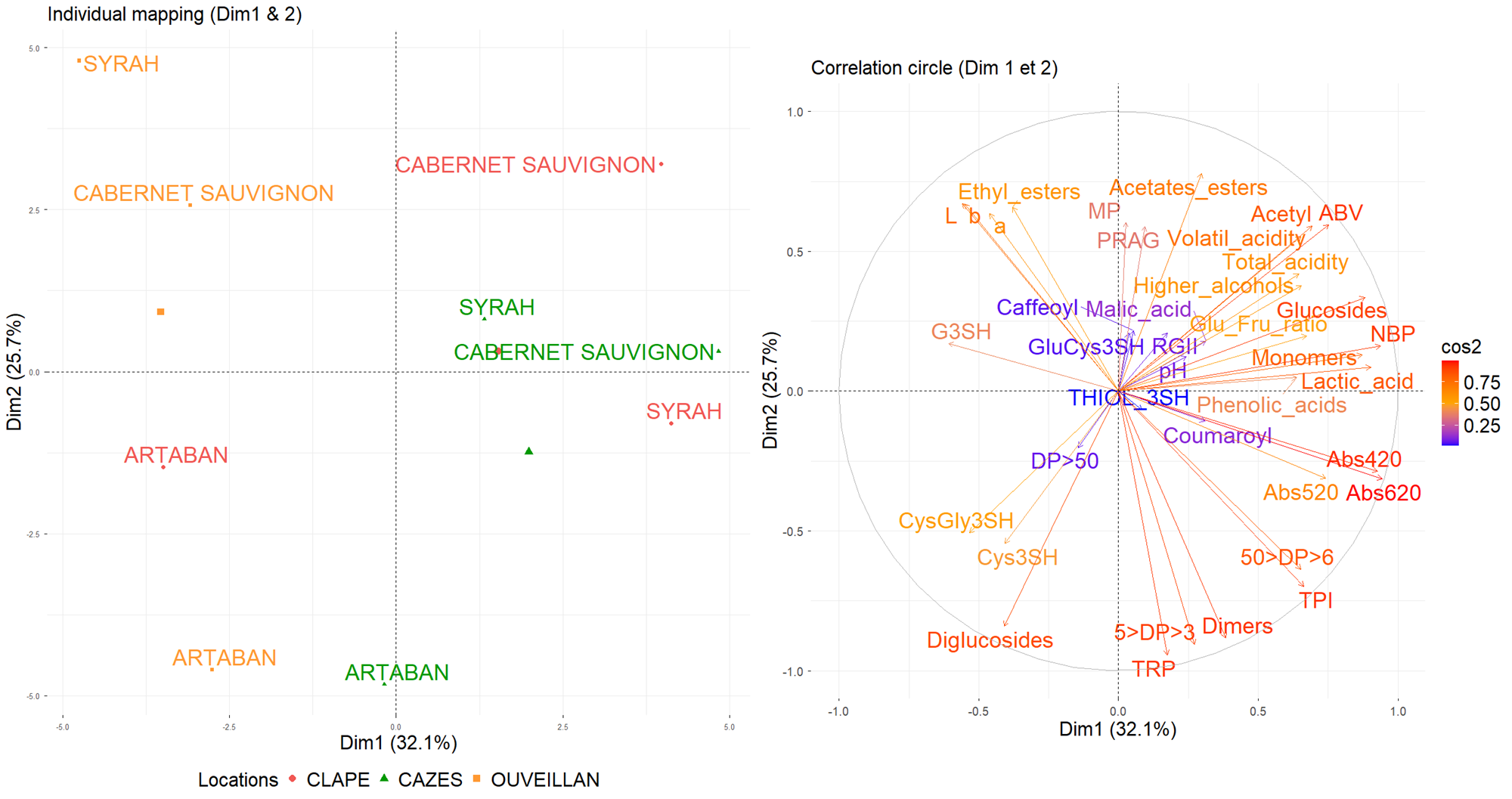
Figure 1. 2-dimensional Principal Component Analysis (PCA) (left: individual mapping; right: correlation circle) of oenological and chemical parameters of wines. The varieties are classified by colour regarding their harvest location: Clape (red), Cazes (green), and Ouveillan (yellow). The factors in the correlation circle are coloured according to their cos2 values.
Overall, in our dataset, wine colour and polyphenol composition are the most discriminant parameters.
The individual map revealed a stronger variety effect on Artaban and Cabernet-. Indeed, the Artaban profile is driven by f anthocyanin diglucosides, which distinguish it from the Vitis vinifera varieties. This Artaban grouping indicates minimal terroir effect and a dominant variety signature. Within this grouping, the harvest-location effect is more visible, as Syrah and Cabernet-Sauvignon from Ouveillan group together and are distinct from the other harvest locations. Cabernet-Sauvignon from Cazes is closer to Syrah from Cazes and Clape than to Cabernet-Sauvignon from Clape and Ouveillan. The three Cazes varieties appear to have higher wine colour and polyphenol content, as indicated by the associated parameters on the correlation circle.
Overall, the data show a clear distinction between hybrid and Vitis vinifera varieties in the anthocyanin content of Artaban diglucosides. The harvest location effect is more pronounced with Cabernet-Sauvignon and Syrah, with Ouveillan surprisingly the most different yet closest to Clape. Finally, in our dataset, harvest location affects wines made from the selected varieties differently.
2. Quantitative effect of harvest location on red wine quality markers
After visualising the qualitative relationships between the selected varieties and harvest locations in wines, it seems necessary to determine which observed correlations are statistically significant in discriminating between the modalities. This approach rigorously identifies which markers are significantly influenced by variety, terroir, both, or neither (Table 1).
Variable | Variety | Harvest location |
pH | 1 | 0.0069* |
Total acidity | 0.3648 | 0.0808 |
ABV1 | 0.0000* | 0.1127 |
Glucose / Fructose ratio | 0.0469* | 0.3238 |
Volatile acidity | 0.0003* | 0.3238 |
Malic acid | 0.69 | 0.0279* |
Lactic acid | 0.0961 | 0.2171 |
Total Polyphenol Index (TPI) | 0.7948 | 0.0294* |
Anthocyanins | 0.0001* | 0.2171 |
Absorbance at 420 nm | 1 | 0.0001* |
Absorbance at 520 nm | 1 | 0.0000* |
Absorbance at 620 nm | 1 | 0.0004* |
Colour Intensity (CI) | 1 | 0.0000* |
L | 1 | 0.0294* |
a | 0.7948 | 0.1127 |
b | 1 | 0.0294* |
Non-bleachable Pigments (NBP) | 0.0154* | 0.0679 |
Total Red Pigments (TRP) | 0.0001* | 0.2171 |
Total anthocyanins | 0* | 0.3589 |
Glucosides | 0* | 0.1082 |
Diglucosides | 0* | 0.9727 |
Acetyl | 0* | 0.7625 |
Caffeoyl | 0* | 0.7625 |
Coumaroyl | 0* | 0.4204 |
Total tannins | 0.0655 | 0.0552 |
DP > 502 | 0.3152 | 0.5251 |
50 > DP > 62 | 0.0726 | 0.0552 |
5 > DP > 32 | 0.0047* | 0.315 |
Dimers | 0.0290* | 0.0176* |
CysGly3SH | 0.0000* | 0.281 |
GluCys3SH | 0.1703 | 0.1467 |
Cys3SH | 0.0017* | 0.1369 |
G3SH | 0.8401 | 0.3301 |
3SH varietal thiol | 0.0004* | 0.4308 |
Higher alcohols | 0.1801 | 0.6714 |
Ethyl esters | 0.0201* | 0.6714 |
Acetate esters | 0.0005* | 0.6714 |
Total polysaccharides in wine | 1 | 0.0494* |
Mannoproteins | 1 | 0.1417 |
Type-II rhamnogalacturonan (RGII) | 1 | 0.0409* |
Polysaccharides rich in Arabinose and Galactose (PRAG) | 0.8308 | 0.0804 |
Arabinose / Galactose | 0.0000* | 1 |
1Alcoholic Strength by volume; 2Degree of Polymerisation; *statistically significant at a threshold of 0.05 after ANOVA corrected for multiplicity by Holm method.
In the present study (Table 1), several wine indicators differed significantly by harvest location.
Concerning wine acidity, only pH and malic acid showed significant p-values at the 0.05 threshold, whereas total acidity, volatile acidity, and lactic acid did not. Only volatile acidity is variety-dependent. These results may be explained by malic acid accumulating in the grape, which is related to pH but is converted to lactic acid during malolactic fermentation. However, the wines were sampled immediately after alcoholic fermentation; thus, malolactic fermentation had not been performed.
The most notable finding from polyphenolic analysis was that chromatic parameters and TPI were terroir-dependent, whereas grape variety determined anthocyanin speciation. Concerning polyphenols, harvest location statistically affects TPI and chromatic wine indicators (L, b, and Absorbances at 420, 520, and 62 0nm), as well as CI, which represents the sum of the absorbances. However, total anthocyanin content, its different families, and derived pigments (NBP and TRP) differ significantly among varieties but not by harvest location. This result does not align with the literature, as phenolic profiles have been reported to be influenced by pedoclimatic conditions, even at the subregional level (Argentero et al., 2026). However, results must be interpreted cautiously, since only Syrah was common to this study, and not every variety is affected by terroir with the same intensity, as Argentero et al. (2026) demonstrated by analysing different cultivars’ wines from the same five subregional terroirs.
These seemingly contradictory results may be explained by the different analytical methods used for those indicators. Indeed, spectrophotometry measures chromatic wine indicators, which accounts for the bathochromic and hyperchromic effects of copigmentation.
Beyond these analytical considerations, this pattern suggests that polyphenolic structures could be genetically determined and variety-specific, as seen in Artaban, which possesses anthocyanin diglucosides, as Yang et al. (2014) have already established. However, pedoclimatic conditions can influence anthocyanin concentrations through gene expression, as widely reported in the literature (Cohen et al., 2012; Gouot et al., 2019; Guan et al., 2016). However, anthocyanins quantified in wines undergo more complex processes, including interactions and combinations during extraction (Boulet et al., 2024).
For tannins, neither total tannin content nor tannins of any degree of Polymerisation (DP) differed significantly between varieties or harvest location. This result may be explained by the fact that extraction and interaction phenomena have a greater impact on the final wine’s tannin content than on the varietal potential itself (Abi-Habib et al., 2021; Ferrero et al., 2025; Setford et al., 2017), as well as by differences in cell wall composition and interactions (Boulet et al., 2023; Fournand et al., 2006). This pattern suggests that tannin accumulation in wine is predominantly governed by extraction and interactions during maceration rather than by intrinsic grape composition. Indeed, tannin extractability is strongly modulated by the Cell wall polysaccharide composition (pectins, hemicelluloses), which varies with ripeness and growing conditions, as well as ethanol concentration during maceration, which enhances tannin solubility, and the Polyphenol-polysaccharide and polyphenol-protein interactions, which can sequester tannins and prevent their extraction (Abi-Habib et al., 2022). However, harvest location statistically impacts dimers. This result, that only dimers exhibit terroir sensitivity, may reflect their unique physicochemical properties: dimers are small enough to diffuse readily through the cell wall matrix, yet large enough to engage in hydrogen bonding with polysaccharides.
Regarding varietal thiol precursors in the must, none differed significantly by harvest location, whereas CysGly3SH and Cys3SH differed by variety at the 0.05 threshold. However, G3SH, the most abundant thiol precursor, did not differ by variety or harvest location. This may be explained by the relatively low content of varietal thiol precursors for Syrah (Wang et al., 2022) and Cabernet-Sauvignon (Peña-Gallego et al., 2012), already reported in the literature. However, while the literature has highlighted the impact of certain viticultural practices on thiol precursor content (Dournes et al., 2022), this study did not examine viticultural practices; therefore, this impact cannot be measured.
Conversely, 3SH varietal thiol differed statistically by variety but not by location, giving this compound its varietal adjective. The absence of location effects on both precursors and volatile thiols suggests that thiol metabolism is primarily variety-controlled, justifying the “varietal thiol” nomenclature. Some studies have reported a strong vintage effect on precursor composition (Cerreti et al., 2015; Sivilotti et al., 2017); however, this trend must be confirmed across several vintages. In a comparative study across multiple varieties, thiol precursor variation can be attributed to a varietal component within a restricted harvest area. From a practical winemaking perspective, this implies that terroir (when restricted to a close area) is unlikely to significantly enhance thiol expression; instead, varietal selection and fermentation management (yeast strain, nitrogen status, temperature) are the dominant levers (Duc et al., 2020; Helwi et al., 2015; Masneuf-Pomarède et al., 2006; Swiegers & Pretorius, 2007).
In red wines, the major aroma compounds remain fermentative aromas produced by yeast during alcoholic fermentation. Logically, harvest location did not affect t the different fermentative aroma families analysed (Table 1) because nitrogen content was standardised with DAP supplementation and this study used only one yeast strain of Saccharomyces cerevisiae. However, variety significantly affected acetate and ethyl esters concentrations (p-values = 0.0005 and 0.0201, respectively). The literature has documented a larger set of varieties (Cesson et al., 2026), which may be due to nitrogen quality, as the total content was standardised using only a mineral nitrogen source, and has demonstrated that nitrogen origin (organic or inorganic) affects yeast production of fermentative aromas (Seguinot et al., 2018). This may also be due to a difference in sterol quantities, intrinsic to the variety or less accessible in the grape pomace in the heterogeneous phase, as reported by Casalta et al. (2019).
Lastly, wine polysaccharides are a support marker of red wine quality since they are not a direct organoleptic component of wine quality, but they can interact with all other compounds to modify the wine composition and perception (Brandão et al., 2020; Kuhlman et al., 2024; Quijada-Morín et al., 2014), as with polyphenols to stabilise colour through colloids (Assunção Bicca et al., 2023; Boulet et al., 2024) or with aromas to modify their perception (Canalejo et al., 2023; Chalier et al., 2007; Jones-Moore et al., 2022). Therefore, polysaccharides and their interactions must be analysed to understand red wine quality. They can come from the grape as Type-II rhamnogalacturonan (RGII) and Polysaccharides Rich in Arabinose and Galactose (PRAG), or from the yeast cell wall as mannoproteins (MP). To confirm the identification of the wine polysaccharides, we analysed and compared size-exclusion wine profiles to a purified standard, as described by Vidal et al. (2003). For example, we report one profile for all Syrah modalities in the Supplementary Information, along with the purified standard profile (Figure S4). Total polysaccharides in wine (grouping RGII, PRAG, and Mannoproteins) differ by harvest location. In contrast, the ratio of total Arabinose and Galactose (Arabinose/Galactose), an indicator of PRAG structural composition, differs by variety. Logically, Mannoprotein content showed no significant variety or terroir effects, as expected given that all fermentations were inoculated with the same Saccharomyces cerevisiae strain under standardised conditions. This negative result serves as an important experimental control, confirming that winemaking parameters were sufficiently standardised to isolate grape-origin effects. RGII differs statistically by harvest location. The modalities with the higher RGII content are Cabernet-Sauvignon and Artaban from Clape (155.97 ± 7.45 mg/L and 84.43 ± 33.99 mg/L, respectively). This latter result concurs with the literature (Apolinar-Valiente et al., 2013), which shows that, in Spanish vineyards, Monastrell RGII content varied substantially across regions, while PRAG remained stable. This result suggests that RGII, a structurally complex, branched pectic polysaccharide resistant to enzymatic degradation, is particularly sensitive to enzymatic release from the cell wall during grape ripening (Barnavon et al., 2000).
Overall, for the selected markers, harvest location plays a major role in determining wine colour but a minor role in shaping wine chemical potential. Some molecules, such as anthocyanins and several aroma precursors, have a varietal origin. However, these results must be interpreted cautiously, as the terroirs used in the study are similar at the subregional level; thus, the pedoclimatic conditions may be too similar to detect a statistical effect. Moreover, wine being a complex matrix, other phenomena, such as polyphenol extraction or reactivity through copigmentation, can also influence the selected indicators and affect the conclusions.
3. Harvest location effect on proportions of red wine quality markers
The previous paragraph examined the impacts of variety and harvest location on key red wine markers. However, these markers can be divided into families based on their chemical nature, and to better assess the impact of these two factors on compound biosynthesis, studying the proportions of different chemical families may be relevant for the rest of the manuscript.
As shown in Table 2, anthocyanin family proportions in wine differ significantly by variety, confirming the varietal character of those indicators. This result complements the previous one in Table 1 and indicates that anthocynanin biosynthesis is variety-dependent.
Variable | Variety | Harvest location |
Glucosides | 0* | 1 |
Diglucosides | 0* | 1 |
Acetyl | 0* | 1 |
Caffeoyl | 0* | 0.4776 |
Coumaroyl | 0* | 1 |
DP > 501 | 0.8036 | 0.595 |
50 > DP > 61 | 0.0002* | 0.2725 |
5 > DP > 31 | 0.1858 | 0.0000* |
Dimers | 0.0001* | 0.595 |
CysGly3SH in must | 0.0000* | 0.9593 |
GluCys3SH in must | 0.1612 | 0.1359 |
Cys3SH in must | 0.0005* | 0.5841 |
G3SH in must | 0.0000* | 0.9593 |
Mannoproteins | 0.8365 | 0.0705 |
RGII | 0.5625 | 0.0829 |
PRAG | 0.1925 | 0.5959 |
1Degree of Polymerisation; *statistically significant at a threshold of 0.05 after ANOVA corrected for multiplicity by the Holm method.
Similarly, only the short-chain tannins with a Degree of Polymerisation between 3 and 5 (3 < DP < 5) showed significant terroir dependence. Alternatively, this pattern could reflect differential extraction efficiency: short-chain tannins extract more readily during maceration than high-DP polymers, and terroir-driven differences in cell wall structure (pectin composition, pore size) may selectively facilitate or hinder extraction of 3 < DP < 5 oligomers while leaving larger polymers unaffected. This interpretation supports our earlier observation that total tannin content shows minimal variety/terroir effects, suggesting extraction phenomena dominate over biosynthetic variation. Otherwise, the proportions of anthocyanin and thiol precursors must differ significantly across varieties, as do the absolute values presented in Table 1. Therefore, these molecules can serve as strong varietal indicators, adequate for discriminating and studying different varieties.
Regarding relative proportions of polysaccharide families (RGII, PRAGs, MPs), unlike the absolute values, none of the selected parameters differs significantly between varieties or harvest locations in wines. This apparent paradox – the fact that terroir modulates RGII levels without affecting its relative proportion – suggests that terroir acts on the degradation and/or extraction of polysaccharides from the cell walls in a proportional manner across the different families, rather than selectively favouring one over another. This result is consistent with a model in which grape ripeness, itself shaped by terroir, acts as a regulator of cell wall metabolism: during ripening, all classes of pectic polysaccharides (RGII and PRAG, grape-derived polysaccharides) undergo coordinated degradation and/or solubilisation (Barnavon et al., 2000), and/or diversification of interactions with other molecules that may affect their relative proportions while altering their final concentrations in musts and wines.
In conclusion, at the subregional level, harvest location does not affect the proportions of the different families across the selected red wine quality markers. Therefore, in our dataset, harvest location appears to have a stronger impact on the marker biosynthesis efficiency, which regulates the absolute quantities of the compounds (Castellarin et al., 2007a; Castellarin et al., 2007b), than on the preferential biosynthetic pathways, leading to specific compounds (Yang et al., 2014). Further experiments should confirm this hypothesis.
Conclusion
In conclusion, this study highlights the respective influences of grape variety and harvest location, within a restricted area, on three red grape cultivars and their corresponding wines produced under standardised fermentation conditions. Our findings demonstrate that variety and harvest location, when limited to a restricted region, operate through distinct but complementary mechanisms: variety determines which biosynthetic pathways are expressed (qualitative control), while harvest location modulates the efficiency of those pathways (quantitative control).
At the qualitative level, a clear discrimination can be made between the hybrid variety Artaban and Vitis vinifera Cabernet-Sauvignon and Syrah. The harvest location effect is stronger in Vitis vinifera, especially for Ouveillan origin. At a quantitative level, the results indicate that the wine’s chromatic characteristics are statistically affected by harvest location, whereas the chemical composition, especially when expressed as proportions, is variety-dependent. Overall, only a limited number of red wine quality markers were significantly affected by harvest location. Results must also be balanced, as wine is a complex matrix; other phenomena, such as extraction and chemical reactivity, must be considered.
Overall, grape variety appears to define the biochemical identity of wine, whereas harvest location fine-tunes the quantitative expression of this compositional potential. Although harvest location is not negligible in shaping red wine quality markers, its influence appears more limited than that of varietal potential within a restricted subregional area. This study demonstrates that it is possible to compare the potential of red wine varieties when harvested within a limited subregional area by carefully interpreting and balancing the results.
Acknowledgements
The authors gratefully acknowledge the financial support from the Occitanie region under the Vinid’Occ program. We thank Domaine de Vassal, Chambre de l’Agriculture de l’Aude, IFV and private winegrowers for providing plant material. This study was also supported by the UMT ACTIA OENOTYPAGE (Joint Technological Unit – French Ministry responsible for Food).
References
- Abi-Habib, E., Poncet-Legrand, C., Roi, S., Carrillo, S., Doco, T., & Vernhet, A. (2021). Impact of grape variety, berry maturity and size on the extractability of skin polyphenols during model wine-like maceration experiments. Journal of the Science of Food and Agriculture, 101(8), 3257–3269. https://doi.org/10.1002/jsfa.10955
- Abi-Habib, E., Vernhet, A., Roi, S., Carrillo, S., Jørgensen, B., Hansen, J., Doco, T., & Poncet-Legrand, C. (2022). Impact of the variety on the adsorption of anthocyanins and tannins on grape flesh cell walls. Journal of the Science of Food and Agriculture, 102(8), 3379–3392. https://doi.org/10.1002/jsfa.11685
- Apolinar-Valiente, R., Romero-Cascales, I., Williams, P., Gómez-Plaza, E., López-Roca, J. M., Ros-García, J. M., & Doco, T. (2014). Effect of winemaking techniques on polysaccharide composition of Cabernet Sauvignon, Syrah and Monastrell red wines. Australian Journal of Grape and Wine Research, 20(1), 62–71. https://doi.org/10.1111/ajgw.12048
- Apolinar-Valiente, R., Williams, P., Romero-Cascales, I., Gómez-Plaza, E., López-Roca, J. M., Ros-García, J. M., & Doco, T. (2013). Polysaccharide Composition of Monastrell Red Wines from Four Different Spanish Terroirs: Effect of Wine-Making Techniques. Journal of Agricultural and Food Chemistry, 61(10), 2538–2547. https://doi.org/10.1021/jf304987m
- Argentero, A., Caillé, S., Nolleau, V., Godet, T., Mouls, L., & Rigou, P. (2024). Exploring the aromatic typicity of blended red wines from geographically close sub-regions in AOC Corbières: A sensory and chemical approach. OENO One, 58(1). https://doi.org/10.20870/oeno-one.2024.58.1.7802
- Argentero, A., Tyson, E., Suc, L., Véran, F., Bauducel, M., Samson, A., Caillé, S., Rigou, P., & Mouls, L. (2026). Influence of terroirs on the phenolic composition and astringency of wines made from representative plots of Corbières subregions. OENO One, 60(1). https://doi.org/10.20870/oeno-one.2026.60.1.9329
- Assunção Bicca, S., Poncet-Legrand, C., Roi, S., Mekoue, J., Doco, T., & Vernhet, A. (2023). Exploring the influence of S. cerevisiae mannoproteins on wine astringency and color: Impact of their polysaccharide part. Food Chemistry, 422, 136160. https://doi.org/10.1016/j.foodchem.2023.136160
- Atanasova, V., Fulcrand, H., Cheynier, V., & Moutounet, M. (2002). Effect of oxygenation on polyphenol changes occurring in the course of wine-making. Analytica Chimica Acta, 458(1), 15–27. https://doi.org/10.1016/S0003-2670(01)01617-8
- Barnavon, L., Doco, T., Terrier, N., Ageorges, A., Romieu, C., & Pellerin, P. (2000). Analysis of cell wall neutral sugar composition, β-galactosidase activity and a related cDNA clone throughout the development of Vitis vinifera grape berries. Plant Physiology and Biochemistry, 38(4), 289–300. https://doi.org/10.1016/S0981-9428(00)00749-X
- Boulet, J.-C., Abi-Habib, E., Carrillo, S., Roi, S., Veran, F., Verbaere, A., Meudec, E., Rattier, A., Ducasse, M.-A., Jørgensen, B., Hansen, J., Le Gall, S., Poncet-Legrand, C., Cheynier, V., Doco, T., & Vernhet, A. (2023). Focus on the relationships between the cell wall composition in the extraction of anthocyanins and tannins from grape berries. Food Chemistry, 406, 135023. https://doi.org/10.1016/j.foodchem.2022.135023
- Boulet, J.-C., Vernhet, A., Poncet-Legrand, C., Cheynier, V., & Doco, T. (2024). Exploring the role of grape cell wall and yeast polysaccharides in the extraction and stabilisation of anthocyanins and tannins in red wines. OENO One, 58(1). https://doi.org/10.20870/oeno-one.2024.58.1.7793
- Brandão, E., Silva, M. S., García-Estévez, I., Williams, P., Mateus, N., Doco, T., De Freitas, V., & Soares, S. (2020). Inhibition Mechanisms of Wine Polysaccharides on Salivary Protein Precipitation. Journal of Agricultural and Food Chemistry, 68(10), 2955–2963. https://doi.org/10.1021/acs.jafc.9b06184
- Canalejo, D., Martínez-Lapuente, L., Ayestarán, B., Pérez-Magariño, S., Doco, T., & Guadalupe, Z. (2023). Grape-Derived Polysaccharide Extracts Rich in Rhamnogalacturonans-II as Potential Modulators of White Wine Flavor Compounds. Molecules, 28(18), 6477. https://doi.org/10.3390/molecules28186477
- Casalta, E., Salmon, J.-M., Picou, C., & Sablayrolles, J.-M. (2019). Grape Solids: Lipid Composition and Role during Alcoholic Fermentation under Enological Conditions. American Journal of Enology and Viticulture, 70(2), 147–154. https://doi.org/10.5344/ajev.2018.18049
- Castellarin, S. D., Matthews, M. A., Di Gaspero, G., & Gambetta, G. A. (2007a). Water deficits accelerate ripening and induce changes in gene expression regulating flavonoid biosynthesis in grape berries. Planta, 227(1), 101–112. https://doi.org/10.1007/s00425-007-0598-8
- Castellarin, S. D., Pfeiffer, A., Sivilotti, P., Degan, M., Peterlunger, E., & Di Gaspero, G. (2007b). Transcriptional regulation of anthocyanin biosynthesis in ripening fruits of grapevine under seasonal water deficit. Plant, Cell & Environment, 30(11), 1381–1399. https://doi.org/10.1111/j.1365-3040.2007.01716.x
- Cerreti, M., Esti, M., Benucci, I., Liburdi, K., de Simone, C., & Ferranti, P. (2015). Evolution of S-cysteinylated and S-glutathionylated thiol precursors during grape ripening of Vitis vinifera L. cvs Grechetto, Malvasia del Lazio and Sauvignon Blanc. Australian Journal of Grape and Wine Research 21(3), 411–416. https://doi.org/10.1111/ajgw.12152
- Cesson, A., Ducasse, M.-A., Carrillo, S., Flores, D., Jørgensen, B., Pedersen, L. G., Macna, F., Meudec, E., Nolleau, V., Perez, M., Roi, S., Roy, A., Simon, J., Suc, L., Sanchez, I., Doco, T., Poncet-Legrand, C., & Mouret, J.-R. (2026). Same Yeast, Different Wines: Impact of Different Grape Variety Must Composition on Fermentation Dynamics and Wine Composition. ACS Food Science & Technology, 6(6), 1723–1738. https://doi.org/10.1021/acsfoodscitech.6c00089
- Chalier, P., Angot, B., Delteil, D., Doco, T., & Gunata, Z. (2007). Interactions between aroma compounds and whole mannoprotein isolated from Saccharomyces cerevisiae strains. Food Chemistry, 100(1), 22–30. https://doi.org/10.1016/j.foodchem.2005.09.004
- Choné, X., Lavigne-Cruège, V., Tominaga, T., Van Leeuwen, C., Castagnède, C., Saucier, C., & Dubourdieu, D. (2006). Effect of vine nitrogen status on grape aromatic potential: Flavor precursors (S-cysteine conjugates), glutathione and phenolic content in Vitis vinifera L. Cv Sauvignon blanc grape juice. OENO One, 40(1), 1-6. https://doi.org/10.20870/oeno-one.2006.40.1.880
- Cohen, S. D., Tarara, J. M., Gambetta, G. A., Matthews, M. A., & Kennedy, J. A. (2012). Impact of diurnal temperature variation on grape berry development, proanthocyanidin accumulation, and the expression of flavonoid pathway genes. Journal of Experimental Botany, 63(7), 2655–2665. https://doi.org/10.1093/jxb/err449
- Cortell, J. M., & Kennedy, J. A. (2006). Effect of Shading on Accumulation of Flavonoid Compounds in ( Vitis vinifera L.) Pinot Noir Fruit and Extraction in a Model System. Journal of Agricultural and Food Chemistry, 54(22), 8510–8520. https://doi.org/10.1021/jf0616560
- De Almeida, L. W., Torregrosa, L., Dournes, G., Pellegrino, A., Ojeda, H., & Roland, A. (2024). New Fungus-Resistant Grapevine Vitis and V. vinifera L. × M. rotundifolia Derivative Hybrids Display a Drought-Independent Response in Thiol Precursor Levels. Journal of Agricultural and Food Chemistry, 72(4), 1855–1863. https://doi.org/10.1021/acs.jafc.2c08595
- Doco, T., Quellec, N., Moutounet, M., & Pellerin, P. (1999). Polysaccharide Patterns During the Aging of Carignan noir Red Wines. American Journal of Enology and Viticulture, 50(1), 25–32. https://doi.org/10.5344/ajev.1999.50.1.25
- Dolet, M.-A., Paire, C., Cheriet, F., Geffroy, O., Le Fur, Y., Hannin, H., Samson, A., Caillé, S., Nougarède, S., Olivier, V., & Chervin, C. (2024). Resumption of the planting of grapevine varieties in France, referred to as “disease-resistant”. IVES Technical Reviews, Vine and Wine. https://doi.org/10.20870/IVES-TR.2024.8261
- Dournes, G., Sachot, S., Suc, L., Le-Guerneve, C., Mouret, J.-R., & Roland, A. (2023). New Light on the Varietal Thiols Pathway during Alcoholic Fermentation: Role of 3-S-(N-Acetyl-cysteinyl)-hexan-1-ol (NAC3SH). Journal of Agricultural and Food Chemistry, 71(9), 4123–4131. https://doi.org/10.1021/acs.jafc.2c08821
- Dournes, G., Verbaere, A., Lopez, F., Dufourcq, T., Mouret, J. ‐R., & Roland, A. (2022). First characterisation of thiol precursors in Colombard and Gros Manseng: Comparison of two cultivation practices. Australian Journal of Grape and Wine Research, 28(3), 492–499. https://doi.org/10.1111/ajgw.12547
- Downey, M. O., Harvey, J. S., & Robinson, S. P. (2004). The effect of bunch shading on berry development and flavonoid accumulation in Shiraz grapes. Australian Journal of Grape and Wine Research, 10(1), 55–73. https://doi.org/10.1111/j.1755-0238.2004.tb00008.x
- Duc, C., Maçna, F., Sanchez, I., Galeote, V., Delpech, S., Silvano, A., & Mouret, J.-R. (2020). Large-Scale Screening of Thiol and Fermentative Aroma Production during Wine Alcoholic Fermentation: Exploring the Effects of Assimilable Nitrogen and Peptides. Fermentation, 6(4), 98. https://doi.org/10.3390/fermentation6040098
- Ducasse, M., Roy, A., Caboulet, D., Bolandard, P., Cesson, A., Sanchez, I., , Sommerer N., , Meudec E., , Flores D., Poncet-Legrand, C., Mouret, J., Perez, M., Saurin, N., Leborgne, C., Aguera, E. (2024). Automated red microvinification (1kg) adapted to the needs of varietal innovation. OIV 2024. https://doi.org/10.58233/6qpGsfX7
- Favieres, L., Bastien, M., Poncet-Legrand, C., Doco, T., Vernhet, A., Godet, T., Noelleau, V., Roi, S., Carrillo, S., Sieczkowski, N., Mekoue, J., & Rigou, P. (2025). Exploring the impact of yeast derivatives on aromatic and sensory profiles of white and red wines: A multifactorial study. OENO One, 59(3). https://doi.org/10.20870/oeno-one.2025.59.3.9264
- Ferrero, L., Paissoni, M. A., Río Segade, S., Mattivi, F., Marangon, M., Parpinello, G. P., Piombino, P., Ugliano, M., Gerbi, V., Rolle, L., & Giacosa, S. (2025). Insight on Tannin Extraction and Mechanical Changes During Maceration from Skins and Seeds of Italian Red Grape Varieties. Food and Bioprocess Technology, 18(6), 5767–5781. https://doi.org/10.1007/s11947-025-03806-9
- Fournand, D., Vicens, A., Sidhoum, L., Souquet, J.-M., Moutounet, M., & Cheynier, V. (2006). Accumulation and Extractability of Grape Skin Tannins and Anthocyanins at Different Advanced Physiological Stages. Journal of Agricultural and Food Chemistry, 54(19), 7331–7338. https://doi.org/10.1021/jf061467h
- Gold, V. (Ed.). (2019). The IUPAC Compendium of Chemical Terminology: The Gold Book (4th ed.). International Union of Pure and Applied Chemistry (IUPAC). https://doi.org/10.1351/goldbook
- Gouot, J. C., Smith, J. P., Holzapfel, B. P., Walker, A. R., & Barril, C. (2019). Grape berry flavonoids: A review of their biochemical responses to high and extreme high temperatures. Journal of Experimental Botany, 70(2), 397–423. https://doi.org/10.1093/jxb/ery392
- Guan, L., Dai, Z., Wu, B.-H., Wu, J., Merlin, I., Hilbert, G., Renaud, C., Gomès, E., Edwards, E., Li, S.-H., & Delrot, S. (2016). Anthocyanin biosynthesis is differentially regulated by light in the skin and flesh of white-fleshed and teinturier grape berries. Planta, 243(1), 23–41. https://doi.org/10.1007/s00425-015-2391-4
- Helwi, P., Thibon, C., Habran, A., Hilbert, G., Guillaumie, S., Delrot, S., Darriet, P., & Van Leeuwen, C. (2015). Effect of vine nitrogen status, grapevine variety and rootstock on the levels of berry S-glutathionylated and S-cysteinylated precursors of 3-sulfanylhexan-1-ol. OENO One, 49(4), 253-265. https://doi.org/10.20870/oeno-one.2015.49.4.40
- Jones-Moore, H. R., Jelley, R. E., Marangon, M., & Fedrizzi, B. (2022). The interactions of wine polysaccharides with aroma compounds, tannins, and proteins, and their importance to winemaking. Food Hydrocolloids, 123, 107150. https://doi.org/10.1016/j.foodhyd.2021.107150
- Kobayashi, H., Takase, H., Suzuki, Y., Tanzawa, F., Takata, R., Fujita, K., Kohno, M., Mochizuki, M., Suzuki, S., & Konno, T. (2011). Environmental stress enhances biosynthesis of flavor precursors, S-3-(hexan-1-ol)-glutathione and S-3-(hexan-1-ol)-L-cysteine, in grapevine through glutathione S-transferase activation. Journal of Experimental Botany, 62(3), 1325–1336. https://doi.org/10.1093/jxb/erq376
- Koyama, K., Ikeda, H., Poudel, P. R., & Goto-Yamamoto, N. (2012). Light quality affects flavonoid biosynthesis in young berries of Cabernet Sauvignon grape. Phytochemistry, 78, 54–64. https://doi.org/10.1016/j.phytochem.2012.02.026
- Kuhlman, B. A., Aleixandre-Tudo, J. L., Moore, J. P., & Du Toit, W. (2024). Astringency perception in a red wine context – a review. OENO One, 58(1). https://doi.org/10.20870/oeno-one.2024.58.1.7774
- Masneuf-Pomarède, I., Mansour, C., Murat, M., Tominaga, T., & Dubourdieu, D. (2006). Influence of fermentation temperature on volatile thiols concentrations in Sauvignon blanc wines. International Journal of Food Microbiology, S016816050600050X. https://doi.org/10.1016/j.ijfoodmicro.2006.01.001
- OIV. (2010). Définition du “Terroir” vitivinicole. Résolution OIV/VITI 333/2010.
- OIVa. (n.d.). Chromatic Characteristics (Type-I). Retrieved https://www.oiv.int/standards/compendium-of-international-methods-of-wine-and-must-analysis/annex-a-methods-of-analysis-of-wines-and-musts/section-2-physical-analysis/chromatic-characteristics-%28type-i%29
- OIVb. (n.d.). Evaluation by refractometry of the sugar concentration in grape musts, concentrated grape musts and rectified concentrated grape musts (Type-I). Retrieved June 2, 2025, from https://www.oiv.int/standards/compendium-of-international-methods-of-wine-and-must-analysis/annex-a-methods-of-analysis-of-wines-and-musts/section-2-physical-analysis/evaluation-by-refractometry-of-the-sugar-concentration-in-grape-musts%2C-concentrated-grape-musts-and-r
- OIVc. (n.d.). Lactic Acid—Enzymatic method (Type-II). Retrieved https://www.oiv.int/standards/annex-a-methods-of-analysis-of-wines-and-musts/section-3-chemical-analysis/section-3-1-organic-compounds/section-3-1-3-acids/lactic-acid-enzymatic-method-%28type-ii%29
- OIVd. (n.d.). pH (Type-I). Retrieved https://www.oiv.int/standards/annex-a-methods-of-analysis-of-wines-and-musts/section-3-chemical-analysis/section-3-1-organic-compounds/section-3-1-3-acids/ph-%28type-i%29
- OIVe. (n.d.). Total malic Acid: Usual method (Type-IV). Retrieved https://www.oiv.int/standards/annex-a-methods-of-analysis-of-wines-and-musts/section-3-chemical-analysis/section-3-1-organic-compounds/section-3-1-3-acids/total-malic-acid%3A-usual-method-%28type-iv%29
- Peña-Gallego, A., Hernández-Orte, P., Cacho, J., & Ferreira, V. (2012). S-Cysteinylated and S-glutathionylated thiol precursors in grapes. A review. Food Chemistry, 131(1), 1–13. https://doi.org/10.1016/j.foodchem.2011.07.079
- Peyrot Des Gachons, C., Leeuwen, C. V., Tominaga, T., Soyer, J., Gaudillère, J., & Dubourdieu, D. (2005). Influence of water and nitrogen deficit on fruit ripening and aroma potential of Vitis vinifera L cv Sauvignon blanc in field conditions. Journal of the Science of Food and Agriculture, 85(1), 73–85. https://doi.org/10.1002/jsfa.1919
- Quijada-Morín, N., Williams, P., Rivas-Gonzalo, J. C., Doco, T., & Escribano-Bailón, M. T. (2014). Polyphenolic, polysaccharide and oligosaccharide composition of Tempranillo red wines and their relationship with the perceived astringency. Food Chemistry, 154, 44–51. https://doi.org/10.1016/j.foodchem.2013.12.101
- R Core Team. (2024). _R: A Language and Environment for Statistical Computing_. R Foundation for Statistical Computing, Vienna, Austria. . (n.d.). [Computer software].
- Redgwell, R. J., Schmitt, C., Beaulieu, M., & Curti, D. (2005). Hydrocolloids from coffee: Physicochemical and functional properties of an arabinogalactan–protein fraction from green beans. Food Hydrocolloids, 19(6), 1005–1015. https://doi.org/10.1016/j.foodhyd.2004.12.010
- Rollero, S., Bloem, A., Camarasa, C., Sanchez, I., Ortiz-Julien, A., Sablayrolles, J.-M., Dequin, S., & Mouret, J.-R. (2015). Combined effects of nutrients and temperature on the production of fermentative aromas by Saccharomyces cerevisiae during wine fermentation. Applied Microbiology and Biotechnology, 99(5), 2291–2304. https://doi.org/10.1007/s00253-014-6210-9
- Sabon, I., De Revel, G., Kotseridis, Y., & Bertrand, A. (2002). Determination of Volatile Compounds in Grenache Wines in Relation with Different Terroirs in the Rhone Valley. Journal of Agricultural and Food Chemistry, 50(22), 6341–6345. https://doi.org/10.1021/jf025611k
- Seguin, G. (1986). ‘Terroirs’ and pedology of wine growing. Experientia, 42(8), 861–873. https://doi.org/10.1007/BF01941763
- Seguinot, P., Rollero, S., Sanchez, I., Sablayrolles, J.-M., Ortiz-Julien, A., Camarasa, C., & Mouret, J.-R. (2018). Impact of the timing and the nature of nitrogen additions on the production kinetics of fermentative aromas by Saccharomyces cerevisiae during winemaking fermentation in synthetic media. Food Microbiology, 76, 29–39. https://doi.org/10.1016/j.fm.2018.04.005
- Setford, P. C., Jeffery, D. W., Grbin, P. R., & Muhlack, R. A. (2017). Factors affecting extraction and evolution of phenolic compounds during red wine maceration and the role of process modelling. Trends in Food Science and Technology. https://doi.org/10.1016/j.tifs.2017.09.005
- Sivilotti, P., Falchi, R., Herrera, J. C., Škvarč, B., Butinar, L., Sternad Lemut, M., Bubola, M., Sabbatini, P., Lisjak, K., & Vanzo, A. (2017). Combined Effects of Early Season Leaf Removal and Climatic Conditions on Aroma Precursors in Sauvignon Blanc Grapes. Journal of Agricultural and Food Chemistry, 65(44), 9815–9815. https://doi.org/10.1021/acs.jafc.7b04861
- Swiegers, J. H., & Pretorius, I. S. (2007). Modulation of volatile sulfur compounds by wine yeast. Applied Microbiology and Biotechnology, 74(5), 954–960. https://doi.org/10.1007/s00253-006-0828-1
- van Leeuwen, C., Roby, J.-P., & De Rességuier, L. (2018). Soil-related terroir factors: A review. OENO One, 52(2), 173–188. https://doi.org/10.20870/oeno-one.2018.52.2.2208
- van Leeuwen, C., & Seguin, G. (2006). The concept of terroir in viticulture. Journal of Wine Research, 17(1), 1–10. https://doi.org/10.1080/09571260600633135
- Vernhet, A., Carrillo, S., Rattier, A., Verbaere, A., Cheynier, V., & Nguela, J. M. (2020). Fate of Anthocyanins and Proanthocyanidins during the Alcoholic Fermentation of Thermovinified Red Musts by Different Saccharomyces cerevisiae Strains. Journal of Agricultural and Food Chemistry, 68(11), 3615–3625. https://doi.org/10.1021/acs.jafc.0c00413
- Vidal, S., Williams, P., Doco, T., Moutounet, M., & Pellerin, P. (2003). The polysaccharides of red wine: Total fractionation and characterization. Carbohydrate Polymers, 54(4), 439–447. https://doi.org/10.1016/S0144-8617(03)00152-8
- Wang, X., Capone, D. L., Kang, W., Roland, A., & Jeffery, D. W. (2022). Impact of accentuated cut edges (ACE) technique on volatile and sensory profiles of Shiraz wines. Food Chemistry, 372, 131222. https://doi.org/10.1016/j.foodchem.2021.131222
- Yang, Y., Labate, J. A., Liang, Z., Cousins, P., Prins, B., Preece, J. E., Aradhya, M., & Zhong, G.-Y. (2014). Multiple loss-of-function 5-O-glucosyltransferase alleles revealed in Vitis vinifera, but not in other Vitis species. Theoretical and Applied Genetics, 127(11), 2433–2451. https://doi.org/10.1007/s00122-014-2388-6
 Views: 5