

VITICULTURE / Review article
Abstract
Viticulture faces a double challenge under climate change: optimizing water use and contributing to the sequestration of atmospheric CO2. This review synthesizes 25 years of advances in flux stations’ measurements of water vapour and carbon fluxes in vineyards using the eddy-covariance (EC) method, based on a corpus of 92 articles focused on evapotranspiration (ET) and Net Ecosystem Exchange (NEE). Most studies show a strong influence of climate on ET and NEE annual cycle variability, especially global radiation and vapour pressure deficit. Evapotranspiration-based studies (81% of the corpus) mainly focus on ET partitioning in irrigated vineyard plots of arid regions. These studies show that ET is primarily driven by transpiration, with contributions ranging from 56% to 86%. Several studies indicate that precise monitoring of ET can help optimize irrigation and thereby reduce water stress. A wide variety of instruments and models were validated via flux station ET measurements, but heat advection from neighboring areas, very common in viticultural regions, generates uncertainties in ET for many such alternatives. Available NEE-based studies (13% of the corpus) were mainly conducted in Italy. Amongst them, to our knowledge, only five sites reported complete annual NEE, yielding an average of -135.7 g C m-2 yr-1. This suggests that Mediterranean vineyards act as moderate carbon sinks, but the agricultural lateral fluxes of carbon, such as harvested grapes, need to be taken into account to reliably assess the vineyard's true potential for carbon uptake. About 5% of the corpus focuses on the Water Use Efficiency (WUE), i.e., the ratio between biomass produced and volume of water consumed by the vineyard. The WUE is particularly relevant for understanding the vine biophysical drivers of carbon and water fluxes, but the diversity of methods used to assess WUE impairs comparisons, calling for developing standardized approach. The scientific community needs to build a vineyard flux network, an EC flux station network dedicated to vineyard research under different pedoclimate contexts, to further understand ET and NEE dynamics and drivers, as well as the influence of viticultural practices for identifying the best way for winegrowers to enhance carbon uptake while reducing vineyard water consumption.
Introduction
Since the pre-industrial period, human activities have increased atmospheric greenhouse gas concentrations, enhancing the absorption and re-emission of outgoing longwave radiation and thereby amplifying the natural greenhouse effect (IPCC, 2023). This radiative forcing has led to global warming, significantly impacting terrestrial ecosystems such as agrosystems. Viticulture is one of the most widespread agricultural activities worldwide, practised in 93 countries in 2023 (OIV, 2022). Water scarcity combined with extremely hot summers can induce prolonged water stress, affecting both the quantity and quality of grape yields (Mira de Orduña, 2010; van Leeuwen et al., 2019). In response, winegrowers are seeking technical solutions to limit water loss and help mitigate greenhouse gases. This involves (i) developing methods for accurately estimating the vine water demand and (ii) assessing the atmospheric CO2 sequestration potential of the vineyards, with the carbon captured through photosynthesis allocated to perennial biomass production (Scandellari et al., 2016) and increased soil organic carbon stocks (Payen et al., 2021).
To support winegrowers in their adaptation and mitigation strategies, it is essential to better understand water and carbon fluxes at the vineyard scale, i.e., one to several hectares. These fluxes are commonly measured at high frequency by flux stations (aka flux towers) using the well-established eddy-covariance (EC) technique (Burba, 2022), the most widely applied today among the vast category of micrometeorological methods (Baldocchi et al., 1988). This approach relies on a 3D sonic anemometer and a gas analyser, both placed above the canopy. The instruments measure the three orthogonal components of wind (vertical, zonal and meridional) and the density of gases such as CO2 and H2O in the transported air volumes, respectively. Under relatively flat and homogeneous terrain, the three-dimensional transport process can be simplified, and the covariance between vertical wind and gas density represents the mass exchanges between the atmosphere and the ecosystem. Applied to H2O air density, the EC method provides estimates of ecosystem evapotranspiration (ET; also called Actual ET), i.e., the volume of water evaporated from the soil and transpired by plants through stomata. Applied to CO2 air density, EC provides estimates of the net ecosystem exchange (NEE), defined as the difference between carbon uptake through photosynthesis (GPP) and carbon release by respiration (Reco; Reichstein et al., 2005b). Respiration includes both autotrophic respiration, linked to plant metabolism, and heterotrophic respiration, resulting from the decomposition of organic matter by soil microorganisms.
ET and NEE measurements by flux stations are widely implemented worldwide in over 2100 locations today and support numerous networks and databases such as FLUXNET (Pastorello et al., 2020) and ICOS (Sabbatini et al., 2018). However, vineyard ecosystems remain largely unexplored compared with other ecosystems. Only three flux stations located in vineyards are integrated into global and regional open-access networks, including ICOS (IT-Lsn; Pitacco et al., 2025), FLUXNET (IT-Arz; Canton et al., 2025) and AmeriFlux (US-Nsa; Davis, 2026). Nevertheless, some ET and NEE studies in viticultural ecosystems have been published in peer-reviewed journals over the past decades. Unlike other ecosystems (e.g., see Rebane et al., 2019 for forests), no synthesis of the current knowledge on water and carbon flux in vineyards has been conducted. It is particularly problematic regarding NEE studies, given the growing societal and political interests in agricultural carbon sinks as a key lever for achieving carbon neutrality (e.g., Minasny et al., 2017).
The main objective of this review is to investigate the current literature on ET and NEE measured by flux stations in vineyards. Specifically, we aim to (1) overview the geography of the studied vineyard and main research axis, (2) present the major results relevant to research on climate change adaptation and mitigation, and (3) discuss the uncertainties and understudied topics in the literature.
Methods
The literature selection process was conducted in three consecutive steps (Figure 1). First, we submitted a specific query in the internal search engine of the Web of Science platform (clarivate.com/products/web-of-science accessed on 01/04/2025) to identify publications with explicit mention in the abstract of eddy-covariance applied to carbon and/or water fluxes in a viticultural context. The exact query and associated keywords are detailed in Figure 1. This step led to the identification of 137 records (i.e., publications), out of which 107 are peer-reviewed papers and 30 are proceedings. Second, we manually filtered the corpus to retain only records focusing on water and/or carbon fluxes measured in vineyards. This step led to the exclusion of 18 records in total, including (i) three published between 1994 and 1999 dealing with ozone deposition in vineyards within the Californian Ozone Deposition Experiment project (see Pederson et al., 1995), and (ii) three studies where flux station measurements are of limited importance regarding the scope of this review (e.g., model validation in a greenhouse setting; Pirkner et al., 2014). Lastly, the corpus was manually completed with three records presenting relevant results yet discarded by the screening steps. Regarding these additions, two earlier papers that investigate NEE in vineyards (Meggio & Pitacco, 2016; Pitacco & Meggio, 2015) were considered but not retained because of extreme values.
The number of excluded or added records after each step is given in parentheses (n). The corpus and databases studied in this review are displayed in bold text.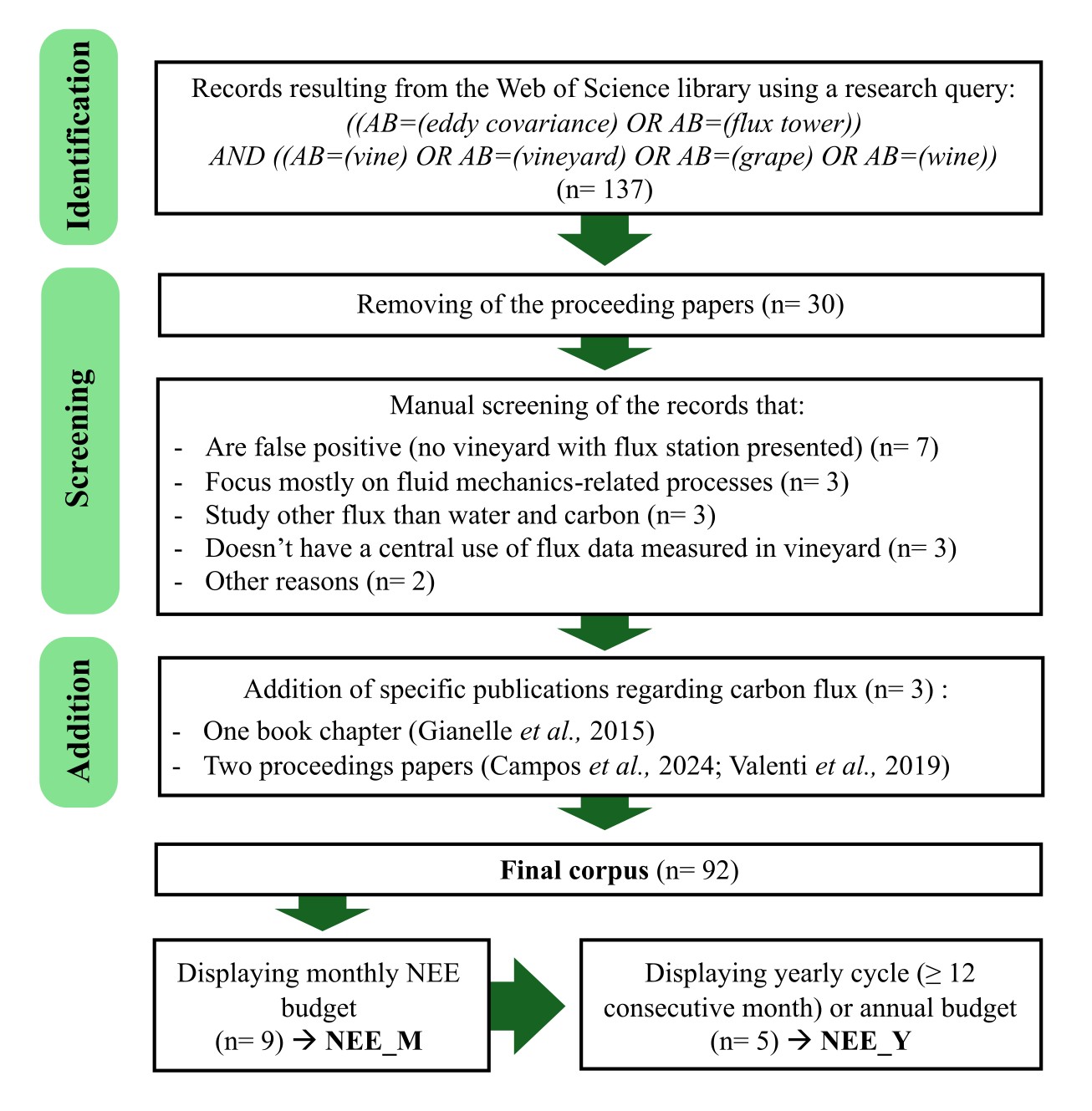
Figure 1. Diagram of the review methodology.
The final corpus consists of 92 papers published between 2000 and early 2025, with 47 different vineyards identified. The full list of references is provided in Supplementary Material S1.
In addition to the qualitative review of the corpus, we conducted quantitative analyses only for carbon fluxes because key information required for water flux analyses, such as ET seasonality as well as precipitation and irrigation data, was often missing. To that end, we extracted monthly NEE values from the corpus, manually for data reported in text or tables and with the R (4.4.2) package juicr (doi.org/10.32614/CRAN.package.juicr) for values presented in figures. This dataset was supplemented with monthly and yearly cumulative NEE values (NEE_VUT_REF) of two flux stations: the ICOS IT-Lsn (2016–2023) and FLUXNET IT-Arz (2018–2022) sites. A high-quality check was applied (NEE_VUT_REF_QC < 0.8), excluding periods for which less than 80 % of the underlying half-hourly data were either directly measured or filled with high-confidence gap-filling (Mauder & Foken, 2011). As a result, the 2021 and 2020 data of the respective datasets were discarded. The AmeriFlux US-Nsa dataset (Davis, 2026) was not retained because it contained too many missing values.
To conduct the quantitative analysis, two datasets were created (Figure 1). The first, NEE_M (Table 1), contains a total of 190 monthly NEE values measured in seven different sites mostly located in Italy (88 %), reflecting mainly humid subtropical (73 %) and Mediterranean (15 %) climates according to the Köppen–Geiger classification (Kottek et al., 2006). This dataset assesses the abiotic factors of NEE using ERA5-Land reanalysis data (Muñoz-Sabater et al., 2021) retrieved at the nearest 9 x 9 km grid point for each site. The second dataset, NEE_Y, is a sub-selection of the first and corresponds to four Italian sites providing at least 12 consecutive months (Lazio-MO, Sardinia-VE, Veneto-SB and Lombardy-C), supplemented with a single annual value (Mezzolombardo-TR; Table 1). It is used to compare NEE annual budgets across different ecosystems in the 35°N–45°N band. To that end, we used the FLUXNET2015 database (Pastorello et al., 2020) and computed the annual budget of each ecosystem (following the IGBP typology) by considering quality-checked data (NEE_VUT_REF_QC < 0.8). The NEE_Y is then used to discuss the NEE annual cycle across the different climate classes.
Site identifier | Localisation | Köppen–Geiger class | Grape variety | Period | Monthly data extracted (n) | Sources | Data-extraction method |
|---|---|---|---|---|---|---|---|
Lazio-MO* | Italy, Lazio (not provided) | mediterranean | Montepulciano | August 2014 to July 2015 | 12 | Chiriacò et al. (2019) | Median values given in Table 7 |
Sardinia-VE* | Italy, Sardinia (39°21′43″N, 9°07′26″E) | mediterranean | Vermentino | June to September 2009 | 4 | Gianelle et al. (2015) | Cumulative values extracted from Figure 11.8 line plot |
October 2009 to September 2010 | 12 | Marras et al. (2015) | Cumulative values given in Table 3 | ||||
Veneto-SB* | Italy, Veneto (45°44′25.80″N, 12°45′1.40″E) | humid subtropical | Sauvignon blanc | May to September 2014, 2015, 2016 | 10** | Vendrame et al. (2019) | Cumulative values given in Table 1 |
January 2015 to April 2016 | 16** | Tezza et al., (2019) | Cumulative values extracted from Figure 5 bar plot | ||||
November 2016 to December 2017 | 14 | Valenti et al. (2019) | Cumulative values extracted from Figure 2 bar plot | ||||
January to December, 2016-2023 without 2021 | 84*** | ICOS IT-Lsn (Pitacco et al. 2025) | Data obtained from the ICOS carbon portal. | ||||
Lombardy-CH* | Italy, Lombardy (45°37′8.47″N, 10°0′8.2″E) | humid subtropical | Chardonnay | October 2016 to December 2017 | 15 | Valenti et al. (2019) | Cumulative values extracted from Figure 2 bar plot |
January to December, 2018-2022 without 2020 | 48*** | FLUXNET IT-Arz (Canton et al. 2025) | Data obtained from the ICOS carbon portal. | ||||
Mezzolombardo-TR* | Italy, Trentino-Alto Adige (46°11′49.2″N, 11°6′50.4″E) | oceanic | Teroldego Rotaliano | 2009 | 0 | Gianelle et al. (2015) | Annual budget given in text (section 11.1.2). |
Slovakia-RC | Slovakia, Tekov (48°16'22'' N, 18°22'35'' E) | oceanic | Riesling/Cabernet Sauvignon | April to September 2022 | 6 | Badraghi et al. (2023) | Mean values extracted from Figure 3a bar plot |
China-PN | China, Gansu (37°51′ N, 102°53′ E) | arid | Pinot noir | June to September 2017, 2018 | 8 | Gao et al. (2019) | Mean NEP (= -NEE) values given in Table 2 |
Mexico-SH | Mexico, Coahuila (25° 26' N, 102° 1' W) | semi-arid | Shiraz | April to December 2018 | 9 | Zermeno-Gonzalez et al. (2015) | Daily cumulated values given in Table 1 |
Total= | 238 |
For simplification, some Köppen–Geiger climate classes were aggregated: mediterranean = Csb + Csa; semi-arid = BSh + BSk; arid = BWh + BWk. *: Sites also included in NEE_Y. **: The May to September 2015 values of Vendrame et al. (2019) were discarded because of overlap with Tezza et al. (2019) data. However, the NEE values of both are relatively similar (mean difference = 0.02 g C m-2 month-1). ***: data not used for the ERA5-Land climatic factors analysis as more confidence was given to the data provided from peer-reviewed publications.
Corpus overview
1. Main topics
A word frequency analysis of the titles of the 92 studies in the corpus was performed to identify the main research topics. Most studies focused on water fluxes, with 54 occurrences of the terms “water” and “evapotranspiration”. These publications especially investigate irrigated vineyards (9.8 % occurrences of “irrig-") in regions where water resource management is a major challenge (16 occurrences of "arid", "california”, and “mediterranean”). Several publications used ET measurements from flux stations to validate alternative measurement systems (e.g., 4 occurrences of “surface-renewal”) or to calibrate water flux models (33.7 % occurrences of “model” and related words). In contrast, carbon flux studies were less prevalent in the corpus (9.8 % occurrences of “carbon” or “CO2”), meaning lower scientific attention to this topic during the period under review. A few studies addressed both variables simultaneously through the Water Use Efficiency (“WUE”, 4.3 % occurrences), defined as the ratio of carbon and water fluxes (Tallec et al., 2013).
Based on this analysis, the corpus was classified into three categories according to the main topic: water fluxes, carbon fluxes, and WUE. Figure 2 show the locations of the vineyards and publication dates, according to these three categories. Studies on water fluxes were the first to be published and the most numerous (81 %), as well as geographically widely distributed. Most study sites were in arid regions heavily reliant on irrigation (e.g., Chile and southern Europe). There is especially a strong density of flux stations in California, all related to the Grape Remote Sensing Atmospheric Profile and Evapotranspiration eXperiment project (GRAPEX; Kustas et al., 2022). Water-related studies dominate for the whole studied period, highlighting the importance of efficient water resource management in arid and climate change contexts. Studies dedicated to carbon fluxes, or including also WUE, were more recent and represent only 13 % and 5 % of the corpus, respectively. These emerging topics reflect the actual growing interest of the scientific community toward viticulture as a climate change mitigation and adaptation solution. Most of the carbon-related studies were conducted in Italy (9 across 7 sites), several of which were part of the CarboItaly project (2007–2010), which aimed to assess the carbon uptake potential of various Italian ecosystems (Papale, 2006; Vendrame et al., 2019). These viticultural sites are located in various pedoclimatic regions, including areas near and within the Alps (Callesen et al., 2023; Campos et al., 2025) and Sardinia (Marras et al., 2015). Studies on WUE concentrated in Gansu province, China (Gao et al., 2019; Li et al., 2015; Zhang et al., 2024), except for one study focused on the Italian Tyrol (Campos et al., 2024). In addition to the above, six flux stations were identified, located in two USA states (California: AmeriFlux US-Nsa; New-York; see Covert, 2019) and two French viticultural regions (Bordeaux and Burgundy).
Vineyards providing monthly NEE budgets (included in NEE_M) are triangle-shaped, and square-shaped when 12 consecutive values or more are available (included in NEE_Y). Veneto-SB (IT-Lsn) is indicated with a star; the relief map illustrates the difference in elevation. The bottom-right bar plot displays the year of publication per publication, and the histogram colours represent the category of the corpus.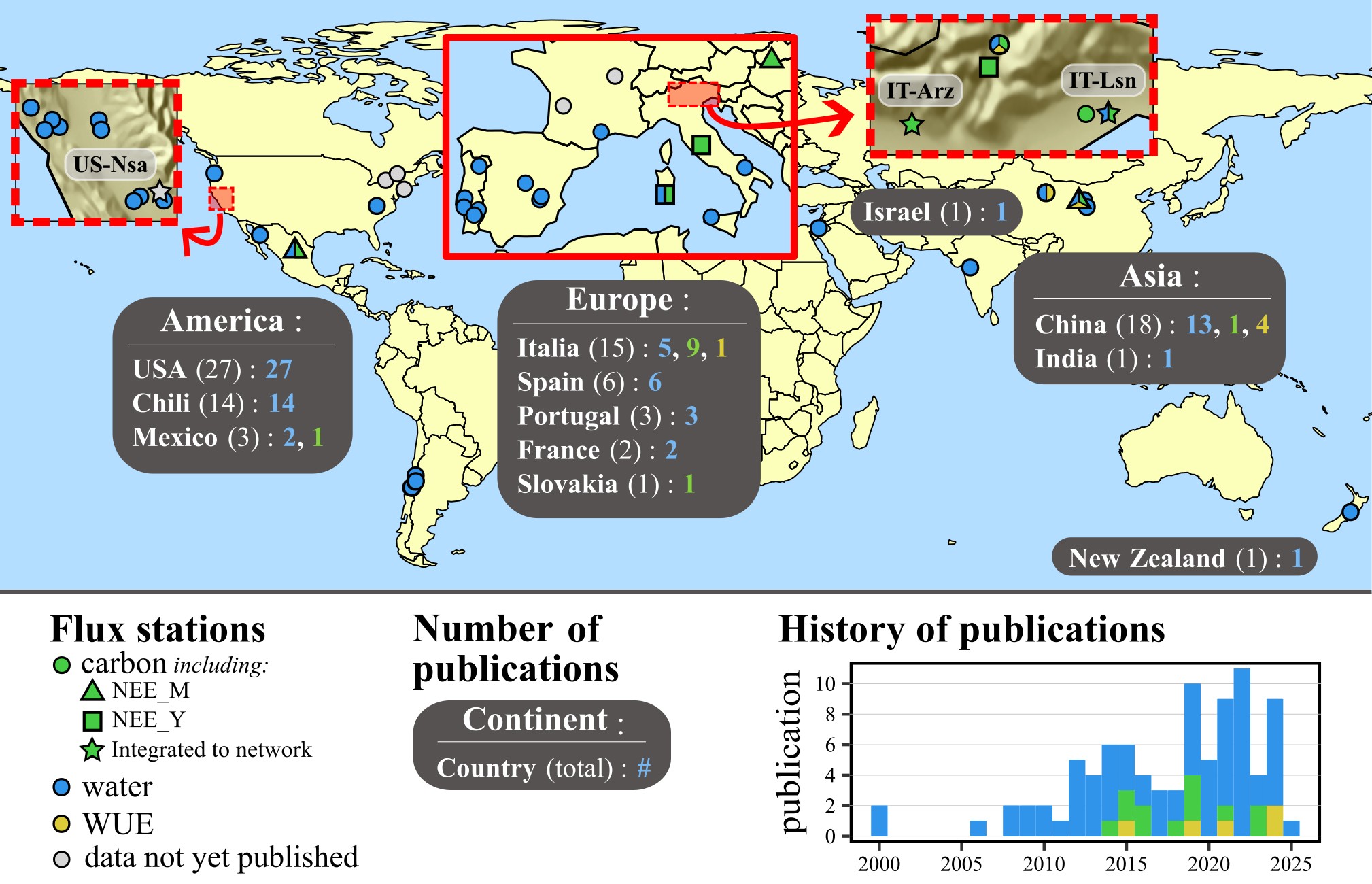
Figure 2. Location of the flux stations, respective number of publications per country and chronology of publications per topic category.
2. Vineyard characteristics
The distribution of the sites across many pedoclimatic regions implies differences in the vineyard’s features, as shown in Figure 3. The “water” sites are mostly located in regions with limited water resources, especially in the Mediterranean, and are more scattered in semi-arid and arid regions (Figure 3a). These sites had an average planting density of 3,306, 2,297, and 3,214 vines ha-1, respectively (Figure 3b). Low-density planting is a well-known strategy to reduce hydric competition between vines (Wang et al., 2025). The "carbon" sites are located mainly in contexts where rainfall is distributed more throughout the year (oceanic and humid subtropical regions; Figure 3a). They exhibit a higher mean planting density (3,911 and 5,287 vines ha-1; Figure 3b) compared to arid regions. The three “WUE” sites were too few to identify common characteristics. Across the corpus, the dominant vine planting setting was vertical shoot positioning (VSP), with a mean maximal canopy height of 2 m.
a: For simplification, some climate classes were aggregated: Mediterranean = Csb + Csa; semi-arid = BSh + BSk; arid = BWh + BWk. b: The boxplot indicates the planting density of the sites grouped by Köppen-Geiger classes. The Kruskal–Wallis comparison of these groups is shown in bold letters, with similar letters indicating non-significant differences (p-value < 0.05).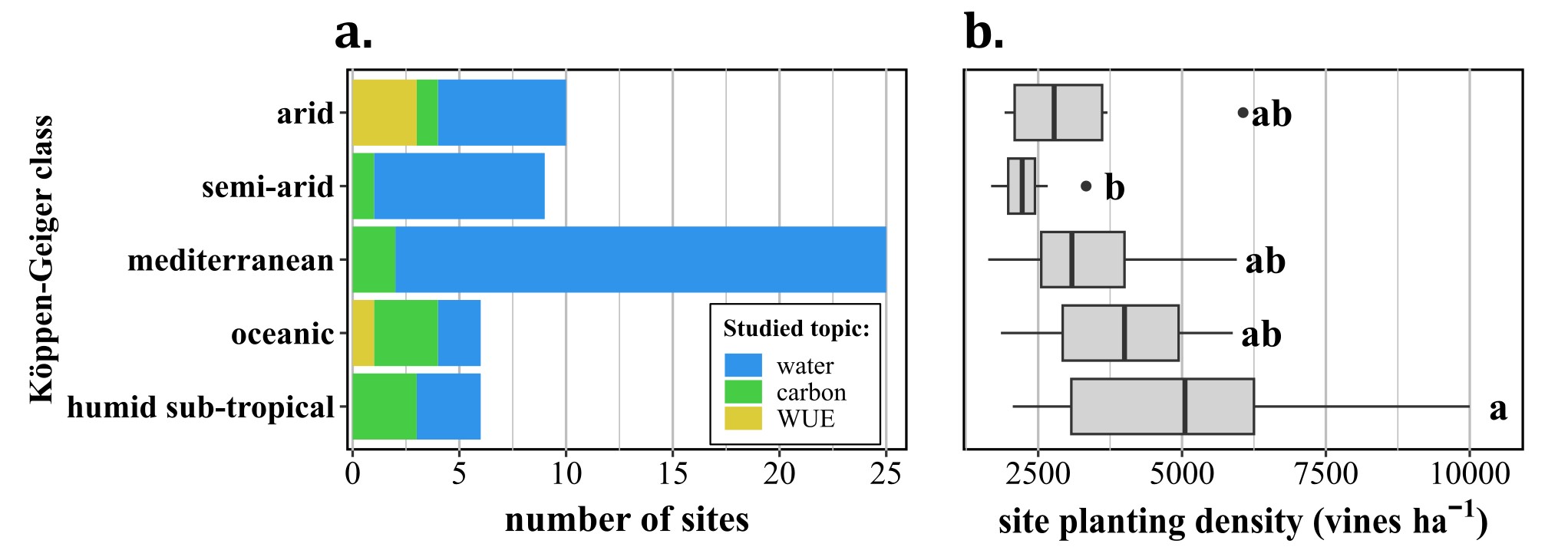
Figure 3. Characteristics of the studied vineyards in the corpus: Köppen–Geiger climate classes (a) and planting density (b).
The studied vineyards also displayed a wide range of grape varieties (Figure 4), though those requiring warm climates were overrepresented (e.g., 11 sites with Cabernet-Sauvignon, 3 with Syrah, and 3 with Sangiovese; Jones et al., 2012), mirroring the predominance of arid to Mediterranean environments in the corpus. This also explains the numerous studies focused on grape varieties (n = 6), such as Thompson seedless (n = 3).
These first insights revealed disparities among research topics, with a predominance of water flux studies compared to the emerging topics of carbon flux and WUE. Most of the vineyards investigated are located in hot and dry regions, with planting configurations adapted to these climate conditions. In contrast, few studies addressed vineyards outside this context, such as high-density plantations in northern Europe, which remain underrepresented despite their economic importance and renowned terroir.
Data are displayed in 2.5 ° latitudinal bins. Occurrences > 1 are indicated with numerical values. For non-table grape varieties, the colours indicate the main type of wine produced (red or white). The grey margin barplots indicate the total number of sites per latitudinal bin (y-axis) and grape varieties (x-axis).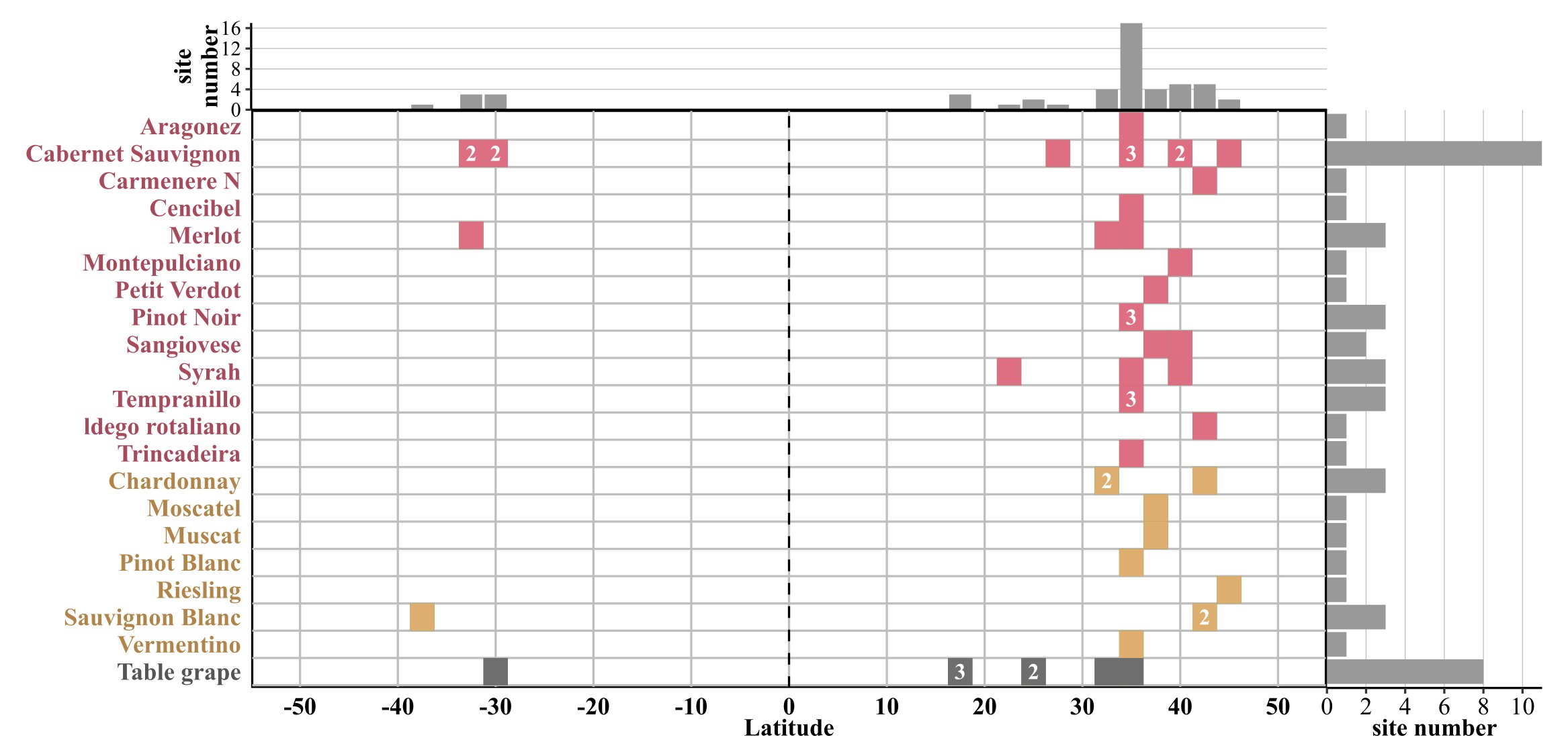
Figure 4. Overview of grape varieties by site latitudes.
3. Flux stations settings
A wide range of equipment measured water and carbon fluxes. Most gas analysers measured CO2 and H2O concentrations simultaneously, allowing computation of both water and carbon fluxes. Such analysers were used in around 57 % of the "water" studies, yet CO2 data were not reported. This implies that many vineyard stations could be mobilised to investigate carbon sequestration dynamics across different pedoclimate contexts (Figure 2).
The height of the flux station is a critical parameter, as it determines the surface area contributing to the measurements, i.e., the station footprint (Leclerc, 2014). The instruments in the corpus were set at an average height of 3.8 m (standard deviation = 1.1 m), corresponding to a footprint radius of ~380 m using a 1:100 rule of thumb (Burba, 2022).
Most studies assessed the quality of their instrumental setup by evaluating vineyard energy–balance closure. This approach compares turbulent heat fluxes (i.e., latent heat flux, LE, and sensible heat flux, H), measured by flux station instruments, with available energy (i.e., net radiation, Rn, and ground heat storage, G), measured by independent sensors. Additional energy storage terms (e.g., canopy heat storage) exist but are often neglected, assuming a minor contribution to the overall energy balance. The Energy Balance Ratio (EBR; Wilson et al., 2002b) is commonly used to quantify this closure, expressed as follows (Equation 1):
A value of 1 indicates perfect closure of the EBR budget. In practice, closure is rarely achieved due to various factors such as technical limitations of instruments, negligence of other energy fluxes, site configuration, and uneven sampling of turbulence (Foken, 2008; Wilson et al., 2002b). Across all measurement periods, the studies in the corpus reported an average EBR of 0.86 (standard deviation = 0.1), which is considered reasonable and comparable to values observed in other ecosystems worldwide (Mauder et al., 2024). Many “water” studies relied on corrections to account for energy imbalance issues (Twine et al., 2000). The most commonly used methods are the residual and Bowen ratio (β) approaches, which consist of closing the energy balance by filling it with only LE, or both LE and H, according to their relative contribution to β. The adequate method is chosen relative to the site characteristics.
Main results of the studies
This section summarises the results of the publications by category, i.e., water, then carbon fluxes and WUE.
1. Water fluxes
The increase in atmospheric evaporative demand, induced by climate warming, compels winegrowers to optimise water resource management, especially in arid regions. In this context, flux station measurements provide a very good understanding of the amount of energy converted into evapotranspiration in irrigated vineyards, measured as latent heat (LE = ET in energy units). The integration of complementary instruments (e.g., sap flow sensors and lysimeters) also allows the partitioning of ET between vine transpiration in planting rows and soil evaporation in interrow (with or without herbaceous vegetation). This makes possible the identification of the main drivers of these fluxes, the testing of ET spatialization strategies, and the validation of more accessible instrument systems.
1.1. Partitioning of net radiation
Key aspects addressed in “water” studies include how available energy (i.e., Rn-G) is converted when reaching the vineyard surface. In particular, the fraction transformed into latent heat (LE), which corresponds to ET = LE.λ-1, where λ is the latent heat of vaporisation. The Bowen ratio (β = H/LE; Bowen, 1926) is the most widely used metric to describe this partitioning. Under non–water-limited conditions, the ratio declines linearly as evaporative demand increases (Wilson et al., 2002a), making it a suitable agricultural indicator relative to plant hydric stress. During the vine growth period, three studies of the corpus have reported monthly averaged β close to 1 (i.e., H = LE) in irrigated vineyards located in the province of Gansu, China (Gao et al., 2020; Li et al., 2009; Zhao et al., 2017). These studies report Bowen ratios ranging from 0.65 to 1.2, with an overall mean of 0.84, indicating that 57 % of the available energy was used for ET. This value is close to the full-annual averages reported for annual crops in the FLUXNET2015 database (β = 0.85), which are among the few ecosystems showing mean values below 1 (e.g., forests range from 1.42 to 2.25; Lin et al., 2022). However, Chen et al. (2024) reported lower values in another vineyard located in the same region (β = 0.14 and 0.25, i.e., 89 % and 80 % used for ET), despite similar climatic conditions and irrigation regimes. These differences are attributed to vineyard planting systems, i.e., VSP versus the single pergola system. The latter likely enhances ET by (i) increasing vine transpiration through greater leaf exposure (as β is negatively correlated with leaf area index: Gao et al., 2020; Zhao et al., 2017), and (ii) increasing soil water availability due to interrow shading under the trellised canopy. There is also a strong seasonal variability in β, driven by water availability, vine phenology and atmospheric evaporative demand (Gao et al., 2020; Li et al., 2009; Zhao et al., 2017). Using 4 years of measurements in a furrow-irrigated vineyard, Zhao et al. (2017) reported a clear U-shaped pattern, similar to that observed in many northern hemisphere ecosystems, although with a different magnitude (Lin et al., 2022). Prior to budbreak, H dominates (β > 1). After budbreak, β decreases sharply as atmospheric evaporative demand increases, and the vine develops its leaf area. When the canopy achieves its maximum development, β stabilises around 0.5 (= 67 % used for ET), reflecting a balance between available energy and non-limited evaporative processes. The sustained evaporative regime is maintained by irrigation, which plays a key role in controlling energy partitioning. In this context, drip irrigation appears more effective than furrow irrigation in reducing β (Gao et al., 2020).
Advection of heat and energy fluxes can affect the local evaporative demand, with potential impacts on EBR and β. In summer, when a strong thermal gradient exists between two adjacent ecosystems (e.g., a relatively cool irrigated vineyard and a relatively hot grassland), heat is advected toward the cooler site. These episodes are frequent in vineyards, particularly those located in arid and heterogeneous agricultural regions (Kustas et al., 2022). Heat advection introduces two main issues. First, the supply of hot and dry air increases atmospheric evaporative demand, leading to higher water loss through LE in irrigated vineyards. Chen et al. (2024) showed that nighttime irrigation reduces these losses by limiting thermal gradients compared with morning irrigation. Second, lateral heat advection increases EBR because most methods only measure vertical fluxes. This leads to strong uncertainty in LE calculations (Bambach et al., 2022; Chen et al., 2024) when LE is measured by various non-EC approaches relying on LE as a residual of energy balance. All these results highlight β and EBR as a comprehensive indicator for adaptive strategies applied in vineyards.
1.2. Evapotranspiration partitioning
Partitioning ET into vine and grass transpiration (T) and soil evaporation (E) is another active research focus, but the EC technique cannot directly disentangle these two components. To make this possible, complementary instruments are needed, such as micro-lysimeters for E and sap-flow systems for vine transpiration (Tvine). Generally, a high T/ET ratio is targeted because it indicates that the vine uses most of the available water rather than losing it through E. Studies of the corpus consistently showed that T is the dominant water flux in arid vineyard ecosystems, although not to the same extent. Its contribution to ET ranges from 56 to 86 % during the vegetative period (Campos et al., 2025; Gao et al., 2019; Kool et al., 2016; Zhang et al., 2024; Zhao et al., 2017). Zhao et al. (2017) further demonstrated that Tvine accounts for most of ET. However, in some cases, E can exceed T when soil water content is high, particularly under generous irrigation practices such as furrow irrigation (Zhao et al., 2018). A strong relationship was also reported between interrow water flux and soil water content under both bare soil conditions (ET = E; Kool et al., 2016) and with cover crops (herbaceous T increases strongly after a rainy event; Campos et al., 2025). In contrast, Tvine is less directly driven by soil water reserves, although prolonged water stress can inhibit vine–atmosphere H2O exchange, sometimes irreversibly (Shtai et al., 2024). Campos et al. (2024) reported strong diurnal variations in the Tvine/ET ratio under drought, as the Tvine contribution to ET changes from > 75 % to < 25 % between the morning and late afternoon because of stomatal closure.
Overall, these results, combined with the previous findings regarding β, highlight the importance of a precise irrigation system focused on vine rows to avoid water losses. These findings also call for further investigations into the specific impact of the vine's biological mechanisms on vineyard water fluxes, a topic that remains poorly addressed in the corpus. In particular, canopy conductance has been identified as a key driver of Tvine/ET, explaining 50 % of its seasonal variability at the daily timescale and up to 90 % at the monthly timescale (Zhang et al., 2024).
1.3. Toward more accessible methods to estimate ET
Monitoring ET represents a major challenge for viticulture. This is true for both irrigated regions, where optimising water inputs is crucial, and non-irrigated regions, which are becoming increasingly vulnerable to severe droughts due to climate change. Another challenge is the high-resolution spatialization of ET, as it is modulated by factors such as topography, soil properties, and exposure, which can vary greatly across and within vineyards. Several studies in the corpus have used flux station measurements to develop and validate more affordable alternatives for estimating ET.
Commonly used alternatives to the EC-based measurements from flux stations indirectly derive ET as a residual of the energy balance equation by measuring its other major components, mainly Rn, G, and H. Rn and G can be measured with dedicated instruments, e.g., a radiometer and soil heat flux plates. For H, we tested two methods and compared them with ET measured directly by flux stations: scintillometry and surface renewal. Scintillometry, a relatively expensive method, analyses the scattering of an optical signal by turbulence above the canopy to measure H. It provides reasonable mesoscale ET data over flat terrain (Perelet et al., 2022; Vendrame et al., 2020). The surface-renewal method, more affordable, uses rapid temperature changes at a single point to estimate local H, without needing specific temperature ramp calibration for vineyard conditions (Parry et al., 2019; Shapland et al., 2012; Tosoni et al., 2021). However, both methods remain relatively inaccessible for routine use. Another alternative to flux station measurements is the Micro Bowen Ratio (MBR) system. The MBR system applies the β ratio at the microscale to derive H and ET (Hossein Ashktorab et al., 1989). It is relatively inexpensive, easy to deploy, and well-suited for small plots, but still requires multiple MBR units to capture the spatial heterogeneity of vineyard ecosystems adequately (Holland et al., 2013; Kustas et al., 2019). The main drawbacks to these alternatives compared with EC-based flux stations are: (i) the absence of direct measurements of water vapour transport, (ii) their strong sensitivity to advection, and (iii) the neglect of other energy storage terms (e.g., canopy heat storage) in the overall energy balance equation. Because ET is estimated from the residual of such an equation, all the closure errors may manifest as errors in ET. This poses a major issue in viticulture, which is commonly subjected to frequent advective episodes in summer.
One other option is to calculate ET using modelling. The FAO Penman-Monteith (FAO-PM; Allen et al., 1998) has been widely used. This model estimates potential evapotranspiration (PET) based on commonly measured climatic variables, such as net radiation, air temperature, and wind speed. PET represents the ET of a well-watered, homogeneous reference grassland. ET for a specific crop can then be approximated by applying a crop coefficient (Kc) to the PET as follows (Equation 2):
Although Kc values for vineyards have been reported in the literature, they were obtained under very specific pedoclimatic and viticultural conditions (Allen et al., 1998). ET measurements from flux stations enable the determination of reliable, site-specific Kc values that winegrowers can use to estimate vineyards' ET easily. For example, this approach has been implemented in Portugal (Ferreira et al., 2012), Mexico (Er-Raki et al., 2013; Zermenio-Gonzalez et al., 2017), and Chile (Villagra et al., 2014).
More complex process-based models can also estimate ET without a flux station. These models account for vineyard ecosystem heterogeneity at two levels of complexity. Two-source models simulate vine and soil water fluxes (Li et al., 2014; Ortega-Farias et al., 2006), while three-source models also include under-row fluxes (Montes et al., 2014; Poblete-Echeverría & Ortega-Farias, 2009). 22 studies in the corpus applied spatial upscaling methods with remote imagery (i.e., satellite, aircraft and drone) to improve ET model prediction compared to flux station measurements (e.g., in Aboutalebi et al., 2022). These spatialized modelling methods hold considerable potential for the development of future tools, either to assess global viticultural budgets or to investigate within-vineyard processes, e.g., the impact of different irrigation regimes on ET within a single vineyard (Burchard-Levine et al., 2025). Readers interested in more details on applications in vineyards are referred to the studies conducted as part of the GRAPEX project listed in Kustas et al. (2022).
In addition to process-based models, two recent studies from the corpus used data-driven modelling to estimate ET in vineyards with a high degree of accuracy (Fuentes et al., 2024; Garcia-Rodriguez et al., 2024). This approach relies on large datasets of flux station measurements and environmental variables from which statistical relationships are derived using machine learning.
2. Carbon fluxes
Studies on vineyard carbon fluxes have primarily focused on measuring the net ecosystem exchange (NEE). A negative NEE value indicates that the vineyard acts as a carbon sink (i.e., GPP > Reco), while a positive NEE means it is a carbon source (i.e., GPP < Reco). These studies aimed to (i) determine whether vineyard ecosystems function as carbon sinks or sources on an annual timescale, (ii) characterise the seasonal dynamics of NEE, and (iii) identify the main drivers of carbon flux.
2.1. NEE annual budget and temporal dynamics
With two exceptions, all sites reported negative annual NEE budgets, giving an average carbon sequestration of –117.6 g C m-2 year-1 (Figure 5a). The mean value of Veneto-SB is the lowest in terms of carbon uptake (–46.3 g C m-2 year-1). This site and Lombardy-CH also show strong interannual variability, including (i) positive budgets in 2019 (+135.5 g C m-2 year-1) and 2022 (+48.5 g C m-2 year-1), respectively, and (ii) two successive near-neutral budgets for Veneto-SB (–14.5 and –2.5 g C m-2 year-1 in 2016 and 2017). Figure 5b shows that, compared to other ecosystems, the five vineyards sequester carbon at comparable levels (p-value > 0.05) to grasslands (–22.3 g C m-2 year-1), shrublands and savannas (–105.6 g C m-2 year-1) or annual crops (–174 g C m-2 year-1), but less than forests (–333.4 g C m-2 year-1).
a: The NEE value of Veneto-SB for 2015* was provided by Tezza et al. (2019), and the others came from the ICOS IT-Lsn flux station, with the 2021 annual budget excluded due to quality issues. Valenti et al. (2019) provided the NEE value for Lombardy-CH for 2017*, and the others came from the FLUXNET IT-Arz flux station, with the 2020 annual budget excluded due to quality issues. The error bars of both sites show the associated random uncertainty of each annual budget (NEE_RANDUNC). The average NEE annual budget (indicated by a vertical red dashed line) was also computed for the whole period. b: The FLUXNET2015 data displayed in the boxplot are annual values averaged for the full period of study per site. The result of a Kruskal–Wallis comparison of these values across ecosystems is displayed in bold letters, with similar letters indicating non-significant differences (p-value < 0.05). The number of sites displayed in the boxplots (n) is indicated in italics. 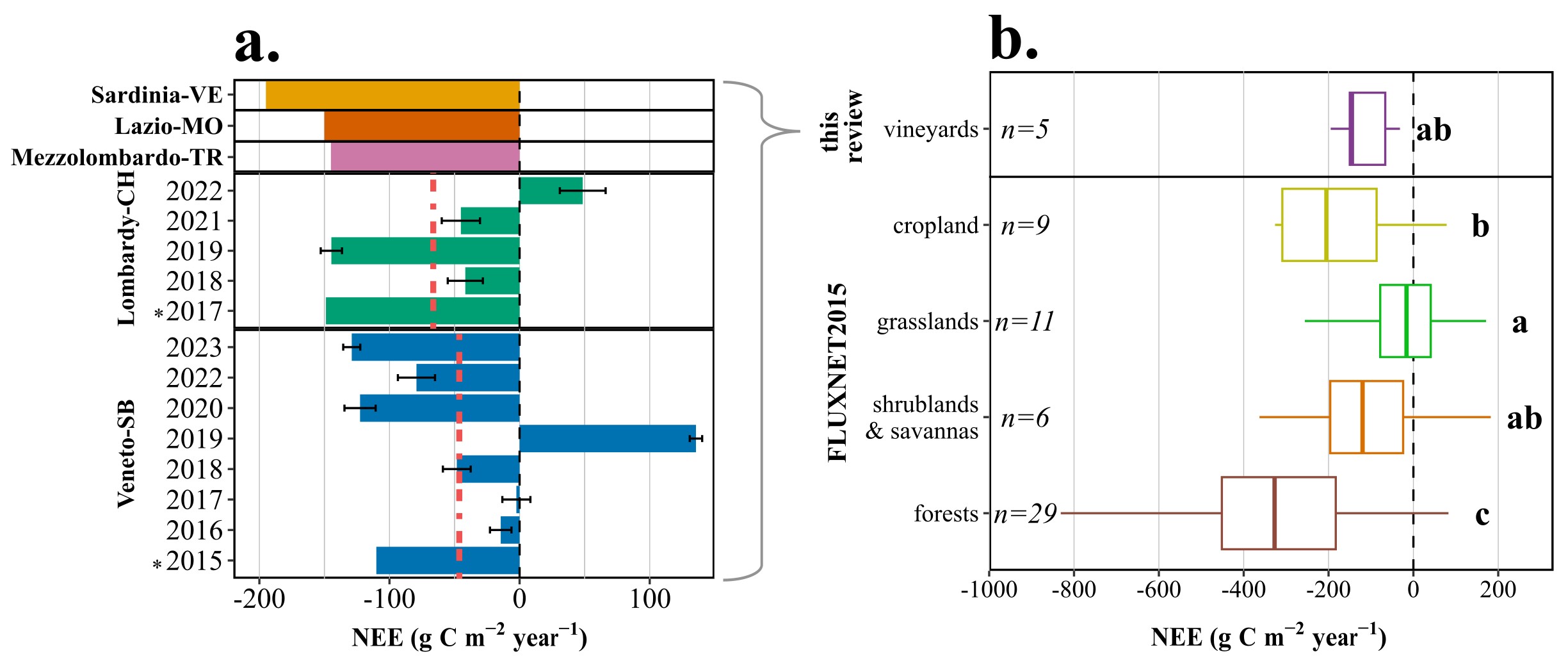
Figure 5. Annual NEE budgets from NEE_Y of (a) vineyards of the corpus, and (b) other ecosystems from the FLUXNET2015 database located in the 35–45°N band.
Beyond the annual NEE budget, the four studies that provide 12 consecutive monthly values (i.e., NEE_Y without Mezzolombardo-TR) reveal a marked seasonality (Figure 6a). The pattern is comparable to that of other extratropical ecosystems such as deciduous forests, with a V-shaped pattern (e.g., Ullah et al., 2025). Vineyards act as carbon sinks in summer due to active photosynthesis (NEE < 0), and as carbon sources in winter during vine dormancy (NEE > 0). The end of the uptake period occurs in mid-autumn across sites, while its onset varies from early spring to early summer depending on local conditions.
b. Data for (i) 2015* were from Tezza et al. (2019), and (ii) 2016-2023 are provided by the ICOS IT-Lsn flux station, with 2021 discarded due to quality issues. c. Data for (i) 2017* were from Valenti et al. (2019) and (ii) 2017–2022 are provided by the FLUXNET IT-Arz flux station, with 2020 discarded due to quality issues.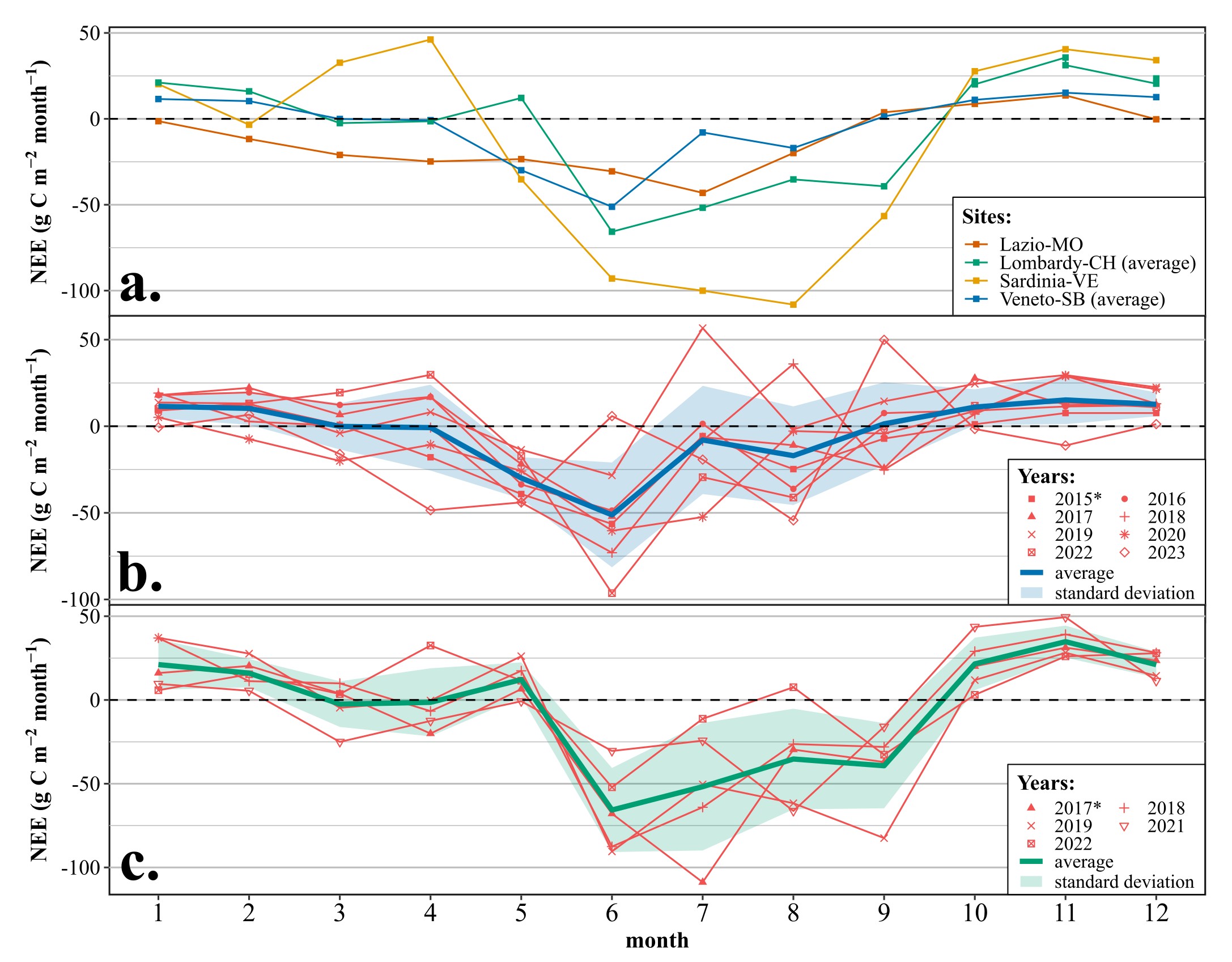
Figure 6. NEE seasonal cycle from (a) publications of the corpus, (b) Veneto-SB and (c) Lombardy-CH.
Only two sites from the corpus, Veneto-SB and Lombardy-CH, allow the examination of NEE interannual variability (Figure 6b and 6c). The onset of carbon uptake differs between the two sites, occurring later for Lombardy-CH (May–June) than Veneto-SB (April–May). This delay does not appear to be driven by varietal phenology, as Chardonnay (Lombardy-CH) is generally documented as an early-budbreak cultivar compared to Sauvignon blanc (Veneto-SB; Zapata et al., 2017). Climate also does not seem to explain this, as air temperatures were comparable between the two sites during the pre-budbreak period. This difference may instead reflect site-specific cultural practices (e.g., later pruning at Lombardy-CH) or ground cover management (e.g., inter-row grass cover at Veneto-SB). However, this information was not reported for both sites, preventing a robust conclusion.
Apart from this difference, the overall seasonal cycle of NEE is broadly consistent between the two sites and years. However, interannual variability is significant in summer, with standard deviation of monthly NEE reaching up to ~30 g C m-2 month-1 at both sites. Relative to the mean summer carbon uptake (–25.4 and –51 g C m-2 month-1 at Veneto-SB and Lombardy-CH, respectively), this variability represents 66 and 59 % of the mean flux magnitude and is thus sufficient to reverse the sign of NEE during some months. These results explain the high variability of the NEE annual budgets previously observed (standard deviation = 87.9 and 82.4 g C m-2 year-1 for Veneto-SB and Lombardy-CH, respectively; Figure 5). More multi-year data are required in different contexts to characterise this variability better.
2.2. Climate influence on NEE
Most “carbon” studies in the corpus investigated the influence of meteorological variables on NEE. These studies consistently identified global radiation (i.e., the primary driver of photosynthesis; Zermeno-Gonzalez et al., 2015), air temperature, vapour pressure deficit (VPD; Badraghi et al., 2023; Guo et al., 2014), and soil water content (Tezza et al., 2019; Vendrame et al., 2019) as the main drivers of the NEE annual cycle in vineyard ecosystems. Among these factors, VPD and soil water content emerged as critical constraints on carbon sequestration during hot and dry compound events. High VPD combined with low soil water content is often associated with stomatal closure, which prevents gaseous exchange (Shtai et al., 2024). Wong et al. (2022) also identified short-term stressful events at their site through abnormal drops in GPP.
To better understand these processes and explore them across a more pedo-climatically diverse dataset, Figure 7 presents relationships between NEE and global radiation, VPD, or soil water content. Incoming solar radiation emerges as the strongest climatic driver, with a near-linear relationship explaining 57 % of the seasonal variability in NEE (Figure 7a). This pattern largely reflects differences among climatically contrasted sites (from humid subtropical, n = 55, to Mediterranean, n = 28) and primarily captures large-scale seasonal energy forcing. In contrast, VPD shows a non-linear influence on NEE (adjusted R2 = 0.50), with carbon sequestration increasing with VPD up to approximately 4 hPa month⁻¹, followed by a decline at higher atmospheric demand (Figure 7b). This threshold-like behaviour is most evident in arid, semi-arid, and Mediterranean contexts, whereas the relationship appears closer to linear in humid subtropical sites, likely due to non-limiting water availability. Soil water content is the least explanatory variable (adjusted R2 = 0.26; Figure 7c). A second-order polynomial model did not improve the fit compared to the linear model (adjusted R2 = 0.26; not shown), highlighting the weak explanatory power of this variable in our dataset. This result is also influenced by large site-to-site differences in soil moisture regimes and the heterogeneous SWC gradient across the dataset. The existing literature further supports a complex relationship between soil moisture and NEE that cannot be fully captured by simple regressions applied to modelled climatic variables, which likely explains the limited performance observed here.
Despite the simplicity of the approach and the use of ERA-Land reanalysis, these results highlight the value of an open-access, multi-site, standardised dataset. It should be noted that in situ climatic data are not provided in the "carbon" studies of the corpus, which explains the use of reanalysis products in this context. A larger observational network would enable more detailed analyses, particularly of interannual variability and ecosystem responses to extreme climatic events, which are expected to increase in frequency under climate change (IPCC, 2023).
The grey area shows the 95 % confidence interval of the regressions. Colours indicate the membership of a site to a Köppen–Geiger class (see Figure 3 for details). The violin plots in the top part of the figure display the distribution of ERA5-LAND climatic values extracted at each site within a Köppen–Geiger class. The respective number of monthly NEE data (n) accounted for is given on the y-axis. The text in the bottom panels displays the equation of the model together with the adjusted coefficient of determination (R²adj) and the p-value (P).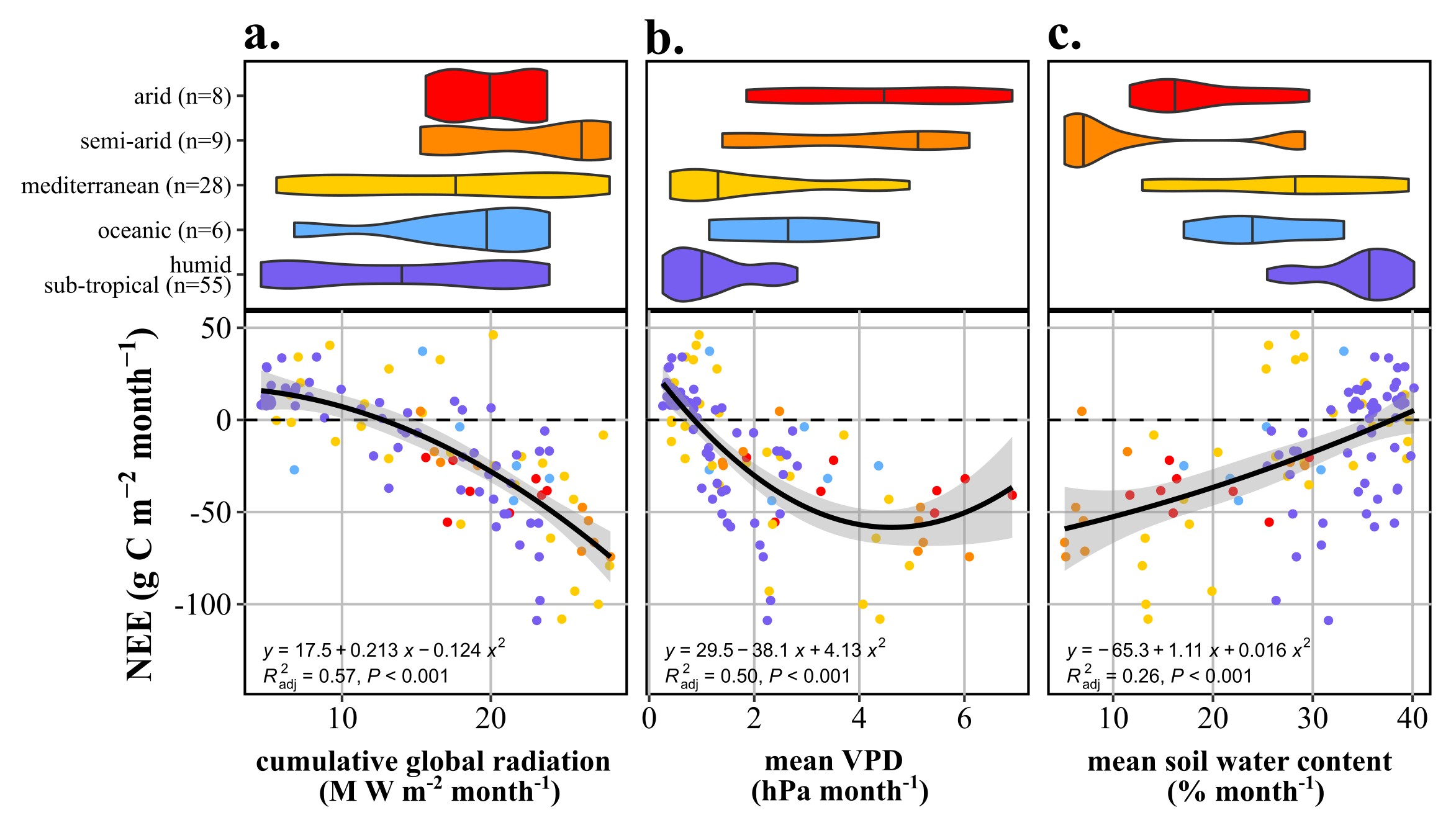
Figure 7. Second-order linear polynomial regressions between monthly NEE from NEE_M and (a) cumulative global radiation, (b) VPD, and (c) soil water content of the first layer.
Vineyard NEE is also indirectly driven by climate through its influence on vine phenology. For example, the onset of vine carbon uptake relies on the bud break date, which depends on the variety-specific chilling requirement and its satisfaction, as well as on average air temperature at the end of dormancy (Zapata et al., 2017). Anomalous cool winter-to-spring transition may delay the carbon uptake period. Conversely, abnormally warm springs accelerate the vegetative processes and increase the risks of late frost, which causes temporary/permanent damage to leaf-related organs. According to Valenti et al. (2019), the occurrence of such an episode in winter 2017 explains the persistence of a near-neutral NEE monthly budget measured in spring at Lombardy-CH (Figure 6c).
2.3. Influence of viticultural practices on NEE variability
Viticultural practices, such as soil management and organic amendment addition, influence vine phenology (Poni et al., 2022) and the dynamics of soil organic matter (Payen et al., 2021). They also directly and indirectly affect the CO2 fluxes of the vine (Poni et al., 2008). However, the impact of these practices on carbon fluxes has been little investigated in the literature (e.g., Tezza et al., 2019). This gap is likely due to the difficulty of disentangling the effects of management from the effects of climate when relying on a single flux station and to the limited temporal coverage of data.
Nevertheless, some studies in the corpus provide initial evidence of such impacts. Marras et al. (2015) reported that the strong carbon release observed at the Sardinia-VE site in March and April (Figure 6a) may be related to soil tillage, which (i) removed the interrow vegetation, thereby affecting the vineyard GPP, and (ii) increased Reco via heterotrophic respiration from soil microorganisms. Maintaining grassed interrows was frequently highlighted in the corpus as a key management practice to enhance carbon sequestration (Scandellari et al., 2016; Tezza et al., 2019), particularly during vine dormancy when photosynthesis by adventive and sowed plants is still active (see winter sequestration at the Lazio-MO site in Figure 6a). Callesen et al. (2023) estimate that grassed interrows accounted for 60 % of the annual carbon uptake of a mountainous vineyard. Additionally, these intermediate crops significantly increased soil organic carbon stocks through root rhizodeposition (McGourty & Reganold, 2005). This effect can be sustained through conservative soil management practices (Payen et al., 2021).
3. Water use efficiency
Only five studies in the corpus investigated the relationship between water and carbon fluxes using the WUE approach (Campos et al., 2024; Gao et al., 2019, Gao et al.,2021; Li et al., 2015; Zhang et al., 2024). A relatively high WUE indicates an efficient system, in which a large amount of biomass is produced with minimal water use. WUE is sensitive to the spatial scale considered (e.g., plant or plot; Tallec et al., 2013), which complicates comparisons across sites. Several studies computed an ecosystem-based WUE (i.e., WUEeco = NEE/ET or GPP/ET; Campos et al., 2024; Li et al., 2015), but its interpretation is difficult because it integrates diverse physical and biological processes (e.g., GPP, Reco, vine and grass transpiration, under and inter-row evaporation). WUE is more robust when applied at the plant scale (i.e., WUEplant = GPP/T with T: vine transpiration), although it requires complementary instruments such as sap-flow sensors (Gao et al., 2019; Zhang et al., 2024) or advanced water flux partitioning methods (Zahn et al., 2022).
However, the studies cited above identified strong relationships between climatic variables and WUE, which were mediated through their effects on carbon and water fluxes (e.g., global radiation, air temperature, wind speed, VPD, and soil water content). Water availability was identified as a key driver that affects water and carbon fluxes differently (Gao et al., 2019). When water is supplied through precipitation or irrigation, ET increases mainly due to E (since the latter is more sensitive than T to soil water content; see section 1.2). As a result, WUEeco decreases, reflecting a significant loss of water that does not contribute to vine productivity. For example, the average WUEeco during the growth period of the vine in an arid, heavily irrigated vineyard (160 mm of rain and 237 mm of irrigation) was estimated to be between 1.2 and 1.6 g C kg-1 H2O-1 (Gao et al., 2021; Zhang et al., 2024). In contrast, Campos et al. (2025) reported a higher value of 4.8 g C kg-1 H2O-1 in a less-watered mountainous site during a hot climatic event (226 mm of rain and 63 mm of irrigation).
Biotic factors have also been shown to influence WUEeco and WUEplant dynamics, as both GPP and T are closely linked to plant stomatal activity, especially leaf area index (LAI; Gao et al., 2019; Li et al., 2015) and canopy conductance (Li et al., 2015; Zhang et al., 2024). Gao et al. (2021) investigated the relative importance of biotic and abiotic factors on the seasonality of WUEeco and WUEplant. They found that both were primarily driven by LAI at the beginning and end of the vineyard growing season, and by abiotic variables (net radiation and soil water content) during the rest of the year, emphasising the limiting role of water on carbon yield. In controlled situations, Patono et al. (2022) showed that drought-recovered grapevines maximise carbon assimilation and its delivery to sinks, resulting in significantly higher amounts of newly fixed carbon compared to both irrigated and water-stressed ones. In the vineyard dynamics, this mechanism may substantially influence the timing of carbon uptake, calling for further in-situ investigation of how vine physiological mechanisms influence WUE.
In summary, WUE is a relevant variable to study the objective of increasing carbon uptake and reducing water use in viticulture. However, it may be complex to use depending on the application scale, i.e., vineyard or vine. Despite interesting results, especially regarding biotic factors, reliable conclusions of the studies remain difficult because of the lack of site diversity.
Discussions
1. Perspectives for water and carbon flux studies
Regarding water flux, a large part of the corpus has focused on variables measured in irrigated vineyards located in arid environments – many uncertainties thus concern rainfed settings where ET is mostly controlled by past precipitation. A huge part of these studies (~75 %) has mainly used the flux stations to develop and validate tools adapted to the specific characteristics of wine-growing ecosystems, e.g., row-inter-row structure. By focusing this review on the EC technique, it was impossible to discuss exhaustively all these alternative methods, especially regarding the numerous process-based models. Some of them are of high complexity, such as the Soil Vegetation Atmosphere Transfer tested in Montes et al. (2014), a three-source model coupled with the simulation of soil hydric balance. Such integrative approaches have considerable potential for ecosystem studies, but they require many input variables, including soil characteristics and climate data. Crop models such as APSIM (Holzworth et al., 2014) or STICS (Beaudoin et al., 2023; Valdés-Gómez et al., 2009) share similar advantages and limits but also take account of agricultural interventions, making these tools particularly well-suited to investigate agroecology transitions (e.g., Fraga & Santos, 2018). Another benefit of these models is their ability to represent plants' internal processes, thereby enabling the simultaneous simulation of water and carbon fluxes (for STICS, see Delandmeter et al., 2023). In this context, modelling WUE should be considered for future viticulture-related research (e.g., Chimonyo et al., 2016), as its relevance has been highlighted in the present review. Hence, the combined use of crop models and EC could provide valuable insights into how vine and grass biological mechanisms, as well as viticultural practices (e.g., by supporting the design of field experiments), influence carbon and water fluxes, which remained insufficiently explored in the corpus.
Regarding carbon flux, this review highlights that the intensity and the variability of the annual NEE budget in a viticultural context remain unclear, mainly due to the limited diversity of study sites and the insufficient temporal coverage of measurements. In addition, lateral carbon fluxes are rarely considered and should be explicitly accounted for in agrosystems. Including these biomass transfers is essential for comprehensive assessment of carbon budgets, as a non-negligible amount of organic carbon is removed at harvest and subsequently transformed or released through various processes. For example, part of the carbon contained in grapes is emitted during the vinification processes, with fermentation releasing 0.085 kg CO2 per bottle of wine produced (Tsalidis et al., 2022). The fate of the resulting pomace also depends on the valorisation strategies adopted by the winegrowers, such as its use as an organic amendment (Buchmann et al., 2025) or its export for other uses. The same applies to vine-pruning residues, which may either be incorporated into the soil, thereby representing a carbon input (Payen et al., 2021), or burned on-site, resulting in a carbon output. Although open burning has become largely restricted across the EU in recent years, this remains a common practice, e.g., in Burgundy. These examples highlight the need for a more suitable and integrative indicator of net carbon exchange. A practical and comprehensive alternative is the annual Net Biome Production (NBP; Kirschbaum et al., 2001), defined as the annual NEE budget corrected for lateral carbon imports (e.g., organic matter) and exports (e.g., harvested grapes). We therefore suggest that future flux tower studies investigating the carbon sequestration potential of viticulture should systematically report NBP, either at the plot scale through input-output balance or at the agrosystem scale, where exported biomass may be recycled as agricultural inputs in other systems (e.g., valorisation of pruning residues). All the elements listed above are essential for a comprehensive assessment of the climate change mitigation potential of vineyards. The influence of viticultural practices, particularly of grass cover, should also be further investigated to help winegrowers enhance sustainable CO2 sequestration without compromising product quality or economic viability.
Finally, by focusing only on water and carbon, this review did not address other greenhouse gases such as CH4 and N2O. Relevant studies can be found in the literature, such as the research conducted under the California Ozone Deposit Experiment project (Pederson et al., 1995). They focused on tropospheric O3 deposition, a phenomenon altering vine photosynthetic processes and then yield quantity and quality (Fumagalli et al., 2019). Further research on CH4, N2O and O3 fluxes would be a valuable complement for supporting climate change mitigation objectives.
2. Toward a more comprehensive and broader viticultural EC network
The quantitative analysis of NEE_M and NEE_Y provides a first overview of annual carbon budget and seasonality for future research. However, the compilation of literature data was constrained to the monthly and annual scales, which is too coarse for more in-depth analysis. Sharing data at a higher temporal resolution is essential for correctly analysing the climate influence on fluxes (e.g., response to extreme events) as well as the impact of instantaneous management practices (e.g., soil tillage or canopy trimming).
Furthermore, the comparison of eddy-covariance measurements is strongly dependent on the instrumentation and data processing protocol of each site. The latter is not negligible, as a significant fraction of the original data is often discarded (Schmidt et al., 2012) following numerous screening steps of the post-processing, such as filtering for low-wind conditions (Barr et al., 2013; Papale et al., 2006), instrument malfunctions, rainy conditions when using an open-path gas analyser, or spatial boundaries using a footprint-based exclusion method (e.g., in Béziat et al., 2009). Flux studies therefore rely greatly on gap-filling, which introduces additional uncertainties (Dragoni et al., 2007). The most widely used method is the Marginal Distribution Sampling (Foltýnová et al., 2020; Reichstein et al., 2005a), which is based on NEE/ET Look-At-Table derived from abiotic flux drivers. This method provides robust estimates for short gap periods and is therefore included in the ONEflux pipeline (Pastorello et al., 2020) used by FLUXNET and ICOS (Sabbatini et al., 2018). However, its performance is debated for consecutive week-long gaps (Moffat et al., 2007), motivating the adoption of alternative techniques such as machine-learning modelling (Lucarini et al., 2024; Winck et al., 2023).
In addition, many sites in the corpus share similar post-processing techniques but rarely the same pipeline. This introduces considerable uncertainties in cross-site comparisons (e.g., NEE_M and NEE_Y for this review), and their assessment is still an active challenge in the scientific community (Billesbach, 2011; Kessomkiat et al., 2013; Richardson et al., 2006; Vitale, 2021). This supports the integration of more viticultural flux stations into global networks such as ICOS or FLUXNET. However, these observation systems are not yet fully suited for comprehensive agrosystem studies, as they do not currently provide a management calendar. Their inclusion would allow proper investigations of the influence of agricultural practices on water and carbon fluxes. Moreover, a proper description of the vineyard soil characteristics could help interpret the influence of pedologic processes, and a proper description of the vine phenological phase, the plant-water status and mechanisms of drought acclimation (Lovisolo et al., 2026) could help address plant-related issues, two well-researched topics in specific papers but under-considered in complex evaluation systems. Such additional information is needed for applied research contributing to vineyard sustainability and to societal goals of carbon neutrality at the vineyard scale.
Conclusion
The existing body of vineyard water and carbon flux research based on direct eddy‑covariance measurements remains constrained by limited temporal depth and poor spatial representativeness of study sites, most of them being located in dry and hot Mediterranean contexts and focusing on evapotranspiration under irrigated conditions. The main findings of this review are hence biased toward arid climatic terroirs, resulting in strong uncertainties regarding major producing regions such as northern and central Europe, South America, Australia, and New Zealand. Establishing a broader network of water and carbon flux stations covering rainfed, grassed interrows, and high planting density vineyards would substantially improve our capacity to characterise vineyard water use and carbon exchange across diverse climatic and management conditions.
It is also noteworthy that approximately 60 % of the vineyard sites reported in studies focused on water were equipped with gas analysers capable of measuring both water and carbon fluxes. These sites cover a wider geographical range than those included in the existing “water-carbon” literature, suggesting that they could be leveraged to generate additional NEE, NBP and WUE estimates. Such information would be particularly valuable for identifying priority regions and informing the strategic design of an expanded vineyard flux network. Furthermore, new regions are currently being investigated, such as the Bordeaux and Burgundy regions in France (“oceanic” Köppen–Geiger class), where two flux towers have recently been installed.
Data from both existing and newly established stations will play a critical role in the calibration and validation of process‑based and data‑driven models. These improved modelling tools will dramatically broaden data coverage, supporting winegrowers at scale in adopting more sustainable, economical, and climate‑resilient vineyard management practices.
Acknowledgements
Thanks to the two anonymous reviewers for their constructive feedback. Financial support for this research was provided by the VITIFLUX project (2025-2028), equally co-funded by the Comité Bourgogne (Bureau Interprofessionnel des Vins de Bourgogne - BIVB) and Comité Champagne (Comité Interprofessionnel des Vins de Champagne - CIVC). J. Crétat thanks the French National Research Agency (ANR-22-CPJ2-0026-01) for funding. This research utilised data provided by the Integrated Carbon Observation System (ICOS). The authors would like to thank the ICOS PIs for providing the data on ETC L2 Fluxnet (half-hourly) for IT-Lsn and IT-Arz. We thank Pitacco, A., Tezza, L., Meggio, F., Peressotti, A., Vendrame, N. of the ICOS IT-Lsn and Canton, M., Meggio, F., Pitacco, A., Tezza, L. of the FLUXNET IT-Arz for sharing these precious data with the community. This research also utilised data from the FLUXNET2015 database (accessed on 2025.1.20) provided by the FLUXNET community on the dedicated website (URL: https://fluxnet.org/). The ERA5-Land data were extracted from the Copernicus Climate Change Service (C3S) (2019), DOI: 10.24381/cds.e2161bac (Accessed on 15-May-2025).
References
- Aboutalebi, M., Torres-Rua, A. F., McKee, M., Kustas, W. P., Nieto, H., Alsina, M. M., White, A., Prueger, J. H., McKee, L., Alfieri, J., Hipps, L., Coopmans, C., Sanchez, L., & Dokoozlian, N. (2022). Downscaling UAV land surface temperature using a coupled wavelet-machine learning-optimization algorithm and its impact on evapotranspiration. Irrigation Science, 40(4–5), 553–574. https://doi.org/10.1007/s00271-022-00801-2
- Allen, R. G., Pereira, L. S., Raes, D., & Smith, M. (1998). Crop evapotranspiration. Guidelines for computing crop water requirements. In FAO Irrigation and Drainage Paper (p. 300).
- Badraghi, A., Novotná, B., Frouz, J., Krištof, K., Trakovický, M., Juriga, M., Chvila, B., & Montagnani, L. (2023). Temporal Dynamics of CO2 Fluxes over a Non-Irrigated Vineyard. Land, 12(10), 1925. https://doi.org/10.3390/land12101925
- Baldocchi, D. D., Hincks, B. B., & Meyers, T. P. (1988). Measuring Biosphere‐Atmosphere Exchanges of Biologically Related Gases with Micrometeorological Methods. Ecology, 69(5), 1331–1340. https://doi.org/10.2307/1941631
- Bambach, N., Kustas, W., Alfieri, J., Prueger, J., Hipps, L., McKee, L., Castro, S. J., Volk, J., Alsina, M. M., & McElrone, A. J. (2022). Evapotranspiration uncertainty at micrometeorological scales: The impact of the eddy covariance energy imbalance and correction methods. In IRRIGATION SCIENCE (Vol. 40, Issues 4–5, SI, pp. 445–461). https://doi.org/10.1007/s00271-022-00783-1
- Barr, A. G., Richardson, A. D., Hollinger, D. Y., Papale, D., Arain, M. A., Black, T. A., Bohrer, G., Dragoni, D., Fischer, M. L., Gu, L., Law, B. E., Margolis, H. A., McCaughey, J. H., Munger, J. W., Oechel, W., & Schaeffer, K. (2013). Use of change-point detection for friction–velocity threshold evaluation in eddy-covariance studies. Agricultural and Forest Meteorology, 171–172, 31–45. https://doi.org/10.1016/j.agrformet.2012.11.023
- Beaudoin, N., Lecharpentier, P., Ripoche-Wachter, D., Strullu, L., Mary, B., Léonard, J., Launay, M., & Justes, E. (Eds). (2023). STICS soil-crop model: Conceptual framework, equations and uses. éditions Quae.
- Béziat, P., Ceschia, E., & Dedieu, G. (2009). Carbon balance of a three-crop succession over two cropland sites in South West France. Agricultural and Forest Meteorology, 149(10), 1628–1645. https://doi.org/10.1016/j.agrformet.2009.05.004
- Billesbach, D. P. (2011). Estimating uncertainties in individual eddy covariance flux measurements: A comparison of methods and a proposed new method. Agricultural and Forest Meteorology, 151(3), 394–405. https://doi.org/10.1016/j.agrformet.2010.12.001
- Bowen, I. S. (1926). The Ratio of Heat Losses by Conduction and by Evaporation from any Water Surface. Physical Review, 27(6), 779–787. https://doi.org/10.1103/PhysRev.27.779
- Buchmann, C., Korz, S., Moraru, A., Richling, E., Sadzik, S., Scharfenberger-Schmeer, M., & Muñoz, K. (2025). From winery by-product to soil improver? – A comprehensive review of grape pomace in agriculture and its effects on soil properties and functions. Science of The Total Environment, 982, 179611. https://doi.org/10.1016/j.scitotenv.2025.179611
- Burba, G. (2022). Eddy covariance method: For scientific, regulatory, and commercial applications. LI-COR Biosciences.
- Burchard-Levine, V., Borra-Serrano, I., Peña, J. M., Kustas, W. P., Guerra, J. G., Dorado, J., Mesías-Ruiz, G., Herrezuelo, M., Mary, B., McKee, L. M., De Castro, A. I., Sanchez-Élez, S., & Nieto, H. (2025). Evaluating the precise grapevine water stress detection using unmanned aerial vehicles and evapotranspiration-based metrics. Irrigation Science, 43(1), 65–85. https://doi.org/10.1007/s00271-024-00931-9
- Callesen, T. O., Gonzalez, C. V., Bastos Campos, F., Zanotelli, D., Tagliavini, M., & Montagnani, L. (2023). Understanding carbon sequestration, allocation, and ecosystem storage in a grassed vineyard. Geoderma Regional, 34, e00674. https://doi.org/10.1016/j.geodrs.2023.e00674
- Campos, F. B., Callesen, T. O., Alberti, G., Montagnani, L., Tagliavini, M., & Zanotelli, D. (2024). Meteorological Drivers of Vineyard Water Vapor Loss and Water use Efficiency During dry Days. IEEE Transactions on AgriFood Electronics, 1–7. https://doi.org/10.1109/TAFE.2024.3466552
- Campos, F. B., Callesen, T. O., Gonzalez, C. V., Alberti, G., Montagnani, L., Tagliavini, M., Nelson, J. A., & Zanotelli, D. (2025). Evapotranspiration Dynamics and Partitioning in a Grassed Vineyard: Ecophysiological and Computational Modeling Approaches. In WATER RESOURCES RESEARCH (Vol. 61, Issue 3). https://doi.org/10.1029/2023WR035360
- Canton, M., Meggio, F., Pitacco, A., & Tezza, L. (2025). Fluxnet Archive Product from Arzelle, 2016-2024 [Data set]. https://hdl.handle.net/11676/xK4i981ZSwQZHJeKKfpx5eZo
- Chen, H., Zhu, Y., Zhu, G., Zhang, Y., He, L., Xu, C., Zhang, K., Wang, J., Ayyamperumal, R., Fan, H., & Wang, B. (2024). Energy partitioning over an irrigated vineyard in arid northwest China: Variation characteristics, influence degree, and path of influencing factors. Agricultural and Forest Meteorology, 350, 109972. https://doi.org/10.1016/j.agrformet.2024.109972
- Chimonyo, V. G. P., Modi, A. T., & Mabhaudhi, T. (2016). Simulating yield and water use of a sorghum–cowpea intercrop using APSIM. Agricultural Water Management, 177, 317–328. https://doi.org/10.1016/j.agwat.2016.08.021
- Chiriacò, M. V., Belli, C., Chiti, T., Trotta, C., & Sabbatini, S. (2019). The potential carbon neutrality of sustainable viticulture showed through a comprehensive assessment of the greenhouse gas (GHG) budget of wine production. Journal of Cleaner Production, 225, 435–450. https://doi.org/10.1016/j.jclepro.2019.03.192
- Covert, J. (2019). Design and implementation of the New York State Mesonet Flux Tower Network [MS, University at Albany, State University of New York]. https://doi.org/10.54014/SMPA-Z4WE
- Davis, K. (2026). AmeriFlux FLUXNET-1F US-NSa NASA HAQ - SJV East Irrigated Vineyard [Data set]. The Pennsylvania State University. https://doi.org/10.17190/AMF/3027367
- Delandmeter, M., Léonard, J., Ferchaud, F., Heinesch, B., Manise, T., Faurès, A., Bindelle, J., & Dumont, B. (2023). A comprehensive analysis of CO2 exchanges in agro-ecosystems based on a generic soil-crop model-derived methodology. Agricultural and Forest Meteorology, 340, 109621. https://doi.org/10.1016/j.agrformet.2023.109621
- Dragoni, D., Schmid, H. P., Grimmond, C. S. B., & Loescher, H. W. (2007). Uncertainty of annual net ecosystem productivity estimated using eddy covariance flux measurements. Journal of Geophysical Research: Atmospheres, 112(D17), 2006JD008149. https://doi.org/10.1029/2006JD008149
- Er-Raki, S., Rodriguez, J. C., Garatuza-Payan, J., Watts, C. J., & Chehbouni, A. (2013). Determination of crop evapotranspiration of table grapes in a semi-arid region of Northwest Mexico using multi-spectral vegetation index. Agricultural Water Management, 122, 12–19. https://doi.org/10.1016/j.agwat.2013.02.007
- Ferreira, M. I., Silvestre, J., Conceição, N., & Malheiro, A. C. (2012). Crop and stress coefficients in rainfed and deficit irrigation vineyards using sap flow techniques. Irrigation Science, 30(5), 433–447. https://doi.org/10.1007/s00271-012-0352-2
- Foken, T. (2008). THE ENERGY BALANCE CLOSURE PROBLEM: AN OVERVIEW. Ecological Applications, 18(6), 1351–1367. https://doi.org/10.1890/06-0922.1
- Foltýnová, L., Fischer, M. & McGloin, R.P. (2020). Recommendations for gap-filling eddy covariance latent heat flux measurements using marginal distribution sampling. Theor Appl Climatol 139, 677–688. https://doi.org/10.1007/s00704-019-02975-w
- Fraga, H., & Santos, J. A. (2018). Vineyard mulching as a climate change adaptation measure: Future simulations for Alentejo, Portugal. Agricultural Systems, 164, 107–115. https://doi.org/10.1016/j.agsy.2018.04.006
- Fuentes, S., Ortega-Farías, S., Carrasco-Benavides, M., Tongson, E., & Gonzalez Viejo, C. (2024). Actual evapotranspiration and energy balance estimation from vineyards using micro-meteorological data and machine learning modeling. Agricultural Water Management, 297, 108834. https://doi.org/10.1016/j.agwat.2024.108834
- Fumagalli, I., Cieslik, S., De Marco, A., Proietti, C., & Paoletti, E. (2019). Grapevine and Ozone: Uptake and Effects. Climate, 7(12), 140. https://doi.org/10.3390/cli7120140
- Gao, L., Kang, S., Bai, X., Li, S., Niu, J., & Ding, R. (2021). Water-carbon relationships and variations from the canopy to ecosystem scale in a sparse vineyard in the northwest China. Journal of Hydrology, 600, 126469. https://doi.org/10.1016/j.jhydrol.2021.126469
- Gao, L., Zhao, P., Kang, S., Li, S., Tong, L., Ding, R., & Lu, H. (2019). Surface soil water content dominates the difference between ecosystem and canopy water use efficiency in a sparse vineyard. Agricultural Water Management, 226, 105817. https://doi.org/10.1016/j.agwat.2019.105817
- Gao, L., Zhao, P., Kang, S., Li, S., Tong, L., Ding, R., & Lu, H. (2020). Comparison of evapotranspiration and energy partitioning related to main biotic and abiotic controllers in vineyards using different irrigation methods. Frontiers of Agricultural Science and Engineering, 7(4), 490. https://doi.org/10.15302/J-FASE-2019310
- Garcia-Rodriguez, D., Ruber, P. C., Iglesias Fuente, D. J., Durá, J. J. M., Baeza, E. L., & Celda, A. G. (2024). Predicting the fundamental fluxes of an eddy-covariance station using machine learning methods. Ecological Informatics, 81, 102638. https://doi.org/10.1016/j.ecoinf.2024.102638
- Gianelle, D., Gristina, L., Pitacco, A., Spano, D., La Mantia, T., Marras, S., Meggio, F., Novara, A., Sirca, C., & Sottocornola, M. (2015). The Role of Vineyards in the Carbon Balance Throughout Italy. In R. Valentini & F. Miglietta (Eds), The Greenhouse Gas Balance of Italy (pp. 159–171). Springer Berlin Heidelberg. https://doi.org/10.1007/978-3-642-32424-6_11
- Guo, W. H., Kang, S. Z., Li, F. S., & Li, S. E. (2014). Variation of NEE and its affecting factors in a vineyard of arid region of northwest China. Atmospheric Environment, 84, 349–354. https://doi.org/10.1016/j.atmosenv.2013.11.057
- Holland, S., Heitman, J. L., Howard, A., Sauer, T. J., Giese, W., Ben-Gal, A., Agam, N., Kool, D., & Havlin, J. (2013). Micro-Bowen ratio system for measuring evapotranspiration in a vineyard interrow. Agricultural and Forest Meteorology, 177, 93–100. https://doi.org/10.1016/j.agrformet.2013.04.009
- Holzworth, D. P., Huth, N. I., deVoil, P. G., Zurcher, E. J., Herrmann, N. I., McLean, G., Chenu, K., Van Oosterom, E. J., Snow, V., Murphy, C., Moore, A. D., Brown, H., Whish, J. P. M., Verrall, S., Fainges, J., Bell, L. W., Peake, A. S., Poulton, P. L., Hochman, Z., … Keating, B. A. (2014). APSIM – Evolution towards a new generation of agricultural systems simulation. Environmental Modelling & Software, 62, 327–350. https://doi.org/10.1016/j.envsoft.2014.07.009
- Hossein Ashktorab, W. O., Pruitt, K. T., Paw, U., & George, W. V. (1989). Energy balance determinations close to the soil surface using a micro-Bowen ratio system. Agricultural and Forest Meteorology, 46(3), 259–274. https://doi.org/10.1016/0168-1923(89)90068-3
- IPCC. (2023). Summary for Policymakers. In Climate Change 2023: Synthesis Report. Contribution of Working Groups I, II and III to the Sixth Assessment Report of the Intergovernmental Panel on Climate Change (pp. 1–34).
- Jones, G. V., Reid, R., & Vilks, A. (2012). Climate, Grapes, and Wine: Structure and Suitability in a Variable and Changing Climate. In P. H. Dougherty (Ed.), The Geography of Wine (pp. 109–133). Springer Netherlands. https://doi.org/10.1007/978-94-007-0464-0_7
- Kessomkiat, W., Franssen, H.-J. H., Graf, A., & Vereecken, H. (2013). Estimating random errors of eddy covariance data: An extended two-tower approach. Agricultural and Forest Meteorology, 171–172, 203–219. https://doi.org/10.1016/j.agrformet.2012.11.019
- Kirschbaum, M. U. F., Eamus, D., Gifford, R. M., Roxburgh, S. H., & Sands, P. J. (2001). Definitions of some ecological terms commonly used in carbon accounting. 2–5.
- Kool, D., Kustas, W. P., Ben-Gal, A., Lazarovitch, N., Heitman, J. L., Sauer, T. J., & Agam, N. (2016). Energy and evapotranspiration partitioning in a desert vineyard. Agricultural and Forest Meteorology, 218–219, 277–287. https://doi.org/10.1016/j.agrformet.2016.01.002
- Kottek, M., Grieser, J., Beck, C., Rudolf, B., & Rubel, F. (2006). World Map of the Köppen-Geiger climate classification updated. Meteorologische Zeitschrift, 15(3), 259–263. https://doi.org/10.1127/0941-2948/2006/0130
- Kustas, W. P., Agam, N., Alfieri, J. G., McKee, L. G., Prueger, J. H., Hipps, L. E., Howard, A. M., & Heitman, J. L. (2019). Below canopy radiation divergence in a vineyard: Implications on interrow surface energy balance. Irrigation Science, 37(3), 227–237. https://doi.org/10.1007/s00271-018-0601-0
- Kustas, W. P., McElrone, A. J., Agam, N., & Knipper, K. (2022). From vine to vineyard: The GRAPEX multi-scale remote sensing experiment for improving vineyard irrigation management. Irrigation Science, 40(4–5), 435–444. https://doi.org/10.1007/s00271-022-00816-9
- Leclerc, M. Y. (with Foken, T.). (2014). Footprints in Micrometeorology and Ecology (1st ed). Springer Berlin / Heidelberg.
- Li, S., Hao, X., Du, T., Tong, L., Zhang, J., & Kang, S. (2014). A coupled surface resistance model to estimate crop evapotranspiration in arid region of northwest China. In HYDROLOGICAL PROCESSES (Vol. 28, Issue 4, pp. 2312–2323). https://doi.org/10.1002/hyp.9768
- Li, S., Kang, S., Zhang, L., Du, T., Tong, L., Ding, R., Guo, W., Zhao, P., Chen, X., & Xiao, H. (2015). Ecosystem water use efficiency for a sparse vineyard in arid northwest China. Agricultural Water Management, 148, 24–33. https://doi.org/10.1016/j.agwat.2014.08.011
- Li, S., Tong, L., Li, F., Zhang, L., Zhang, B., & Kang, S. (2009). Variability in energy partitioning and resistance parameters for a vineyard in northwest China. Agricultural Water Management, 96(6), 955–962. https://doi.org/10.1016/j.agwat.2009.01.006
- Li, S., Zhang, L., Kang, S., Tong, L., Du, T., Hao, X., & Zhao, P. (2015). Comparison of several surface resistance models for estimating crop evapotranspiration over the entire growing season in arid regions. Agricultural and Forest Meteorology, 208, 1–15. https://doi.org/10.1016/j.agrformet.2015.04.002
- Lin, H., Li, Y., & Zhao, L. (2022). Partitioning of Sensible and Latent Heat Fluxes in Different Vegetation Types and Their Spatiotemporal Variations Based on 203 FLUXNET Sites. Journal of Geophysical Research: Atmospheres, 127(21), e2022JD037142. https://doi.org/10.1029/2022JD037142
- Lovisolo, C., Perrone, I., Chitarra, W., Nerva, L., & Ferrandino, A. (2026). The grapevine as a model plant to describe intra- and interspecific mechanisms of drought acclimation. Npj Science of Plants, 2(1), 14. https://doi.org/10.1038/s44383-026-00028-6
- Lucarini, A., Cascio, M. L., Marras, S., Sirca, C., & Spano, D. (2024). Artificial intelligence and Eddy covariance: A review. Science of The Total Environment, 950, 175406. https://doi.org/10.1016/j.scitotenv.2024.175406
- Marras, S., Masia, S., Duce, P., Spano, D., & Sirca, C. (2015). Carbon footprint assessment on a mature vineyard. Agricultural and Forest Meteorology, 214–215, 350–356. https://doi.org/10.1016/j.agrformet.2015.08.270
- Mauder, M., & Foken, T. (2011). Documentation and Instruction Manual of the Eddy-Covariance Software Package TK3. University of Bayreuth, Bayreuth.
- Mauder, M., Jung, M., Stoy, P., Nelson, J., & Wanner, L. (2024). Energy balance closure at FLUXNET sites revisited. Agricultural and Forest Meteorology, 358, 110235. https://doi.org/10.1016/j.agrformet.2024.110235
- McGourty, G., & Reganold, J. (2005). Managing Vineyard Soil Organic Matter with Cover Crops. CA.: American Society for Enology and Viticulture. https://www.researchgate.net/publication/265112850_Managing_Vineyard_Soil_Organic_Matter_with_Cover_Crops_Managing_Vineyard_Soil_Organic_Matter_with_Cover_Crops
- Meggio, F., & Pitacco, A. (2016). Carbon budget of a temperate-climate vineyard – a green future for viticulture? Acta Horticulturae, (1112), 455–460. https://doi.org/10.17660/ActaHortic.2016.1112.61
- Minasny, B., Malone, B. P., McBratney, A. B., Angers, D. A., Arrouays, D., Chambers, A., Chaplot, V., Chen, Z.-S., Cheng, K., Das, B. S., Field, D. J., Gimona, A., Hedley, C. B., Hong, S. Y., Mandal, B., Marchant, B. P., Martin, M., McConkey, B. G., Mulder, V. L., … Winowiecki, L. (2017). Soil carbon 4 per mille. Geoderma, 292, 59–86. https://doi.org/10.1016/j.geoderma.2017.01.002
- Mira de Orduña, R. (2010). Climate change associated effects on grape and wine quality and production. Food Research International, Climate Change and Food Science, 43(7), 1844–1855. https://doi.org/10.1016/j.foodres.2010.05.001
- Moffat, A. M., Papale, D., Reichstein, M., Hollinger, D. Y., Richardson, A. D., Barr, A. G., Beckstein, C., Braswell, B. H., Churkina, G., Desai, A. R., Falge, E., Gove, J. H., Heimann, M., Hui, D., Jarvis, A. J., Kattge, J., Noormets, A., & Stauch, V. J. (2007). Comprehensive comparison of gap-filling techniques for eddy covariance net carbon fluxes. Agricultural and Forest Meteorology, 147(3–4), 209–232. https://doi.org/10.1016/j.agrformet.2007.08.011
- Montes, C., Lhomme, J.-P., Demarty, J., Prévot, L., & Jacob, F. (2014). A three-source SVAT modeling of evaporation: Application to the seasonal dynamics of a grassed vineyard. Agricultural and Forest Meteorology, 191, 64–80. https://doi.org/10.1016/j.agrformet.2014.02.004
- Muñoz-Sabater, J., Dutra, E., Agustí-Panareda, A., Albergel, C., Arduini, G., Balsamo, G., Boussetta, S., Choulga, M., Harrigan, S., Hersbach, H., Martens, B., Miralles, D.G., Piles, M., Rodríguez-Fernández, N.J., Zsoter, E., Buontempo, C., Thépaut, J.-N. (2021). ERA5-Land: A State-of-the-Art Global Reanalysis Dataset for Land Applications. Earth System Science Data 13, nᵒ 9, 4349‑83. https://doi.org/10.5194/essd-13-4349-2021
- OIV. (2022). Base de données | OIV. https://www.oiv.int/fr/what-we-do/data-discovery-report?oiv
- Ortega-Farias, S., Carrasco, M., Olioso, A., Acevedo, C., & Poblete, C. (2006). Latent heat flux over Cabernet Sauvignon vineyard using the Shuttleworth and Wallace model. Irrigation Science, 25(2), 161–170. https://doi.org/10.1007/s00271-006-0047-7
- Papale, D. (2006). Il Progetto CARBOITALY: una rete nazionale per la misura dei sink forestali e agricoli italiani e lo sviluppo di un sistema di previsione dell’assorbimento dei gas serra. Forest@ - Rivista Di Selvicoltura Ed Ecologia Forestale, 3(2), 165–167. https://doi.org/10.3832/efor0382-0003
- Papale, D., Reichstein, M., Aubinet, M., Canfora, E., Bernhofer, C., Kutsch, W., Longdoz, B., Rambal, S., Valentini, R., Vesala, T., & Yakir, D. (2006). Towards a standardized processing of Net Ecosystem Exchange measured with eddy covariance technique: Algorithms and uncertainty estimation. Biogeosciences, 3(4), 571–583. https://doi.org/10.5194/bg-3-571-2006
- Parry, C. K., Shapland, T. M., Williams, L. E., Calderon-Orellana, A., Snyder, R. L., Paw U, K. T., & McElrone, A. J. (2019). Comparison of a stand-alone surface renewal method to weighing lysimetry and eddy covariance for determining vineyard evapotranspiration and vine water stress. Irrigation Science, 37(6), 737–749. https://doi.org/10.1007/s00271-019-00626-6
- Pastorello, G., Trotta, C., Canfora, E., Chu, H., Christianson, D., Cheah, Y.-W., Poindexter, C., Chen, J., Elbashandy, A., Humphrey, M., Isaac, P., Polidori, D., Reichstein, M., Ribeca, A., Van Ingen, C., Vuichard, N., Zhang, L., Amiro, B., Ammann, C., … Papale, D. (2020). The FLUXNET2015 dataset and the ONEFlux processing pipeline for eddy covariance data. Scientific Data, 7(1), 225. https://doi.org/10.1038/s41597-020-0534-3
- Patono, D. L., Said‐Pullicino, D., Eloi Alcatrāo, L., Firbus, A., Ivaldi, G., Chitarra, W., Ferrandino, A., Ricauda Aimonino, D., Celi, L., Gambino, G., Perrone, I., & Lovisolo, C. (2022). Photosynthetic recovery in drought‐rehydrated grapevines is associated with high demand from the sinks, maximizing the fruit‐oriented performance. The Plant Journal, 112(4), 1098–1111. https://doi.org/10.1111/tpj.16000
- Payen, F. T., Sykes, A., Aitkenhead, M., Alexander, P., Moran, D., & MacLeod, M. (2021). Soil organic carbon sequestration rates in vineyard agroecosystems under different soil management practices: A meta-analysis. Journal of Cleaner Production, 290, 125736. https://doi.org/10.1016/j.jclepro.2020.125736
- Pederson, J. R., Massman, W. J., Mahrt, L., Delany, A., Oncley, S., Hartog, G. D., Neumann, H. H., Mickle, R. E., Shaw, R. H., Paw U, K. T., Grantz, D. A., MacPherson, J. I., Desjardins, R., Schuepp, P. H., Pearson, R., & Arcado, T. E. (1995). California ozone deposition experiment: Methods, results, and opportunities. Atmospheric Environment, 29(21), 3115–3132. https://doi.org/10.1016/1352-2310(95)00136-M
- Perelet, A. O., Ward, H. C., Stoll, R., Mahaffee, W. F., & Pardyjak, E. R. (2022). Quantifying Turbulence Heterogeneity in a Vineyard Using Eddy-Covariance and Scintillometer Measurements. Boundary-Layer Meteorology, 184(3), 479–504. https://doi.org/10.1007/s10546-022-00714-9
- Pirkner, M., Dicken, U., & Tanny, J. (2014). Penman-Monteith approaches for estimating crop evapotranspiration in screenhouses—A case study with table-grape. International Journal of Biometeorology, 58(5), 725–737. https://doi.org/10.1007/s00484-013-0653-z
- Pitacco, A., & Meggio, F. (2015). Carbon budget of the vineyard – A new feature of sustainability. BIO Web of Conferences, 5, 01024. https://doi.org/10.1051/bioconf/20150501024
- Pitacco, A., Tezza, L., Meggio, F., Peressotti, A., & Vendrame, N. (2025). ETC L2 Fluxnet (half-hourly) from Lison, 2015-12-31–2024-12-31 [Data set]. https://hdl.handle.net/11676/aOuFeaCFFJvpulVI1UXOThDO
- Poblete-Echeverría, C., & Ortega-Farias, S. (2009). Estimation of actual evapotranspiration for a drip-irrigated Merlot vineyard using a three-source model. In IRRIGATION SCIENCE (Vol. 28, Issues 1, SI, pp. 65–78). https://doi.org/10.1007/s00271-009-0183-y
- Poni, S., Bernizzoni, F., & Civardi, S. (2008). The effect of early leaf removal on whole-canopy gas exchange and vine performance of Vitis vinifera L. ‘Sangiovese’. VITIS - Journal of Grapevine Research, 47(1), 1–1. https://doi.org/10.5073/vitis.2008.47.1-6
- Poni, S., Sabbatini, P., & Palliotti, A. (2022). Facing Spring Frost Damage in Grapevine: Recent Developments and the Role of Delayed Winter Pruning – A Review. American Journal of Enology and Viticulture. https://doi.org/10.5344/ajev.2022.22011
- Rebane, S., Jõgiste, K., Põldveer, E., Stanturf, J. A., & Metslaid, M. (2019). Direct measurements of carbon exchange at forest disturbance sites: A review of results with the eddy covariance method. Scandinavian Journal of Forest Research, 34(7), 585–597. https://doi.org/10.1080/02827581.2019.1659849
- Reichstein, M., Falge, E., Baldocchi, D., Papale, D., Aubinet, M., Berbigier, P., Bernhofer, C., Buchmann, N., Gilmanov, T., Granier, A., Grünwald, T., Havránková, K., Ilvesniemi, H., Janous, D., Knohl, A., Laurila, T., Lohila, A., Loustau, D., Matteucci, G., … Valentini, R. (2005a). On the separation of net ecosystem exchange into assimilation and ecosystem respiration: Review and improved algorithm. Global Change Biology, 11(9), 1424–1439. https://doi.org/10.1111/j.1365-2486.2005.001002.x
- Reichstein, M., Subke, J., Angeli, A. C., & Tenhunen, J. D. (2005b). Does the temperature sensitivity of decomposition of soil organic matter depend upon water content, soil horizon, or incubation time? Global Change Biology, 11(10), 1754–1767. https://doi.org/10.1111/j.1365-2486.2005.001010.x
- Richardson, A. D., Hollinger, D. Y., Burba, G. G., Davis, K. J., Flanagan, L. B., Katul, G. G., William Munger, J., Ricciuto, D. M., Stoy, P. C., Suyker, A. E., Verma, S. B., & Wofsy, S. C. (2006). A multi-site analysis of random error in tower-based measurements of carbon and energy fluxes. Agricultural and Forest Meteorology, 136(1–2), 1–18. https://doi.org/10.1016/j.agrformet.2006.01.007
- Sabbatini, S., Mammarella, I., Arriga, N., Fratini, G., Graf, A., Hörtnagl, L., Ibrom, A., Longdoz, B., Mauder, M., Merbold, L., Metzger, S., Montagnani, L., Pitacco, A., Rebmann, C., Sedlák, P., Šigut, L., Vitale, D., & Papale, D. (2018). Eddy covariance raw data processing for CO2 and energy fluxes calculation at ICOS ecosystem stations. International Agrophysics, 32(4), 495–515. https://doi.org/10.1515/intag-2017-0043
- Scandellari, F., Caruso, G., Liguori, G., Meggio, F., Assunta, M. P., Zanotelli, D., Celano, G., Gucci, R., Inglese, P., Pitacco, A., & Tagliavini, M. (2016). A survey of carbon sequestration potential of orchards and vineyards in Italy. In EUROPEAN JOURNAL OF HORTICULTURAL SCIENCE (Vol. 81, Issue 2, pp. 106–114). https://doi.org/10.17660/eJHS.2016/81.2.4
- Schmidt, M., Reichenau, T. G., Fiener, P., & Schneider, K. (2012). The carbon budget of a winter wheat field: An eddy covariance analysis of seasonal and inter-annual variability. Agricultural and Forest Meteorology, 165, 114–126. https://doi.org/10.1016/j.agrformet.2012.05.012
- Shapland, T. M., Snyder, R. L., Smart, D. R., & Williams, L. E. (2012). Estimation of actual evapotranspiration in winegrape vineyards located on hillside terrain using surface renewal analysis. Irrigation Science, 30(6), 471–484. https://doi.org/10.1007/s00271-012-0377-6
- Shtai, W., Asensio, D., Kadison, A. E., Schwarz, M., Raifer, B., Andreotti, C., Hammerle, A., Zanotelli, D., Haas, F., Niedrist, G., Wohlfahrt, G., & Tagliavini, M. (2024). Soil water availability modulates the response of grapevine leaf gas exchange and PSII traits to a simulated heat wave. Plant and Soil. https://doi.org/10.1007/s11104-024-06536-7
- Tallec, T., Béziat, P., Jarosz, N., Rivalland, V., & Ceschia, E. (2013). Crops’ water use efficiencies in temperate climate: Comparison of stand, ecosystem and agronomical approaches. Agricultural and Forest Meteorology, 168, 69–81. https://doi.org/10.1016/j.agrformet.2012.07.008
- Tezza, L., Vendrame, N., & Pitacco, A. (2019). Disentangling the carbon budget of a vineyard: The role of soil management. Agriculture, Ecosystems & Environment, 272, 52–62. https://doi.org/10.1016/j.agee.2018.11.002
- Tosoni, D. E., Meza, F. J., & Lacy, S. N. (2021). Independent estimation of sensible and latent fluxes in a vineyard using improved surface renewal analysis. Theoretical and Applied Climatology, 144(3–4), 1375–1385. https://doi.org/10.1007/s00704-021-03612-1
- Tsalidis, G. A., Kryona, Z.-P., & Tsirliganis, N. (2022). Selecting south European wine based on carbon footprint. Resources, Environment and Sustainability, 9, 100066. https://doi.org/10.1016/j.resenv.2022.100066
- Twine, T. E., Kustas, W. P., Norman, J. M., Cook, D. R., Houser, P. R., Meyers, T. P., Prueger, J. H., Starks, P. J., & Wesely, M. L. (2000). Correcting eddy-covariance flux underestimates over a grassland. Agricultural and Forest Meteorology, 103(3), 279–300. https://doi.org/10.1016/S0168-1923(00)00123-4
- Ullah, A., Crétat, J., Michel, G., Mathieu, O., Thevenot, M., Dara, A., Granat, R., Wu, Z., Bonnefoy-Claudet, C., Capelle, J., Cacot, J., & Kimball, J. S. (2025). Climate impact on mean annual cycle and interannual variability of CO2 fluxes in European deciduous broadleaf and evergreen needleleaf forests: Insights from observations and state-of-the-art data-driven and process-based models. Biogeosciences, 22(16), 4135–4162. https://doi.org/10.5194/bg-22-4135-2025
- Valdés-Gómez, H., Celette, F., García De Cortázar-Atauri, I., Jara-Rojas, F., Ortega-Farías, S., & Gary, C. (2009). Modelling soil water content and grapevine growth and development with the stics crop-soil model under two different water management strategies. OENO One, 43(1), 13. https://doi.org/10.20870/oeno-one.2009.43.1.806
- Valenti, L., Ghiglieno, I., Sambo, F., Pitacco, A., Tezza, L., Vendrame, N., Virgili, G., Minardi, I., Giovenali, E., & LoBello, J. (2019). LIFE15 ENV/IT/000392 − LIFE VITISOM Project, viticulture innovation technology and GHG emission monitoring. BIO Web of Conferences, 13, 02008. https://doi.org/10.1051/bioconf/20191302008
- van Leeuwen, C., Destrac-Irvine, A., Dubernet, M., Duchêne, E., Gowdy, M., Marguerit, E., Pieri, P., Parker, A., de Rességuier, L., & Ollat, N. (2019). An Update on the Impact of Climate Change in Viticulture and Potential Adaptations. Agronomy, 9(9), 514. https://doi.org/10.3390/agronomy9090514
- Vendrame, N., Tezza, L., & Pitacco, A. (2019). Study of the Carbon Budget of a Temperate-Climate Vineyard: Inter-Annual Variability of CO2 Flux. American Journal of Enology and Viticulture, 70(1), 34–41. https://doi.org/10.5344/ajev.2018.18006
- Vendrame, N., Tezza, L., & Pitacco, A. (2020). Comparison of sensible heat fluxes by large aperture scintillometry and eddy covariance over two contrasting−climate vineyards. Agricultural and Forest Meteorology, 288–289, 108002. https://doi.org/10.1016/j.agrformet.2020.108002
- Villagra, P., García De Cortázar, V., Ferreyra, R., Aspillaga, C., Zuñiga, C., Ortega-Farias, S., & Selles, G. (2014). Estimation of water requirements and Kc values of Thompson Seedless table grapes grown in the overhead trellis system, using the Eddy covariance metho. Chilean Journal of Agricultural Research, 74(2), 213–218. https://doi.org/10.4067/S0718-58392014000200013
- Vitale, D. (2021). A performance evaluation of despiking algorithms for eddy covariance data. Scientific Reports, 11(1), 11628. https://doi.org/10.1038/s41598-021-91002-y
- Wang, J., Gao, L., Hou, X., Hao, W., Nangia, V., & Gong, D. (2025). Vine age, variety and planting density influencing the effects of water supply on yield and quality of wine grapes—A meta-analysis. Agricultural Water Management, 319, 109768. https://doi.org/10.1016/j.agwat.2025.109768
- Wilson, K., Goldstein, A., Falge, E., Aubinet, M., Baldocchi, D., Berbigier, P., Bernhofer, C., Ceulemans, R., Dolman, H., Field, C., Grelle, A., Ibrom, A., Law, B. E., Kowalski, A., Meyers, T., Moncrieff, J., Monson, R., Oechel, W., Tenhunen, J., … Verma, S. (2002b). Energy balance closure at FLUXNET sites. Agricultural and Forest Meteorology, FLUXNET 2000 Synthesis, 113(1), 223–243. https://doi.org/10.1016/S0168-1923(02)00109-0
- Wilson, K. B., Baldocchi, D. D., Aubinet, M., Berbigier, P., Bernhofer, C., Dolman, H., Falge, E., Field, C., Goldstein, A., Granier, A., Grelle, A., Halldor, T., Hollinger, D., Katul, G., Law, B. E., Lindroth, A., Meyers, T., Moncrieff, J., Monson, R., … Wofsy, S. (2002a). Energy partitioning between latent and sensible heat flux during the warm season at FLUXNET sites. Water Resources Research, 38(12). https://doi.org/10.1029/2001WR000989
- Winck, B. R., Bloor, J. M. G., & Klumpp, K. (2023). Eighteen years of upland grassland carbon flux data: Reference datasets, processing, and gap-filling procedure. Scientific Data, 10(1), 311. https://doi.org/10.1038/s41597-023-02221-z
- Wong, C. Y. S., Bambach, N. E., Alsina, M. M., McElrone, A. J., Jones, T., Buckley, T. N., Kustas, W. P., & Magney, T. S. (2022). Detecting short-term stress and recovery events in a vineyard using tower-based remote sensing of photochemical reflectance index (PRI). Irrigation Science, 40(4–5), 683–696. https://doi.org/10.1007/s00271-022-00777-z
- Zahn, E., Bou-Zeid, E., Good, S. P., Katul, G. G., Thomas, C. K., Ghannam, K., Smith, J. A., Chamecki, M., Dias, N. L., Fuentes, J. D., Alfieri, J. G., Kwon, H., Caylor, K. K., Gao, Z., Soderberg, K., Bambach, N. E., Hipps, L. E., Prueger, J. H., & Kustas, W. P. (2022). Direct partitioning of eddy-covariance water and carbon dioxide fluxes into ground and plant components. Agricultural and Forest Meteorology, 315, 108790. https://doi.org/10.1016/j.agrformet.2021.108790
- Zapata, D., Salazar-Gutierrez, M., Chaves, B., Keller, M., & Hoogenboom, G. (2017). Predicting Key Phenological Stages for 17 Grapevine Cultivars (Vitis vinifera L.). American Journal of Enology and Viticulture, 68(1), 60–72. https://doi.org/10.5344/ajev.2016.15077
- Zermenio-Gonzalez, A., Isain Melendres-Alvarez, A., Alberto Fuerte-Mosqueda, L., Plutarco Muiguia-Lopez, J., & Ibarra-Jimenez, L. (2017). EVAPOTRANSPIRATION RATE OF A VINEYARD AND ITS RELATION TO THE REFERENCE OF THE FAO PENMAN-MONTEITH METHOD. In AGROCIENCIA (Vol. 51, Issue 1, pp. 1–12).
- Zermeno-Gonzalez, A., Mendez-Lopez, G., Rodriguez-Garcia, R., Cadena-Zapata, M., Cardenas-Palomo, J. O., & Catalan-Valencia, E. A. (2015). BIOFERTILIZATION OF A VINEYARD ANDD ITS RELATIONSHIP TO PHOTOSYNTHESIS, YIELD AND FRUIT QUALITY. In AGROCIENCIA (Vol. 49, Issue 8, pp. 875–887).
- Zhang, Y., Zhu, G., Che, T., Wang, S., Xu, C., Chen, H., Zhang, Y., Su, Y., & Fan, H. (2024). The ratio of transpiration to evapotranspiration and water use efficiency in an irrigated oasis agroecosystem: Different temporal-scale effects. Agricultural Water Management, 302, 108980. https://doi.org/10.1016/j.agwat.2024.108980
- Zhao, P., Kang, S., Li, S., Ding, R., Tong, L., & Du, T. (2018). Seasonal variations in vineyard ET partitioning and dual crop coefficients correlate with canopy development and surface soil moisture. Agricultural Water Management, 197, 19–33. https://doi.org/10.1016/j.agwat.2017.11.004
- Zhao, P., Zhang, X., Li, S., & Kang, S. (2017). Vineyard Energy Partitioning Between Canopy and Soil Surface: Dynamics and Biophysical Controls. Journal of Hydrometeorology, 18(7), 1809–1829. https://doi.org/10.1175/JHM-D-16-0122.1
 Views: 311
 XML: 31