

VITICULTURE / Original research article
Abstract
Climate change is increasingly exposing vineyards to extreme heat and summer drought, affecting vine physiology and fruit composition. In this context, adapting canopy management practices such as shoot trimming may help maintain vine physiology, yield and grape quality under rising temperatures. This study evaluated the effectiveness of early shoot trimming over two consecutive seasons (2023 and 2024) in a rainfed vineyard of Vitis vinifera L. cv. Carricante, located on the Eastern slope of Mount Etna (Sicily, Italy). At BBCH 73 (berries groat-sized), shoots were trimmed above the last bunch. Canopy morphological traits were assessed on nine vines per treatment at trimming and at the end of the season. Physiological parameters were monitored from June to September, and yield and grape composition were assessed at commercial harvest. The experimental design also allowed evaluation of potential carry-over effects in vines trimmed for two consecutive years versus one season. In both years, despite contrasting vigor and climatic conditions, early trimming consistently reduced primary leaf area and induced a canopy restructuring largely driven by the development of lateral shoots. By the end of the season, lateral leaves accounted for 100 % of the canopy leaf area in 2023 and 75 % in 2024, indicating that canopy rebuilding relied almost entirely on lateral growth. Across both seasons, trimmed vines showed more anisohydric behaviour, maintaining higher gas‐exchange capacity during the warmest periods without reductions in PSII photochemical efficiency. Yield per vine, cluster number, cluster and berry weights were not significantly affected by early trimming in either year. However, the technique consistently influenced grape composition: in 2023 it reduced total soluble solids by 1.5 °Brix, suggesting a delay in sugar accumulation, while in 2024 it favored higher titratable acidity and slightly lower pH. In both years, however, trimmed vines showed improved total polyphenol content, with increases of 19 % in 2023 and 16 % in 2024 compared with the control. No carry-over effects associated with repeated early trimming across the two seasons were detected at any of the investigated morphological, physiological, or productive levels.
Introduction
The grapevine (Vitis vinifera L.) is one of the most widely cultivated perennial crops worldwide, characterised by high genetic diversity and remarkable phenotypic plasticity. Despite this adaptability, viticulture is increasingly challenged by climate change, as rising temperatures and CO2 concentrations, reduced precipitation and more frequent extreme weather events alter vine physiology, yield stability and berry composition (Lu et al., 2023). According to the International Organisation of Vine and Wine (OIV), global wine production has reached historically low levels, with 2024 estimated at 226 million hectolitres, the lowest value recorded in more than 60 years (OIV, 2024). Beyond yield losses, warmer growing conditions accelerate phenological development and berry ripening, often leading to excessive sugar accumulation, higher must pH, reduced acidity, and an imbalance between technological and phenolic maturity (Jones et al., 2005; Petrie & Clingeleffer, 2005; Iorizzo et al., 2023). High temperatures have also been associated with reduced anthocyanins, fatty and organic acids, and aroma compounds (Mori et al., 2007; Lecourieux et al., 2017) as well as with berry shrivelling and dehydration. For these reasons, developing effective adaptation strategies is increasingly important to support vineyard sustainability, maintain wine quality, and preserve the distinctive characteristics linked to their origin (van Leeuwen & Darriet, 2016).
Because many traditional wine-growing areas advise against modifying the genetic components of the production system (Bennici et al., 2018), adapting agronomic practices is a key strategy to mitigate climate change impacts (Ferlito et al., 2018; Nicolosi et al., 2022). Among these practices, canopy management techniques have gained increasing attention due to their ability to regulate vine physiology, source-sink relationships, and bunch microclimate. While historically, practices such as leaf removal, shoot thinning, and late topping have been used to enhance bunch exposure to sunlight and prevent grape diseases (Ferlito et al., 2014; Ferlito et al., 2020; Nicolosi et al., 2021; Ferlito et al., 2023), under the current climate change scenario, they should be reconsidered to prevent or mitigate their negative effects.
In this context, shoot trimming has recently been investigated not only as a traditional practice for controlling canopy size but also as a tool to reshape vine architecture when applied earlier and more severely during the growing season. Early shoot trimming around the groat-size berry stage strongly reduces primary leaf area, promoting lateral shoot development, and generating a renewed canopy with different physiological and structural characteristics (Wolf et al., 1986). This approach may temporarily modify the vine source-sink balance, delay ripening progression towards more favourable periods (Poni et al., 2023; Cameron et al., 2024) and improve bunch-zone microclimate (Smart et al., 1982; Bondada et al., 2016) through progressive canopy restructuring.
Therefore, early and severe shoot trimming may represent a promising adaptation strategy to increasing temperatures and radiation load. The aim of this study was to evaluate the effects of this practice on canopy development and grape composition at harvest, compared with the control treatment. We hypothesised that the changes in canopy structure and source-sink balance induced by early trimming could influence the contribution of lateral leaves under summer stress conditions and affect grape composition at harvest, particularly in terms of sugar accumulation and acidity retention.
Materials and methods
1. Site description, plant material, and experimental design
The trial was carried out over two consecutive seasons (2023 and 2024) in a rainfed vineyard located on the eastern slope of Mount Etna (Sicily, southern Italy; 37°41'19.95" N 15°09'23.93" E; 252 m a.s.l.). The study involved 12-year-old vines of the local white grape cultivar Carricante grafted onto 140 Ruggeri rootstock. Rows were oriented E-W, with a spacing of 2.5 m × 1.2 m (3.330 vines ha–1). Vines were trained to a vertical shoot-positioned (VSP) spur-pruned permanent cordon, positioned 0.7 m above the ground. The canopy extended from the cordon to approximately 1.9 m above ground level, corresponding to a canopy height of about 1.2 m. Vines were winter-pruned to six to ten nodes per vine (two nodes per spur and three to five spurs per vine). The experimental layout followed a randomised block design with three independent blocks, each comprising one row of 60 vines. Within each row, three elementary plots of 20 vines were randomly assigned to the treatments. In each plot, three alternate central index vines were selected to minimise border effects, resulting in nine index vines per treatment, and used for physiological and vegetative-productive measurements. The three experimental rows were separated by one buffer row to avoid interference among treatments. In 2023, two treatments were applied: (i) early trimming (ET 2023) and (ii) conventional trimming (CT 2023), as a control. One plot within each block (three plots in total) was maintained under the standard vineyard trimming practice during the 2023 season and was not subjected to the experimental early trimming treatment. These plots were reserved for the ET 2024 treatment, which was applied exclusively during the second experimental season.
Contrary to 2023, in 2024, three treatments were therefore compared: (i) early trimming applied only in 2024 (ET 2024), (ii) early trimming applied in both seasons (ET 2023+2024), and (iii) conventional trimming (CT 2023+2024), used as a control. This design allowed the comparison between vines trimmed for two consecutive years and vines trimmed only in 2024, enabling assessment of treatment consistency and potential carry-over effects between growing seasons. According to the USDA classification scheme, the soil was loamy-sandy and sub-acid, with moderate drainage and limited water-holding capacity. A weather station near the experimental vineyard provided monthly minimum, mean, and maximum air temperature (T), rainfall, and relative humidity data. The daily air vapour pressure deficit (VPD) was calculated to better characterise the atmospheric demand for water in both years according to Equation 1: where es (Tmean) is the saturation vapour pressure (kPa) at mean daily air temperature (Tmean, °C), and RHmean is the mean daily relative humidity (%).
(Equation 1)
We also defined tropical nights as nights with a minimum air temperature above 20 °C, calculated from 8:00 p.m. to 8:00 a.m. between June and September, coinciding with the summer period.
2. Vine canopy management
Early trimming (ET) consisted of manual shoot trimming at the node immediately above the last cluster at the BBCH 73 stage (berries at groat size and clusters beginning to hang). Conventional trimming (CT) was performed during the last week of June, at BBCH 77, according to standard regional practices, when vegetative growth exceeded the top trellis wire, and shoots began to droop downward due to their length and weight. No further canopy management practices, including additional trimming or leaf removal, were performed after either ET or CT, as vine vigour remained limited throughout the season and no additional interventions were required.
3. Vegetative growth monitoring
Immediately after early shoot trimming (24 May 2023 and 3 June 2024), the leaf area removed from both main and lateral shoots was measured using a leaf area meter (LI-3100 Area Meter, LI-COR Inc., Lincoln, NE, USA). We estimated total leaf area before trimming from a representative subsample of 9 shoots (one per vine). For each selected shoot, we sampled and counted leaves separately for main (primary) and lateral shoots and determined their respective mean leaf areas. We then used these values to estimate total leaf area by multiplying the average leaf area per leaf type by the total number of main and lateral leaves recorded on each sampled shoot. We used the difference between the pre-trimming leaf area and the area of removed leaves to calculate the leaf area remaining on the vines after trimming. At harvest (25 September 2023 and 12 September 2024), total leaf area per vine was estimated using the same procedure applied before trimming, i.e., by multiplying the total number of main and lateral leaves by their corresponding average leaf areas. This approach also allowed the determination of the relative contribution (%) of main and lateral shoots to the total leaf area.
4. Physiological measurements
We measured base physiological parameters with a portable infrared gas analyser, IRGA (Leaf Chamber Analyser-ADC LCA4 Bio Scientific Ltd., Rickmansworth, England). Net photosynthesis (Pn, μmol CO2 m−2 s−1), transpiration rate (E, mmol H2O m−2 s−1), stomatal conductance (gs, mol H2O m−2 s−1), and leaf temperature (Tl, °C) were measured between 12:00 and 14:00 h solar time, a time window commonly used in grapevine physiological studies because it allows the assessment of near-maximum diurnal values under high light and temperature conditions. During measurements, photosynthetically active radiation (PAR) ranged from 1700 to 2000 µmol photons m–2 s–1, while ambient CO2 concentration ranged from 415 to 420 ppm. We used the Pn/E ratio as an estimate of instantaneous water use efficiency (iWUE). Midday leaf water potential (Ψleaf) was measured by a Scholander pressure chamber (Soil Moisture Equipment Corp., Sta. Barbara, CA, USA) (Scholander et al., 1965). Chlorophyll fluorescence was measured using a portable hand-held fluorimeter (OS-30p+, ADC BioScientific Ltd., Hoddesdon, UK), equipped with an integral optical probe and designed for rapid Fv/Fm and OJIP analysis. Prior to data acquisition, leaves were dark-adapted for 30 minutes using light-exclusion clips to ensure complete oxidation of the PSII electron transport chain. The maximum quantum efficiency of PSII (Fv/Fm) was calculated from dark-adapted chlorophyll fluorescence measurements according to Equation 2, where F0 represents the minimum fluorescence yield and Fm the maximum fluorescence yield following a saturating light pulse.
(Equation 2)
All measurements were performed between 12:00 and 14:00 h solar time. Physiological measurements were conducted once per month from June to September on two distinct leaf types, with different fully expanded, healthy, and sun-exposed leaves selected for each measurement in order to avoid repeated sampling of the same leaves: (i) leaf located at nodes 3-4 of the primary shoot, within the fruiting zone, and (ii) lateral leaf, defined as the first fully expanded leaf of the first lateral shoot developed along the primary shoot. One leaf per type was selected from each of the nine vines. Due to the senescence of basal leaves in mid-July (approximately 50 days after full leaf expansion) following early shoot trimming, comparisons between leaf types were limited to June and July. The seasonal assessment of vine physiological performance was therefore based exclusively on lateral leaves, which remained functional throughout the monitoring period.
5. Yield and berry characteristics
Bunches from all treatments were harvested on a single common date within each year (25 September 2023 and 12 September 2024, respectively) to assess whether the different treatments affected berry ripening at harvest. We picked bunches from nine vines per treatment (3 vines × 3 replicates) for yield assessment. A sample of five bunches per treatment per block (15 bunches per treatment) was used to determine bunch weight and the number and weight of berries. A 100-berry sample per experimental block was divided into three sub-samples, crushed with a manual press, and the juice was utilised to determine the total soluble solids (TSS) using a digital refractometer (RX-5000, Atago Co., Ltd., Bellevue, WA, USA), must pH and titratable acidity (TA), using an automatic titrator (798 Titrino, Metrohm, Riverview, FL, USA) as described by Nicolosi et al. (2016). Total polyphenol content was determined using the Folin-Ciocalteu reagent assay (Singleton et al., 1999), with absorbance measured using a UV–Vis spectrophotometer (Cary 100 Scan, Varian, Palo Alto, CA, USA), and the results were expressed as mg kg–1 of grapes.
6. Statistical analysis
All statistical analyses were conducted in R software (v 4.2.3, R Core Team, 2021). The mean, standard deviation and confidence interval were calculated for all datasets using the libraries ‘dplyr’ and plyr’ (Wickham, 2011; Wickham et al., 2023). Based on these results, we detected and removed outliers. A one-way ANOVA was conducted to compare ET and CT treatments for each month (Wickham, 2016). Post hoc multiple comparisons were performed using Tukey’s Honest Significant Difference (HSD) test. The Principal Component Analyses were conducted by employing the library factoextra and FactoMineR (Kassambara & Mundt, 2017). For the PCA analyses, K-means clustering was conducted. The optimal number of clusters was estimated by the ‘Average Silhouette’ method.
Results and discussion
1. Weather data
Both seasons showed a typical Mediterranean climate pattern, characterised by mild winters and hot and dry summers (Figures 1 and 2). Tmin increased steadily from early spring, reaching its highest values between July and August, when Tmax frequently exceeded 35 °C. Rainfall events were irregularly distributed, with most precipitation concentrated in autumn and winter, while summer was characterised by prolonged drought, with no rain from mid-June to mid-September in 2023 and from the end of May to the end of September in 2024. In 2024, a few intense rainfall episodes occurred in late autumn, after grape harvest, with rainfall of 100–200 mm recorded in a single day, contributing to higher annual cumulative rainfall than in 2023.
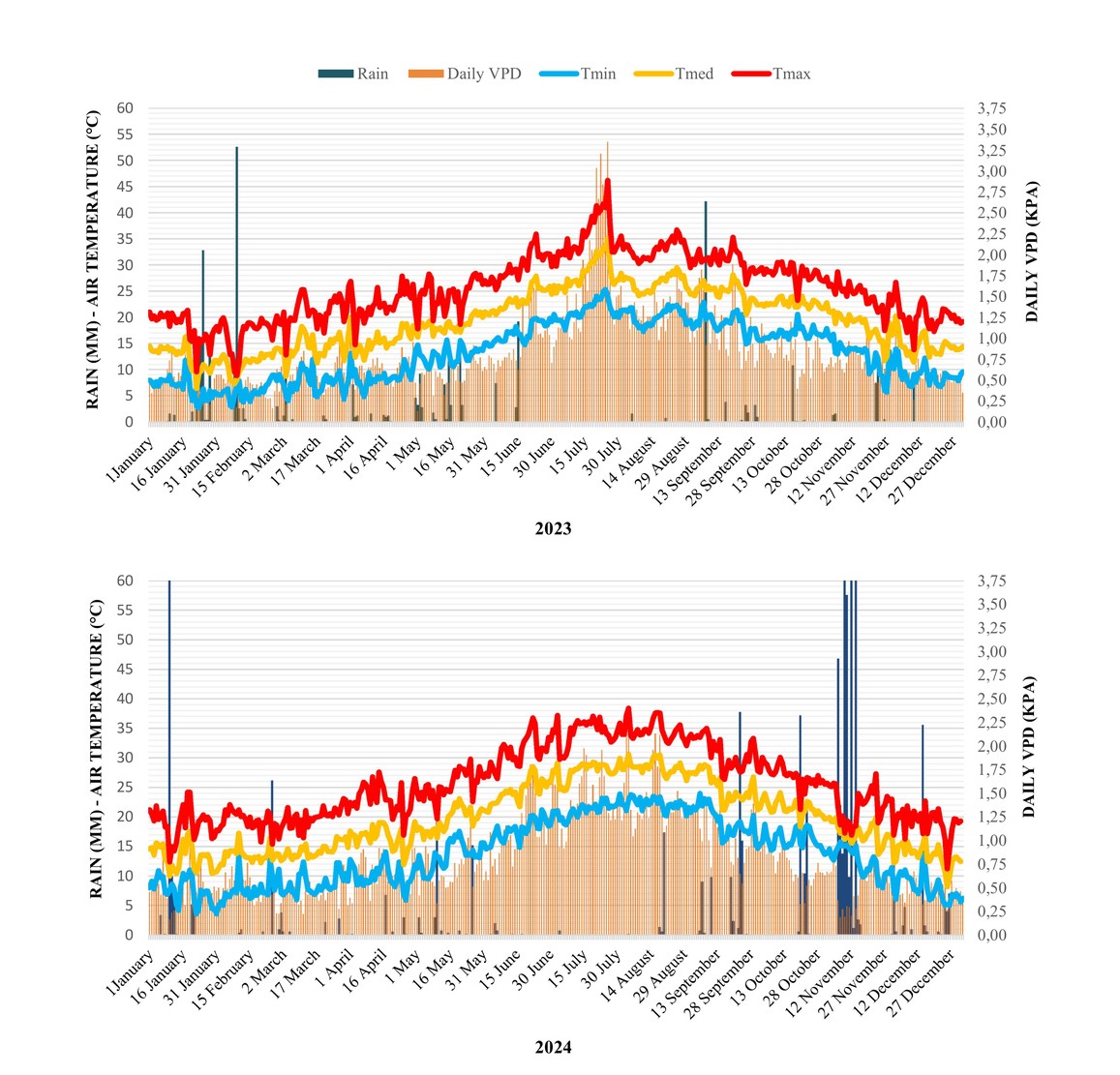
Figure 1. Daily minimum, mean, and maximum air temperature, rainfall, and air VPD recorded in the experimental field during the 2023 and 2024 seasons.
Overall, in both growing seasons, VPD reached elevated values (> 2 kPa), coinciding with periods of high air temperature and indicating a strong atmospheric evaporative demand and, consequently, high vine water requirements during summer. However, in contrast to 2024, in which the Tmax was registered for a long and continuous period, precisely from mid-June to end-August, with 28 days exceeding 35 °C, in 2023 about 10 days of very high air T and VPD were registered, with peaks of 46 °C and 3.3 kPa (Figure 1). These conditions reflect the strong intra-annual variability typical of semi-arid viticultural regions, where water availability and T extremes can markedly influence vine performance and berry weight and composition.
Both years exhibited a high incidence of tropical nights (Figure 2). In contrast, July showed no change in the number of tropical nights between 2023 and 2024 (26 days in both years), while August showed a markedly different pattern. In 2024, the frequency of tropical nights was substantially higher than in 2023, with 31 nights compared to 16, indicating a pronounced intensification of nocturnal warming. This data indicates a progressive increase in nighttime heat accumulation, which may significantly affect grapevine physiology by increasing nighttime respiratory activity, accelerating malic acid degradation, and promoting faster technological ripening. These processes may ultimately reduce berry acidity and lead to an imbalance between sugar accumulation and phenolic maturity (Tombesi et al., 2019). These increasingly frequent and adverse environmental conditions further highlight the need to adopt management practices that mitigate heat stress effects.
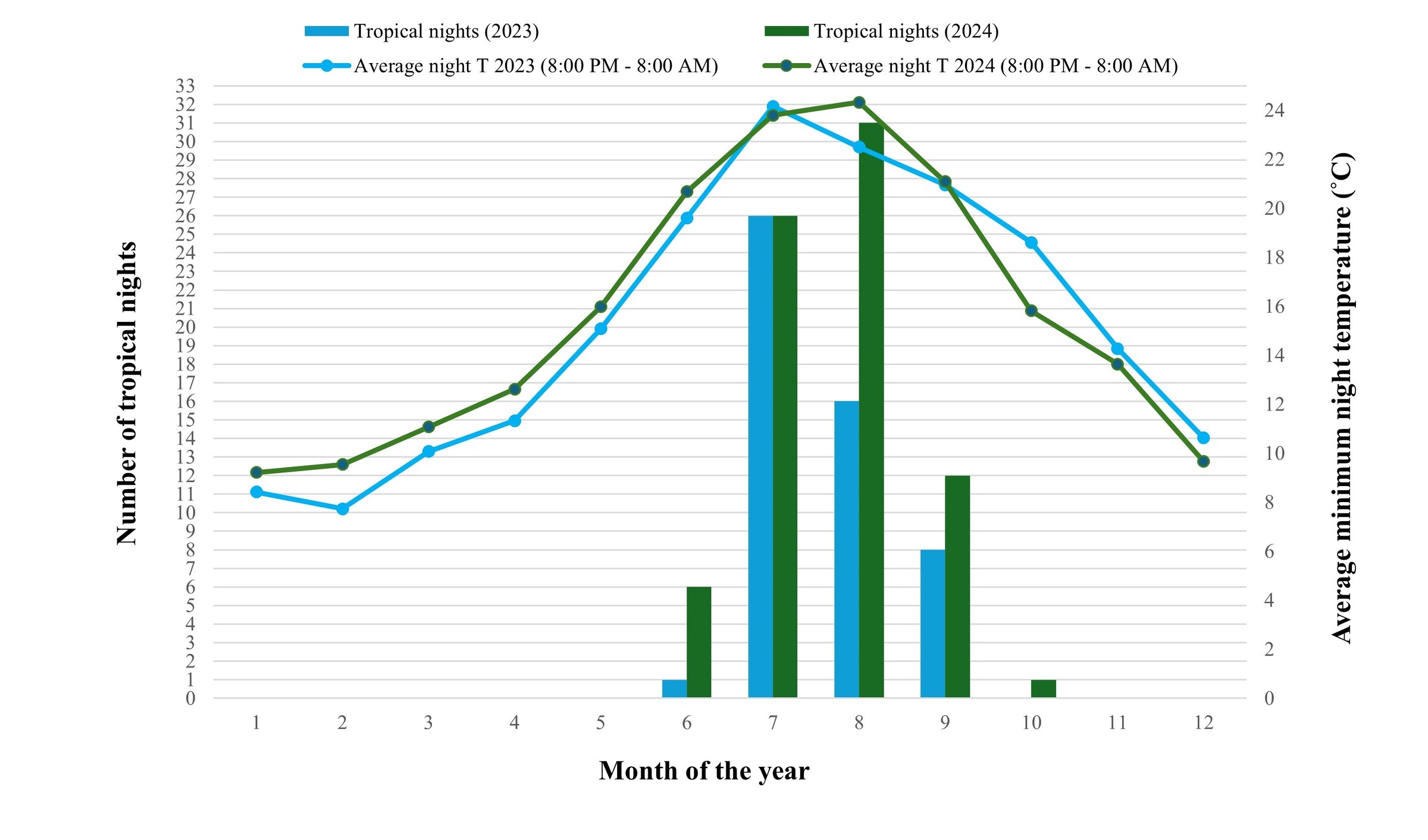
Figure 2. Number of tropical nights and average minimum night T in the experimental field during the trial seasons 2023 and 2024.
2. Vegetative vines response
At early trimming (BBCH 73), canopy development appeared greater in 2024 than in 2023 (Table 1). Before trimming, total leaf area per vine (TLA) was 0.52 m2 in 2023, of which 93 % consisted of primary shoot leaves, whereas in 2024 TLA reached 1.24 m2, with 81 % derived from primary shoots. This difference may be related, at least in part, to the trimming being performed 10 days later in 2024. After trimming, TLA fell to 0.20 m2 in 2023, corresponding to 61 % canopy removal, while in 2024 it fell to 0.30 m2, reflecting a more severe 76 % reduction due to greater initial vigour.
| 2023 | 2024 | ||
BEFORE TRIMMING | AFTER TRIMMING | BEFORE TRIMMING | AFTER TRIMMING | |
Primary shoot TLA (m2) | 0.48 ± 0.07 b | 0.19 ± 0.04 a | 1.00 ± 0.15 b | 0.28 ± 0.21 a |
Percentage (%) | 93 % | 95 % | 81 % | 94 % |
Lateral shoot TLA (m2) | 0.04 ± 0.008 b | 0.01 ± 0.004 a | 0.24 ± 0.07 b | 0.02 ± 0.004 a |
Percentage (%) | 7 % | 5 % | 19 % | 6 % |
TLA vine–1 (m2) | 0.52 ± 0.07 b | 0.20 ± 0.04 a | 1.24 ± 0.16 b | 0.30 ± 0.16 a |
At harvest (BBCH 89), the canopy showed contrasting trends between the two seasons (Table 2). In 2023, ET showed a higher TLA than CT, reaching 1.31 m2 vine–1 (+34 %) compared with CT at 0.98 m2. ET 2023 compensated for the leaf loss through lateral growth, ultimately surpassing CT 2023 in TLA at harvest. This suggests that early trimming under moderate vigour can stimulate canopy renewal and maintain photosynthetic function through the formation of strong lateral foliage. In ET 2023+2024, the TLA amounted to 1.33 m2, with lateral leaves representing 75 % of the total. A similar pattern was observed in ET 2024 vines, which accumulated a TLA of 1.28 m2, again lower than CT 2023+2024 with 1.84 m2. In ET 2024 vines, primary leaves accounted for only 28 % of the TLA, while lateral leaves contributed the remaining 72 %. By contrast, in CT 2023+2024 vines, primary leaves still represented 60 % of TLA. These findings are consistent with previous studies reporting that early shoot trimming, when performed between flowering and the pea-size stage, initially reduces canopy size but simultaneously stimulates vigorous lateral shoot development (Tessarin et al., 2018; Abad et al., 2019; Bubola et al., 2022). Consequently, the initial reduction in leaf area is often progressively compensated during the season, particularly in vigorous vineyards where lateral regrowth can completely restore, or even exceed, the original canopy size (Abad et al., 2019). This behaviour was clearly observed in 2023, when vigorous lateral shoot development more than compensated for the initial canopy reduction. Conversely, the same compensatory response was not observed in 2024, when ET vines maintained a lower final TLA than the control. Poni et al. (2023) described similar year-to-year variability, highlighting that the extent of canopy recovery after early shoot trimming depends largely on post-trimming growing conditions and the vine's capacity to sustain lateral shoot development.
| 2023 | 2024 | |||
ET 2023 | CT 2023 | ET 2024 | ET 2023+2024 | CT 2023+2024 | |
Primary shoot TLA (m2) | 0 | 0.87 ± 0.13 | 0.36 ± 0.09 a | 0.34 ± 0.23 a | 1.11 ± 0.28 b |
Percentage (%) | 0 % | 89 % | 28 % | 25 % | 60 % |
Lateral shoot TLA (m2) | 1.31 ± 0.32 a | 0.11 ± 0.04 b | 0.92 ± 0.19 ns | 1.0 ± 0.37 ns | 0.73 ± 0.40 ns |
Percentage (%) | 100 % | 11 % | 72 % | 75 % | 40 % |
TLA vine–1 (m2) | 1.31 ± 0.32 a | 0.98 ± 0.14 b | 1.28 ± 0.10 ab | 1.33 ± 0.20 ab | 1.84 ± 0.28 b |
The results suggest that severe early shoot trimming induced a significant modification of vine architecture, characterised by reduced vigour and canopy height and by the progressive replacement of primary leaves with lateral foliage, resulting in a clear rejuvenation of the canopy, although the extent of canopy recovery was strongly dependent on seasonal conditions affecting post-trimming regrowth.
3. Physiological responses
In both seasons, basal primary leaves underwent premature senescence as a consequence of the multiple summer stresses resulting from the combination of very high air temperature, elevated VPD, and extremely limited rainfall during July and August, limiting their functionality to the early part of the season. In contrast, lateral leaves remained present from June to September and therefore sustained canopy physiological activity over a longer period.
The composed line graphs and the multi-panel grouped bar charts (Figures 3 and 4) were used to evaluate the physiological behaviour of the two leaf types during the first two months under the two treatments, also considering the different developmental stages (approximately 40–50 days after emergence for main leaves and 20–30 days for lateral leaves). In addition, they provide an overview of the seasonal physiological dynamics of the canopy, which, from August onwards, was represented exclusively by lateral leaves.
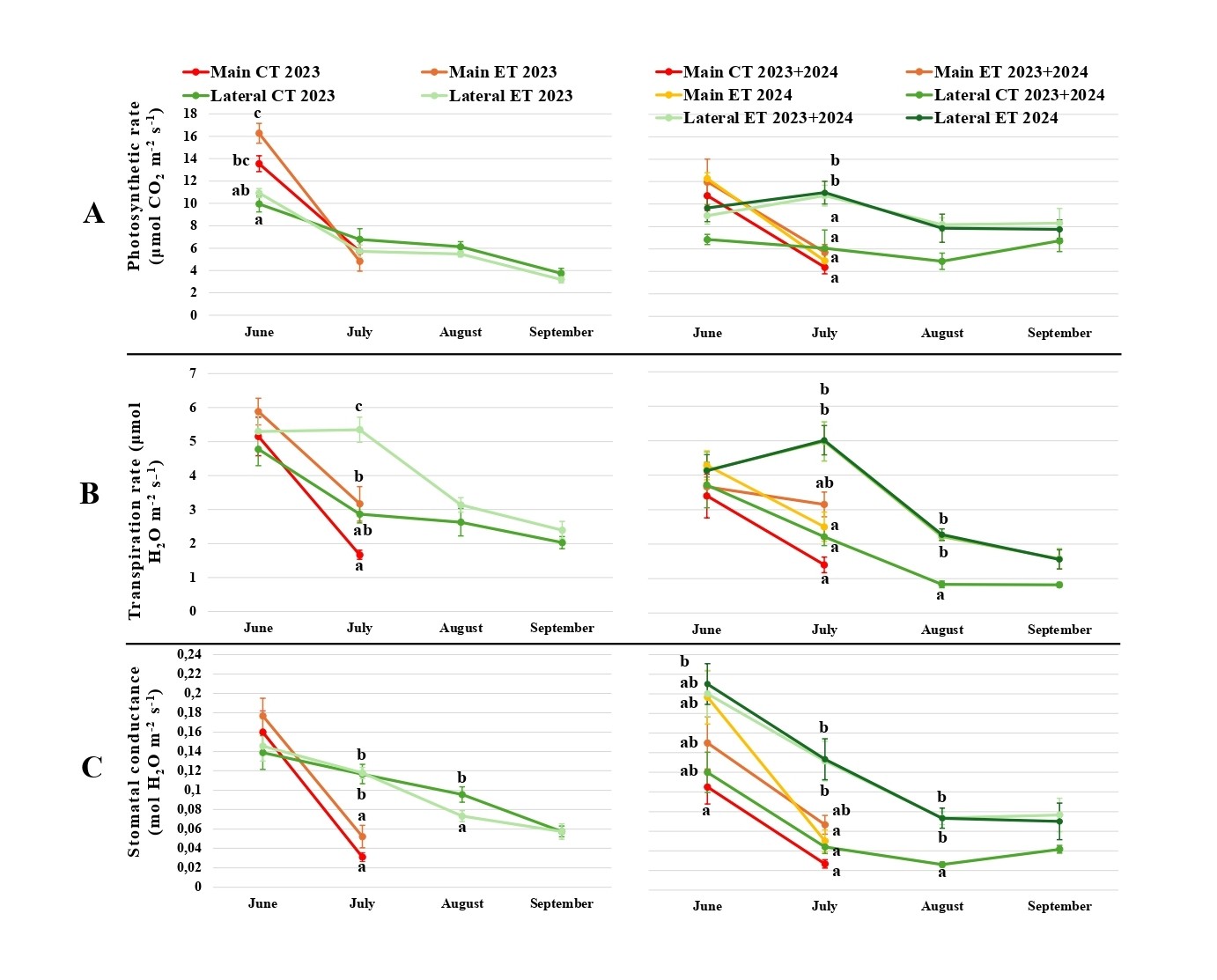
Figure 3. Seasonal dynamics of leaf gas exchange parameters measured during the physiological surveys performed from June to September. Panel A shows net photosynthetic rate (Pn; μmol CO2 m–2 s–1), panel B shows transpiration rate (E; mmol H2O m–2 s–1), and panel C shows stomatal conductance (gs; mol H₂O m–2 s–1) in the main and lateral leaves of each treatment. Data represent mean values ± SE. Different letters indicate significant differences among treatments and leaf types within each sampling date according to Tukey’s HSD test (p ≤ 0.05).
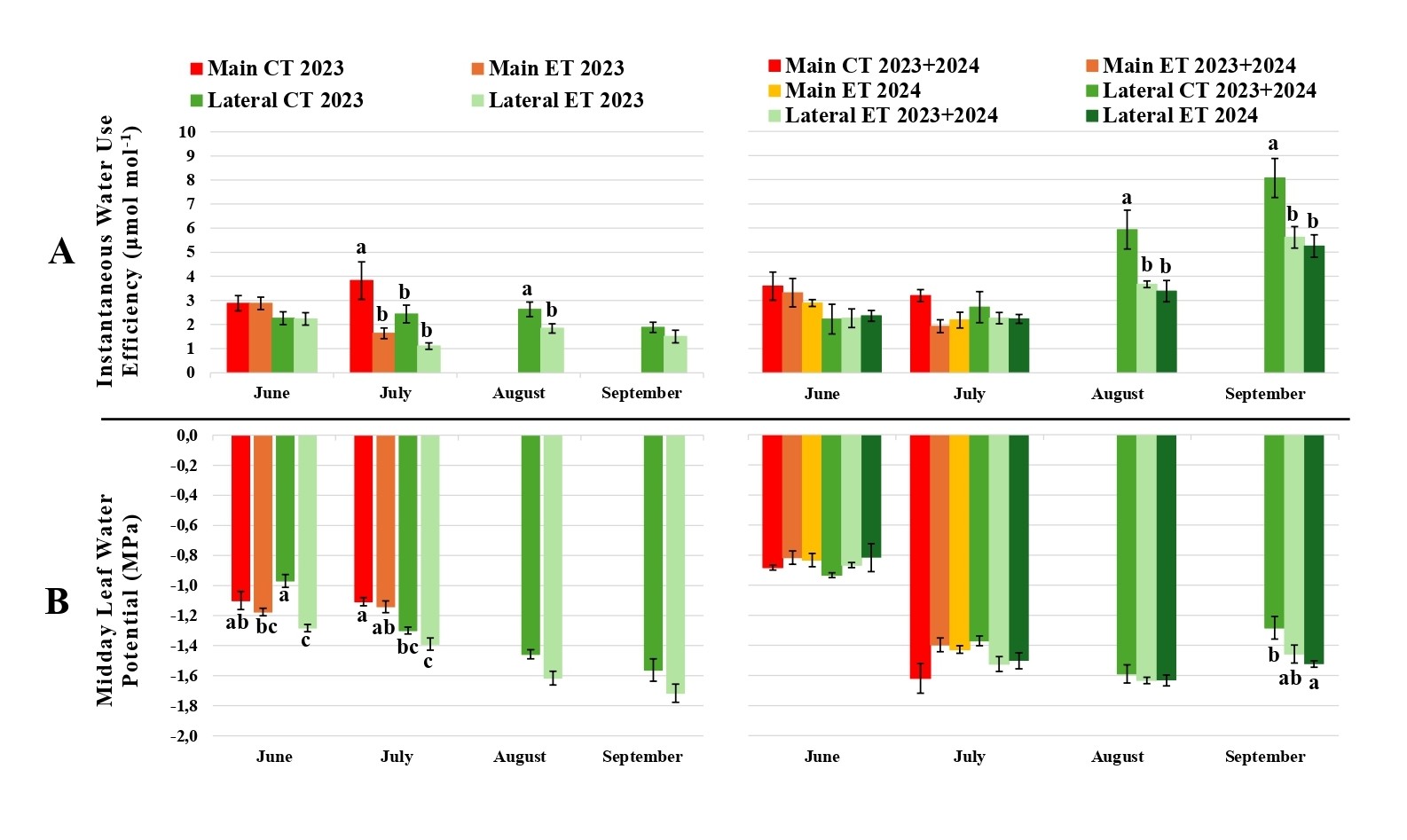
Figure 4. Seasonal dynamics of vine water-related physiological parameters measured during the physiological surveys performed from June to September. Panel A shows instantaneous water use efficiency (iWUE; μmol mol–1) and panel B shows midday leaf water potential (Ψleaf; MPa). Data represent mean values ± SE. Different letters indicate significant differences among treatments and leaf types within each sampling date according to Tukey’s HSD test (p ≤ 0.05).
During June 2023, the physiological differences were mainly associated with leaf developmental stage rather than treatment. Main leaves exhibited significantly higher Pn than lateral leaves (p < 0.01; Figure 3A) in both CT and ET vines (respectively +36 % and +49 %), reflecting the fully developed photosynthetic apparatus of primary foliage, whereas lateral leaves had recently emerged following shoot trimming and had not yet reached full physiological maturity. In addition, the sudden removal of the younger apical portion of the canopy may have further enhanced photosynthetic activity in the retained main leaves of ET vines, inducing a temporary compensatory response to maintain whole-vine carbon assimilation in the absence of a fully developed lateral canopy (Hunter & Visser, 1988). Despite these differences in carbon assimilation, gs, E, and iWUE remained comparable between treatments and leaf types.
By July 2023, rising atmospheric demand and the onset of summer stress promoted stomatal closure, particularly in ageing primary leaves, leading to parallel reductions in E and Pn. The strongest reduction in transpiration, as confirmed by the statistical analysis, occurred in CT 2023 (Figure 3B), where E was 90 % lower than in ET 2023 in main leaves and 86 % lower in lateral leaves, while gs showed only modest differences between treatments for each leaf type. This resulted in higher iWUE in CT 2023 (+16 %) on the same date (Figure 4A), reflecting a proportionally greater increase in E relative to carbon assimilation.
Midday Ψleaf data further support this interpretation (Figure 4B). In July, main leaves showed less negative midday Ψleaf values, indicating a better water status than lateral leaves, which, together with reduced gs, is consistent with the higher iWUE observed in these leaves. Together, these observations indicate that main leaves adopted a conservative physiological strategy, whereas lateral leaves progressively became the main contributors to canopy gas exchange as summer progressed. From August 2023 onwards, ET vines maintained significantly higher gs, whereas E and Pn remained broadly similar between treatments throughout the season. Consequently, the lower iWUE observed in ET mainly reflected greater water loss rather than differences in photosynthetic capacity.
In 2024, we compared the physiological behaviour of lateral leaves among ET 2024, ET 2023+2024, and CT 2023+2024 to evaluate potential carry-over effects of repeated trimming. Significant differences among treatments were detected mainly in mid-summer. In June, we detected no significant differences in Pn between treatments or leaf types, suggesting that lateral leaves had already reached a more advanced stage of development than in the previous season. At the same time, both ET treatments exhibited consistently higher gs than CT, irrespective of leaf type. However, these differences had not yet translated into appreciable changes in Pn and E.
The divergence among treatments became more evident in July 2024. As observed in the previous season, gs declined in all treatments as summer stress intensified, but the reduction was considerably greater in main leaves, regardless of treatment, and in the lateral leaves of CT 2023+2024. In contrast, lateral leaves of both ET treatments maintained a higher physiological activity, as evidenced by significantly higher gs, E, and Pn. Stomatal conductance in both ET 2023+2024 and ET 2024 was approximately three times higher than in CT 2023+2024, indicating that early shoot trimming allowed lateral leaves to sustain gas exchange despite the increasing summer stress. Pn levels were maintained similar to those recorded in June, compensating for the functional decline of ageing main leaves. Palliotti et al. (2000) reported similar differences between main and lateral shoot leaves for Cabernet franc and Trebbiano Toscano, indicating that lateral leaves, despite their smaller size, may exhibit photosynthetic capacities comparable to, or even greater than, those of primary leaves, particularly later in the season.
Consistently, Poni et al. (2014) observed that when trimming is performed early in the season, vigorous vegetative regrowth generally shortens the duration of transpiration suppression by rapidly restoring leaf area. These findings suggest that canopy restructuring toward lateral-dominated foliage after early trimming promotes less conservative, more anisohydric regulation of gas exchange. In contrast, CT 2023+2024 adopts tighter stomatal control under increasing summer stress. Consequently, CT 2023+2024 exhibited significantly higher iWUE than both ET treatments during August and September (Figure 4A), reflecting its more conservative regulation of transpirational water loss. Midday Ψleaf, however, declined similarly across all treatments, with no significant differences detected throughout most of the season. The only exception occurred in September, when both ET treatments exhibited significantly more negative leaf water potential values than CT 2023+2024, indicating greater water stress in ET 2023+2024 and ET 2024 (approximately 14 % and 20 %, respectively). Different responses have been reported in several studies, where post-trimming lateral regrowth is strongly restricted, allowing the initial reduction in transpiring leaf area to persist throughout the season (Pascual et al., 2015; Pallotti et al., 2025). This contrasts with the present study, where, despite lower final leaf area in ET vines during 2024, the development of physiologically active lateral shoots likely compensated for the reduced canopy size, maintaining transpiration rates and limiting substantial changes in vine water status.
Importantly, the absence of significant physiological differences between ET 2023+2024 and ET 2024 indicates that repeating shoot trimming over two consecutive seasons did not produce detectable carry-over effects.
The PCA (Figure 5A), conducted on the above-mentioned measurements, provides a comprehensive overview of the relationships among treatments, sampling dates, and leaf types, explaining a large proportion of the total variance (84.1 %; PC1 = 54.2 % and PC2 = 29.1 %). The first principal component primarily separates samples according to measurement date. June observations cluster on the left side of the plot, whereas July observations are distributed on the right, indicating that seasonal progression represents the main driver of physiological and compositional variation among vines. This temporal effect appears more pronounced than the treatment effect.
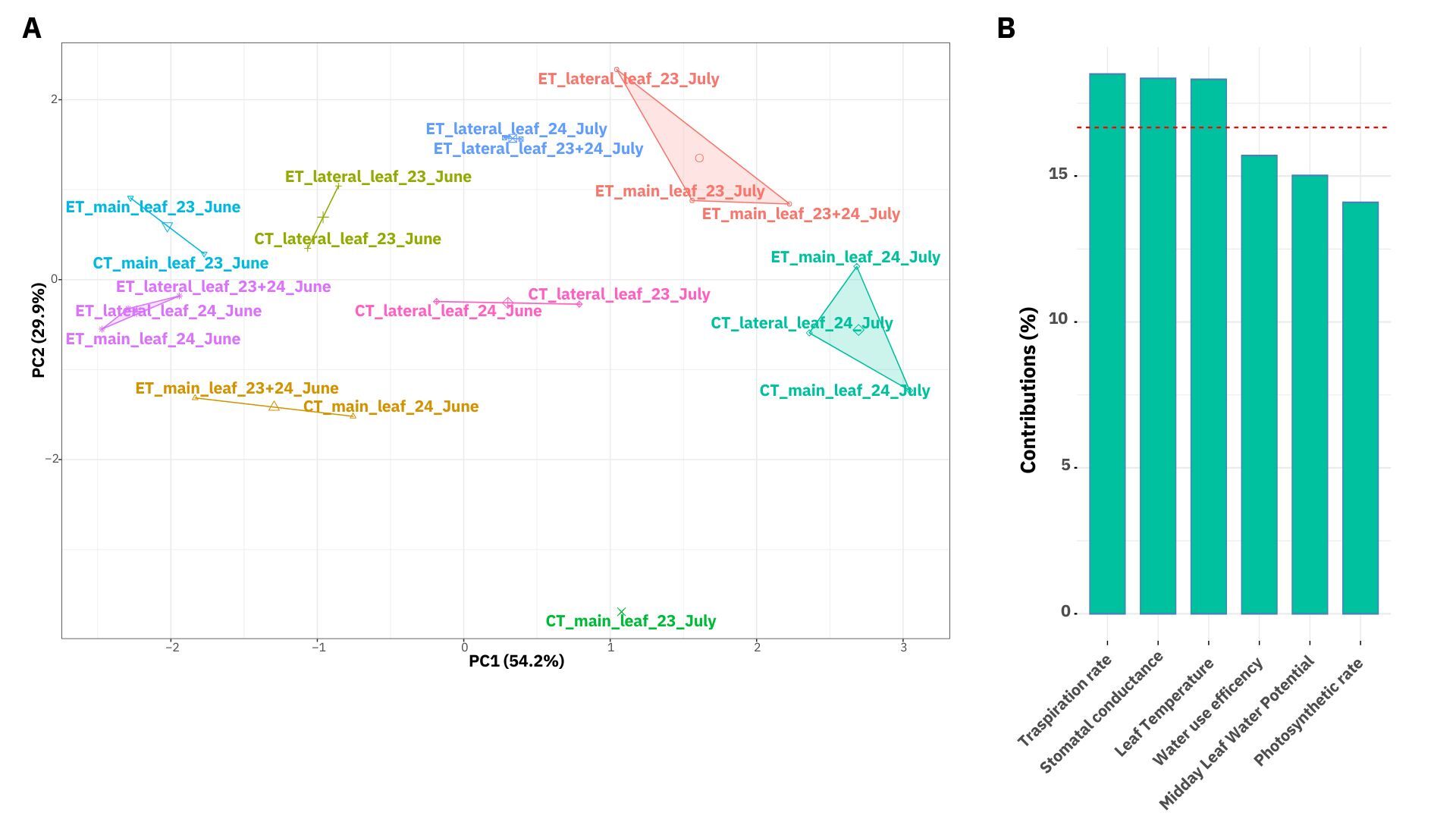
Figure 5. Principal Component Analysis (PCA) of physiological measurements collected from main and lateral leaves of ET 2023, CT 2023, ET 2024, ET 2023+2024, and CT 2023+2024 vines, measured in June and July across the 2023 and 2024 growing seasons. Panel A depicts the distribution of individuals and clustering, based on the K-means method, differentiated by colour. Panel B illustrates the contribution of individual variables to the variance.
The second principal component captures variability associated with leaf type, partially separating main and lateral leaves and highlighting functional heterogeneity within the canopy. The trimming treatment exerts a more subtle, yet still discernible, influence. While CT and ET vines largely overlap in June, a clearer separation emerges in July, when ET forms more distinct clusters compared with CT. This pattern is further supported by K-means clustering analysis, which identified nine clusters and suggests that the effects of trimming become more evident later in the season, likely as a consequence of cumulative canopy adjustments and source-sink rebalancing.
Regarding variable contributions (Figure 5B), E, gs, and Tl contributed most to total variance. Overall, the PCA indicates that seasonal dynamics predominantly shape vine responses, whereas trimming contributes to additional differentiation, particularly under mid-summer conditions.
Fv/Fm and Tl for ET and CT across 2023 and 2024 provide an overview of the effects of early shoot trimming on maximum PSII efficiency (Table 3). In 2023, ET reached a higher Tl than CT (42.8 vs 39.2 °C) and showed lower Fv/Fm values (0.66 vs 0.73). In 2024, although Tl values were similarly high, Fv/Fm remained relatively stable across treatments. Even where slight reductions were observed, particularly under ET, values remained above the range commonly associated with severe PSII impairment. Overall, despite elevated summer Tl, we detected no clear evidence of sustained photochemical damage attributable to the treatment.
Month | Treatment | Tl (°C) | Fv/Fm |
June | ET 2023 | 38.44 ± 1.25 a | 0.63 ± 0.14 b |
CT 2023 | 38.13 ± 0.95 ab | 0.68 ± 0.06 b | |
July | ET 2023 | 42.77 ± 0.70 c | 0.66 ± 0.05 a |
CT 2023 | 39.2 ± 2.44 a | 0.73 ± 0.06 a | |
August | ET 2023 | 38.67 ± 0.37 a | 0.73 ± 0.03 a |
CT 2023 | 39.6 ± 0.31 a | 0.71 ± 0.07 a | |
September | ET 2023 | 38.01 ± 0.29 ab | 0.78 ± 0.01 a |
CT 2023 | 36.54 ± 1.39 b | 0.71 ± 0.07 a | |
June | ET 2024 | 34.5 ± 1.04 be | 0.64 ± 0.09 d |
ET 2023+2024 | 35 ± 1.55 abe | 0.67 ± 0.06 cd | |
CT 2023+2024 | 38.34 ± 2.01 a | 0.71 ± 0.07 bcd | |
July | ET 2024 | 42.48 ± 1.26 c | 0.79 ± 0.02 ab |
ET 2023+2024 | 42.6 ± 0.75 c | 0.80 ± 0.03 a | |
CT 2023+2024 | 42.82 ± 2.11 c | 0.79 ± 0.02 ab | |
August | ET 2024 | 38.27 ± 1.03 a | 0.79 ± 0.03 ab |
ET 2023+2024 | 37.13 ± 0.73 ab | 0.78 ± 0.02 ab | |
CT 2023+2024 | 35.8 ± 2.15 ab | 0.80 ± 0.01 a | |
September | ET 2024 | 32.05 ± 0.36 de | 0.73 ± 0.04 abcd |
ET 2023+2024 | 31.07 ± 0.53 d | 0.76 ± 0.02 ab | |
CT 2023+2024 | 30.22 ± 1.46 d | 0.75 ± 0.06 abc |
4. Yield and grape quality
No significant differences were observed between ET and CT vines in yield per vine, number of bunches per vine, bunch weight, berry weight, and number of berries per cluster in either 2023 or 2024 (Table 4).
PARAMETERS | ET 2023 | CT 2023 | ET 2024 | ET 2023+2024 | CT 2023+2024 |
Yield vine–1 (kg) | 1.5 ± 0.1 ns | 1.7 ± 0.2 ns | 0.9 ± 0.1 ns | 1.0 ± 0.1 ns | 0.8 ± 0.1 ns |
Bunch vine–1 (n) | 9.9 ± 0.6 ns | 11.8 ± 1.3 ns | 9.3 ± 1.2 ns | 7.8 ± 0.8 ns | 10.2 ± 1.3 ns |
Bunch weight (g) | 162.09 ± 35.3 ns | 144.5 ± 11.6 ns | 101.2 ± 20.0 ns | 124.9 ± 17.3 ns | 77.5 ± 6.5 ns |
Berry weight (g) | 2.1 ± 0.2 ns | 2.3 ± 0.2 ns | 1.72 ± 0.11 ns | 1.73 ± 0.12 ns | 1.71 ± 0.11 ns |
Berries bunch–1 (n) | 75.0 ± 9.6 ns | 64.1 ± 7.1 ns | 61.8 ± 12.9 ns | 76.2 ± 10.2 ns | 48.1 ± 3.8 ns |
Rachis weight (g) | 17.2 ± 2.1 ns | 13.5 ± 0.8 ns | 5.4 ± 0.9 ab | 7.7 ± 0.8 a | 4.6 ± 0.3 b |
Total soluble solids (°Brix) | 21.6 ± 0.3 b | 23.1 ± 0.1 a | 21.5 ± 1.4 ns | 18.9 ± 0.7 ns | 19.0 ± 1.5 ns |
Titratable acidity (g L–1) | 3.8 ± 0.2 ns | 3.6 ± 0.1 ns | 5.6 ± 0.1 ab | 6.0 ± 0.1 a | 5.4 ± 0.1 b |
Must pH | 4.12 ± 0.21 a | 3.64 ± 0.09 b | 4.13 ± 0.07 a | 3.69 ± 0.03 b | 4.08 ± 0.04 a |
Total polyphenols (mg kg–1 fw) | 341.3 ± 6.4 a | 286.8 ± 7.4 b | 733.8 ± 161.7 ns | 720.4 ± 51.4 ns | 622.5 ± 34.3 ns |
Ravaz index (kg kg–1) | 2.4 ± 0.2 ns | 1.75 ± 1 ns | 6.9 ± 1.3 a | 9.5 ± 0.8 a | 2.0 ± 0.4 b |
The lack of significant effects on yield components is consistent with previous studies, where shoot trimming after fruit set generally did not alter yield performance because vines can compensate for the temporary reduction in assimilating leaf area through lateral shoot development (Bubola et al., 2022). The timing of trimming appears to play a key role in determining the reproductive response. Earlier interventions performed around flowering may enhance fruit set and yield by temporarily reducing the competition for carbohydrates between actively growing shoot tips and inflorescences (Collins & Dry, 2009; Vanderlinde et al., 2013). Conversely, severe canopy reductions under conditions that limit vegetative recovery and carbohydrate availability have been linked to reductions in berry growth and yield (Martínez de Toda et al., 2013; Santesteban et al., 2017).
In the present study, shoot trimming at BBCH 73 was performed after fruit set, when the final number of berries per cluster had already been largely established, explaining the absence of effects on cluster structure. Moreover, the subsequent development of lateral shoots likely restored sufficient photosynthetic capacity to support berry growth, preventing reductions in berry weight and final yield. This compensatory response agrees with Poni et al. (2014), who reported unchanged yield components following shoot trimming despite substantial modifications in canopy structure.
Yield ranged between 0.8 and 1.7 kg vine–1, with higher production recorded in 2023 than in 2024, reflecting the influence of seasonal environmental conditions on vine performance (Table 4). Although, in 2023, three to four consecutive days were characterised by peak air temperature and VPD values of approximately 46 °C and 3.3 kPa, respectively (Figure 1), yield per vine was almost double that observed in 2024, due to the maintenance of normal berry and cluster weights. The very low berry and cluster weights observed in 2024, despite a similar number of clusters per vine and berries per cluster, can be partly attributed to the higher air temperatures recorded after July 24, when 28 days with air T above 35 °C were recorded compared with only two days in 2023, together with extremely limited rainfall. In fact, from late May until harvest, no rainfall occurred. Moreover, in August 2024, the number of tropical nights doubled compared to 2023, with minimum night temperatures approximately 2 °C higher than in the previous year. Elevated night temperatures can affect several physiological processes, including carbohydrate translocation, respiratory carbon losses and the recovery of photosynthetic activity (Tombesi et al., 2019). Increased nocturnal respiration may reduce carbon-use efficiency and alter assimilate partitioning, while also accelerating malic acid degradation and technological ripening, thereby contributing to acidity loss and higher must pH, with values frequently exceeding optimal ranges under warmer growing conditions. The warmer nocturnal conditions recorded in summer 2024 may therefore have contributed to the reduced vine performance compared to 2023, as reflected in lower yield, cluster and berry weights, and must TSS, together with higher titratable acidity.
In 2023, must TSS was significantly lower in ET than in CT (–1.5 °Brix), despite similar Pn, E, gs, and midday leaf water potential during summer and a larger total leaf area at harvest. However, the higher final leaf area in ET resulted from canopy reconstitution following the severe trimming-induced leaf area reduction and does not necessarily reflect the seasonal carbon balance experienced by the vines. The initial source limitation imposed during early berry development may have delayed ripening progression, requiring a longer period to fully recover sugar accumulation.
In 2024, the opposite trend was observed: ET vines showed higher must TSS (+2.5 °Brix) than CT, associated with higher Pn, E, and gs (Table 4; Figure 3). These contrasting responses between seasons further support the idea that seasonal environmental conditions and the resulting source-sink balance within the canopy strongly influence early trimming's effects on sugar accumulation. Early shoot trimming is generally known to temporarily decrease the leaf area-to-fruit ratio, potentially slowing sugar accumulation and delaying ripening towards cooler periods (Martínez de Toda et al., 2013; Martínez de Toda et al., 2014). This delay has been proposed as an adaptive strategy under climate change, as it may reduce the gap between technological and phenolic maturity. However, excessive or prolonged initial source limitation may delay fruit ripening when subsequent vegetative and physiological recovery is insufficient to fully compensate for the earlier carbon restriction. Therefore, the effectiveness of this practice depends not only on restoring an adequate leaf area, but also on the timing and efficiency of canopy recovery, ensuring sufficient photosynthetic capacity to sustain crop demand and complete the ripening process. Conversely, TA and must pH exhibit a clear compensatory pattern, particularly in 2024: ET 2023+2024 showed higher TA (up to 6 g L–1) and lower pH (approximately 3.69) than CT 2023+2024, consistent with delayed ripening and improved acid retention in the berries. In 2023, TA values reached very low levels, in contrast to the findings of Abad et al. (2019), likely due to the extremely high temperatures recorded during the summer of that year.
Polyphenol content was generally higher in ET vines. Compared with CT, ET showed increases of 19 % in 2023 and 16 % and 18 % in 2024 in ET 2023, ET 2023+2024, and ET 2024, respectively (Table 4), although these differences were statistically significant only in 2023, indicating a marked year-dependent response. The stronger effect in 2023 may relate to the specific canopy structure resulting from early shoot trimming. In that season, canopy renewal relied entirely on lateral shoots, while the progressive loss of basal and middle primary leaves due to senescence and abiotic stresses maintained a relatively open fruiting zone throughout ripening; this condition was not observed in 2024, when approximately 25–28 % of primary leaves were retained in the fruiting zone. This likely created a distinct bunch microclimate, characterised by greater light penetration and air circulation, conditions known to promote the synthesis and accumulation of phenolic compounds (Haselgrove et al., 2000). Previous studies have also highlighted the potential of shoot trimming to improve canopy light distribution by modifying canopy architecture, contributing to a more favourable microclimate for berry composition (Smart et al., 1982; Bondada et al., 2016). In addition, the altered source-sink balance and the slight delay in ripening associated with early trimming may have further contributed to this response. Similar responses have been reported when shoot trimming is performed at the berry pea-size stage, resulting in delayed ripening and increased phenolic compounds at comparable soluble solids levels (Martínez de Toda et al., 2014). However, these findings differ from the general trend reported by Cameron et al. (2024) in a meta-analysis across different cultivars, environments and trimming strategies, where the severity of leaf area removal emerged as a key factor driving ripening responses. The authors reported that moderate reductions in leaf area (> 25–50 %) may decrease TSS accumulation without affecting anthocyanin content. When more than 50 % of the leaf area is removed, ripening is generally delayed, with consistent reductions in sugar accumulation, anthocyanin concentration, and pH. This contrast suggests that the physiological impact of severe shoot trimming cannot be explained solely by the initial leaf area reduction, but also depends on the post-trimming capacity of vines to restore an efficient source-sink balance.
Early shoot trimming across both seasons markedly increased the Ravaz index, reaching values up to 9.5 kg kg–1 in ET 2023+2024, compared to the lower ratios observed in CT 2023+2024 (2 kg kg–1). This suggests that early shoot trimming may help balance vegetative and reproductive functions, improving crop load equilibrium, particularly in vines trimmed over consecutive years.
Conclusions
The results of the present study indicate that the effects of very early shoot trimming are strongly influenced by seasonal environmental conditions and vine vigour, confirming the importance of interpreting canopy management practices within each season’s environmental context.
Early shoot trimming substantially modified canopy architecture by stimulating compensatory lateral growth, resulting in a lateral-dominated canopy. Physiologically, this structural change was associated with a shift toward more anisohydric-like behaviour, with ET vines maintaining higher gs and E under elevated temperature and VPD, although with reduced iWUE. Despite higher gas-exchange activity, we observed no persistent impairment of PSII efficiency. Yield components were unaffected in both seasons, confirming that trimming at BBCH 73 does not interfere with reproductive development. However, berry composition showed a season-dependent response: in 2023, the initial carbon limitation induced by severe leaf area reduction likely delayed sugar accumulation, whereas in 2024, early trimming promoted higher TSS and titratable acidity while slightly reducing must pH. Moreover, early trimming tended to increase total polyphenol content across both seasons, although this effect was statistically significant only in 2023, likely due to changes in canopy architecture and bunch microclimate.
Overall, early shoot trimming, consistent with the working hypothesis of modifying vine architecture, enhancing lateral shoot growth, and altering source-sink relationships under high temperature and radiation conditions, showed a potential to affect vine physiology and grape composition. However, the observed responses were not consistent across the two experimental years. Therefore, the conclusions should be interpreted with caution, given the strong seasonal variability of the results. The absence of detectable carry-over effects from one season to the next suggests that the physiological adjustments induced by early trimming are largely reversible, supporting the potential use of this practice under variable climatic conditions.
Acknowledgements
Author Contributions: “Conceptualization, F.F., E.N., G.L.C., A.P.; experimental set up, F.F., G.L.C., A.Giuf., E.N. and A.P.; data collection, L.R., F.F., E.N., A.Giuf. and G.L.C.; data analysis, L.R., F.F., L.P.L., L.G., A.P. and E.N.; statistical analysis, L.R., F.F. and L.P.L.; writing-original draft preparation, L.R., F.F., G.L.C., E.N. and L.G.; writing-review and editing, L.R., F.F., G.L.C., E.N., and A.Gent.; supervision, F.F., E.N., A.Gent., A.P. All authors have read and agreed to the published version of the manuscript.”.
Conflicts of interest
The authors declare no conflict of interest.
References
- Abad, F.J., Marín, D., Loidi, M., Miranda, C., Royo, J.B., Urrestarazu, J., & Santesteban, L.G. (2019). Evaluation of the incidence of severe trimming on grapevine (Vitis vinifera L.) water consumption. Agricultural Water Management, 213, 646-53. https://doi.org/10.1016/j.agwat.2018.10.015
- Bennici, S., Las Casas, G., Distefano, G., Di Guardo, M., Continella, A., Ferlito, F., Gentile, A., & La Malfa, S. (2018). Elucidating the contribution of wild related species on autochthonous pear germplasm: a case study from Mount Etna. PloSOne, 13(6), e0198512. https://doi.org/10.1371/journal.pone.0198512
- Bondada, B., Covarrubias, J. I., Tessarin, P., Boliani, A. C., Marodin, G., & Rombolà, A. D. (2016). Postveraison shoot trimming reduces cluster compactness without compromising fruit quality attributes in organically grown Sangiovese grapevines. American Journal of Enology and Viticulture, 67(2), 206-211. https://doi.org/10.5344/ajev.2016.15058
- Bubola, M., Persic, M., Rossi, S., Bestulić, E., Zdunić, G., Plavša, T., & Radeka, S. (2022). Severe shoot trimming and crop size as tools to modulate cv. merlot berry composition. Plants, 11(24), 3571. https://doi.org/10.3390/plants11243571
- Cameron, W., Petrie, P. R., & Bonada, M. (2024). Effects of vineyard management practices on winegrape composition. A review using meta-analysis. American Journal of Enology and Viticulture, 75(2). https://doi.org/10.5344/ajev.2024.24018
- Collins, C., & Dry, P. R. (2009). Response of fruitset and other yield components to shoot topping and 2‐chlorethyltrimethyl‐ammonium chloride application. Australian Journal of Grape and Wine Research, 15(3), 256-267. https://doi.org/10.1111/j.1755-0238.2009.00063.x
- Ferlito, F., Allegra, M., Torrisi, B., Pappalardo, H., Gentile, A., La Malfa, S., Continella, A., Stagno, F., & Nicolosi, E. (2020). Early defoliation effects on water status, fruit yield and must quality of ‘Nerello Mascalese’ grapes. Scientia Agricola, 77(6), 20190025. https://doi.org/10.1590/1678-992x-2019-0025
- Ferlito, F., Nicolosi, E., Gentile, A., Lo Piero, A.R., Squadrito, M., & Continella, A. (2014). Responses of four winegrape varieties to managed water stress and partial defoliation in an arid environment. Vitis, 53(2), 73-80. https://doi.org/10.5073/vitis.2014.53.73-80
- Ferlito, F., Nicolosi, E., La Malfa, S., Cicala, A., & Gentile, A. (2018). First characterisation of minor and neglected Vitis vinifera L. cultivars from Mount Etna. Horticultural Science, 45, 37-46. https://doi.org/10.17221/198/2016-HORTSCI
- Ferlito, F., Nicolosi, E., Sicilia, A., Villano, C., Aversano, R., & Lo Piero, A.R. (2023). Physiological and productive responses of two Vitis vinifera L. cultivar across three sites in central-south Italy. Horticulturae, 9(12), 1321. https://doi.org/10.3390/horticulturae9121321
- Haselgrove, L., Botting, D., Van Heeswijck, R., Høj, P. B., Dry, P. R., Ford, C., & Land, P. G. I. (2000). Canopy microclimate and berry composition: The effect of bunch exposure on the phenolic composition of Vitis vinifera L cv. Shiraz grape berries. Australian Journal of Grape and Wine Research, 6(2), 141-149. https://doi.org/10.1111/j.1755-0238.2000.tb00173.x
- Hunter, J.J., & Visser, J.H. (1988). The effect of partial defoliation, leaf position and developmental stage of the vine on the photosynthetic activity of Vitis vinifera L. cv. Cabernet Sauvignon. South African Journal of Enology and Viticulture, 9, 9-15. https://doi.org/10.21548/9-2-2297
- Iorizzo, M., Sicilia, A., Nicolosi, E., Forino, M., Picariello, L., Lo Piero, A.R., Vitale, A., Monaco, E., Ferlito, F., Succi, M., Tremonte, P., Gambuti, A., Villano, C., Bonfante, A., Aversano, R., & Coppola, R. (2023). Investigating the impact of pedoclimatic conditions on the oenological performance of two red cultivars grown throughout southern Italy. Frontiers in Plant Science, 14, 1250208. https://doi.org/10.3389/fpls.2023.1250208
- Jones, G.V., White, M.A., Cooper, O.R., & Storchmann, K. (2005). Climate change and global wine quality. Climatic Change, 73, 319–343. https://doi.org/10.1007/s10584-005-4704-2
- Kassambara, A., & Mundt, F. (2017). Package ‘factoextra’. Extract and visualise the results of multivariate data analyses, 76(2). https://doi.org/10.32614/CRAN.package.factoextra
- Lecourieux, F., Kappel, C., Pieri, P., Charon, J., Pillet, J., Hilbert, G., Renaud, C., Gomès, E., Delrot, S., & Lecourieux, D. (2017). Dissecting the biochemical and transcriptomic effects of a locally applied heat treatment on developing Cabernet-Sauvignon grape berries. Frontiers in Plant Science, 8, 53. https://doi.org/10.3389/fpls.2017.00053
- Lu, H., Tian, M., Shi, N., Han, X., Li, H., Cheng, C., Chen, W., Li, S., He, F., Duan, C., & Wang, J. (2023). Severe shoot topping slows down berry sugar accumulation rate, alters the vine growth and photosynthetic capacity, and influences the flavoromics of Cabernet-Sauvignon grapes in a semi-arid region. European Journal of Agronomy, 145, 126775. https://doi.org/10.1016/j.eja.2023.126775
- Martínez de Toda, F., Sancha, J. C., & Balda, P. (2013). Reducing the sugar and pH of the grape (Vitis vinifera L. cvs.‘Grenache’and ‘Tempranillo’) through a single shoot trimming. South African Journal of Enology and Viticulture, 34(2), 246-251. https://doi.org/10.21548/34-2-1101
- Martínez de Toda, F., Sancha, J. C., Zheng, W., & Balda, P. (2014). Leaf area reduction by trimming, a growing technique to restore the anthocyanins: sugars ratio decoupled by the warming climate. Vitis, 53(4), 189-192. https://doi.org/10.5073/vitis.2014.53.189-192
- Mori, K., Goto-Yamamoto, N., Kitayama, M., & Hashizume, K. (2007). Loss of anthocyanins in red-wine grape under high temperature. Journal of Experimental Botany, 58, 1935-1945. https://doi.org/10.1093/jxb/erm055
- Nicolosi, E., Ferlito, F., Allegra, M., Cicala, A., Trovato, F., & La Malfa, S. (2016). Influences of aspect and tillage on two wine grape cultivars on Mount Etna. New Zealand Journal of Crop and Horticultural Science, 44(2), 83-102. https://doi.org/10.1080/01140671.2016.1147472
- Nicolosi, E., Iovino, V., Distefano, G., Di Guardo, M., La Malfa, S., Gentile, A., Palliotti, A., Las Casas, G., & Ferlito, F. (2021). Mid-term effects of conservative soil management and fruit-zone early leaf removal treatments on the performance of Nerello Mascalese (Vitis vinifera L.) grapes on Mount Etna (Southern Italy). Agronomy, 11(6), 070. https://doi.org/10.3390/agronomy11061070
- Nicolosi, E., Sicilia, A., Ferlito, F., Bonfante, A., Monaco, E., & Lo Piero, A.R. (2022). Phenotypic plasticity in bud fruitfulness expressed in two distinct wine grape cultivars grown under three different pedoclimatic conditions. Agriculture, 12(10), 1660. https://doi.org/10.3390/agriculture12101660
- OIV. (2024). State of the world vine and wine sector in 2024. OIV. https://www.oiv.int/sites/default/files/2025-04/OIV-State_of_the_World_Vine-and-Wine-Sector-in-2024.pdf
- Palliotti, A., Cartechini, A., & Ferranti, F. (2000). Morpho-anatomical and physiological characteristics of primary and lateral shoot leaves of Cabernet franc and Trebbiano Toscano grapevines under two irradiance regimes. American Journal of Enology and Viticulture, 51(2), 122-130. https://doi.org/10.5344/ajev.2000.51.2.122
- Pallotti, L., Partida, G., Laroche-Pinel, E., Lanari, V., Pedroza, M., & Brillante, L. (2025). Late-season source limitation practices to cope with climate change: delaying ripening and improving colour of Cabernet Sauvignon grapes and wine in a hot and arid climate. OENO One, 59(1). https://doi.org/10.20870/oeno-one.2025.59.1.8232
- Pascual, M., Romero, M. P., Rufat, J., & Villar, J. M. (2015). Canopy management in rainfed vineyards (cv. Tempranillo) for optimising water use and enhancing wine quality. Journal of the Science of Food and Agriculture, 95(15), 3067-3076. https://doi.org/10.1002/jsfa.7342
- Petrie, P. R., & Clingeleffer, P. R. (2005). Effects of temperature and light (before and after budburst) on inflorescence morphology and flower number of Chardonnay grapevines (Vitis vinifera L.). Australian Journal of Grape and Wine Research, 11(1), 59-65. https://doi.org/10.1111/j.1755-0238.2005.tb00279.x
- Poni, S., Frioni, T., & Gatti, M. (2023). Summer pruning in Mediterranean vineyards: is climate change affecting its perception, modalities, and effects? Frontiers in Plant Science, 14, 1227628. https://doi.org/10.3389/fpls.2023.1227628
- Poni, S., Zamboni, M., Vercesi, A., Garavani, A., & Gatti, M. (2014). Effects of early shoot trimming of varying severity on single high-wire trellised Pinot noir grapevines. American Journal of Enology and Viticulture, 65(4), 493-498. https://doi.org/10.5344/ajev.2014.14037
- R Core Team. (2021). R: a language and environment for statistical computing.
- Santesteban, L. G., Miranda, C., Urrestarazu, J., Loidi, M., & Royo, J. B. (2017). Severe trimming and enhanced competition of laterals as a tool to delay ripening in Tempranillo vineyards under semiarid conditions. Oeno One, 51(2), 191-203. https://doi.org/10.20870/oeno-one.2017.51.2.1583
- Scholander, P. F., Bradstreet, E. D., Hemmingsen, E. A., & Hammel, H. T. (1965). Sap pressure in vascular plants: negative hydrostatic pressure can be measured in plants. Science, 148(3668), 339-346. https://doi.org/10.1126/science.148.3668.339
- Singleton, V.L., Orthofer, R., Lamuela-Raventós, R.M. (1999). Analysis of total phenols and other oxidation substrates and antioxidants by means of Folin-Ciocalteau reagent. Methods Enzymology, 299, 152-178. https://doi.org/10.1016/S0076-6879(99)99017-1
- Smart, R. E., Shaulis, N. J., & Lemon, E. R. (1982). The effect of Concord vineyard microclimate on yield. II. The interrelations between microclimate and yield expression. American Journal of Enology and Viticulture, 33(2), 109-116. https://doi.org/10.5344/ajev.1982.33.2.109
- Tessarin, P., Parpinello, G. P., & Rombolà, A. D. (2018). Physiological and enological implications of postveraison trimming in an organically-managed Sangiovese vineyard. American Journal of Enology and Viticulture, 69(1), 59-69. https://doi.org/10.5344/ajev.2017.16045
- Tombesi, S., Cincera, I., Frioni, T., Ughini, V., Gatti, M., Palliotti, A., & Poni, S. (2019). Relationship among night temperature, carbohydrate translocation and inhibition of grapevine leaf photosynthesis. Environmental and Experimental Botany, 157, 293-298. https://doi.org/10.1016/j.envexpbot.2018.10.023
- Vanderlinde, G., Brighenti, A. F., Malinovski, L. I., Cipriani, R., Simon, S., Sander, G. F., ... & Silva, A. L. (2013). Influence of the timing of shoot topping on yield and grape quality in'Cabernet Sauvignon'and'Merlot'cultivars. In IX International Symposium on Grapevine Physiology and Biotechnology, 1157, 407-412. https://doi.org/10.17660/ActaHortic.2017.1157.57
- van Leeuwen, C., & Darriet, P. (2016). The impact of climate change on viticulture and wine quality. Journal of Wine Economics, 11(1), 150-167. https://doi.org/10.1017/jwe.2015.21
- Wickham, H. (2011). The split-apply-combine strategy for data analysis. Journal of Statistical Software, 40(1), 1-29. https://doi.org/10.18637/jss.v040.i01
- Wickham, H. (2016). ggplot2: elegant graphics for data analysis. Springer-Verlag New York, ISBN 978-3-319-24277-4. https://doi.org/10.1007/978-3-319-24277-4
- Wickham, H., François, R., Henry, L., Müller, K., & Vaughan, D. (2023). dplyr: A grammar of data manipulation. R package version 1.1.4. https://doi.org/10.32614/CRAN.package.dplyr
- Wolf, T. K., Pool, R. M., & Mattick, L. R. (1986). Responses of young Chardonnay grapevines to shoot tipping, ethephon, and basal leaf removal. American Journal of Enology and Viticulture, 37, 263-268. https://doi.org/10.5344/ajev.1986.37.4.263
 Views: 1